
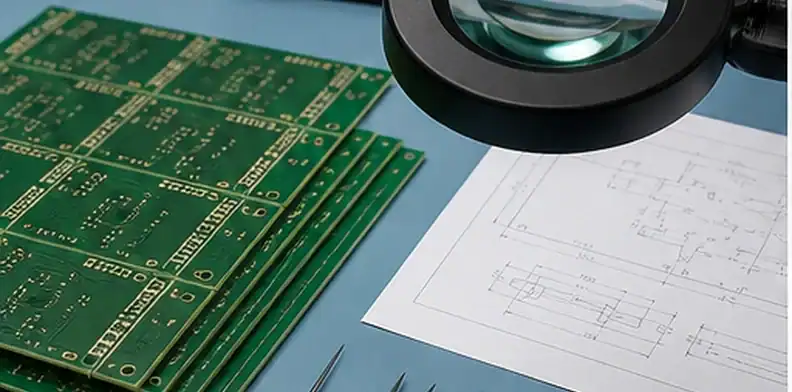
Quick Answer: PCB edge burr acceptance should decide whether a routed edge is safe for fit, handling, assembly, and shipment. Buyers should separate harmless roughness from loose fibers, chips, delamination, dimension problems, or plated-edge damage that needs supplier disposition.
Key takeaways
- Non-plated edge burr review is different from edge plating or castellated-hole acceptance.
- The drawing should state profile tolerance, critical fit edges, chamfer or radius needs, and any cosmetic limit.
- Receiving should collect photos, edge location, affected quantity, and fit impact before accepting or rejecting the lot.
- Routing or deburring changes can affect board dimensions, cleanliness, and repeat-order consistency.
PCB edge burr problems look small until boards fail to fit a slot, shed glass fibers during handling, scrape a housing, or raise a cosmetic dispute with a customer. Because the feature sits on the board perimeter, it can be dismissed as appearance even when the edge controls mechanical assembly.
This article is not about plated edges or castellated modules. For separation-method choices, use the V-score versus tab routing page. Here the buyer decision is whether a routed edge is acceptable for release and what evidence should support that decision.
Table of Contents
- Separate burrs from plated-edge requirements
- Define which edges control fit
- Set an inspection path for routed edges
- Classify burr, chip, and fiber conditions
- Review cleaning and handling effects
- Control routing or deburring changes
- Compare supplier replies before shipment
- Send QueenEMS the edge-quality package
Separate burrs from plated-edge requirements
A non-plated routed edge is judged differently from an edge-plated contact, a castellated half hole, or a solderable module edge. The buyer should first define what kind of edge is under review. A small rough edge on a panel tab may be acceptable, while the same roughness on a guide-rail edge may stop assembly.
Keep the drawing language specific. State whether the edge is cosmetic, mechanical, clearance-sensitive, mating, or exposed to handling. Add profile tolerance, chamfer, bevel, or radius needs only where they matter. Over-controlling every edge adds cost; under-controlling a fit edge creates rework.
Boundary rule: PCB edge burr review owns routed-edge release, not plated-edge continuity or castellated solderability.
This distinction matters because the corrective action is different. A plated-edge problem may require plating and finish review; a dry routed-edge burr may require router, stack height, deburr, cleaning, or packing review.
The first review should also exclude unrelated edge problems. Copper smear, exposed metal on plated edges, castellated plating voids, and cracked half holes need different evidence. Keeping dry route burrs in their own category prevents the corrective action from drifting toward the wrong process.
Define which edges control fit
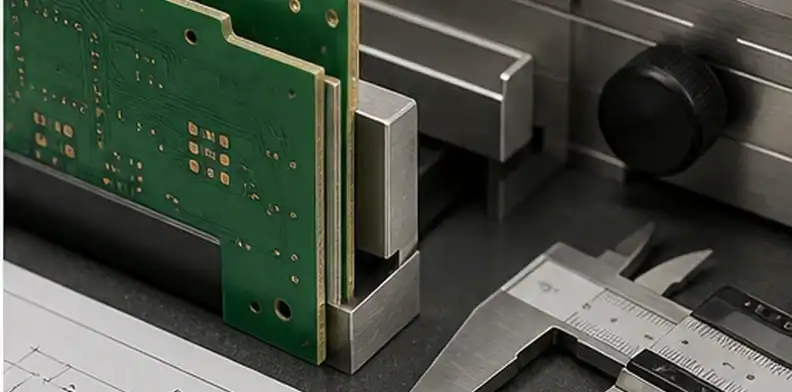
Critical edges are the ones that touch housings, card guides, slots, heatsinks, seals, displays, operators, or final-product cosmetics. Mark those edges on the drawing or mechanical file. A supplier cannot infer the difference between a hidden internal edge and a customer-visible edge from Gerbers alone.
Use board thickness selection and mechanical drawings together when fit is tight. Edge burrs become more troublesome when thickness tolerance, outline tolerance, and housing clearance are all narrow. A board that is electrically good can still fail the build if its routed profile is rough or oversized.
| Edge type | Risk | RFQ note |
|---|---|---|
| Card-guide edge | Fit drag or scrape | Control burr and profile |
| Customer-visible edge | Cosmetic rejection | Define appearance class |
| Hidden clearance edge | Usually lower risk | Use routine routing acceptance |
| Panel-tab area | Loose nubs after breakout | State final deburr expectation |
Fit signal: Mark the mechanical edges that matter before asking the supplier to price tighter finishing.
Mechanical drawings should mark the edge with the real use, such as card guide, enclosure wall, operator touch surface, or cosmetic outside edge. That short note is often clearer than adding tight roughness language to every perimeter line.
Mechanical teams can help by naming the mating surface instead of only sending a board outline. A board edge that slides into a molded guide, touches a gasket, or sits near an optical path deserves more control than an edge hidden inside free space.
Set an inspection path for routed edges
Inspection should include enough detail to support a release decision. Photos should show scale, edge location, affected quantity, and whether the burr is loose, attached, sharp, fibrous, chipped, or only visually rough. Without that context, a supplier may see the condition as cosmetic while assembly sees it as fit risk.
The PCB cosmetic acceptance criteria page helps separate appearance from function. Edge burr review should go one step further by asking whether the condition can detach, interfere with enclosure fit, contaminate assembly, or expose damaged laminate at a controlled edge.
Incoming inspectors should avoid scraping or sanding samples before photos are taken. Altering the edge can destroy evidence and make the supplier response less useful. Keep at least one untouched board if a claim may be needed.
Inspection rule: Photograph the edge before rework so release, sort, or replacement decisions rest on the original condition.
A photo set should include at least one overview and one close view. The overview shows whether the defect is isolated or repeated; the close view shows whether the condition is rough texture, loose fiber, chip, crack, or sharp sliver.
Scale matters in photos. A close-up without a ruler or known board feature can make a small fiber look like a severe crack, while an overview alone can hide a sharp sliver. Ask for both views before deciding whether the condition is cosmetic or functional.
Classify burr, chip, and fiber conditions
Not every rough edge is a reject. Small fiber texture may be acceptable on noncritical edges if it does not shed, cut, interfere with fit, or violate the drawing. A chip, crack, delamination line, sharp sliver, or loose glass strand near a handled or fitted edge deserves stronger review.
Create a disposition language that receiving and engineering can use quickly. Accept with note, sort, deburr, supplier review, engineering deviation, or reject are better choices than arguing over whether a photo “looks bad.” Each disposition should name who approves and whether the supplier must adjust the repeat process.
| Condition | Release concern | Possible disposition |
|---|---|---|
| Light roughness | Cosmetic only on hidden edge | Accept with note |
| Loose fibers | Contamination or handling risk | Supplier review or sort |
| Sharp burr | Operator or housing damage | Hold for deburr decision |
| Edge chip near fit zone | Dimensional and reliability concern | Engineering disposition |
Release call: The question is not whether an edge is perfectly smooth; it is whether the condition changes fit, safety, cleanliness, or customer acceptance.
Disposition should also consider the downstream operation. A small edge nub that is harmless before conformal coating may become a particle source after handling, washing, or enclosure insertion.
The disposition should also state whether local deburring is allowed. Some boards can be safely touched up after supplier agreement, while others lose traceability, cosmetic consistency, or dimensional confidence once a buyer modifies the edge.
Review cleaning and handling effects
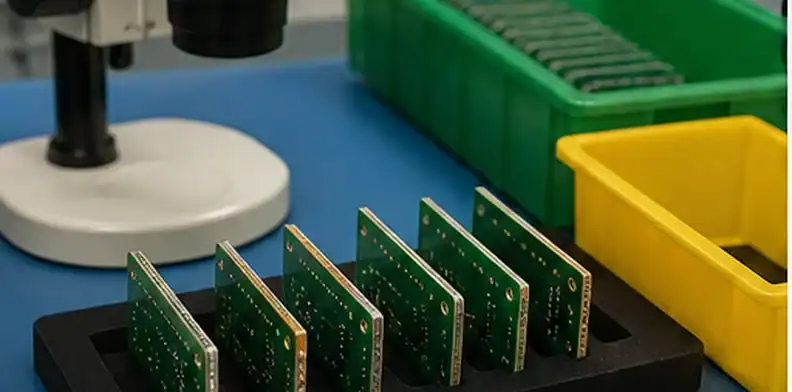
Deburring can solve one problem and create another. Aggressive brushing, sanding, or scraping may change board outline, expose fibers, contaminate surfaces, or damage solder mask near the perimeter. Ask the supplier how the edge will be cleaned after routing and whether any post-route handling is included in the quote.
Edge fibers also connect to cleanliness. A board going into conformal coating, optics, medical hardware, or a sealed housing may have lower tolerance for loose particles. In those cases, tie edge review to ionic cleanliness or contamination evidence only when residue or particles could affect assembly.
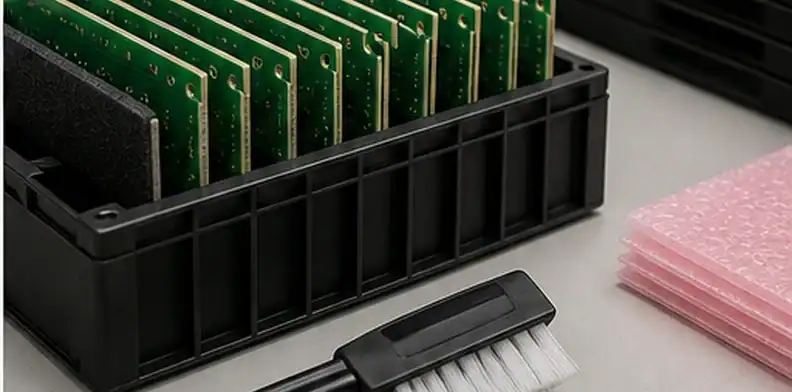
Packaging matters too. Boards can leave the router acceptable and arrive with abraded edges if they rub inside a stack. Ask for separators, bagging, or packing changes when edge cosmetics or loose debris matter to the customer.
Handling rule: Edge quality is not finished at the router; cleaning and packaging decide what receiving actually sees.
Packing review is easy to miss. Boards stacked edge-to-edge can damage each other during shipment, especially when the perimeter is already rough from routing or tab breakaway.
Cleaning and packaging should be discussed before shipment when the board enters a clean assembly, optical module, sensor, or sealed enclosure. Edge debris that is harmless on a bench can become a field complaint after it moves inside the product. The packing note can be simple: prevent board edges from rubbing during shipment when perimeter finish is controlled. That one sentence is often enough to make the supplier choose separators, trays, or tighter stacking discipline for the critical lot.
Control routing or deburring changes
A supplier may change router bit, feed, stack height, panel tab design, deburring method, or packing method after first article. Those changes can improve yield, but they can also shift outline tolerance and edge finish. Repeat orders should keep the approved edge route stable when fit or cosmetics matter.
Use processed Gerber approval when the supplier asks to modify tabs, breakaway points, route paths, or panel layout. Edge-quality improvements are welcome, but the buyer should know whether the final outline, keepouts, or assembly fixture clearance changes.
Good change control can be simple: “Critical edges A and B require no loose burrs after final route; report router path, tab, or deburr changes that affect profile or visible edge finish.” That gives CAM a practical release boundary.
Change boundary: A deburr improvement still needs approval when it changes profile, cleanliness, or visible-edge expectations.
Routing changes should be approved against the mechanical file, not only the Gerber outline. Fixture clearance, panel rails, breakaway nubs, and route-bit diameter can affect what the assembler receives.
Panel breakaway design can add its own risk. Mouse bites, tabs, route gaps, and residual nubs may need separate approval when the final edge fits into a housing or slides through an assembly fixture. A change from hand deburr to automated brushing, or from one router stack height to another, should be visible when the board has a controlled edge. The goal is consistency, not a perfect-looking one-off sample.
Compare supplier replies before shipment
Compare supplier replies by looking at the inspection and disposition plan. One supplier may quote routine route and ship. Another may include critical-edge marking, first-lot photos, final deburr, and controlled packing. The second quote may cost more, but it may prevent a mechanical-fit hold.
Ask suppliers to identify the finished profile tolerance, deburr expectation, maximum acceptable tab remnant when relevant, critical edge handling, and what evidence comes with the first lot. A useful reply acknowledges where the drawing is silent and asks for the missing mechanical priority.
Read the reply as a short release signal:
- Critical edges identified: the supplier understands the mechanical priority, so drawing signoff can proceed if the tolerance and evidence match.
- Routine routing only: the quote may still be usable for noncritical edges, but the buyer should confirm that no housing, guide rail, or operator-contact edge is exposed.
- Manual deburr offered: the buyer should ask how the supplier protects dimensions and avoids cosmetic variation.
- No packing comment: add separator, sleeve, or carton protection when edge abrasion could create receiving noise.
Buyer call: A low-cost route quote is acceptable only when the edge does not control fit, cleanliness, or visible quality.
When comparing suppliers, ask for one sentence on how critical edges are protected. The answer reveals whether the factory sees the board as an electrical panel only or as a mechanical part of the final product.
Supplier comparison can include a sample edge from the first article. A small retained sample helps future buyers know what was accepted, especially when the drawing uses plain language rather than a numeric roughness requirement.
Send QueenEMS the edge-quality package
Send the Gerber or ODB++ files, mechanical drawing, outline tolerance, critical-edge marking, panelization preference, tab or V-score notes, housing or fixture clearance, cosmetic requirement, and photos from any previous edge issue. QueenEMS can review whether the board needs routine routing, critical-edge deburr control, packing protection, or first-lot edge photos.
A useful RFQ note is: “PCB edge burr acceptance is controlled on the marked mechanical edges. Supplier to state routing/deburr assumption, profile tolerance, tab-remnant expectation, packing method, and approval rule for route or deburr changes.” That wording keeps the focus on release rather than subjective appearance.
Send the outline drawing and edge-quality photos through the QueenEMS contact page when fit or customer-visible edge quality must be closed before quotation.
Handoff rule: The final package should show which edges can be routine and which edges must be release-controlled.
For the handoff, photos from an old rejected lot are valuable. They show the exact edge condition that should not repeat and help QueenEMS recommend a practical drawing or packing note.
For production release, keep the approved edge photos with the drawing revision. That gives incoming inspection a practical reference and helps avoid rejecting normal routed texture while still catching sharp burrs or loose fibers.
FAQ
Is every PCB edge burr a reject?
No. Light roughness on a noncritical hidden edge may be acceptable, while loose fibers, sharp burrs, chips, or fit-edge damage need disposition.
Should the drawing define every edge finish?
No. Define critical mechanical or cosmetic edges, then let routine edges follow normal fabrication practice unless the product requires tighter control.
Can deburring change board dimensions?
Yes. Aggressive deburring or sanding can affect profile, edge appearance, and nearby mask, so controlled edges need an approved method.
What evidence should I collect for an edge-quality claim?
Collect photos with scale, affected quantity, edge location, lot information, fit impact, and at least one untouched sample board.
Sources
Written by the QueenEMS Engineering Team
Upload your files today · Free DFM check before production · Ship worldwide
Get your PCB prototypes in as fast as 24 hours. We handle FR4, Rogers, and hybrid boards up to 40 layers in volume production, with advanced builds subject to engineering review — free prototypes for 2–4 layer FR-4 boards, no minimum order.
Just upload your Gerber + BOM — we source every part, assemble, and inspect (AOI + X‑Ray) so you don't have to chase suppliers. Boards ship in as fast as 24 hours.