
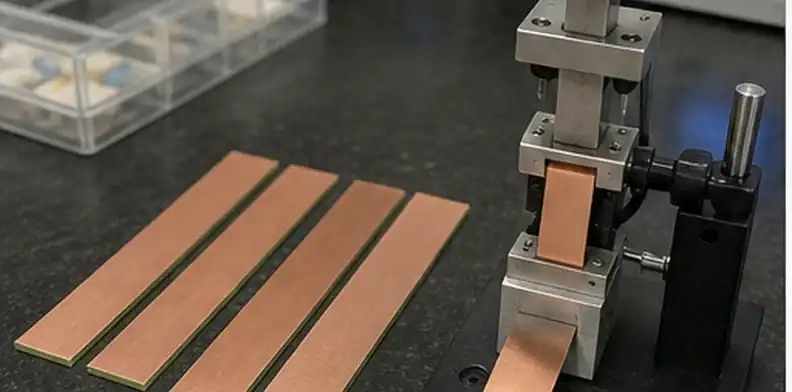
Quick Answer: PCB copper peel strength evidence shows whether copper foil remains bonded to the laminate after the conditioning or thermal exposure required by the product. Buyers should not treat a laminate datasheet value, a finished-board visual check, and a lot-specific test record as the same level of proof.
Key takeaways
- Peel strength belongs to material and process qualification more than routine incoming inspection.
- Thermal exposure, rework, heavy copper, and fine traces can turn weak adhesion into a real release risk.
- A datasheet value is useful background, but a controlled board may need lot or qualification evidence.
- Supplier substitutions should preserve the adhesion basis, not only the Tg or Dk value.
PCB copper peel strength becomes a buying issue when traces lift during rework, copper separates after thermal stress, or a material change is proposed for a repeat design. The defect may look like a workmanship problem, but the root question is often whether the laminate, copper foil, and fabrication route still match the product’s thermal and mechanical demand.
This article does not replace the PCB microsection report page. A microsection can show geometry and local defects; peel strength is an adhesion property that needs the right test context, conditioning, and approval rule.
Table of Contents
- Define what peel strength is proving
- Separate datasheet values from lot evidence
- Identify when adhesion becomes a release risk
- Ask for the right test context
- Handle material substitutions carefully
- Use inspection evidence without overclaiming
- Compare supplier answers before approval
- Decide where the proof belongs
- Send QueenEMS the adhesion-risk package
Define what peel strength is proving
Peel strength is a measure of copper adhesion to the laminate system. In purchasing terms, it answers whether copper remains attached well enough for the board’s fabrication, assembly, rework, and service exposure. It does not prove every other material property, and it does not replace electrical test.
The buyer should first decide what risk the evidence is meant to reduce. A power board with heavy copper may care about thermal cycling and rework survival. A fine-line board may care about narrow trace lift. A cost-down material change may care about whether a lower-cost laminate still carries enough copper adhesion margin.
Do not ask for a peel number without naming the condition. As-received, after solder float, after thermal aging, and after elevated-temperature exposure can tell different stories. Engineering owns the required condition; purchasing owns whether the quote includes it.
Definition rule: PCB copper peel strength evidence is useful only when the test condition matches the release risk.
The practical question is not whether copper can be peeled in a laboratory. It is whether the copper system has enough adhesion margin for the way this board will be fabricated, soldered, reworked, and handled.
The result should also be interpreted with the copper feature in mind. Wide copper areas, narrow traces, pads exposed to hand soldering, and heavy power copper can fail in different ways. A single headline peel value does not automatically describe every feature on the finished board.
Separate datasheet values from lot evidence
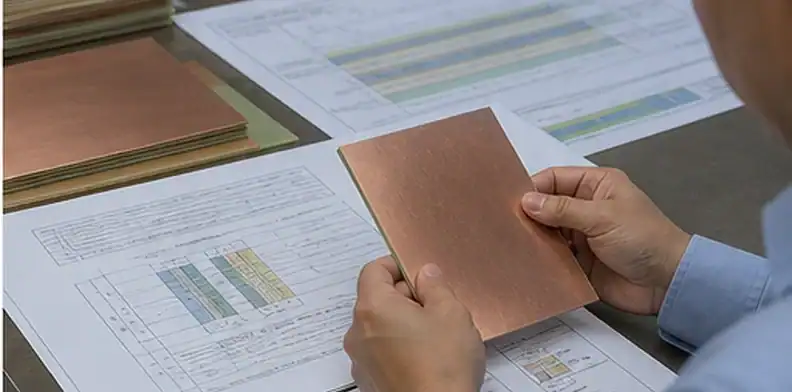
A laminate datasheet peel value is a starting point, not a finished-board release record. It normally describes the material under defined test conditions. A production lot, however, includes imaging, etching, plating, thermal cycles, bake history, and handling that may not be represented by the brochure value.
Use PCB material substitution approval logic when a supplier proposes a different laminate or copper foil. Even when thickness and Tg look similar, copper treatment, foil type, resin system, and thermal history can change adhesion behavior. The RFQ should ask which evidence supports equivalence.
| Evidence type | What it can support | Limit |
|---|---|---|
| Laminate datasheet | Material family screening | Not lot-specific |
| Supplier qualification record | Process capability | May not match this stackup |
| First-lot test or coupon | Release confidence | Costs time and must be specified |
| Failure analysis sample | Defect investigation | Reactive, not preventive |
Evidence call: Treat datasheet peel strength as background unless the supplier ties it to the actual material and build route.
For repeat orders, ask whether the datasheet basis is still the same after a material change. A replacement laminate may look similar in electrical or thermal fields while using a different copper treatment or resin chemistry.
When the quote relies on a datasheet, ask whether the supplier has actually built that laminate with the requested copper weight and finish route. The material value is stronger when it is paired with a manufacturing path the supplier knows well.
Identify when adhesion becomes a release risk
Copper adhesion risk rises when the board sees heat, mechanical stress, narrow copper features, heavy copper steps, repeated rework, or aggressive cleaning. The risk also rises when the design has large copper areas next to sparse regions, because stress and resin flow may not be uniform. A routine two-layer prototype usually does not need the same evidence as a high-temperature production board.
Ask engineering where lifted copper would matter. A nonfunctional thieving area and a power trace do not carry the same consequence. A test coupon may be justified for a controlled product, while ordinary visual inspection may be enough for a low-risk prototype.
Good RFQ wording names the reason: “Copper adhesion is controlled due to repeated rework exposure,” or “Supplier to confirm laminate and foil peel-strength basis for this heavy-copper stackup.” That helps the supplier quote the evidence instead of guessing.
Risk signal: Adhesion evidence is strongest when it points to a named heat, rework, or feature-risk condition.
Rework history is a useful clue. A board that survives one normal solder cycle but fails after repeated pad repair may need a different disposition than a board that arrives with copper already lifted from the supplier.
Adhesion risk can be seasonal or process-related as well. Storage humidity, bake history, and soldering exposure may change the way a marginal material behaves. A controlled quote should therefore name both the material requirement and the process exposure that creates concern.
Ask for the right test context
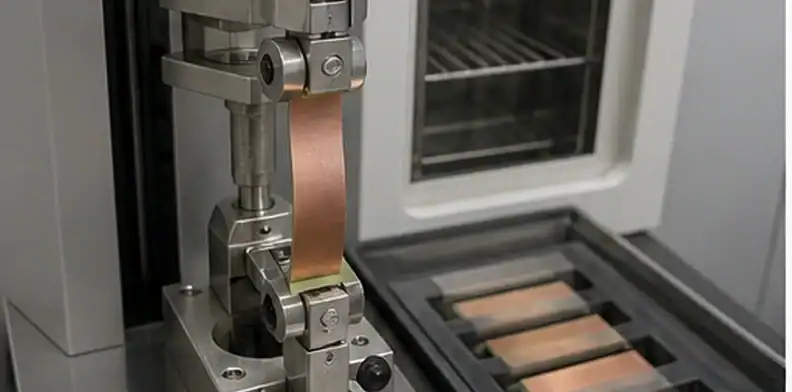
Peel-strength testing should be discussed by method, specimen, conditioning, and acceptance logic. IPC-TM-650 includes peel-strength methods for metallic clad laminates and related materials, but the buyer still has to decide which method and conditioning are relevant to the product. A casual “provide peel test” request can create mismatched evidence.
Ask what sample will be tested. Is it raw laminate, a process coupon, a production panel strip, or a failure sample? Ask whether the test is as received or after thermal exposure. Ask how results are reported and who reviews them. These questions make the supplier’s answer usable without forcing the buyer to write a lab procedure.
| Test question | Why it matters | Record to keep |
|---|---|---|
| Which specimen? | Raw laminate and finished board differ | Sample description |
| Which conditioning? | Heat can change adhesion | Exposure condition |
| Which limit? | Pass/fail needs an agreed basis | Drawing or PO note |
| Which lot? | Traceability matters for release | Lot or panel ID |
Test rule: A peel-strength result without specimen and conditioning details is weak evidence for a production release.
Test context should be quoted before the order because sample preparation and conditioning take time. Waiting until a failure happens can turn an engineering question into a line-stop argument.
Handle material substitutions carefully
Material substitution is where peel strength often gets overlooked. A supplier may offer an equivalent laminate to reduce lead time or cost, but equivalence should not be judged only by Tg, CTI, Dk, thickness, or UL file status. Copper adhesion basis deserves review when the product has rework, thermal, or reliability risk.
The surface finish thickness page shows how finished surfaces need measurable evidence. Peel strength works differently, but the lesson is similar: a property that affects release should not be hidden inside a generic “equivalent material” line. Ask the supplier to state whether the substituted laminate has comparable copper foil treatment and peel-strength support for the approved construction.
Engineering may approve the substitution, reject it, or approve only for prototype. Purchasing should keep that decision with the quote so repeat orders do not drift into a new material without review.
Substitution boundary: A cheaper or faster laminate is not equivalent until the copper-adhesion basis has been considered for the product’s use.
A substitution note should mention copper adhesion when the design has fine traces, power copper, hot components, or field repair. Otherwise the buyer may approve a material based only on headline laminate properties.
A substitution review can be short when the product is low risk. A supplier note that names the replacement laminate, copper foil type or treatment basis when available, and relevant qualification support may be enough. High-risk assemblies deserve a stronger approval trail.
Use inspection evidence without overclaiming
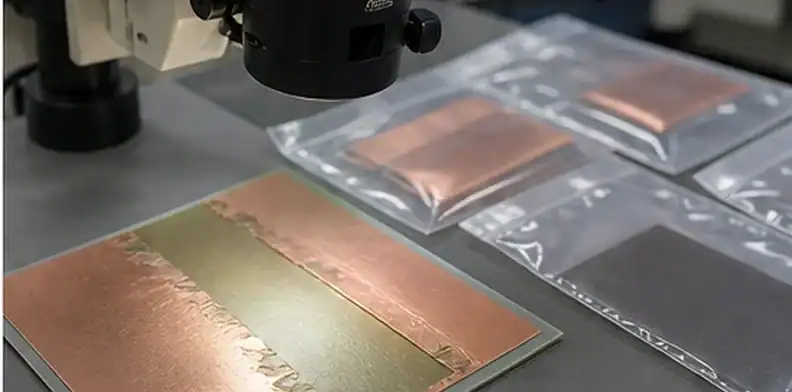
Visual inspection can catch lifted copper, blistering, and damaged traces, but it cannot quantify peel strength. Use it as a release screen and failure trigger, not as proof that the laminate meets a specific adhesion value. Receiving should photograph suspect copper, identify affected locations, and record whether the damage appeared before or after assembly.
The incoming inspection process should separate fabrication defects from assembly handling damage. A trace lifted after repeated soldering may tell a different story than copper lifting from an unopened shipment. Keep samples because adhesion disputes are hard to resolve from photos alone.
Microsection may support the investigation by showing laminate condition, copper thickness, and local damage, but it still does not replace a peel-strength test when the claim is specifically about copper adhesion force. Use each evidence type for what it can prove.
Inspection call: Visual copper lift should trigger containment and evidence collection, not an unsupported peel-strength conclusion.
During incoming inspection, keep damaged samples dry, labeled, and unmodified. Scraping the lifted copper flat for better photos can remove the physical evidence that would help a supplier or lab understand the failure.
Compare supplier answers before approval
Supplier answers are easier to compare when every quote receives the same adhesion questions. Ask whether peel strength is controlled by the selected laminate, whether any test evidence is included, whether thermal exposure changes the evidence, and whether material substitutions preserve the adhesion basis. A short technical reply is better than a long assurance paragraph.
| Supplier answer | Buyer reading | Next step |
|---|---|---|
| Names laminate and test basis | Clear support | Send to engineering review |
| Only says material is equivalent | Adhesion not proven | Ask for foil and peel support |
| Offers test after PO only | Schedule risk | Decide if evidence is required before order |
| Cannot trace evidence to material | Weak release record | Treat as open qualification issue |
Quotes may differ because one includes testing and another excludes it. That difference is not only price; it changes what the buyer can prove later if copper lifts during assembly or in the field.
Buyer call: Compare adhesion evidence as a line item before choosing the lowest material quote.
A supplier that cannot provide lot evidence may still be usable for prototypes, but production buyers should know that limit before they rely on the same route for a qualified product.
Price comparison should also include the consequence of missing evidence. A cheaper quote that cannot support a field claim may be more expensive after rework, sorting, or engineering time. That is why the evidence line should be visible before the PO is placed.
Decide where the proof belongs
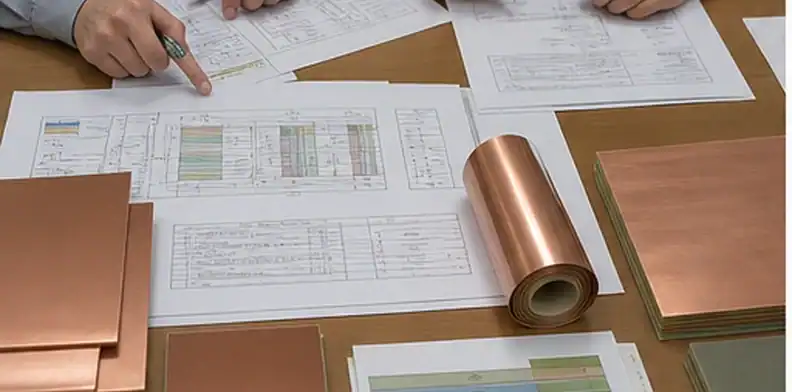
Peel-strength proof can belong in qualification, first article, routine lot release, or failure analysis. Those are different commitments. A qualification record supports the material and supplier route; a first-article check supports the initial production decision; routine lot testing adds recurring cost; failure analysis answers a problem after it appears.
Decide the stage before the PO is placed. For a new material, first build, or customer-controlled product, qualification or first-article evidence may be worth the schedule impact. For a stable repeat order, a change-control note may be enough unless the laminate, copper foil, soldering exposure, or supplier route changes.
The strongest approval record states the chosen stage and the reason. For example, “first-lot peel evidence required because the product uses repeated hand rework,” or “qualification evidence accepted; repeat lots need change notification only.” That phrasing prevents a later buyer from asking for a different proof level without understanding the original decision.
Approval rule: Place the peel-strength evidence at the right product stage instead of asking every lot to prove the same question again.
The final RFQ should state whether adhesion proof is a qualification item, a first-lot item, or a failure-analysis item. Each choice changes cost, timing, and the strength of the release record.
For mature products, the cleanest record is often a short approval note rather than a long report. State the laminate, copper basis, exposure concern, and evidence level chosen for that product stage so later repeat orders do not reopen the same adhesion question.
Send QueenEMS the adhesion-risk package
Send the stackup, laminate callout, copper weight, soldering or rework exposure, thermal requirement, surface finish, suspected defect photos if any, and whether peel evidence is needed for prototype, first article, or production. QueenEMS can review whether the package needs a laminate-equivalence check, first-lot evidence, or a supplier clarification before quotation.
A practical RFQ note is: “PCB copper peel strength is controlled for this build because of thermal and rework exposure. Supplier to state laminate and copper foil basis, included test evidence, conditioning if applicable, and approval rule for material substitution.” That wording gives engineering a real decision point.
Send the stackup and adhesion-risk notes through the QueenEMS contact page so the quotation can separate routine material supply from controlled copper-adhesion evidence.
Release rule: The final package should show whether peel-strength proof is required before fabrication or only if a lot becomes suspect.
FAQ
Is a laminate datasheet enough for PCB copper peel strength?
Sometimes, but only for low-risk screening. A controlled build may need supplier qualification or lot-specific evidence if heat, rework, or material substitution creates adhesion risk.
Can microsection prove copper peel strength?
No. A microsection can show geometry and local damage, but peel strength needs the proper adhesion test context if a numeric or pass/fail adhesion claim is required.
Should peel strength be checked on every lot?
No. Routine lot testing is usually reserved for controlled products, qualification builds, material changes, or failure investigations.
What makes copper adhesion worse during assembly?
Repeated rework, high thermal exposure, incompatible material substitution, harsh handling, and poor process control can all reduce practical copper-adhesion margin.
Sources
Written by the QueenEMS Engineering Team
Upload your files today · Free DFM check before production · Ship worldwide
Get your PCB prototypes in as fast as 24 hours. We handle FR4, Rogers, and hybrid boards up to 40 layers in volume production, with advanced builds subject to engineering review — free prototypes for 2–4 layer FR-4 boards, no minimum order.
Just upload your Gerber + BOM — we source every part, assemble, and inspect (AOI + X‑Ray) so you don't have to chase suppliers. Boards ship in as fast as 24 hours.