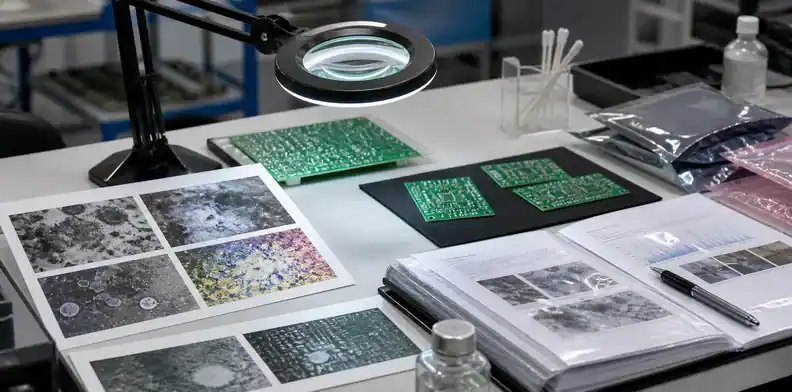
Quick Answer: PCB ionic cleanliness should be specified when residue risk can affect soldering, coating, leakage current, corrosion, or customer acceptance. A common legacy ROSE reference many buyers still recognize is 1.56 ug/cm2 NaCl equivalent, but the RFQ should name the test method, accepted limit, lot evidence, and hold rule because customer drawings or ion-chromatography plans may use different limits.
Key takeaways
- Use ionic cleanliness testing when bare-board residues can create assembly or field risk.
- Separate bare-board cleanliness from PCBA washing and no-clean flux process choices.
- Ask for method, limit, lot ID, and report evidence before boards are released to assembly.
- Treat white residue as a symptom that needs root-cause review, not only cosmetic debate.
Cleanliness is easy to ignore because the boards may look acceptable when they leave fabrication. The problem often appears later: soldering residue, conformal coating defects, leakage paths, or a customer asking why a lot was not controlled.
Table of Contents
- Decide whether cleanliness belongs in the bare-board RFQ
- Choose the method and limit before quoting
- Separate fabrication residue from assembly residue
- Use white residue as a decision signal
- Connect cleanliness to coating and high-impedance circuits
- Ask for records that match the shipped lot
- Handle a failed or missing cleanliness report
- Send QueenEMS the cleanliness review package
Decide whether cleanliness belongs in the bare-board RFQ
PCB ionic cleanliness belongs in the RFQ when residue can affect electrical performance, soldering, coating adhesion, cosmetic acceptance, or customer documentation. It is not needed on every simple board, but it should not be discovered after assembly trouble begins.
Typical triggers include fine-pitch devices, high-impedance analog circuits, conformal coating, harsh environments, medical or industrial controls, high-voltage spacing, or any customer document that asks for ionic contamination evidence. If the board will be assembled immediately with expensive components, the buyer should decide before shipment whether bare-board cleanliness evidence is part of release.
A practical RFQ sentence is: “Quote bare-board cleanliness evidence for this lot; state test method, accepted limit, sample rule, and report format before PO acceptance.” That sentence avoids a vague request such as “clean boards,” which suppliers may interpret differently.
For simple low-risk prototypes, a buyer may accept the supplier’s normal cleaning process without a report. The key is to make that choice visible. A silent omission creates disputes when the assembler finds residue or the customer asks for a record.
| Product condition | Cleanliness decision | Buyer reason |
|---|---|---|
| Fine-pitch SMT | Request report or process evidence | Residue can hurt soldering |
| Conformal coating | Define cleanliness before coating | Residue can reduce adhesion |
| High-impedance circuit | Use stricter review | Leakage current risk |
| Simple prototype | May waive report | Cost may outweigh risk |
The buyer should also decide whether the cleanliness request applies before solder mask, after final fabrication, after packaging, or after assembly. Most RFQ language should focus on the finished bare board before shipment, because that is the point the PCB supplier controls. If the project also needs post-assembly cleanliness, that should be written as a PCBA process requirement.
For products with customer audits, keep the wording simple enough for procurement to enforce. “Provide lot cleanliness evidence before shipment” is easier to control than a long technical note that never appears in the PO. Engineering can define the method, while purchasing keeps the requirement visible during quote comparison. Decision rule: Put cleanliness into the RFQ when residue could affect soldering, coating, leakage, corrosion, or customer acceptance.
Choose the method and limit before quoting
A cleanliness request should name the test method or accepted standard, the limit, and whether the report applies to every lot or only to selected orders. Without those details, two suppliers can quote different levels of work while using similar language.
ROSE testing and ion chromatography are often discussed in this area, but they are not interchangeable purchasing phrases. The buyer does not need to specify a lab method from scratch if the customer has already named one. If the customer has no rule, the buyer should ask the supplier what method is normal and whether a report can be provided for the lot.
Many older purchasing documents still cite 1.56 ug/cm2 NaCl equivalent as a ROSE cleanliness limit. That number is useful as a recognizable reference, but it should not be copied blindly into every RFQ. Some customers require ion chromatography, a different extraction method, a lower internal limit, or a process-specific acceptance rule.
The RFQ should therefore pair the number with the method. A report that says “pass” without naming ROSE, ion chromatography, extraction conditions, sample rule, and accepted limit is difficult for quality or receiving to use later.
| Cleanliness field | Practical RFQ value to name | Buyer check |
|---|---|---|
| Legacy ROSE limit | 1.56 ug/cm2 NaCl equivalent | Use only when this is the accepted customer rule |
| Solvent mix on many ROSE setups | 75/25 IPA-water | Confirm the supplier’s actual method |
| IPC-TM-650 method reference | 2.3.25 or 2.3.28 family | Match ROSE or ion chromatography to the customer request |
| Report unit | ug/cm2 or ug/in2 | Do not compare unlike units without conversion |
This table is not a universal specification. It gives purchasing concrete fields to request so engineering can compare the supplier’s report against the real customer requirement.
Unit conversion matters during supplier comparison. The legacy 1.56 ug/cm2 NaCl-equivalent limit is about 10.1 ug/in2 because 1 in2 equals 6.45 cm2. A buyer should not compare a 1.56 ug/in2 report against a 1.56 ug/cm2 requirement and assume they mean the same contamination level.
Limits should be realistic for the product. An aggressive limit may increase processing cost or create delays if the supplier must use outside testing. A weak limit may fail to protect the assembly. The engineering owner should approve the boundary before purchasing pushes for the cheapest quote.
The PCB quality documents before shipment article helps frame the report package. Cleanliness evidence should be one defined record, not a surprise document request after the packing list is ready.
Acceptance rule: A cleanliness report is useful only when the method, limit, sample rule, and lot connection are agreed before shipment.
Separate fabrication residue from assembly residue
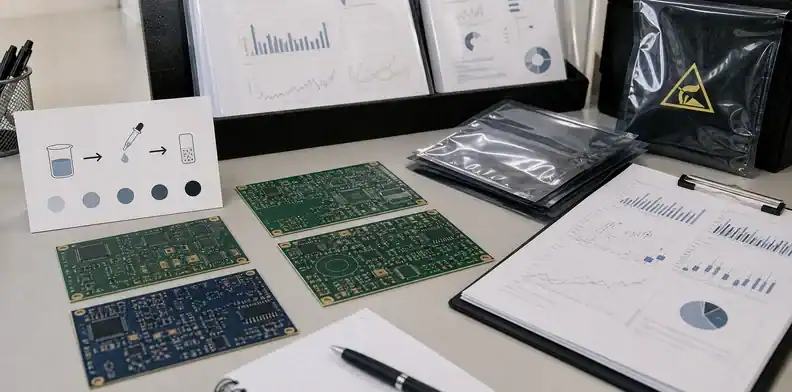
Bare-board cleanliness and PCBA cleaning are related, but they are not the same decision. Bare-board residue can come from fabrication chemistry, rinsing, handling, packaging, or storage. Assembly residue can come from flux, reflow profile, wash process, or handling after soldering.
This boundary matters when white residue appears after reflow. The PCB supplier may argue that the boards shipped clean, while the assembler may point to soldering chemistry. The buyer needs records from both sides before assigning responsibility.
For a PCB-only order, the RFQ can ask for bare-board cleanliness evidence before shipment. For PCBA, the buyer should decide whether the assembly process will use no-clean flux, wash, bake, coating, or ionic testing after assembly. A single cleanliness sentence in the bare-board quote will not control the whole assembly process.
If the concern is solder joint quality rather than board residue, review the process boundary with cold solder joint prevention. Some defects look related on a photo but need different corrective actions.
Boundary signal: Do not blame the bare board or assembly process until the buyer separates fabrication residue evidence from assembly residue evidence.
Use white residue as a decision signal
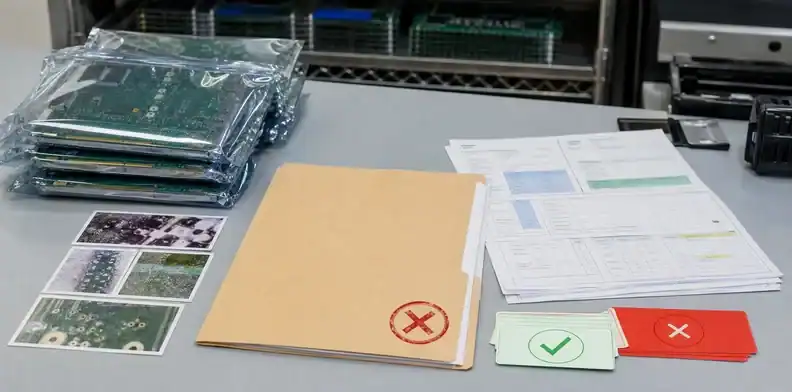
White residue should trigger a structured review, not an argument over appearance. The buyer should ask where the residue appears, whether it is on unassembled boards or after reflow, whether it affects solderability, and whether any coating or leakage requirement is involved.
Photos help, but photos alone rarely prove the source. A useful review includes incoming board condition, packaging, storage time, reflow process, flux type, wash process, and any cleanliness report. The goal is to determine whether the residue is cosmetic, process-related, or a functional risk.
The disposition should name who decides. Quality may classify the visual condition; engineering should decide whether leakage, corrosion, coating, or solderability risk exists; purchasing should keep the supplier response with the order record.
If the residue is found before assembly, hold the lot long enough to ask for supplier explanation and possible cleaning or retest. If it is found after assembly, the review must include the PCBA process because the bare-board supplier no longer controls every variable.
| Residue timing | Likely review path | Buyer action |
|---|---|---|
| Before assembly | Bare-board storage and fabrication evidence | Ask supplier for report or disposition |
| After reflow | Flux, profile, wash, board evidence | Review PCB and PCBA records |
| After coating | Surface cleanliness and coating process | Pause coating release |
| After field exposure | Corrosion and leakage risk | Escalate technical review |
Evidence check: Treat visible residue as a signal to collect records, not as automatic proof of which supplier caused the issue.
Connect cleanliness to coating and high-impedance circuits
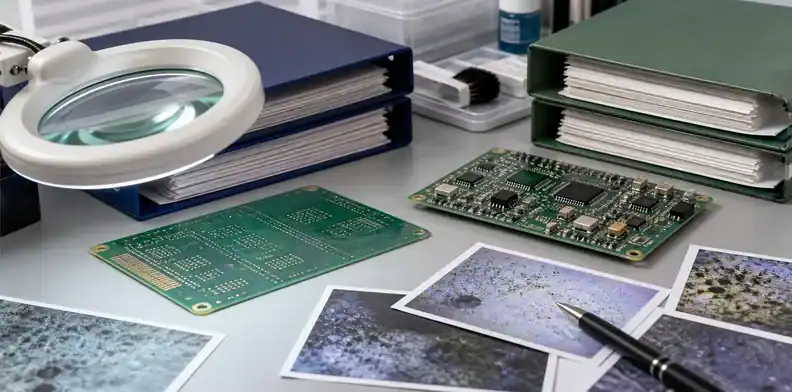
Cleanliness matters more when the next process makes residue harder to remove or when the circuit is sensitive to leakage. Conformal coating is a common example: coating over residue can trap contamination and create adhesion or corrosion problems.
High-impedance circuits, sensor inputs, medical electronics, outdoor controls, and high-voltage boards also deserve closer review. The buyer should not wait for a field problem before asking whether ionic residues were controlled.
For coated assemblies, the buyer should connect the cleanliness requirement to the coating plan. The conformal coating article can help define when coating is part of the product risk. Cleanliness is one of the checks that should happen before coating locks the surface condition in place.
This does not mean every coated board needs the same test. A low-risk consumer board may rely on normal process controls, while an industrial controller with long service life may need formal evidence. The useful question is what failure mode the cleanliness requirement is meant to prevent.
Risk rule: Raise the cleanliness evidence level when residue would be trapped by coating or could create leakage, corrosion, or customer rejection.
Ask for records that match the shipped lot
A cleanliness statement is stronger when it names the lot, date, method, limit, measured result, and disposition. A generic “boards are clean” sentence may be acceptable for a low-risk quote, but it is weak if a customer asks for proof.
The report should connect to the same part number and revision shipped to the buyer. If boards are split into multiple lots or shipped after storage, the record should make clear which lot was tested. That matters when one shipment is accepted and another is questioned later.
Buyers should also ask how the boards were packed after cleaning. Cleanliness can be compromised by handling or storage if bags, labels, humidity control, or shelf-life rules are loose. Pairing cleanliness records with packaging evidence gives a better release picture.
For projects where finished boards may sit before assembly, connect this topic to bare-board storage planning. A clean board can still become questionable if it is opened, handled, and stored without a controlled rule.
Storage can make the evidence harder to interpret. A lot that passed cleanliness testing before packaging may still be questioned if bags are opened, boards are handled without gloves, or the assembly date moves far beyond the original plan. The buyer should record both the report and the storage condition when the boards will wait before soldering.
A receiving team does not need to retest every board to use this rule. It only needs to know when to escalate: opened packaging, visible residue, customer-required evidence missing, or a process change between the quoted lot and the received lot. Record rule: A cleanliness report should be lot-specific enough that receiving or quality can decide whether the exact shipment is accepted.
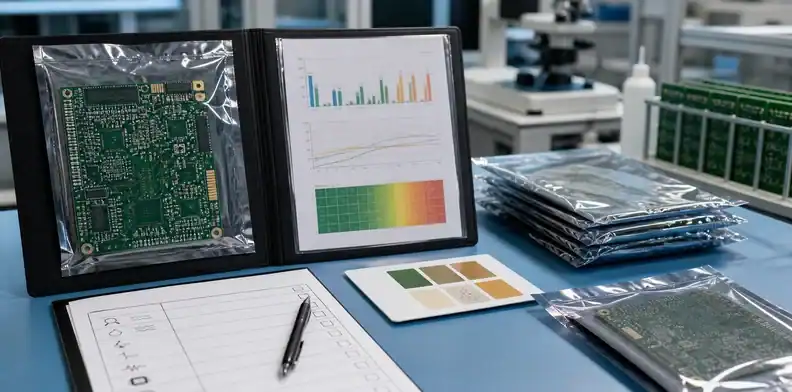
Handle a failed or missing cleanliness report
A failed report should not automatically mean the boards are scrap. Engineering should review the product risk, the measured result, the method, and whether cleaning, retesting, or deviation is reasonable before assembly.
A missing report is different. If the PO required cleanliness evidence, the buyer should hold the paperwork release and ask for the report or a written disposition. If the report was never quoted, the buyer should decide whether the risk justifies added testing before shipment.
The buyer should keep the decision with the released files. If a waiver is accepted for a prototype, that waiver should not silently become the production rule. Repeat orders need a clear baseline: report required, report waived, or report required only for certain products.
For corrective action, the buyer should ask for a narrow answer rather than a long generic quality report. The supplier or assembler should state what residue was observed, where it was found, what process step is suspected, what cleaning or retest is proposed, and whether the lot can proceed. That format gives engineering enough information to decide without turning the issue into an email chain.
If the order is still at quotation stage, the same lesson becomes preventive. Add the cleanliness evidence, storage rule, and assembly-process boundary before the first lot ships. It is far cheaper to define the evidence upfront than to rebuild a dispute after the boards have passed through reflow. Release rule: Do not let a missing required cleanliness report become an informal waiver for future production lots.
Send QueenEMS the cleanliness review package
Send the bare-board files, fabrication notes, soldering process concern, coating plan if any, customer cleanliness requirement, photos of residue if available, quantity, and shipment timing. QueenEMS can help separate bare-board cleanliness, assembly-process residue, and report evidence before the quote or corrective action path is chosen.
For PCB work, the review can return a practical cleanliness note, sample rule, and shipment record request. For PCBA work, the review can also connect the board condition to flux, washing, reflow, coating, and incoming inspection so the decision does not fall between suppliers.
If your PCB or PCBA project has residue, coating, soldering, or customer cleanliness requirements, contact QueenEMS with the photos, files, process notes, and target quantity so our team can help turn the concern into a clear RFQ or release decision.
FAQ
Is PCB ionic cleanliness needed for every bare board?
No. It is most useful when residue risk affects soldering, coating, leakage, corrosion, or customer documentation. Low-risk prototypes may use normal supplier process controls.
Does white residue prove the PCB supplier caused the problem?
No. White residue can come from bare-board fabrication, storage, flux, reflow, washing, or handling. The buyer should compare PCB records with PCBA process records before assigning cause.
Should the cleanliness limit be in the drawing or the PO?
Put the requirement where both engineering and purchasing will enforce it. A drawing note is strong for technical control, while the PO should also state whether a report is included before shipment.
Can QueenEMS review cleanliness before quoting PCBA?
Yes. QueenEMS can review board files, coating plans, assembly chemistry concerns, customer requirements, and residue photos so the quote separates bare-board evidence from assembly process controls.
Sources
- IPC standards and test method documents define electronics cleanliness and printed-board evidence frameworks used by manufacturers and buyers: https://www.ipc.org/standards
- Zestron explains ionic contamination, ROSE testing, and cleanliness control concepts for electronic assemblies: https://www.zestron.com/en/technical-center/technical-information/ionic-contamination.html
Written by the QueenEMS Engineering Team
Upload your files today · Free DFM check before production · Ship worldwide
Get your PCB prototypes in as fast as 24 hours. We handle FR4, Rogers, and Flex up to 60 layers — free prototypes for 2–4 layer boards, no minimum order.
Just upload your Gerber + BOM — we source every part, assemble, and inspect (AOI + X‑Ray) so you don't have to chase suppliers. Boards ship in as fast as 24 hours.