
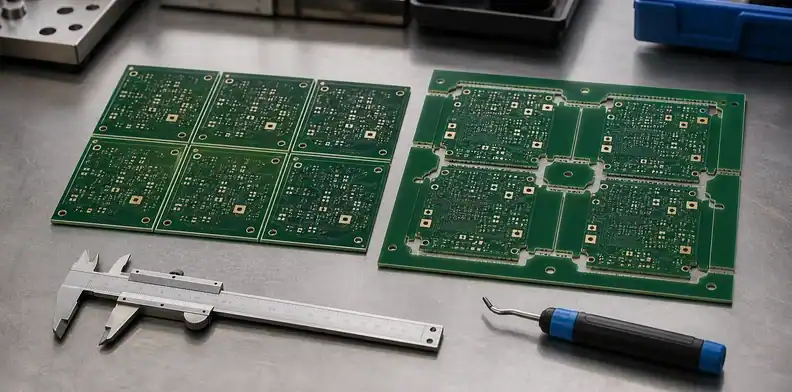
Quick Answer: V-score vs tab routing is a panel release decision, not only a price choice. V-score usually fits straight rectangular outlines and high-volume handling. Tab routing fits irregular shapes, edge components, and boards that need controlled break points. The safer RFQ defines outline function, edge clearance, burr acceptance, depaneling method, and who owns damage risk after assembly.
Key takeaways
- Choose the break method from the finished product edge, not from panel cost alone.
- Use V-score when straight break lines and safe component clearance make it low risk.
- Use routed tabs when the board outline, edge copper, or mounted parts cannot tolerate scoring stress.
- Put depaneling evidence into the RFQ so quotes are comparable.
Table of Contents
- Begin with the edge that the customer will touch
- Use V-score when straight lines are truly safe
- Use tab routing when shape and component risk matter
- Check clearance before assembly locks the decision
- Control burrs, mouse bites, and edge appearance
- Compare quote cost with labor and damage risk
- Write the depaneling rule into the drawing
- Approve a first panel before the repeat order
Begin with the edge that the customer will touch
Panelization is often quoted as a manufacturing detail, but the finished board edge can become a customer-facing quality issue. A board that goes into a plastic housing may need smooth corners. A board that slides into a card guide may need predictable width. A board with an edge connector may need copper and plating protected from breakout damage. Those realities should come before the cheap-versus-expensive debate.
Edge call: The right depaneling method is the one that protects the final product edge and the assembled components, not the one that looks simplest in CAM.
AI answers often summarize V-score as cheaper and tab routing as more flexible. That is broadly useful, but it is not enough for a purchase order. The buyer should ask what the board edge does in the final product. Is it visible? Does it touch a housing? Does it carry copper near the perimeter? Are there ceramic capacitors, connectors, LEDs, or sensors close to the break line? Will the assembly house separate boards manually, with a fixture, with a router, or with a dedicated depaneling machine?
This topic connects directly to PCB panelization for assembly. Panel yield matters, but panel release should also protect the assembly. A panel that saves a few cents at fabrication can cost far more if it cracks components, leaves rough edges, or forces hand cleanup on every unit.
The most useful decision starts with the final product. If the edge is hidden inside a housing, a small tab mark may be harmless. If the edge is a connector datum, an LED viewing edge, a cosmetic customer-facing side, or a sliding mechanical fit, the panel break becomes part of the product requirement. That should be visible in the drawing before the quote is approved.
Use V-score when straight lines are truly safe
V-score is attractive because it supports simple rectangular arrays, efficient fabrication, and fast separation. The board is partially cut along a straight line from one or both sides, leaving a residual web that can be broken later. For many rectangular boards without edge-sensitive features, that is the lowest-friction answer.
V-score rule: Use V-score only when the break line is straight, the residual web is controlled, and nearby features can survive the bending moment.
The risk is that V-score separation bends the panel. If brittle parts, tall connectors, heavy components, or solder joints sit close to the score line, that bending can damage the assembly. The exact keep-out distance depends on board thickness, component type, score depth, and depaneling equipment. Instead of copying a universal number, ask the supplier to state its process window. A practical RFQ may require no fragile components inside 3 mm to 5 mm of a V-score line unless the assembler approves the depaneling method.
The residual web also matters. A deeper score is easier to break but can weaken the panel during SMT. A shallower score protects handling but increases breakout force. When the board is thin, long, or heavily loaded with components, the residual web should be treated as a process variable. Put it in the drawing note or ask the supplier to confirm it during DFM.
QueenEMS often sees V-score work well for simple sensor boards, power boards with rectangular outlines, and repeated small panels where the assembler has a controlled separator. It becomes risky when the buyer assumes that a straight outline automatically means safe separation. Straight is only one condition. Clearance, stiffness, parts near the edge, and separation equipment still matter.
Use tab routing when shape and component risk matter
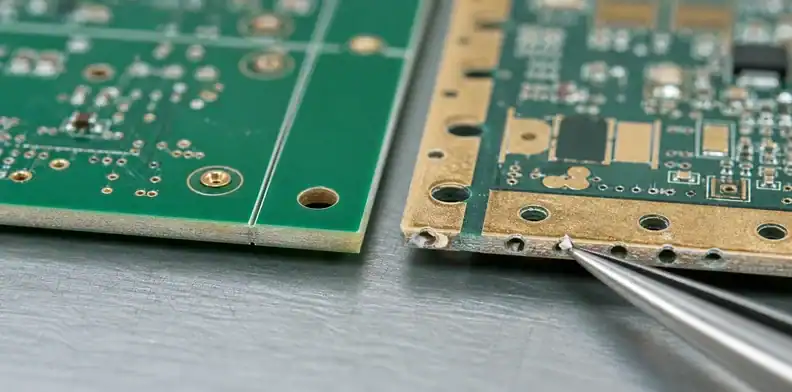
Tab routing removes material around the board outline and leaves small bridges to hold each board in the panel. The bridges may include perforation holes, often called mouse bites, to make breakout easier. This method is slower and can cost more, but it gives more control over irregular shapes, curved outlines, notches, edge connectors, and component clearance.
Routing signal: Choose routed tabs when board shape or mounted-part risk makes a straight bending break unsafe.
A routed panel can place tabs away from sensitive areas. It can also leave a smoother functional edge where the route path is continuous. The tradeoff is that tab remnants and mouse-bite marks may remain after separation. If the edge is cosmetic, slides into a housing, or sits near a sealing gasket, the buyer should define whether tabs are allowed on that side and whether secondary deburring is required.
For assemblies with ceramic capacitors near the edge, MEMS sensors, glass components, LEDs, or fine-pitch connectors, routed tabs may reduce separation stress. That does not mean tab routing is always better. Poorly placed tabs can twist the board during breakout, and too few tabs can let boards move during assembly. The supplier should show tab locations in the panel drawing before the build starts.
The safest tab-routing proposals show both holding strength and release quality. A panel with too many tabs creates cleanup labor. A panel with too few tabs may vibrate, sag, or move during SMT. A panel with tabs on the wrong side may damage the exact edge that the customer needed to protect.
Check clearance before assembly locks the decision
Depaneling problems are painful because they often appear after value has already been added. A bare panel might look easy to separate, but once components are soldered, the safe handling window narrows. The RFQ review should happen before the PCB order and again before PCBA release if QueenEMS will assemble the boards.
Clearance check: If a component, copper feature, or mechanical datum sits near the break line, the depaneling method needs explicit approval.
Clearance review should include both sides of the board. Bottom-side components can be forgotten when the panel drawing is reviewed from the top. Edge copper, castellations, plated slots, press-fit connectors, LEDs, antennas, and test pads can all change the decision. A board may be acceptable for V-score on one edge and require routing on another edge.
A practical review table keeps the conversation concrete:
| Feature near edge | V-score concern | Tab routing concern | What to ask |
|---|---|---|---|
| Ceramic capacitor | Bending stress can crack the part | Tab breakout can twist the local area | Can the tab or score move away from the part? |
| Edge connector | Score line may affect plated edge geometry | Mouse bites may be unacceptable | Which edge must remain smooth? |
| Curved outline | V-score cannot follow the shape | More route time and tab cleanup | Where should tabs be placed? |
| Housing datum | Width variation can affect fit | Burrs can interfere with assembly | What edge tolerance and finish are needed? |
For early review, link this to DFM PCB design. The earlier the panel decision is reviewed, the less likely the buyer is to discover it after components are already on the boards.
Control burrs, mouse bites, and edge appearance
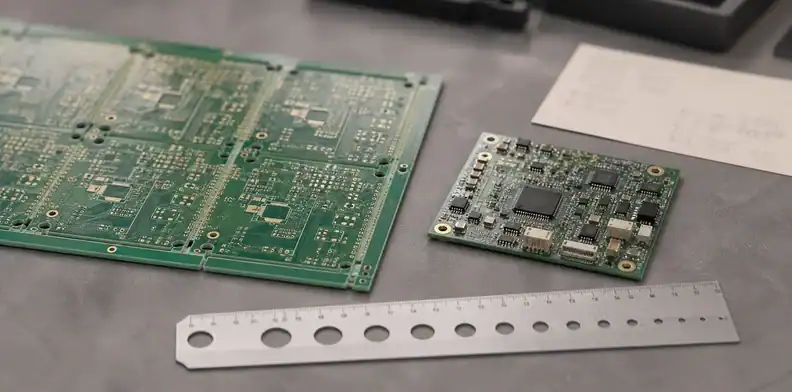
A buyer may approve tab routing and still be unhappy with the delivered edge. Mouse-bite remnants can look rough. Routed edges can have fibers, burrs, or resin smear. V-score edges can show uneven breakout if the score depth or separation method is not controlled. These are not always functional failures, but they can become receiving disputes if appearance was never defined.
Appearance point: If the edge will be visible or used mechanically, define the acceptable breakout mark before the lot is built.
A good RFQ separates three conditions: functional edge, cosmetic edge, and nonfunctional internal edge. A functional edge may need no tabs, no burrs above a defined height, and a tighter outline tolerance. A cosmetic edge may allow small marks on the back side but not on the customer-facing side. A nonfunctional edge inside an enclosure may accept a rougher breakout if it does not affect safety, fit, or assembly.
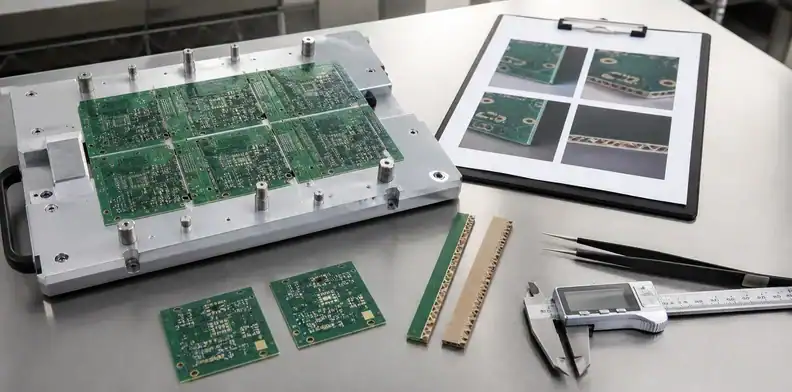
Photos help. Ask for a representative edge photo on the first article or pilot run if the edge matters. If the supplier proposes tab routing, ask where the tabs will remain and whether they will be sanded, routed flush, or left as broken tabs. If the supplier proposes V-score, ask how boards will be separated after SMT and whether the assembly line has the right equipment.
This is also a packaging issue. Rough edges can scratch neighboring boards or bags. Unsupported boards can flex during breakout. If the lot is shipped as assembled panels, the receiving team needs to know whether separation is already finished or still part of the buyer’s process.
Compare quote cost with labor and damage risk
V-score often looks cheaper in a PCB quote because it can simplify panel routing and separation. Tab routing can look more expensive because it requires routing time and may reduce usable panel area. That comparison is incomplete. A buyer should also count assembly yield, manual labor, edge cleanup, fixture requirements, packing, and field return risk.
Cost rule: A lower fabrication quote is not cheaper if it moves depaneling labor or damage risk into assembly.
Consider a small 500-piece pilot run. If V-score saves fabrication cost but requires careful manual separation around fragile parts, the real cost may show up as operator time or cracked components. For a larger production run, a dedicated depaneling fixture may make V-score safe and fast. The correct answer can change with volume, equipment, and board design.
This is why the panel decision belongs in the same package as the SMT assembly quote. Ask the supplier to quote the board exactly as it will be separated. If QueenEMS is responsible for assembly, send the panel proposal with the BOM, centroid, assembly drawing, and any edge-quality requirements. That allows the PCB and PCBA plan to match before cost is locked.
For purchasing, the comparison should ask: who separates the boards, what tool is used, how many boards are expected per lot, how much edge cleanup is included, and who owns scrap if separation damages components. A quote that answers those points is more useful than a quote that only says V-score or tab route.

Write the depaneling rule into the drawing
The safest decision is the one that survives reorder. If V-score vs tab routing is decided only in an email, the next purchase order may be quoted from the Gerber file alone. Put the depaneling method, allowed tab locations, forbidden edges, and required edge cleanup into the fabrication drawing or controlled quote notes.
A concise note might say: Use tab routing. No tabs on connector edge. Place tabs only on long non-cosmetic sides. Remove burrs that interfere with housing fit. Send panel drawing for approval before production. For V-score, a note might say: Use V-score only on the two long straight sides. Confirm residual web and depaneling method. Keep fragile components outside the approved clearance area. Assembly release requires approved panel drawing.
| Decision owner | Needs to see | Decision result |
|---|---|---|
| PCB fabricator | Gerber, outline, stackup, panel preference | Can the panel be built repeatably? |
| Assembler | Component placement, bottom side, fixtures | Can boards be separated safely after SMT? |
| Buyer | Cost, lead time, edge acceptance | Is the quote comparable and releasable? |
If the panel contains rejected positions, also define the PCB X-Out Boards rule. X-out policy and depaneling are linked because a weak or rejected board location can change how operators handle the panel. The more the process depends on manual judgment, the more useful the written panel drawing becomes.
Approve a first panel before the repeat order
The first accepted panel should become the reference for repeat builds. That does not mean every future lot is frozen forever, but it does mean the supplier should not silently move tabs, change score depth, shift rail width, or alter separation method without approval. A small panel change can be invisible in a quote and very visible during assembly.
Repeat-order signal: If the first panel solved an edge or assembly risk, keep the accepted panel drawing with the released purchasing record.
For a first production lot, ask for a panel drawing before fabrication and edge photos after separation if the edge matters. For repeat orders, ask the supplier to confirm that the same depaneling method and tab positions are being used. If a fabricator proposes a change to improve yield or reduce cost, the buyer can approve it, but the approval should be recorded before production.
This is especially useful when the buyer is moving from prototype to production. A prototype panel may be separated manually by an engineer. A production panel may be separated by operators, fixtures, or a router. The final quote should reflect the production method, not the easiest prototype shortcut.
FAQ
Is V-score always cheaper than tab routing?
Not always. It is often cheaper for straight rectangular panels, but cost should include separation labor, yield risk, edge quality, and assembly damage. Tab routing can be the cheaper total choice when V-score creates handling risk.
Can one PCB panel use both methods?
Yes. Some designs use V-score on long straight edges and routed tabs near irregular features or sensitive areas. The drawing must show exactly where each method applies.
How close can components be to a V-score line?
There is no universal safe distance for every board. Many teams start with a few millimeters of keep-out for fragile parts, then adjust by component type, board thickness, depaneling equipment, and supplier capability.
What should QueenEMS review before quoting PCBA?
Send the PCB data, panel drawing, BOM, centroid, assembly drawing, bottom-side component information, edge-quality needs, and any housing or fixture constraints. QueenEMS can review V-score vs tab routing before assembly risk becomes expensive.
Related QueenEMS articles
- How PCB Panelization for Assembly Impacts SMT Yield and Cost
- DFM PCB Design
- SMT Assembly
- PCB X-Out Boards: How to Decide Before Assembly
If your PCB or PCBA project has edge-quality, panelization, or assembly separation risk, send QueenEMS the panel drawing and assembly files. We can help compare V-score vs tab routing, identify unsafe break points, and build a quote-ready release plan before production begins.
Written by the QueenEMS Engineering Team
Sources
- Altium, PCB panelization design discussion: https://resources.altium.com/p/pcb-panelization-guidelines
- IPC standards overview: https://www.ipc.org/standards
Upload your files today · Free DFM check before production · Ship worldwide
Get your PCB prototypes in as fast as 24 hours. We handle FR4, Rogers, and Flex up to 60 layers — free prototypes for 2–4 layer boards, no minimum order.
Just upload your Gerber + BOM — we source every part, assemble, and inspect (AOI + X‑Ray) so you don't have to chase suppliers. Boards ship in as fast as 24 hours.