
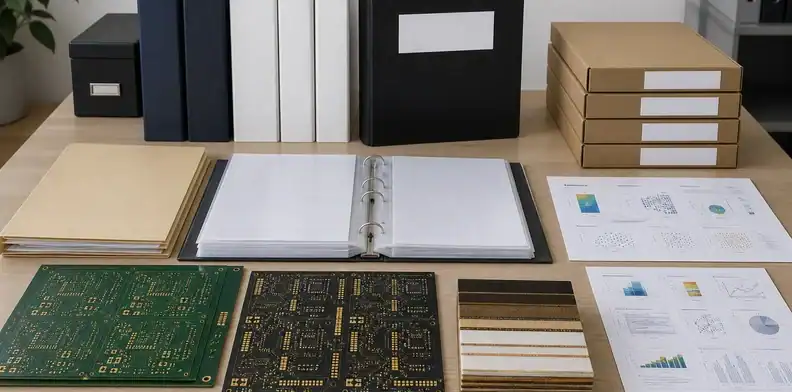
Quick Answer: Hybrid PCB production release should be a controlled package that freezes the approved stackup, fabrication data, material set, impedance or RF evidence, quality documents, deviations, and repeat-order change rules. The buyer should not release volume quantity from a prototype success alone, because hybrid boards can hide material, CAM, and evidence assumptions that only appear when production scales.
Key takeaways
- A release package converts a successful sample into a repeatable fabrication baseline.
- The package should separate frozen files, supplier evidence, open deviations, and future change triggers.
- Hybrid boards need explicit material, stackup, impedance, hole, registration, and flatness boundaries.
- The final record should be usable by engineering, purchasing, quality, and the supplier on the next PO.
The last buyer question before volume is not “Did the prototype work?” It is “What exactly are we allowing the supplier to repeat?” A hybrid PCB can pass functional testing while the approved material set, CAM output, impedance evidence, hole preparation, or first-lot deviation remains scattered across emails and reports.
This page is different from hybrid PCB first article inspection. First article inspection proves a first build. Production release defines the complete order package that lets the next build repeat the accepted construction without reopening every technical argument.
Table of Contents
- Freeze the product definition before release
- Attach the approved hybrid stackup
- Lock processed CAM and controlled changes
- Include material and substitution decisions
- Add impedance, RF, and hole evidence
- Close deviations before volume quantity
- Define shipment and receiving documents
- Set the repeat-order change trigger
- Assign engineering, purchasing, and quality owners
- Send a release-ready package for quotation
Freeze the product definition before release
Production release starts with the files that define what will be built. The package should include Gerber or ODB++ data, drill files, rout files, stackup drawing, fabrication notes, impedance table, material callouts, surface finish, finished thickness, acceptance class, panel preference, and any customer-specific requirements.
Do not rely on a prototype folder that has been modified informally. The released package should show the part number, revision, date, and approved source of truth. Purchasing uses it for the PO. Engineering uses it for change control. Quality uses it for receiving and dispute review.
| File or record | Release purpose | Common gap |
|---|---|---|
| Fabrication data | Defines copper, drill, route, and layers | Old CAM files mixed with new drawing |
| Stackup drawing | Defines material and thickness path | Quote stackup not signed |
| Impedance table | Defines controlled structures | Missing layer pair |
| Quality requirement | Defines acceptance evidence | Generic certificate only |
Release rule: Do not release production until the supplier and buyer point to the same controlled file set.
The release folder should also separate customer-controlled requirements from supplier recommendations. A supplier may propose a better panel, different copper balance, or alternate report format. Those items can be accepted, but the final package should show which ones became part of the product definition and which ones were only discussion notes.
For a growing program, this discipline saves time on the second and third order. The next buyer does not have to search old emails to find out which stackup, finish, and evidence level were approved. The supplier receives a cleaner package and can quote fewer assumptions.
Attach the approved hybrid stackup
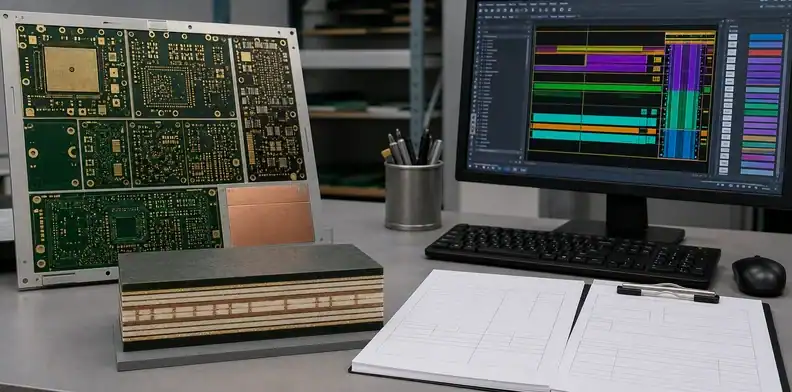
The stackup is the center of a hybrid release package. It should show material family, layer order, core and bondply thickness, copper weights, finished thickness target, controlled impedance layer pairs, and any supplier-approved construction change. A prototype screenshot is not enough.
Use supplier stackup signoff as the release reference. If the stackup changed during prototype, first article, or supplier DFM, the production package should carry the final accepted version. That protects against a repeat order using an early quote version by mistake.
When the stackup contains RF and FR4 regions, state which layers are low-loss, which are support layers, and whether any substitution is allowed. This avoids a purchasing shortcut that approves price while changing the electrical product.
Stackup call: The production package should freeze the stackup as a build document, not leave it as an estimate.
Lock processed CAM and controlled changes
Suppliers often make CAM changes that are normal for manufacturability: etch compensation, solder mask clearance adjustment, drill compensation, rout relief, copper balancing, or panelization. Those changes can be acceptable, but they should be tied to the released product when they affect function or acceptance.
Connect the release to processed Gerber approval. The buyer should know which CAM output was approved, which changes are supplier-controlled, and which changes require engineering signoff. For hybrid boards, CAM changes near RF launches, impedance traces, grounding, and material transitions deserve special care.
A useful release package has a short change table. It lists approved CAM changes, rejected changes, open questions, and future triggers. That table prevents a repeat lot from inheriting an unresolved engineering question.
CAM signal: Production release should make accepted CAM changes visible and repeatable.
Include material and substitution decisions
Material decisions belong inside the release package, not only in the supplier’s purchasing system. Include approved material grade, allowed alternates, prohibited substitutions, compliance needs, and who may approve a change. If the supplier proposed an alternate during prototype, include the final disposition.
The related hybrid PCB material substitution page covers the general change-control logic. A production release package should state the result: exact material accepted, evidence repeated, and future approval boundary.
| Material item | Release answer | Owner |
|---|---|---|
| RF dielectric | Exact grade and thickness | Engineering |
| Bond system | Approved construction | Supplier and engineering |
| FR4 support material | Grade or accepted family | Engineering or quality |
| Alternate material | Allowed, conditional, or rejected | Engineering and purchasing |
Material point: If the material set is not visible in the release package, the repeat order is not truly controlled.
Add impedance, RF, and hole evidence
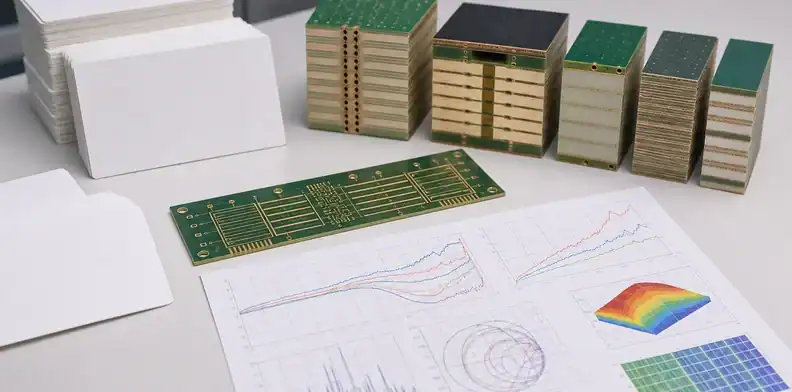
Hybrid production evidence should match the design risk. Controlled impedance may need coupon or TDR records. RF launch geometry may need first article or connector-fit review. Holes may need microsection evidence. Registration, thickness, solder mask, and surface finish may also matter depending on the product.
Do not ask for every possible document when the risk is low. Instead, list the evidence that proved the first build and the evidence that must repeat for production. This keeps the package useful instead of turning it into a folder that nobody reads.
Quality should record which evidence ships with the boards and which remains supplier-held. Purchasing should include the evidence scope in the PO so it is priced and scheduled.
Evidence check: The production package should state which proof repeats with production and which proof was only first-lot validation.
Evidence should also state timing. Some proof must be reviewed before the supplier continues, such as a first-lot microsection or corrected CAM output. Other proof can ship with the boards, such as a routine electrical test record. The release package should not mix those timing rules.
For PCBA work, decide whether bare-board evidence must be approved before components are committed. Expensive ICs, RF connectors, or consigned parts should not be placed on boards that still have an open fabrication release question.
Close deviations before volume quantity
Open deviations are the quiet risk in many volume releases. A prototype may have been accepted with a note such as minor thickness offset, material lead-time alternate, coupon missing, connector edge rework, or cosmetic concession. Those notes should be closed, carried forward with limits, or rejected before production quantity starts.
Create a deviation table with decision owner, allowed duration, affected quantity, evidence, and repeat-order rule. A temporary prototype acceptance should not become a silent production standard unless engineering and quality choose that result.
| Deviation status | Meaning | Production action |
|---|---|---|
| Closed | Corrected before volume | Build to released files |
| Accepted for one lot | Temporary concession | Requires new approval next lot |
| Accepted as standard | Future builds allowed | Update drawing or release note |
| Rejected | Not allowed | Supplier must correct before release |
Deviation rule: Volume release should not carry open exceptions without owner, limit, and repeat-order decision.
Define shipment and receiving documents
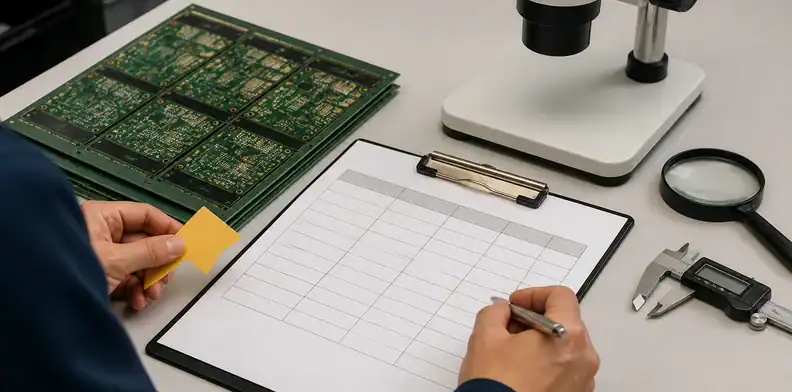
Shipment documents should support the release decision. The package may include certificate of conformance, material record, impedance report, microsection, electrical test, dimensional result, flatness measurement, surface finish data, first article report, and approved deviation list.
Tie the list to PCB quality documents before shipment so receiving has a clear expectation. For low-risk builds, the list can be short. For RF, high-speed, regulated, or expensive assemblies, the document package may need to be more specific.
The buyer should also decide whether documents are required before shipment or can arrive with the boards. Late documents can delay assembly even when the boards are physically on time.
Receiving call: A production release package should tell receiving which documents prove the lot and when they must arrive.
Set the repeat-order change trigger
The release package should say what can change without buyer review and what cannot. Routine process controls may remain inside the supplier’s system. Product-definition changes should return to the buyer. Examples include material grade, stackup thickness, copper weight, controlled impedance target, panelization that affects edges, hole preparation evidence, or accepted deviation status.
This rule protects both the buyer and supplier. The supplier does not need approval for every internal setting, and the buyer does not discover a changed product after shipment. The trigger should be short enough to copy into a reorder PO.
For dual sourcing, the same trigger helps the second supplier understand which evidence and decisions were part of the baseline.
Change signal: The release record should tell a future buyer exactly when the order must return to engineering.
A repeat trigger can be short but powerful: “No material, stackup, impedance, hole-preparation evidence, panel-support change, or accepted deviation change without buyer approval.” That sentence helps purchasing recognize a technical change even when the supplier presents it as a routine update.
For dual sourcing, the trigger also supports comparison. The second supplier may use a different internal process, but it should return equivalent release evidence or clearly state which evidence cannot be matched.
Assign engineering, purchasing, and quality owners
Production release is a team decision. Engineering owns design intent, stackup, impedance, RF function, and accepted technical changes. Purchasing owns supplier quote scope, PO wording, cost, lead time, and commercial exceptions. Quality owns receiving evidence, conformance records, and deviation disposition.
Small teams may have one person wearing several hats, but the decisions should still be separate. That separation prevents a buyer from approving a technical change accidentally or an engineer from missing a commercial condition that changes what the supplier quoted.
Add the owner next to each release item. The result is easier to audit and easier to reuse on the next order.
Owner check: A release package is stronger when each technical, commercial, and quality decision has a named decision lane.
A founder or program manager can use the owner table as a release meeting agenda. Engineering answers whether the design definition is frozen. Purchasing answers whether the supplier quote matches that definition. Quality answers whether the evidence and receiving rule are ready. The meeting can be short, but the record prevents hidden assumptions from moving into production.
Send a release-ready package for quotation
Before asking for volume pricing, send the controlled data set, approved stackup, CAM disposition, material decision, evidence scope, deviation table, shipment document list, quantity, lead-time target, and repeat-order change trigger. Ask the supplier to quote exactly that release package and identify any assumption it cannot meet.
This is also the point to ask QueenEMS for a pre-quote review. If your PCB or PCBA project has a mixed-material stackup, RF or high-speed requirements, first-lot evidence, or repeat-build risk, send the release files and open supplier questions through the contact page. QueenEMS can help check whether the package is ready for quotation, DFM/CAM review, and production handoff.
Quote-ready point: A hybrid production release package should let a supplier quote what will actually be repeated, not guess from prototype history.
Ask the supplier to return a clean exception list. “No exceptions” is useful only when the supplier has reviewed the same file set. If there are exceptions, the buyer should classify them as engineering review, commercial negotiation, quality evidence, or schedule risk. That prevents a technical exception from hiding inside a price note.

Sources
FAQ
Is a working prototype enough for hybrid PCB production release?
No. A working prototype is useful evidence, but production release also needs controlled files, material decisions, CAM approval, quality evidence, and repeat-order change rules.
What is the minimum release package for a low-volume hybrid PCB?
At minimum, freeze the fabrication data, stackup, material callout, impedance or RF notes, acceptance requirement, and shipment evidence. Add more proof when risk or customer flow-down requires it.
Should deviations be allowed in production?
Only when the owner, lot limit, evidence, and repeat-order rule are recorded. A prototype concession should not silently become a production rule.
Who owns the release package?
Engineering owns design intent, purchasing owns quote scope and PO release, and quality owns evidence and receiving disposition.
If your PCB or PCBA project has a mixed-material stackup, RF or high-speed requirements, first-lot evidence, or repeat-build risk, send the release files and open supplier questions through the contact page. QueenEMS can help check whether the package is ready for quotation, DFM/CAM review, and production handoff.
Written by the QueenEMS Engineering Team
Upload your files today · Free DFM check before production · Ship worldwide
Get your PCB prototypes in as fast as 24 hours. We handle FR4, Rogers, and Flex up to 60 layers — free prototypes for 2–4 layer boards, no minimum order.
Just upload your Gerber + BOM — we source every part, assemble, and inspect (AOI + X‑Ray) so you don't have to chase suppliers. Boards ship in as fast as 24 hours.