

Quick Answer: PCB expedite fee approval should check three things before a rush order is released: whether the files are stable, which process step is actually being accelerated, and which inspection or shipment evidence cannot be skipped. A rush fee is worth approving when the faster date protects a real business deadline and the supplier can still build the correct board with controlled risk.
Key takeaways
- Treat PCB expedite fee approval as a controlled release decision, not as a quick yes to a faster date.
- Ask the supplier to name the bottleneck being accelerated: CAM, material, fabrication, finish, inspection, packing, or shipping.
- Keep one short approval note with the RFQ or PO so engineering, purchasing, quality, and receiving teams all understand the same rush assumption.
A rush PCB order usually starts with a simple message: “Can you ship this faster, and how much extra will it cost?” That question is understandable, but it is not enough for a safe release.
The real decision is whether speed can be purchased without changing the board, hiding an open engineering question, or removing evidence the buyer needs later. A supplier may quote an expedite fee because it can move the job ahead in one queue. That does not automatically mean the whole order is ready for production.
For a buyer, the safest approach is to approve the fee only after the rush condition is written down. The note can be short. It should say which files are active, what the supplier is accelerating, what evidence still comes back, and what change would pause the rush order.
Table of Contents
- Confirm the file set before approving speed
- Ask what the expedite fee actually changes
- Protect the evidence that affects acceptance
- Write the hold rule before the order starts
- Decide whether the rush fee is commercially worth it
- Separate expedite cost from engineering change approval
- Record what will not be accelerated
Confirm the file set before approving speed
Approve a rush PCB fee only after the supplier and buyer are looking at the same released file set. At minimum, the order should have the active Gerber or ODB++ package, drill file, fabrication drawing, stackup, finish, quantity, and delivery target.
This sounds basic, but it is where many urgent orders become messy. A purchasing person may approve the faster price from a quote email while engineering is still checking a hole-size change, board outline, copper weight, material note, or silkscreen correction. The supplier may start CAM quickly, then stop again when the “final” package changes.
Use the same baseline thinking as a normal PCB DFM review before PO, just with a shorter response window. A rush order does not need a slow review. It needs a clear review.
For example, a buyer may need 20 prototype boards for a customer demo. The expedite fee can make sense if the design files are frozen, the finish is standard, and the only remaining question is the courier service. The same fee is risky if the stackup is still being adjusted or the supplier has not confirmed whether the selected material is available.
The approval note should identify the real release package:
| Item to confirm | Why it matters before paying a rush fee |
|---|---|
| Active fabrication data | Prevents the supplier from building from an old or partial file set |
| Drawing revision | Keeps thickness, finish, tolerance, and notes tied to one version |
| Stackup and material | Avoids late material substitution or impedance questions |
| Quantity and ship-to location | Keeps the promised date tied to the real shipment plan |
| Open DFM/CAM questions | Shows what must close before the rush path is safe |
Engineering does not have to write a long report. A short line such as “Revision B Gerber, drawing, stackup, ENIG finish, 50 pcs, ship to Ohio; no material or CAM change approved without buyer reply” is often enough to stop confusion.
That single line also helps compare suppliers. One quote may look faster because it assumes no DFM questions. Another may look slower because the supplier included CAM review and confirmation time. Without a clear file baseline, the buyer is comparing dates that may not mean the same thing.
Ask what the expedite fee actually changes
The supplier should explain which step becomes faster. A useful expedite fee is tied to a specific bottleneck, such as CAM priority, material allocation, fabrication queue position, surface finish capacity, inspection timing, packing, or shipping.
The phrase “rush charge” by itself is too vague. It may mean the supplier will review CAM files sooner. It may mean the board will move ahead in the fabrication queue. It may only mean the supplier will use a faster courier after production. These are very different promises.
Use PCB fabrication lead time planning to separate the real schedule drivers. If ENIG capacity, controlled impedance review, nonstandard laminate, or final inspection controls the date, paying to accelerate only CAM may not solve the buyer’s problem.
Here is the practical question to ask:
“Which operation does the expedite fee shorten, and which operations still follow normal timing?”
The answer should be concrete enough for purchasing to approve and for engineering to trust. Good supplier replies look like:
- “CAM review will be prioritized today, but material is standard lead time.”
- “Fabrication queue can be moved up after DFM approval; final inspection remains mandatory.”
- “Production date can move forward, but shipment date depends on courier pickup after packing.”
- “Rush is not available unless the buyer accepts the proposed material alternative.”
The last answer is not automatically bad. It simply changes the decision. If the faster date depends on a material alternative, processed CAM edit, tolerance relaxation, or changed shipping method, the issue is no longer only a fee. It becomes an approval decision that may need engineering, purchasing, or quality signoff.
The clearest RFQ response names the accelerated step, the unchanged steps, and the condition that would cancel the rush promise. That keeps the supplier from absorbing hidden assumptions and keeps the buyer from approving a date that depends on a change no one accepted.

Protect the evidence that affects acceptance
PCB expedite fee approval should not quietly remove evidence that the buyer needs to accept the lot. Some updates can be simplified during a rush order, but product-risk evidence should remain attached to the delivery.
The buyer may decide that extra progress photos are not worth delaying a prototype. The buyer should be much more careful with evidence tied to material, finish, impedance, solderability, controlled dimensions, packing labels, or receiving inspection.
The PCB production release package should make those evidence rules visible before the supplier starts. This is especially important for overseas sourcing because the cost of a vague rush decision often appears at receiving, not during quotation.
Use a simple separation:
| Evidence type | Rush decision |
|---|---|
| Material, finish, impedance, or solderability proof | Keep when it affects function, reliability, or customer acceptance |
| First article or dimensional confirmation | Keep when fit, connector alignment, or assembly risk is high |
| Packing label or shipment evidence | Keep when the receiving team needs lot traceability |
| Extra progress photos | Relax when they do not affect release or acceptance |
| Internal factory notes | Request only when they change a buyer decision |
This is where an experienced supplier response is valuable. The supplier should not simply say “OK, expedited.” A better answer says which evidence will still be provided and which noncritical updates are being reduced to save time.
For example, a bare-board prototype for an internal bench test may not need a long photo trail. A board used in a customer demo may need clean packing, label proof, and visual acceptance boundaries. A controlled-impedance board may still need impedance evidence even when the schedule is urgent.
Quality and purchasing should agree on this before the fee is approved. Otherwise, the team may receive boards quickly and then spend the saved time arguing about whether the lot can be accepted.
The safest wording is direct:
“Expedite approved only if required inspection evidence and packing/label proof remain included. Noncritical progress photos may be reduced.”
That sentence is short enough for an RFQ note, but it gives the supplier a real boundary.
Write the hold rule before the order starts
Every rush order needs a clear hold rule before irreversible cost begins. The hold rule states what change pauses the rush path, triggers buyer approval, or requires a revised quote.
A rushed order becomes expensive when the team discovers too late that the supplier made a practical change to protect the schedule. Some changes are harmless. Others affect the product that was purchased. The buyer should not leave that judgment to memory.
Connect the hold rule to processed Gerber approval whenever the supplier proposes CAM edits. A fast CAM adjustment still needs buyer approval when it changes the board outline, slots, drill sizes, copper-to-edge clearance, panel method, or any controlled note on the drawing.
A good rush hold rule covers four situations:
- The released design revision changes.
- The material, surface finish, stackup, or copper weight changes.
- The supplier proposes a CAM edit that changes the purchased board.
- The required evidence or shipment method changes.
The rule does not have to sound legal. It just needs to be operational. Here is usable RFQ wording:
“Expedite fee is approved for the released file package listed in this RFQ. Hold production and ask for approval before any material change, finish change, CAM deviation, evidence removal, or shipment method change.”
That wording helps each role. Engineering knows when a technical change returns for review. Purchasing knows whether the quote still matches the PO. Quality knows what evidence to expect. Receiving knows why a lot may be held if the shipment arrives without the agreed documents.
Without that rule, the supplier may do the fastest reasonable thing, while the buyer later judges the lot against a different expectation. Nobody benefits from that. The hold rule protects the schedule by removing uncertainty before the job is already moving.
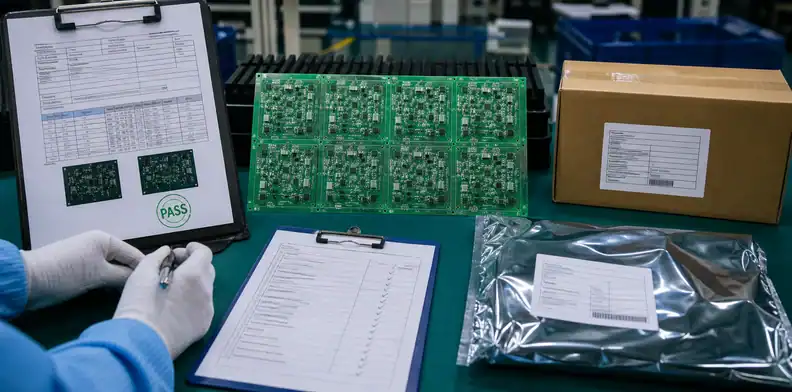
Decide whether the rush fee is commercially worth it
Approve the fee when the missed date would cost more than the rush charge and the technical risk is controlled. Do not approve it just because a faster option is available.
The commercial reason should be real. A founder may need working boards for an investor demo. A purchasing manager may be protecting a customer delivery. An engineer may need fast prototypes to unlock a second design spin. Those are good reasons to consider a rush fee.
The fee is weaker when the date is only preferred, the files are not stable, the supplier cannot name the bottleneck, or the faster schedule depends on an unapproved assumption.
Use PCB quote exclusions before comparing rush quotes. A cheaper rush quote can become expensive if it excludes retest, special packing, split shipment, inspection evidence, or rework handling. The buyer should compare the total release condition, not only the extra fee.
A simple decision map is enough:
| Approve the expedite fee when | Pause or revise the quote when |
|---|---|
| Files and drawing revision are frozen | Drawings or CAM files still conflict |
| The supplier names the accelerated step | The quote only says “rush” |
| Required evidence remains included | Inspection or shipment proof is unclear |
| The business deadline is real | The date is only convenient |
| A hold rule is written | Supplier changes can happen without approval |
For a PCB-only order, the package may be just fabrication data, drawing, stackup, finish, quantity, evidence, and ship date. For a PCBA order, the rush decision may also touch BOM availability, consigned parts, centroid data, programming files, functional test, packaging, and shipment evidence.
When PCB fabrication and PCBA assembly are both involved, keep the decision in one place. A faster bare-board date does not help much if components, assembly drawing, test fixture, or firmware release will still block delivery.
If your PCB or PCBA project has an urgent delivery target, send QueenEMS the released files, rush quote, target date, open DFM/CAM questions, required evidence, and shipment expectation. We can review whether the expedite path is quote-ready, which assumptions should be closed, and whether a safer phased release would protect the order better.
Separate expedite cost from engineering change approval
A rush fee should not become a hidden engineering approval. If the faster date depends on a material substitution, relaxed tolerance, changed finish, skipped evidence, or different shipment method, the buyer should approve that change separately from the fee.
The clean way to handle this is to write two short decisions: one commercial decision for the expedite charge and one technical decision for any changed assumption. That keeps purchasing speed from overriding engineering intent.
- Expedite fee: what queue or shipment step becomes faster
- Engineering change: what technical assumption changes
- Approval owner: who can accept the change
- Hold rule: what stops release until the buyer replies
Record what will not be accelerated
Some steps should remain fixed even during a rush build. Final inspection, solderability evidence, controlled impedance review, and packing labels may protect acceptance more than they affect speed. The supplier should state which steps stay normal so the buyer does not assume every part of the schedule moved forward.
For urgent North American RFQs, this short negative list is useful because it makes the promise measurable. If the supplier accelerates CAM only, the buyer can still plan around material, fabrication, inspection, and courier timing.
- Inspection evidence that cannot be skipped
- Material or finish constraints that stay unchanged
- Shipment documents that must still match the PO
- Any process step that remains normal lead time
FAQ
Can I approve a PCB expedite fee before DFM is complete?
Only when the remaining DFM questions cannot change cost, schedule, material, fit, function, or acceptance evidence. If the open DFM item could change the purchased board, wait for a short engineering disposition before approving the rush path.
Does a rush PCB fee guarantee the delivery date?
No. It should define what gets faster and what still follows normal timing. Material availability, file changes, inspection requirements, packing, and courier pickup can still control the real delivery date.
What should purchasing record when approving the rush fee?
Record the active file revision, accelerated process step, accepted fee, target delivery date, evidence that remains required, hold trigger, and approval owner. Keep that note with the RFQ or PO.
What is a bad supplier answer to an expedite request?
A weak answer only says “rush available” or “confirmed” without naming the bottleneck, unchanged steps, evidence, or approval limits. Ask for the assumption behind the faster date before releasing the order.
Can QueenEMS review an urgent PCB or PCBA quote before release?
Yes. Send the active files, supplier quote, target date, open engineering questions, and required evidence. QueenEMS can help identify whether the rush decision is quote-ready or whether a hold, phased release, or revised assumption is safer.
Send QueenEMS a quote-ready rush package
If your PCB or PCBA project has an urgent schedule tied to PCB expedite fee approval, send QueenEMS the released Gerber or ODB++ files, fabrication drawing, stackup, finish, quantity, supplier rush quote, target delivery date, open DFM/CAM questions, required evidence, and shipment expectation. We can help review the rush-fee boundary, hold triggers, evidence requirements, and safer PCB or PCBA release options before the supplier begins irreversible work.
Written by the QueenEMS Engineering Team
Upload your files today · Free DFM check before production · Ship worldwide
Get your PCB prototypes in as fast as 24 hours. We handle FR4, Rogers, and Flex up to 60 layers — free prototypes for 2–4 layer boards, no minimum order.
Just upload your Gerber + BOM — we source every part, assemble, and inspect (AOI + X‑Ray) so you don't have to chase suppliers. Boards ship in as fast as 24 hours.