

Quick Answer: A purchase order can be issued before every minor PCB DFM comment is closed, but production should not be released while an open question can change the board definition, material, stackup, price, test method, acceptance criteria, or committed date. Classify each DFM item, name the decision owner, record the approved answer, and separate commercial authorization from technical release.
Key takeaways – A PO authorizes commercial commitment; it should not silently authorize an unresolved design interpretation. – Close product-changing and price-changing questions before fabrication starts. – Give every open item an owner, due date, status, and controlled answer. – Keep the final DFM disposition with the released revision and order record.
A PCB DFM review before PO release often arrives at the worst possible moment: purchasing has a delivery target, engineering is still answering questions, and the supplier wants authorization to reserve capacity. The wrong response is either to wait for perfect information without judging risk or to release everything because the schedule feels urgent.
The practical solution is a release gate. Buyers need to know which questions affect the product they are buying, which affect only the supplier’s internal process, and which can safely remain open after commercial approval. Engineers need a traceable way to approve changes. Owners need visibility into cash and schedule exposure. This article turns a mixed DFM email thread into a decision record that a North American buyer can use before placing a custom PCB order.
Table of Contents
- Separate the PO from production release
- Classify every DFM question by consequence
- Close board-definition and performance decisions
- Resolve commercial and schedule exposure
- Control supplier proposals and file revisions
- Build a release-ready DFM register
- Approve the order without losing control
- FAQ
Separate the PO from production release
Teams often treat “PO issued” and “factory may build” as the same event. They do not have to be. The purchase order can authorize a defined commercial step while the technical release remains on hold. For example, the buyer may approve engineering review or raw-material reservation but prohibit tooling, imaging, drilling, or fabrication until specified DFM items are closed.
That separation needs explicit wording. A vague note such as “proceed pending DFM” leaves too much room for interpretation. State what the supplier may commit, the maximum authorized amount, the activities that remain blocked, and the person who can lift the hold. Ask the supplier to acknowledge those limits in writing.
This approach is useful when a real lead-time risk exists, but it is not permission to send incomplete data. The quotation and PO should still identify the PCB part number, revision, quantity, agreed price, delivery expectation, and controlled file package. Use a PCB purchase-order review to confirm that the commercial record points to the same revision engineering is reviewing.
For a simple, fully defined board, the cleanest sequence remains DFM closure, quote confirmation, PO, and production release. Split authorization is a controlled exception for schedule or material reasons, not a default shortcut.
Classify every DFM question by consequence
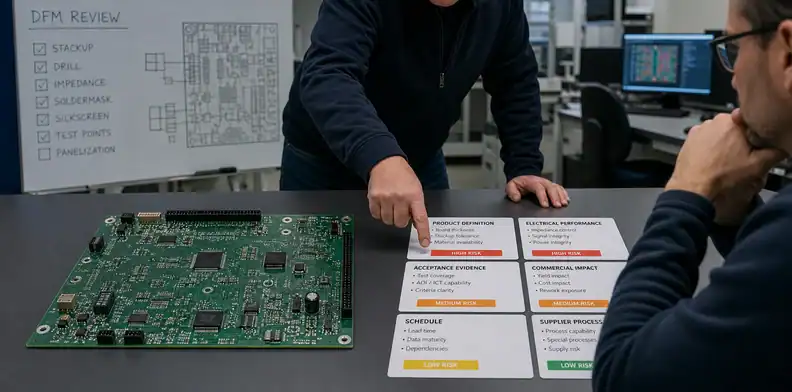
Not every supplier comment deserves the same approval path. A useful DFM register classifies each item by the consequence of the answer rather than by how difficult the question sounds.
| DFM class | Typical examples | Required action before build |
|---|---|---|
| Product definition | finished hole size, outline, copper-to-edge, polarity, layer order | Customer approval and controlled data |
| Electrical or reliability | impedance, copper weight, via structure, material family, solder-mask clearance | Engineering disposition; revalidation when applicable |
| Acceptance and evidence | test coverage, coupon, report, dimensional inspection, IPC class | Written acceptance requirement |
| Commercial | added process, yield risk, tooling, premium material, extra test | Repriced or explicitly included |
| Schedule | material lead time, engineering hold, approval deadline | Revised milestone and owner |
| Supplier process only | panel utilization or internal routing that does not change deliverable | Supplier may document internally |
The table prevents a common mistake: closing a list by counting answers instead of examining their consequences. Ten cosmetic comments may be low risk, while one proposed stackup change can affect impedance, qualification, price, and delivery.
Mark each item as open, answered, accepted, rejected, or superseded. “Answered” is not the same as “accepted.” A supplier may explain why it wants a change, but engineering still needs to decide whether the manufactured board may differ from the customer data.
Add a severity explanation instead of relying only on high, medium, or low labels. High can mean a functional defect, a regulatory failure, or simply an inability to fabricate with the chosen supplier; those are different decisions. Write the failure mode, affected requirement, and likely downstream consequence. The owner can then judge the evidence and choose a response without decoding the supplier’s internal rating system.
Also separate a manufacturability limit from a preference. A hard capability limit means the proposed design cannot be produced under the quoted process. A preference may improve yield, cycle time, or cost while the original requirement remains possible. Ask the supplier to say which condition applies and quantify the likely effect where practical. That distinction prevents an optional optimization from being treated as a compulsory design change.
Close board-definition and performance decisions
Any DFM question that can change what arrives at receiving must be closed before fabrication. Board outline, cutouts, finished dimensions, plated status, finished hole size, layer count, layer order, copper weight, surface finish, solder-mask color, legend, controlled impedance, and special routing all belong to the purchased definition.
Do not approve a change only in the body of an email. Update the drawing, fabrication note, stackup, or controlled deviation record, then identify the released revision. The factory should not have to choose between an old Gerber package and a newer conversational answer. QueenEMS’s PCB fabrication quote file checklist shows the kinds of data that should travel together.
Performance-related proposals need a second question: what evidence supports equivalence? A different laminate label may still meet the required electrical, thermal, flammability, and processing properties, but the approval must be based on declared requirements rather than a generic “equivalent material” statement. A modified stackup may preserve overall thickness while changing impedance or copper distribution. An enlarged pad may improve annular ring while creating clearance or assembly consequences.
Ask engineering to record the function protected by the original requirement. That makes the decision transferable. A note such as “approved because finished impedance remains 50 ohms ±10%, dielectric family remains qualified, and overall thickness stays within drawing tolerance” is stronger than “OK to use supplier stackup.”
Netlist and polarity questions should be treated as product-definition issues even when the physical change appears small. A free PCB DFM check can identify producibility concerns, but only the design owner can authorize a functional change.
Resolve commercial and schedule exposure
DFM closure is also a purchasing control. Supplier proposals can add laser drilling, sequential lamination, controlled-depth routing, selective finish, extra coupons, tighter inspection, or lower-yield processing. Those changes may be correct, but the buyer needs a revised commercial baseline before work begins.
For every cost-changing item, record one of three outcomes: included in the accepted price, repriced and approved, or rejected with the original requirement retained. Avoid “TBD after production,” because the buyer loses leverage after material and capacity have been consumed. The same rule applies to tooling and test evidence that was omitted from the original quotation.
Schedule questions need dates, not adjectives. “Material may be delayed” should become a confirmed material availability date, an approval deadline, and an updated ship commitment. Identify whether lead time begins at PO receipt, payment, file acceptance, DFM closure, or material arrival. The supplier and buyer should use the same clock.
When a late answer can move delivery, show the decision deadline in the DFM register. Engineering can then see the business consequence without purchasing pressuring it to approve blindly. Owners can decide whether to accept a longer schedule, pay for a viable alternative, or change order quantity.

Control supplier proposals and file revisions
A good supplier proposal describes the current condition, requested change, manufacturing reason, affected files, consequence of approval, and consequence of rejection. A screenshot with a red circle may locate the issue, but it is not a complete engineering change request.
Give each question a stable identifier such as DFM-01. Keep that identifier through clarification and final disposition. When multiple revisions circulate, add the file name and checksum or controlled package reference reviewed by the supplier. The decision record should show which data became obsolete.
Customer-supplied changes require the same discipline. Replacing one Gerber file without updating the readme or revision field can produce a mixed package. Send a complete replacement package, label it clearly, and obtain confirmation that the supplier removed the superseded data from the job. The PCB DFM case study provides practical context for turning CAM findings into controlled decisions.
Supplier discretion also needs boundaries. The buyer may allow routine changes that do not alter form, fit, function, reliability, appearance, or customer-controlled evidence. Write that authority narrowly. Typical internal panelization or tooling-strip decisions may stay with the factory, while changes to delivered board dimensions, materials, copper, holes, markings, or acceptance criteria return to the customer.
Never use a blanket sentence such as “factory may optimize as needed.” It shifts product-definition responsibility without defining what optimization means.
Build a release-ready DFM register
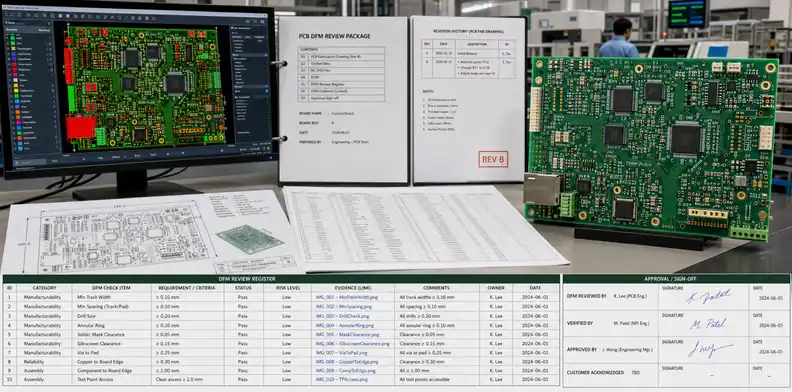
The register can be a spreadsheet, ticket system, or supplier portal. Its value comes from the fields and approvals, not the software. At minimum, include:
- DFM item ID and date raised
- affected part number, revision, and file
- supplier observation and requested decision
- risk category: product, reliability, evidence, cost, or schedule
- supplier recommendation with technical reason
- customer answer and approval owner
- cost and lead-time effect
- status and closure date
- reference to the final controlled file or deviation
Add a “build blocker” field. A red blocker prevents tooling or fabrication. An amber item can remain open only under a written, limited authorization. A green item is closed or demonstrably internal to the supplier. Color helps scanning, but the status text and owner remain the official record.
The register should also expose dependencies. A material change may require a new stackup; the new stackup may require impedance confirmation; that confirmation may change coupons and test documentation. Closing the first row without its dependent rows creates false confidence.
Attach evidence at the level needed for the decision. CAM screenshots should show scale, layer, feature, and requested dimension. A stackup proposal should include materials, dielectric thicknesses, copper weights, finished thickness, and impedance assumptions. A claimed tolerance conflict should cite the drawing value and the factory capability used for the quote. Buyers do not need a long report for every item, but approvers need enough context to understand what they are accepting.
Before the release meeting, sort the register by blocker, owner, and due date. Resolve contradictory answers and remove superseded screenshots from the active package. This short preparation step keeps the meeting focused on decisions rather than reconstructing the history of the email thread.
Before release, purchasing should reconcile the register with the quotation, and engineering should reconcile it with the released design package. Quality should confirm that acceptance evidence still tests what the approved design requires. That three-way check is more reliable than asking one person whether “DFM is done.”
Approve the order without losing control
Use a short release statement once the blocking items are closed. It should identify the part number and revision, accepted quote, DFM register revision, approved deviations, production quantity, and effective delivery commitment. Name the person issuing technical release.
Where minor items remain, list them individually and state why they do not block the build. Do not rely on “all other questions can follow.” The supplier should acknowledge the release and confirm that no unlisted exception remains.
A practical sequence is:
- Purchasing confirms the quote and PO match the controlled data.
- Engineering closes product and performance decisions.
- Quality confirms inspection, test, reports, and acceptance evidence.
- The supplier updates price and schedule effects.
- The designated owner issues technical release.
- Both sides archive the approved DFM register with the order.
For repeat orders, compare the new package with the last accepted baseline. A previous DFM approval does not automatically apply after a revision, material change, quantity change, or new supplier. Conversely, questions already incorporated into the controlled drawing should not be reopened as informal tribal knowledge.
QueenEMS can review the files, quotation, and open DFM list together before production authorization. Send the controlled package through the contact page and identify the decisions that are blocking your PO or build release.
FAQ
Must every PCB DFM comment be closed before issuing a PO?
No. A minor supplier-process comment can remain open when it cannot change the delivered product, price, acceptance evidence, or committed schedule. Product-changing or commercially material questions must be closed before fabrication, and any limited authorization should state exactly what work is permitted.
Who should approve a PCB DFM change?
The person who owns the affected requirement should approve it. Engineering owns product and performance changes; quality owns acceptance evidence; purchasing owns price and commercial terms. One coordinator may collect answers, but should not approve outside assigned authority.
Is an email answer enough for DFM approval?
Email can document a decision, but the final answer should be tied to a controlled file revision, deviation, or DFM register. The production team needs one unambiguous baseline rather than several messages that may conflict.
What happens when the supplier finds a DFM issue after release?
The supplier should stop the affected work, identify cost and schedule exposure, and raise a new controlled question. The buyer then approves a change, retains the original requirement, or cancels the affected authorization according to the purchase terms.
Can QueenEMS reserve material before DFM closure?
That depends on the material, exposure, and written authorization. A buyer may authorize a capped material commitment while prohibiting irreversible fabrication. The quotation or acknowledgment should state ownership, cancellation exposure, and what happens if engineering changes the requirement.
Sources
- Microboard supplier requirements: controlled data, stackup approval, and DFM expectations
- QueenEMS PCB DFM case study
Upload your files today · Free DFM check before production · Ship worldwide
Get your PCB prototypes in as fast as 24 hours. We handle FR4, Rogers, and Flex up to 60 layers — free prototypes for 2–4 layer boards, no minimum order.
Just upload your Gerber + BOM — we source every part, assemble, and inspect (AOI + X‑Ray) so you don't have to chase suppliers. Boards ship in as fast as 24 hours.