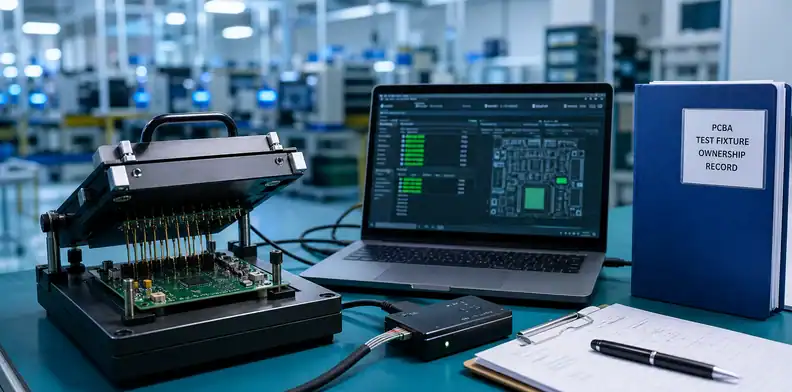
Quick Answer: Decision: test-fixture ownership record. Controlled object: asset register covering mechanics, interface hardware, golden units, programs, firmware loaders, documentation, and supplier-only equipment. Design-owned boundary: test coverage, acceptance limits, buyer-owned deliverables, reuse rights, data retention, and access to controlled source files. Supplier discretion: supplier maintenance changes that preserve validated coverage and remain documented under the fixture revision. Stop rule: production test beginning before acceptance, missing source or executable rights, or transfer language that excludes a required adapter.
A PCBA test fixture often starts as a practical solution: the product needs programming, functional test, ICT, boundary-scan access, or repeatable go/no-go evidence. The problem appears later when the buyer asks who owns the fixture and which files can be reused on the next lot.
Fixture ownership is not only a legal topic. It affects quotation, production release, repeat orders, repair, supplier transfer and field-quality investigations.
The buyer should settle the ownership boundary before paying NRE, approving the test plan, or releasing a larger build.
Table of Contents
- Name every fixture-related asset
- Separate fixture build from test acceptance
- Clarify firmware and software file rights
- Define storage, maintenance and reuse
- Decide transfer limits before supplier change
- Put fixture ownership into the quote package
- Set repair and calibration responsibility before NPI
Name every fixture-related asset
Ownership should cover more than the box with pogo pins.
List physical fixture, bed-of-nails plate, adapter cables, programming jig, power supplies, firmware-loader files, test scripts, golden unit, calibration notes and work instructions.
The design-for-test discussion in PCB design for test helps engineering decide whether the board exposes the access points a fixture needs.
A vague fixture line in the quote can hide different assets. Ask what will be built, what will be stored, what can be modified and what is supplier-internal.
Separate fixture build from test acceptance
A fixture can exist without a clear rule for passing, failing or holding production.
The fixture plan should state what it tests, what data it records, what limits define pass/fail and what happens when the result is marginal.
Use PCBA functional testing lifecycle to connect prototype validation, production test and shipment release.
Quality evidence should be proportional. A simple LED functional check and a calibrated measurement fixture should not carry the same documentation burden.
Clarify firmware and software file rights
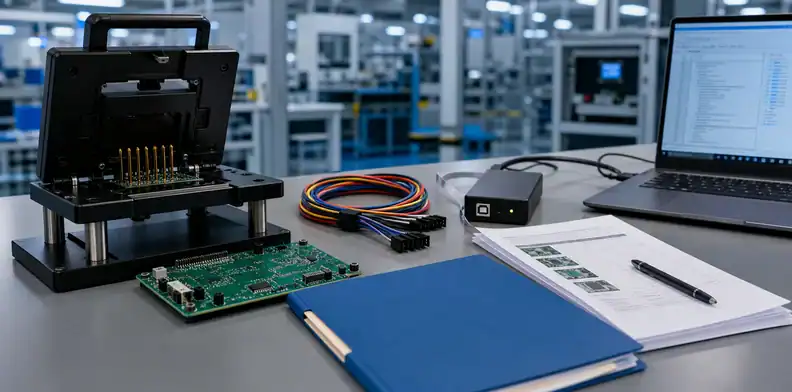
The most important fixture asset may be the test program or firmware-loading process rather than the hardware.
Some buyers provide firmware and the supplier only executes loading. Others ask the supplier to create scripts, adapters, or production programming flow.
The RFQ should say whether source files, compiled binaries, fixture scripts, logs, configuration files and operator instructions are buyer-provided, supplier-created, returned, or retained.
Security-sensitive firmware may need access control. The supplier can run the process, but engineering should decide what files are shared and how revisions are controlled.
Define storage, maintenance and reuse
Fixture reuse depends on condition, revision compatibility, calibration and storage responsibility.
Ask where the fixture will be stored, how long it will be retained, who pays for repair, and whether repeat orders require revalidation after idle time.
Connect the fixture record to PCB production release package so the approved test method travels with the build record.
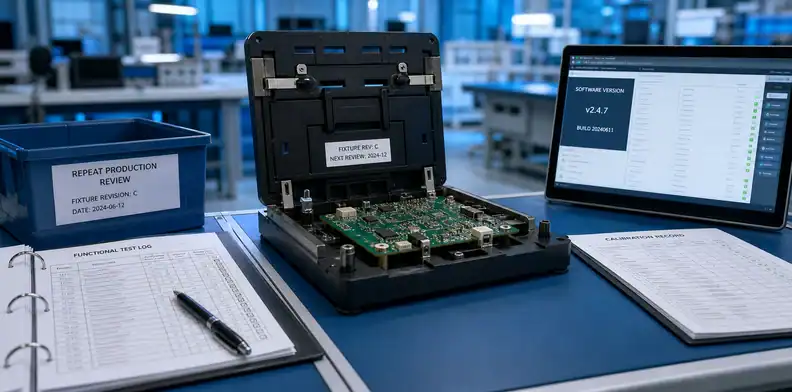
A repeat lot should not depend on memory. The supplier acknowledgement should identify fixture revision, software version and any retest or calibration requirement.
Decide transfer limits before supplier change
A paid fixture may not be portable unless the transfer package is defined.
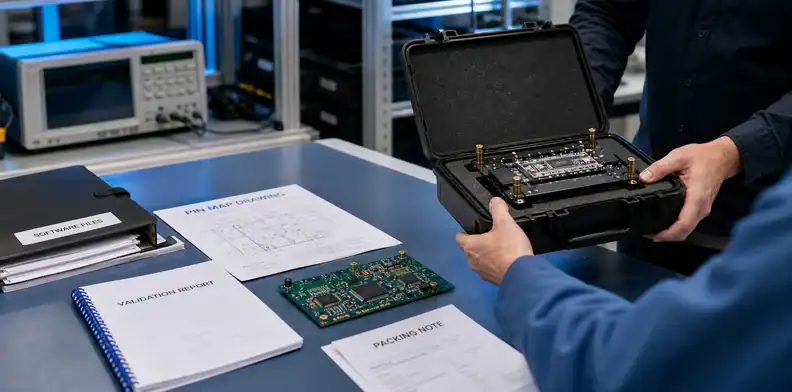
A physical fixture can be shipped to another site, but the receiving supplier may still need drawings, pin map, software, work instructions, fixture validation data and spare parts.
For qualification or second-source planning, PCB supplier qualification order helps define what evidence a new supplier must reproduce.
If transfer matters, the buyer should request file formats, return condition, packing method, transfer timing and responsibility for damage or revalidation.
Put fixture ownership into the quote package
The RFQ should turn fixture NRE into a named ownership, reuse and evidence record.
Send the assembly files, BOM, test requirement, firmware-loading needs, expected volumes, failure-disposition rule and any customer evidence requirement.
Use PCBA RFQ files to make sure fixture requirements are not separated from the assembly package.
QueenEMS can review PCBA projects where test fixture NRE, firmware files, programming flow or production evidence affect quotation and repeat builds. Send the fixture quote, test spec, firmware handoff rule and expected reorder path; we can help return a practical ownership and release record.
Practical order-stage examples
A prototype fixture may be enough for engineering bring-up but not stable enough for production acceptance. That difference should be priced and documented.
A buyer may pay for fixture NRE and still not receive source files, scripts or transfer rights. The RFQ should distinguish what is owned from what is used inside the supplier process.
A repeat order can fail if firmware version, fixture revision or calibration state is not preserved with the previous lot record.
For fixture-heavy assemblies, the buyer should also ask how failures found by the fixture will be recorded back into the production lot. A fixture that only flashes red or green is useful for sorting, but a lot-level failure record is more useful when engineering later reviews yield, repair, or customer-return risk.
How to judge the supplier reply
Set repair and calibration responsibility before NPI
Fixture ownership should also say who keeps the fixture usable after the first accepted lot. A buyer may own the hardware, but the supplier may still be responsible for storage, calibration records, wear-part replacement, wiring repair, software loading, and first-level debug.
This matters most when the project moves from NPI to repeat production. If the fixture fails during the second order, the buyer needs to know whether the delay is a supplier maintenance issue, a paid engineering change, or a customer-owned asset problem.
- Who stores the fixture and where it will be kept
- Which checks prove the fixture is still valid before reuse
- Who pays for repair after damage, wear, or ECO change
- What evidence comes back with the first production lot
Production record for the test-fixture ownership record
Controlled object
Controlled object: asset register covering mechanics, interface hardware, golden units, programs, firmware loaders, documentation, and supplier-only equipment.
Failure boundary
Failure boundary: paying NRE without transferable assets, losing test continuity, unclear pass limits, or paying again after a supplier change.
Design-owned conditions
Design-owned conditions: test coverage, acceptance limits, buyer-owned deliverables, reuse rights, data retention, and access to controlled source files.
Supplier discretion
Supplier discretion: supplier maintenance changes that preserve validated coverage and remain documented under the fixture revision.
Required proof
Required proof: fixture acceptance results, calibration status where applicable, program checksum, asset photographs, and a signed custody list.
Production stop
Production stop: production test beginning before acceptance, missing source or executable rights, or transfer language that excludes a required adapter.
Repeat-order baseline
Repeat-order baseline: fixture ID, asset list, software versions, calibration and repair history, storage location, and transfer condition.
RFQ inputs
RFQ inputs: test specification, DFT data, board and BOM revision, NRE quote, software deliverables, pass limits, volumes, and future sourcing plan.
FAQ
Can the supplier decide the test-fixture ownership record?
Discretion for test-fixture ownership record: supplier maintenance changes that preserve validated coverage and remain documented under the fixture revision. Engineering control for test-fixture ownership record: test coverage, acceptance limits, buyer-owned deliverables, reuse rights, data retention, and access to controlled source files.
What stops this test-fixture ownership record?
Stop rule for test-fixture ownership record: production test beginning before acceptance, missing source or executable rights, or transfer language that excludes a required adapter. Disposition owner for test-fixture ownership record: the named engineering approver.
Which proof closes the test-fixture ownership record?
Evidence for test-fixture ownership record: fixture acceptance results, calibration status where applicable, program checksum, asset photographs, and a signed custody list. Revision link for test-fixture ownership record: the quoted dataset.
What survives into the next order?
Reorder baseline for test-fixture ownership record: fixture ID, asset list, software versions, calibration and repair history, storage location, and transfer condition.
For a focused test-fixture ownership record, send QueenEMS test specification, DFT data, board and BOM revision, NRE quote, software deliverables, pass limits, volumes, and future sourcing plan. Redline request: test-fixture ownership record. Open assumptions: test-fixture ownership record. Approver: test-fixture ownership record owner.
Written by the QueenEMS Engineering Team
Sources
Upload your files today · Free DFM check before production · Ship worldwide
Get your PCB prototypes in as fast as 24 hours. We handle FR4, Rogers, and Flex up to 60 layers — free prototypes for 2–4 layer boards, no minimum order.
Just upload your Gerber + BOM — we source every part, assemble, and inspect (AOI + X‑Ray) so you don't have to chase suppliers. Boards ship in as fast as 24 hours.