
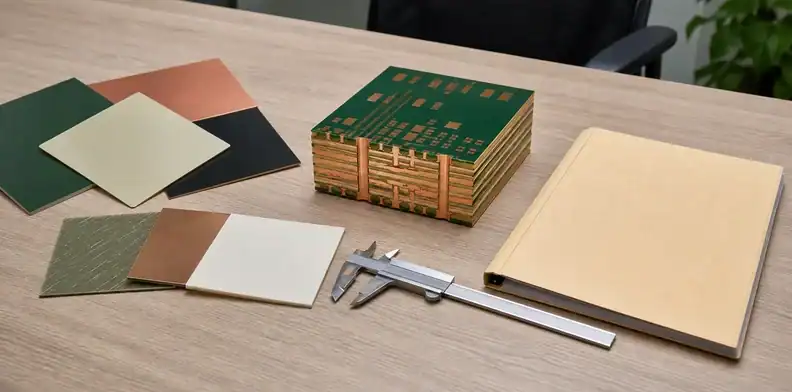
Quick Answer: Hybrid PCB material substitution should be approved only after the supplier states what changed, why it changed, and which electrical, thermal, lamination, UL, and delivery assumptions remain valid. The buyer should treat a mixed-material substitution as an engineering decision, not a purchasing note, because one alternate laminate can change impedance, loss, thickness, registration, and qualification evidence.
Key takeaways
- Separate supply-driven alternate proposals from engineering-approved equivalent materials.
- Ask whether the alternate changes Dk, Df, Tg, CTE, copper foil, bondply, thickness, and UL or customer flow-down status.
- Do not accept a cheaper or faster quote unless the supplier states what evidence will be repeated.
- Save the final approval with the stackup and PO so repeat orders do not drift.
A hybrid board often combines a low-loss RF or high-speed dielectric with FR4 support layers. That makes material substitution more sensitive than a simple laminate-brand change. The supplier may be trying to solve lead time or cost, but the buyer still needs to know whether the board will behave like the released design.
This page does not replace the general PCB material substitution approval article. It owns the mixed-material approval problem, where one alternate can affect impedance, lamination behavior, CTE stress, registration, edge launch geometry, and compliance paperwork. The useful output is a written approval record that states the accepted material set, the evidence repeated, and the condition that would stop production.
Table of Contents
- Define the substitution request
- Compare the electrical properties that drive function
- Check the lamination and reliability effect
- Separate equivalent from available
- Protect UL and customer flow-down requirements
- Decide what evidence must be repeated
- Put the approval rule into the quote
- Preserve the approved material set
Define the substitution request
The first useful question is what problem the supplier is trying to solve. A material change may be proposed because the original laminate is unavailable, lead time is too long, cost has changed, panel utilization is poor, or the supplier prefers a house material. Those reasons are commercial inputs, not automatic engineering approvals.
Ask the supplier to name the original material, proposed material, affected layers, affected bondply or prepreg, copper foil change, expected thickness change, and reason for the proposal. A sentence such as “equivalent material will be used” is not enough for a hybrid stackup because the buyer cannot see which dielectric group changed.
| Request field | Buyer use | Weak signal |
|---|---|---|
| Original and proposed material | Confirms the actual change | Equivalent with no grade |
| Affected layers | Shows whether RF or support layers changed | No layer map |
| Reason | Separates supply, cost, and process causes | Factory standard only |
| Evidence repeated | Shows release scope | No retest statement |
Approval rule: Do not review a hybrid material substitution until the changed layer, changed material, and reason are explicit.
Compare the electrical properties that drive function
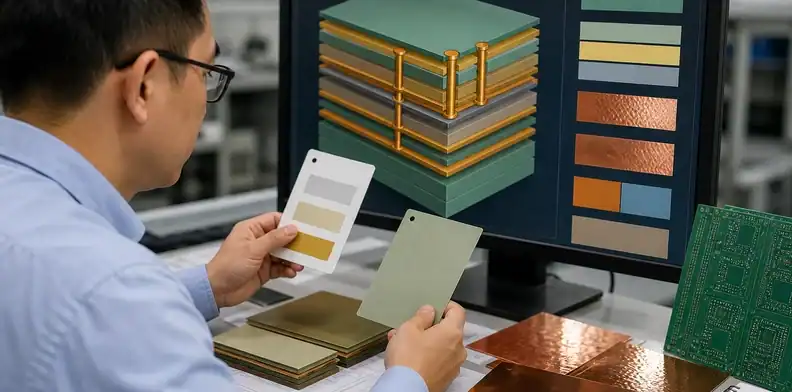
Electrical comparison should start with the properties the design actually uses. For RF and high-speed work, Dk, Df, copper roughness, dielectric thickness, resin or bond system, and frequency range may matter more than the material brand. The buyer does not need to run the model personally, but engineering should confirm whether the alternate keeps the controlled impedance or RF performance assumptions valid.
A supplier may offer a material that looks close on a datasheet but behaves differently in the final pressed board. Ask whether the stackup model, impedance calculation, and any coupon plan will be revised. If the material change affects top-layer microstrip, launch geometry, or a tightly controlled differential pair, the approval should return to design engineering before CAM release.
Use the signed stackup from supplier stackup signoff as the reference. The alternate should produce a new stackup revision or a documented no-impact decision.
Electrical call: Approve the alternate only after engineering knows whether the impedance or RF model changes.
The comparison should also state whether the change affects simulation margin. If the original stackup was already close to an impedance, insertion-loss, or phase-matching limit, a small material shift may deserve a larger review than the purchasing team expected. If the design has wide margin, the same change may be accepted with a lighter evidence package.
For a quote, ask the supplier to separate datasheet values from built-board assumptions. Datasheet Dk and Df are not the same as final pressed thickness, copper roughness, or fabrication compensation. The approval should state whether engineering accepted the data sheet alone or accepted a revised model and coupon plan.
Check the lamination and reliability effect
Mixed-material boards can also fail through process mismatch. A lower-cost or faster laminate may create different expansion, moisture behavior, resin flow, drill response, plasma treatment need, or press-cycle behavior. That effect may not appear in a simple price quote.
Ask whether the proposed material changes lamination recipe, press cycle, drill parameters, desmear or plasma treatment, hole-wall preparation, registration control, or thermal stress. If the answer is unclear, the substitution is not ready for production release. It may still be a good option, but it needs process evidence before the buyer accepts the risk.
This is where the boundary differs from the hybrid PCB lamination and CTE article. That page explains lamination risk; this page decides whether an alternate material can enter the released order.
Process signal: A material alternate that changes processing must carry a process-evidence answer, not only a datasheet comparison.
Separate equivalent from available
Available material is not the same as approved equivalent material. A supplier can have a good reason to offer a stocked grade, but the buyer still needs a controlled comparison. In a rush order, the commercial temptation is to accept the available material first and document the decision later. That creates trouble when receiving, customer audit, or a field issue asks which construction was approved.
Create three choices. Accepted equivalent means engineering agrees the alternate does not change product risk and the evidence scope is unchanged. Conditional alternate means the change is acceptable only with repeated coupon, microsection, RF, or first-article evidence. Rejected alternate means the supplier must quote the released material or return with a different proposal.
| Supplier proposal | Buyer decision | Record needed |
|---|---|---|
| Same laminate family and controlled properties | Possible equivalent | Engineering note and stackup revision |
| Different dielectric group | Conditional at best | Revised model and evidence |
| Stock material without data | Not approved | Supplier comparison required |
| Cost reduction only | Commercial input | Engineering review before use |
Buyer call: Treat availability as a schedule fact and equivalence as an engineering decision.
Protect UL and customer flow-down requirements
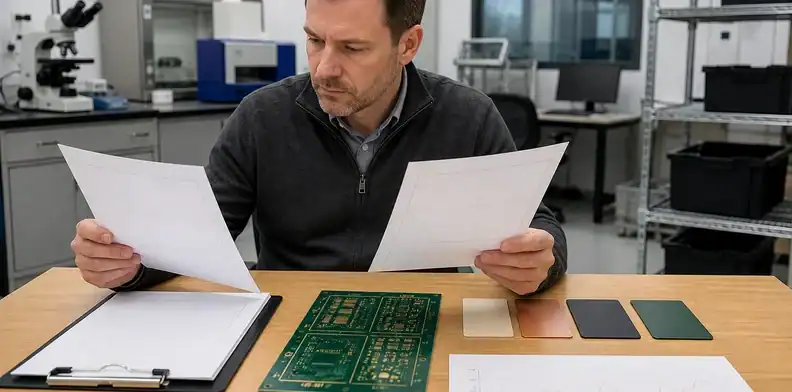
Some substitutions are blocked by compliance or customer requirements even when the electrical model looks acceptable. UL recognition, flammability, customer approved material lists, IPC slash-sheet references, automotive or medical flow-downs, and drawing notes can limit what the supplier may change.
Ask the supplier to identify whether the proposed material is covered by the same required compliance path for the finished board construction. Do not assume that a laminate brand or family name automatically carries through to the final PCB. The buyer should also check whether the customer’s drawing says “or equivalent” and who has authority to approve that equivalent.
Purchasing should keep this answer with the PO because it affects both incoming documentation and future supplier changes. A clean technical comparison can still be commercially unusable if it breaks a customer-mandated material callout.
Compliance check. A technically workable alternate is not release-ready if it breaks the drawing, customer list, or required safety file path.
The safest approval record should state whether compliance was checked, not simply assume that the alternate inherits the old answer. If the customer drawing names a material, the buyer should ask whether “or equivalent” is allowed and who signs that equivalence. If the board depends on a safety file, the supplier should state whether the finished construction remains inside the required path.
This also helps owners and founders who are not reading laminate datasheets. The commercial question is whether accepting the alternate creates a later customer or certification discussion. That decision should be visible before the PO is released.
Decide what evidence must be repeated
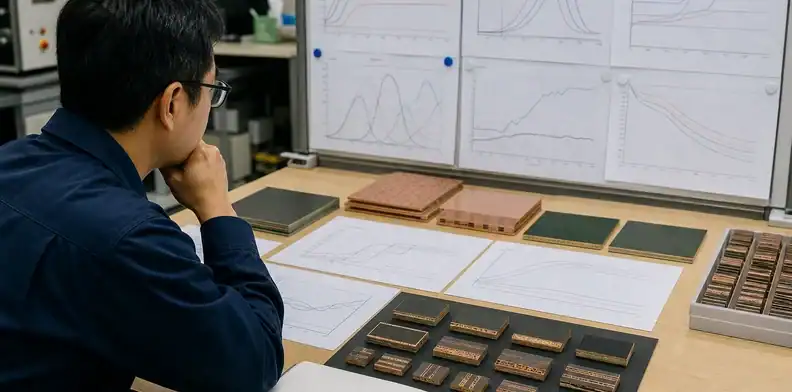
The evidence package should match the changed risk. A small support-layer material change might need a revised stackup and supplier declaration. A low-loss core change may need impedance modeling, coupon testing, RF review, or a new first article. A bonding system change may need lamination review, microsection, thermal exposure, or dimensional checks.
Define the retest before accepting the quote. If the quote does not include repeated evidence, the buyer may save money on the first line item and then lose time arguing over whether the supplier owed new proof. A clear scope also helps compare suppliers fairly.
| Change type | Likely evidence | Owner |
|---|---|---|
| Dielectric constant or thickness shift | Impedance model and coupon | Engineering |
| Bondply or resin system change | Lamination and microsection review | Process or quality |
| Copper foil change | Loss or impedance review if relevant | Engineering |
| Compliance material change | Documentation review | Quality and purchasing |
Evidence point: The substitution approval should say exactly which proof is repeated and which proof is intentionally not repeated.
Evidence does not need to be expensive to be useful. A short supplier comparison, revised stackup PDF, and impedance model may be enough for a low-risk support layer. A changed RF dielectric may need coupon evidence, first article review, or customer approval before the order moves forward. The key is to match evidence to the changed assumption.
Purchasing should also ask whether the evidence affects lead time. A material alternate that saves ten days on laminate delivery but adds a new first article hold may not be faster for the full project. Put that trade-off in the quote comparison instead of discovering it after the PO.
Put the approval rule into the quote
The quote request should require the supplier to state whether the released material set is being used. If an alternate is proposed, the reply should include the material comparison, affected layers, reason, evidence repeated, cost or lead-time effect, and required buyer approval.
A practical RFQ sentence is: “Quote the released hybrid stackup as specified; any material alternate must identify changed layers, original and proposed grade, electrical and process impact, repeated evidence, and buyer approval requirement before CAM release.” That wording prevents the supplier from treating a material change as an internal factory choice.
Connect the request to the hybrid PCB stackup drawing RFQ article when the drawing must carry the material table. The material decision should not live only in an email thread.
RFQ signal: The quote should make alternate material use visible before purchase, not after the shop starts fabrication.
The quote should also ask for a price and lead-time comparison between the released material and the proposed alternate. That lets the buyer decide whether the technical review is worth the commercial benefit. A small cost reduction may not justify a new evidence loop, while a real supply shortage may justify a controlled alternate with documented proof.
Preserve the approved material set
The final approval record should include the released stackup, the supplier alternate request, engineering disposition, evidence required, and buyer approval date. Save it with the PO and quality document package. For a repeat order, the buyer should ask whether the same material set and evidence level are being used.
Do not leave the record as a loose note in a chat. A later buyer may only see a lower price and miss the conditional approval that made the first order acceptable. Revision control protects both sides: the supplier knows what was approved, and the buyer knows when a new proposal must return to engineering.
Record rule. Repeat production should use the same approved material set or reopen the substitution approval before release.
A good record is short enough to reuse. It can say: original material, accepted alternate, affected layers, reason, evidence repeated, approval owner, and repeat-order trigger. That sentence gives a future buyer enough context to avoid reopening the same question or approving a different alternate by accident.
For supplier management, the record also reduces dispute risk. The supplier can see which alternate was approved and which was not. The buyer can see whether a future price or lead-time change is a new request or the same approved construction.
That record should travel with the project handoff if the buyer changes role or the program moves from prototype to production.
Sources
FAQ
Can purchasing approve a hybrid PCB material substitution alone?
No. Purchasing can approve price and schedule, but engineering should approve electrical and construction impact. Quality or compliance should review customer flow-downs and required documentation.
Is a same-family laminate always equivalent?
No. A same-family name can still hide changes in thickness, copper, loss, availability, or processing. Ask for the exact grade and affected layers.
What if the original material is unavailable?
Treat the alternate as a controlled deviation. Decide whether to wait, approve with repeated evidence, or redesign the stackup.
Should the supplier update the stackup drawing?
Yes when the accepted material set changes. The final stackup should show what will actually be built.
If your PCB or PCBA project has a mixed-material stackup, alternate laminate proposal, delivery pressure, or compliance flow-down, send QueenEMS the released stackup, material callout, supplier alternate, impedance needs, and approval notes through the contact page. QueenEMS can help turn the substitution into a quote-ready decision instead of an informal supplier promise.
Written by the QueenEMS Engineering Team
Upload your files today · Free DFM check before production · Ship worldwide
Get your PCB prototypes in as fast as 24 hours. We handle FR4, Rogers, and Flex up to 60 layers — free prototypes for 2–4 layer boards, no minimum order.
Just upload your Gerber + BOM — we source every part, assemble, and inspect (AOI + X‑Ray) so you don't have to chase suppliers. Boards ship in as fast as 24 hours.