

Quick Answer: Hybrid PCB via reliability depends on treating the complete plated-through-hole as a mixed-material interface, not as an ordinary FR4 drill. Before production, the buyer should confirm the drill structure, PTFE and epoxy hole-wall preparation, copper plating acceptance, microsection plan, and the thermal evidence tied to the released stackup.
Key takeaways
- PTFE and FR4 do not need the same hole-wall preparation, so the sequence must be reviewed before copper deposition.
- A generic statement such as “IPC compliant” does not identify which holes, coupons, cross-sections, or lot records will be reviewed.
- Microsections show construction and plating condition; thermal testing addresses whether the interconnect remains stable after repeated temperature exposure.
- The purchase order should preserve the accepted stackup, via type, inspection evidence, and deviation route for repeat lots.
A hybrid board may pass a bare-board electrical test even when its plated holes carry a process weakness that only appears after assembly heat or field cycling. That is why buyers searching for hybrid PCB via reliability need more than a capability chart. They need a release plan that connects the material interface to measurable evidence.
The risk is concentrated where one drilled hole crosses materials with different mechanical and chemical behavior. FR4 resin smear must be removed from interconnect surfaces. PTFE is chemically inert and needs suitable activation before metallization. Drill quality, surface preparation, copper continuity, and thermal strain therefore belong to one manufacturing decision.
This article stays within that decision boundary. It does not repeat the broader hybrid PCB lamination review or choose the full stackup. It explains what engineering, quality, and purchasing should request when the through-hole or via barrel is the reliability concern.
Table of Contents
- Find the via interfaces that carry the real risk
- Separate drilling from hole-wall preparation
- Define plating evidence before the quote is final
- Use microsections to answer construction questions
- Match thermal evidence to the order risk
- Turn supplier answers into a release decision
- Send a quote-ready via reliability package
Find the via interfaces that carry the real risk
The first review should map every plated hole to the materials and copper layers it crosses. A through-hole that passes from an outer PTFE RF layer through FR4 cores and bonding layers has a different process burden from a blind via formed only in an epoxy build-up layer. Calling both of them “0.25 mm vias” hides the part of the construction that drives preparation and inspection.
Mark the holes that connect RF layers, carry current, sit beside edge launches, enter via-in-pad structures, or cross more than one material family. Also identify nonfunctional pads, backdrill intent, filled or capped vias, and any holes that the fabricator may resize during CAM. The review is about the manufactured interconnect, not just the CAD drill diameter.
The material map should answer four questions: where does the drill enter, which resin or PTFE surfaces are exposed, which inner-layer lands must connect, and what finished hole size remains after plating. A mixed-material via can be electrically simple while still being difficult to prepare consistently.
| Via condition | Main manufacturing concern | Buyer record |
|---|---|---|
| PTH crosses PTFE and FR4 | Different smear and activation response | Stackup section plus hole callout |
| Blind via ends on an RF layer | Landing accuracy and local surface preparation | Layer span and target land |
| Filled via-in-pad | Fill, cap, planarity, and plating sequence | Fill type and acceptance note |
| Backdrilled PTH | Residual stub and remaining barrel integrity | Backdrill depth and inspection method |
Risk signal: A supplier answer is incomplete when it confirms only finished diameter but cannot state which material interfaces the hole crosses or how those interfaces affect the process route.
Separate drilling from hole-wall preparation
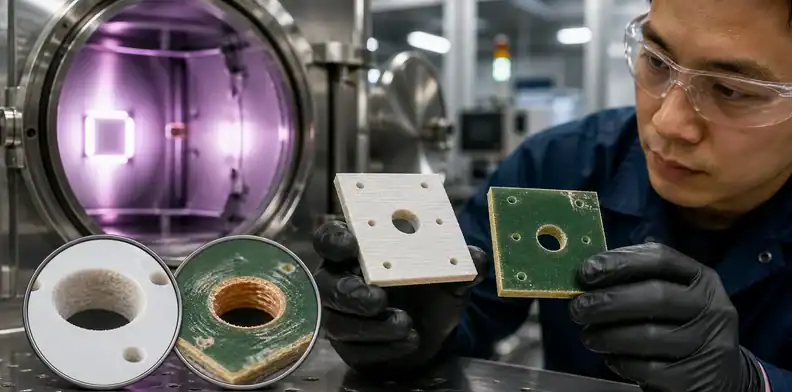
Drilling creates the geometry; hole-wall preparation creates a surface that can be metallized. Buyers should keep those two operations separate in the RFQ because a clean-looking entry hole does not prove that exposed inner-layer copper and dielectric surfaces are ready for plating.
Standard FR4 workflows commonly address epoxy smear after drilling. PTFE-based laminates require a treatment that changes the otherwise low-energy surface so metallization can wet and adhere. IPC technical material on high-frequency laminates describes performing the preparation for the other circuit materials first and then the PTFE preparation for a hybrid build. The exact factory recipe remains process know-how, but the sequence and evidence should not be left ambiguous.
Drill parameters also matter. PTFE-rich materials can react differently to heat and mechanical loading than glass-reinforced epoxy. Ceramic-filled RF laminates may be more abrasive. A fabricator may change tool type, hit count, feed, speed, entry material, or drill direction to control smear, debris, and wall roughness. Purchasing does not need those machine settings in the PO, but engineering should ask whether the proposed hole sizes and stack thickness are inside the supplier’s proven window.
For a deeper construction record, use the PCB microsection report requirements page to define which images and measurements must accompany the lot.
Process rule: Approve the hole only after the fabricator has reviewed both the drill geometry and the preparation sequence for every exposed material family.
Define plating evidence before the quote is final
Electroless deposition establishes the conductive seed layer, while subsequent copper plating builds the barrel. The buyer’s acceptance language should focus on the finished result: continuous coverage, acceptable connection to inner-layer lands, no disallowed voids or cracks, and a measured construction that matches the invoked specification and drawing.
Avoid writing a universal copper number into a new RFQ without checking the governing class, via type, finished diameter, and customer requirement. IPC released IPC-6012F as a performance specification for rigid boards that includes plated-through holes, buried and blind vias, microvias, hole registration, internal plated layers, dielectric spacing, and microsection evaluation. The purchase package should name the applicable document and revision rather than copying an isolated value from an online capability page.
Ask the supplier how the production coupon represents the selected hole. The coupon should use a relevant layer span, drill structure, and plating process. A generic coupon from a different panel technology cannot prove the condition of a critical hybrid via. When a board contains several risk groups, the quality plan may need more than one cross-section location.
| Evidence item | What it can answer | What it cannot prove alone |
|---|---|---|
| Electrical test | Opens and shorts at test time | Long-term barrel stability |
| Copper thickness measurement | Local deposited copper amount | Every interface across the panel |
| Microsection image | Wall, land, dielectric, and plating condition | Future thermal life by itself |
| Process traveler or lot record | Which route and lot were used | Conformance without measured results |
Evidence check: Do not accept “electrical test passed” as the only proof when the purchase risk is copper adhesion or barrel survival through thermal exposure.
Use microsections to answer construction questions
A useful microsection is a decision record, not a decorative microscope photo. It should identify the part number, revision, lot or panel reference, coupon or board location, magnification or scale, section orientation, and the characteristics being judged. The report should let a reviewer connect the image to the released hybrid stackup.
For mixed PTFE/FR4 holes, the reviewer looks for clean contact at inner-layer connections, continuous copper, acceptable wall condition, and evidence that the preparation route did not damage one material while treating the other. The exact acceptance criteria come from the drawing and invoked specification. A buyer should not infer pass or fail from color, polish marks, or one cropped image without the measurement context.
Microsection sampling is also a commercial choice. More locations and more coupons add inspection work and may affect panel use or lead time. The right request is proportional to the risk: a first build with a new material pairing deserves a stronger evidence plan than a stable repeat lot with controlled history.
Link the report to PCB lot traceability so the image, material batch, traveler, and shipment can be reconciled later. That connection matters when a failure review begins months after receiving.
Record rule: A microsection becomes useful when it identifies what was cut, where it came from, what was measured, and which released requirement was used for the disposition.

Match thermal evidence to the order risk
Thermal evidence addresses a different question from a room-temperature cross-section: will the plated interconnect remain stable after the heat exposure defined for the product? Assembly reflow, rework, operating cycles, storage, and qualification can place different loads on the barrel. The RFQ should state which exposure is relevant instead of asking vaguely for a “thermal test.”
For an initial hybrid construction, engineering may request a documented thermal stress, cycling method, resistance monitoring method, or another qualification agreed with the fabricator and end customer. The choice depends on application risk and the governing procurement specification. Do not convert one laboratory method into a universal requirement for every commercial RF board.
The test vehicle also matters. A coupon with representative hole size, layer span, copper structure, and material interfaces provides more useful evidence than a convenient coupon that omits the difficult transition. Results should be tied to the same construction being ordered, including approved changes made during CAM.
Existing HDI work may need a different plan. The HDI microvia thermal cycling qualification article focuses on stacked or staggered microvia structures; this page focuses on a mixed-material plated-hole route. A board containing both risk types should control both rather than assuming one test covers everything.
Decision point: Request thermal evidence when the consequence of a latent interconnect failure justifies it, and make the coupon represent the actual hybrid hole rather than a simpler surrogate.
Turn supplier answers into a release decision
The quote review should translate process statements into buyer decisions. “We have plasma” describes equipment. “We will use the approved hybrid route for the listed PTFE/FR4 construction and provide the agreed cross-section report” describes an order commitment. The second statement is easier for engineering, quality, and purchasing to approve.
Use a short response matrix so suppliers answer the same points. This reduces the chance that one quote includes microsection and thermal evidence while another appears cheaper because those items were never priced.
| RFQ question | Acceptable answer pattern | Hold condition |
|---|---|---|
| Is the exact stackup reviewed? | Named drawing revision and material set | Generic hybrid capability only |
| Is the via structure buildable? | Layer span, drill class, finished hole, CAM notes | Diameter confirmed without layer path |
| How are mixed walls prepared? | Sequence confirmed for epoxy and PTFE surfaces | Standard FR4 process assumed silently |
| What evidence ships? | Named report, coupon, sampling, and lot link | “Quality report available” |
| What change needs approval? | Material, hole, plating, or evidence deviation route | Supplier may change without notice |
At QueenEMS, a practical review separates the supplier’s protected process recipe from the buyer’s right to measurable conformance. We usually ask for the build assumption, the evidence output, and the hold point—not confidential machine parameters. That approach keeps the RFQ usable without pretending that every factory must run the same chemistry.
Release call: Approve the order when the supplier’s answer names the released construction, the evidence to be delivered, and the changes that must return to the buyer.

Send a quote-ready via reliability package
The final package should let the fabricator evaluate the hole before the quote is locked. Send the Gerber or ODB++ data, fabrication drawing, controlled stackup, drill and rout files, via table, finished board and hole tolerances, material callouts, surface finish, quantity, assembly heat exposure, applicable specifications, and required reports.
Highlight the few holes that control the risk. Identify the layer span, connection function, fill or cap requirement, backdrill condition, and whether the supplier may propose a different pad or finished diameter. When all vias are treated as equally critical, the supplier may overquote the job or overlook the one transition that needs special review.
State who can approve a change. A drill compensation that preserves the released finished hole may be normal CAM work; a different material, layer span, pad geometry, plating requirement, or reduced evidence package needs engineering or quality review. Keep the approved answer with the supplier stackup signoff and purchase record.
A clean RFQ note can read: “Review the listed PTFE/FR4 vias against the attached stackup. Confirm the proposed drill and hole-wall preparation route is suitable for the exposed materials. Quote the specified microsection and thermal evidence, identify the representative coupon, and hold for approval before changing the via structure, material set, or evidence scope.”
The result is a package that purchasing can compare, engineering can defend, and quality can inspect at receiving. It turns a broad reliability concern into specific deliverables without dictating an unsupported process recipe.
FAQ
Can a hybrid PCB pass electrical test and still have a weak via?
Yes. Electrical test checks continuity and isolation at the time of test. It does not by itself demonstrate copper adhesion, barrel condition after thermal exposure, or the long-term stability of a mixed-material interface.
Does every PTFE/FR4 board need thermal cycling data?
No. The evidence should match application risk, customer requirements, build novelty, and prior production history. A prototype may use targeted microsection and assembly validation, while a high-reliability program may invoke a documented qualification plan.
What should a hybrid via microsection report identify?
It should identify the part and revision, lot or panel, coupon or board location, section orientation, scale, measured characteristics, governing acceptance requirement, and disposition. Images without traceability are weak receiving evidence.
Should the buyer specify the plasma chemistry?
Usually no. The supplier controls the validated process recipe. The buyer should define the material construction, finished requirements, evidence, and approval boundary, then require the supplier to confirm that its route supports them.
Discuss a hybrid via reliability RFQ with QueenEMS
If your PCB or PCBA project uses PTFE, Rogers, another low-loss laminate, and FR4 in one construction, send QueenEMS the released files, stackup, via table, quantities, assembly profile, and required quality evidence through the contact page. We can review the mixed-material hole boundary, identify open fabrication questions, and return a quote that states the build assumptions and evidence scope before production begins.
Sources
Written by the QueenEMS Engineering Team
Upload your files today · Free DFM check before production · Ship worldwide
Get your PCB prototypes in as fast as 24 hours. We handle FR4, Rogers, and Flex up to 60 layers — free prototypes for 2–4 layer boards, no minimum order.
Just upload your Gerber + BOM — we source every part, assemble, and inspect (AOI + X‑Ray) so you don't have to chase suppliers. Boards ship in as fast as 24 hours.