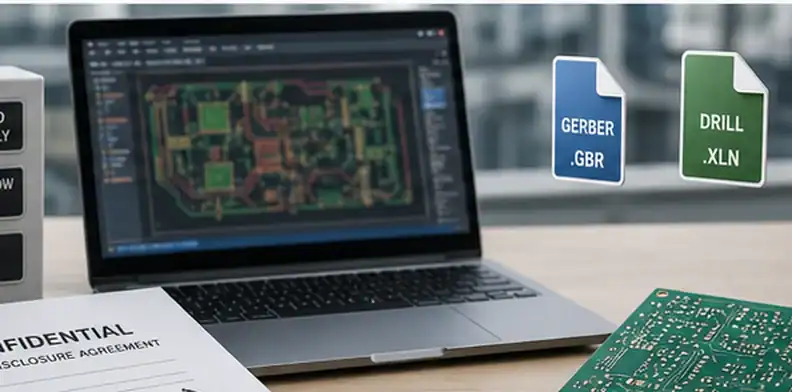
Quick Answer: PCB design IP protection is a layered process: use the right legal agreement, share only the manufacturing data needed for each stage, control file access, and qualify the supplier before releasing a full production package. For most PCB and PCBA projects, the practical checklist has 8 parts: NDA/NNN terms, file segmentation, controlled revisions, secure transfer, supplier due diligence, component and firmware boundaries, audit evidence, and a clear exit plan.
Key takeaways – An NDA helps, but it is not enough by itself when design files leave your company. – Gerbers, ODB++, IPC-2581, BOM, CPL, test fixtures, and firmware do not carry the same IP risk. – Early RFQ files can often be simplified before full CAM, sourcing, or assembly release. – Treat overseas manufacturing as a controlled data workflow, not just a price comparison.
Outsourcing PCB fabrication or PCBA to an overseas manufacturer can reduce cost and improve build flexibility, but it also forces a hard question: what exactly are you giving away when you send the design package?
The answer is rarely “everything” or “nothing.” A bare PCB fabricator needs enough geometry to build copper, solder mask, drill, stack-up, finish, and outline correctly. A turnkey PCBA supplier may also need BOM, placement data, approved alternates, test instructions, and sometimes programming details. Each file type has a different business value and a different disclosure risk.
This guide explains how engineers, founders, and purchasing teams can structure PCB design IP protection before using an overseas manufacturer. It focuses on practical controls that fit a real quotation and production workflow, not fear-based advice that makes manufacturing impossible.
Table of Contents
- What Does PCB Design IP Protection Actually Protect?
- Which Files Create the Most IP Risk?
- Is an NDA Enough Before Sharing PCB Files?
- How Should You Split RFQ and Production Data?
- What Can You Remove From Early Gerber Packages?
- How Do BOM, Firmware, and Test Files Change Risk?
- How Should You Qualify an Overseas Manufacturer?
- What Security Evidence Should You Ask For?
- When Should You Keep Some Work Domestic?
- What Should You Send QueenEMS for a Safer Review?
What Does PCB Design IP Protection Actually Protect?
PCB design IP protection protects the confidential information that gives your hardware product commercial value, not only the board outline or copper artwork. In a PCB project, that may include layout strategy, stack-up, component choices, firmware, test methods, sourcing rules, performance limits, and the manufacturing route.
Start by separating legal IP categories from manufacturing files. A patent, trademark, copyright, trade secret, and confidential manufacturing package are not the same thing. WIPO describes trade secrets as IP rights in confidential information, and USPTO guidance emphasizes that trade secrets depend on information remaining secret and being protected by reasonable measures.
For a hardware buyer, the practical question is: which parts of the design would damage your business if copied, leaked, reused, or shown to another customer? That answer determines what you can share during RFQ, what must wait until supplier approval, and what should never be sent to a general PCB quotation inbox.
Use a simple classification:
| Information type | Example | Typical risk |
|---|---|---|
| Board geometry | Gerbers, drill files, stack-up | Reveals routing, layer structure, dimensions, and special processes |
| Assembly data | BOM, CPL, drawings | Reveals component choices, suppliers, cost drivers, and product function |
| Functional logic | firmware, test scripts, calibration data | Reveals product behavior and validation method |
| Commercial data | target volumes, launch timing, customer market | Reveals market strategy and bargaining position |
The safest workflow does not hide everything. It gives the manufacturer enough controlled information to answer the right question at the right stage.
Which Files Create the Most IP Risk?
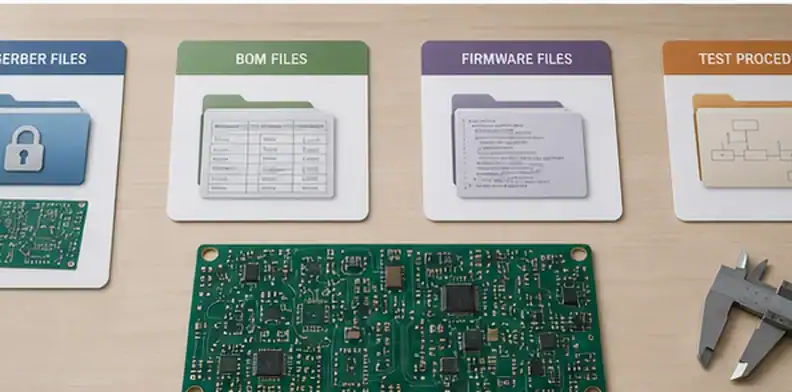
The highest-risk files are usually the ones that explain function, sourcing, or proprietary behavior, not the ones that only describe copper images. Gerbers matter, but BOM, firmware, source design files, test procedures, and calibration data often reveal more about the product.
For bare board fabrication, the manufacturer normally needs fabrication outputs such as Gerber or ODB++ data, drill files, a stack-up or material requirement, fabrication drawing, surface finish, impedance requirements, and quality notes. The PCB fabrication quote files guide covers that file set in detail.
For PCBA, the risk expands. A complete assembly package may include BOM, centroid/CPL, assembly drawing, polarity notes, approved vendor list, substitution rules, test method, programming files, and packaging instructions. The PCB assembly RFQ checklist should own those assembly quotation details.
Do not treat every file as equally sensitive. A zip file that only proves board manufacturability may be acceptable for early screening. A full package containing schematics, native CAD, firmware, BOM pricing assumptions, and production test scripts deserves a tighter release process.
Is an NDA Enough Before Sharing PCB Files?
No. An NDA is important, but it is only one layer of PCB design IP protection. It creates a confidentiality obligation, but it does not decide which files should be shared, who can access them, how subcontractors are controlled, or what evidence proves the supplier followed the process.
Ask counsel to review the agreement before you rely on it. For overseas manufacturing, buyers often discuss NDA, non-use, non-circumvention, ownership, subcontractor disclosure, data handling, jurisdiction, dispute process, and return or destruction of files. The exact structure depends on your company, country, product, and risk tolerance.
From a manufacturing perspective, the agreement should connect to file handling. If the contract says the supplier must protect confidential information, the RFQ package should mark which files are confidential, who may open them, whether subcontractors may receive them, and which files are prohibited from reuse.
The buyer should also avoid a false sense of safety. A signed document does not prevent accidental exposure through email forwarding, shared cloud folders, public support tickets, or uncontrolled quoting portals. That is why the legal layer and the data workflow must match.
How Should You Split RFQ and Production Data?
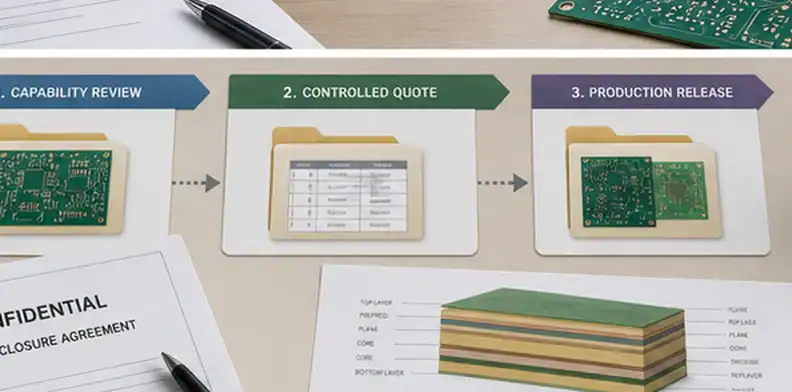
Split the project into at least 3 release stages: preliminary capability review, controlled quotation, and production release. Each stage should answer a different question and receive only the data needed for that question.
| Stage | Supplier question | Suggested file boundary |
|---|---|---|
| Capability review | Can this board fit the process route? | board specs, sanitized stack-up, critical features, sample Gerber excerpt if needed |
| Controlled quotation | What is the realistic price, lead time, and open issue list? | controlled fabrication package, revision, quantity, finish, impedance, test scope |
| Production release | What exact revision is authorized to build? | full approved file set, PO revision, quality requirements, approved changes |
This split reduces risk and improves quotation quality. It also prevents a common problem: a buyer sends a complete package to 10 suppliers, receives 10 quick prices, and later realizes that several suppliers never checked the hardest features.
For board-level process screening, link the first stage to a PCB manufacturer capability check. For supplier trust and commercial qualification, keep the broader decision in the PCB manufacturer selection guide.
A production quote still requires controlled data. The goal is not to starve the supplier of information. The goal is to release information in the order that matches the decision.
What Can You Remove From Early Gerber Packages?
For early screening, you can often remove or reduce information that is not needed to judge manufacturability. Keep the geometry and construction data required for the supplier to evaluate process fit, but avoid sending unnecessary product context.
Common early-stage reductions include:
- removing customer names, product names, and market labels from silkscreen;
- using project codes instead of commercial product names;
- withholding schematics and native CAD unless they are needed;
- replacing BOM detail with assembly-risk categories when only fab is being screened;
- redacting firmware, calibration, and programming instructions;
- sharing only critical stack-up and impedance requirements before the final revision;
- sending selected screenshots or design summaries for a first capability discussion.
Be careful with over-redaction. A PCB fabricator cannot quote controlled impedance, drill span, surface finish, special plating, material, or routing constraints from vague screenshots. If the data is too thin, the price becomes a placeholder, not a buildable quote.
Ucamco’s Gerber documentation and Gerber Job File work show why structured fabrication data matters: the manufacturer needs layer function, drill, and job-level intent, not random copper images without context. IPC-2581 is another intelligent data format that can carry a broader product model, which can be helpful for accuracy but may also reveal more information than a minimal Gerber package.
Your safest early package is not the smallest file set. It is the smallest file set that still answers the manufacturing question honestly.
How Do BOM, Firmware, and Test Files Change Risk?
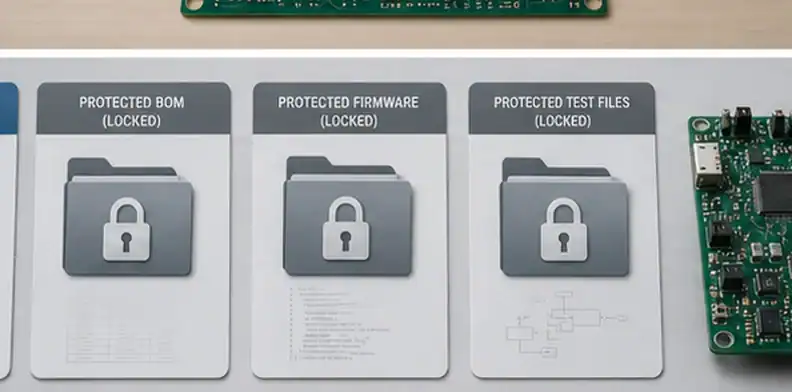
BOM, firmware, and test files usually raise the IP risk because they explain what the board does and how the product is validated. This is where PCB design IP protection must expand from fabrication control to assembly and product control.
A BOM can reveal key IC choices, RF modules, sensors, security chips, power architecture, approved suppliers, shortage strategy, and cost structure. A CPL file shows exact placement and rotation. Firmware or programming files may expose product behavior, communication protocols, security assumptions, calibration flow, or licensing logic.
Use a tiered release:
| Data | Early RFQ | Controlled quote | Production release |
|---|---|---|---|
| BOM | high-level risk summary or partial BOM | controlled BOM with alternates | approved BOM revision |
| CPL | usually not needed for bare PCB | needed for PCBA quotation | locked placement revision |
| Firmware | avoid unless required for test | define programming need without source | encrypted or controlled binary if needed |
| Test procedure | describe coverage | define fixture and acceptance scope | locked procedure and revision |
If the assembly project includes expensive or sensitive components, review turnkey PCB assembly vs consigned assembly before release. Consigning critical parts, programming secure ICs after receipt, or separating final firmware loading can sometimes reduce exposure, though it may add handling and test complexity.
Do not design security only around secrecy. If the product depends on firmware keys, anti-cloning measures, secure elements, or authenticated boot, those controls should be designed into the product architecture before manufacturing.
How Should You Qualify an Overseas Manufacturer?
Qualify an overseas manufacturer by checking process fit, quality evidence, communication discipline, data handling, and subcontractor boundaries before sending the full package. A low price is not a security control.
For PCB fabrication, ask who will review CAM data, who controls material substitution, whether outside processes are used, how revisions are marked, and what data is retained after quotation. For PCBA, ask who sees BOM and CPL files, whether sourcing data is shared with distributors, whether programming is internal or outsourced, and how rejected lots are documented.
Useful due-diligence questions include:
- Who has access to customer design data?
- Are quotation, CAM, procurement, production, and quality files stored in controlled systems?
- Can subcontractors receive files, and how is that approved?
- How are obsolete revisions removed from production?
- Can the supplier sign your NDA or use a mutually reviewed agreement?
- What happens to files if the project is canceled?
- How are photos, videos, and factory visitors controlled?
- Can you get quality records without exposing extra design data?
This is also where geography matters. A US, Canada, or Mexico buyer may choose an overseas manufacturer for cost, material access, or scaling, but keep a domestic partner for restricted programs, government-related work, final programming, or market-sensitive launch units.
If you are evaluating several suppliers, use the remote PCB assembly quality evaluation guide for evidence collection without turning every inquiry into a factory tour.
What Security Evidence Should You Ask For?
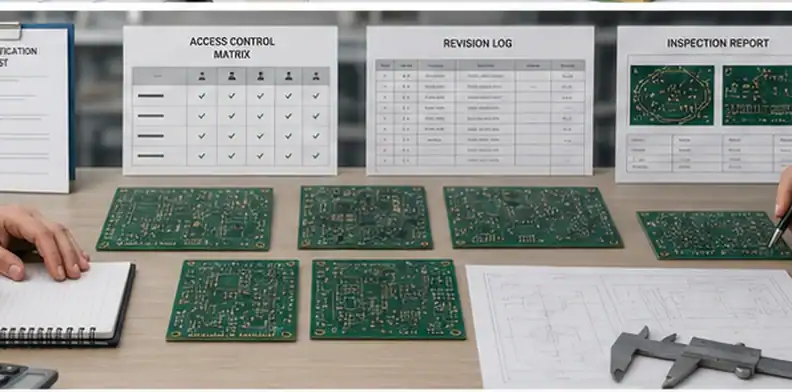
Ask for evidence that matches the risk level of the files you are releasing. A supplier’s statement that “we protect IP” is useful only when it connects to actual controls: access, revision, storage, subcontractors, communication, and disposal.
Evidence can include:
| Control area | Evidence to request |
|---|---|
| Access control | named project contacts, role-based file access, restricted folders |
| Revision control | revision log, obsolete-file removal process, quote revision trace |
| Transfer control | secure upload path, file retention rule, no public links |
| Subcontracting | written approval before outside process sharing |
| Quality records | inspection reports tied to revision, lot, and PO |
| Data disposal | return, deletion, or archival rule after project close |
For sensitive or regulated projects, use stronger information-security requirements. NIST SP 800-171 is written for controlled unclassified information in nonfederal systems; not every commercial PCB project needs it, but its access-control and confidentiality framing is useful when customers require formal data safeguards.
IPC also has intellectual-property protection standards for printed board and electronics manufacturing contexts, including IPC-1071 and IPC-1072. You do not need to turn a normal prototype into a standards audit, but those standards show that PCB data protection is a recognized manufacturing issue, not just a founder worry.
Record the supplier’s answer in the RFQ package. If the project later moves to production, the data-handling expectation should travel with the purchase order and revision release.
When Should You Keep Some Work Domestic?
Keep some work domestic or in a tighter supply chain when the business loss from exposure is higher than the savings from full overseas release. This can apply to defense-related work, controlled data, medical or safety-sensitive devices, unreleased consumer products, proprietary RF designs, security hardware, or products where firmware and calibration define the value.
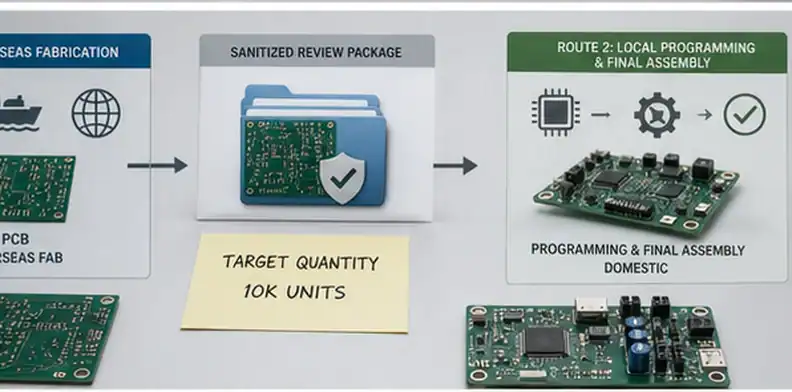
Common hybrid models include:
- overseas bare PCB fabrication with domestic final assembly;
- overseas PCB and generic SMT, with final sensitive ICs installed locally;
- offshore prototype builds after a domestic DFM and IP review;
- overseas volume production after firmware locking and secure programming are ready;
- separate suppliers for PCB fabrication, component sourcing, and final programming;
- limited pilot builds before release of full production volume.
Hybrid sourcing is not automatically safer. More suppliers can mean more file transfers, more handoffs, and more revision risk. The point is to decide which party needs which data and when.
For location decisions, the China vs USA PCB assembly comparison and the PCB manufacturing China vs USA cost comparison can help separate landed cost, compliance, quality evidence, and IP concerns.
The safest answer is sometimes simple: do not send an overseas supplier the file they do not need. The second-safest answer is to make every shared file traceable to one project, one revision, and one approved purpose.
What Should You Send QueenEMS for a Safer Review?
Send QueenEMS a staged review package that states your manufacturing goal and your confidentiality boundary. This lets the engineering review focus on manufacturability and quote readiness without asking for sensitive files too early.
For an initial PCB fabrication review, send:
- project code and product stage;
- board dimensions, layer count, thickness, copper, finish, and quantity;
- stack-up or impedance targets if applicable;
- special holes, vias, slots, edge plating, castellations, or gold fingers;
- target destination country and lead-time expectation;
- a sanitized Gerber package or critical feature summary;
- your NDA or confidentiality requirement if needed.
For a PCBA review, add only the assembly details needed for the decision: BOM risk category, sourcing model, placement complexity, package types, test scope, programming requirement, and any files that can be safely released at that stage. If the project requires full production quotation, the final controlled package can be released after the confidentiality and revision rules are aligned.
QueenEMS can then separate 3 questions: whether the board looks technically buildable, which files are still missing for quotation, and which information should wait until a tighter production release. That is the point where IP protection and manufacturing practicality meet.
If you want a manufacturing review before releasing the full package, send the sanitized board summary, controlled file list, target quantity, and confidentiality requirement through the QueenEMS contact page. QueenEMS can help define what is enough for a useful quote and what should remain protected until production release.
FAQ
Can I get a PCB quote without sharing all my IP?
Yes, for an early estimate or capability screen you can often share a sanitized specification summary, stack-up targets, critical features, quantity, and limited manufacturing data. A production-ready quote still needs controlled fabrication files and approved assumptions.
Should I send native CAD files to a PCB manufacturer?
No, not by default. Most PCB fabricators can work from Gerber, drill, ODB++, IPC-2581, drawings, and stack-up information. Native CAD files may expose extra design intent and should be shared only when there is a clear reason.
Is a China manufacturer always risky for PCB IP?
No. Risk depends on the supplier, contract, data workflow, product sensitivity, subcontracting, and what files you release. A disciplined overseas supplier with controlled file handling can be safer than an informal low-cost workflow anywhere.
Can I hide the function of my PCB from the manufacturer?
Sometimes you can reduce product context, remove labels, use project codes, withhold schematics, and separate firmware or sensitive parts. But the manufacturer still needs enough board data to build and inspect the product correctly.
What is the safest file-sharing method for PCB projects?
Use a controlled upload path with named recipients, revision labels, access limits, and retention rules. Avoid public links, uncontrolled email forwarding, and mixed folders where obsolete and current files sit together.
Sources
- WIPO: Trade Secrets, https://www.wipo.int/en/web/trade-secrets
- WIPO: How to Protect Trade Secrets, https://www.wipo.int/en/web/trade-secrets/protection
- USPTO: Trade Secret Policy, https://www.uspto.gov/ip-policy/trade-secret-policy
- USPTO: Trade Secret Intellectual Property Toolkit, https://www.uspto.gov/sites/default/files/documents/tradesecretsiptoolkit.pdf
- NIST SP 800-171 Rev. 3, https://csrc.nist.gov/pubs/sp/800/171/r3/final
- IPC-1072 product page, https://shop.electronics.org/ipc-1072/ipc-1072-standard-only/Revision-0/english
- Ucamco Gerber Job File, https://www.ucamco.com/en/gerber/gerber-job-file
- IPC-2581 Revision C announcement, https://www.ipc.org/news-release/ipc-releases-ipc-2581-revision-c-generic-requirements-printed-board-assembly-products
Written by the QueenEMS Engineering Team
Upload your files today · Free DFM check before production · Ship worldwide
Get your PCB prototypes in as fast as 24 hours. We handle FR4, Rogers, and Flex up to 60 layers — free prototypes for 2–4 layer boards, no minimum order.
Just upload your Gerber + BOM — we source every part, assemble, and inspect (AOI + X‑Ray) so you don't have to chase suppliers. Boards ship in as fast as 24 hours.