Quick Answer: PCB manufacturing China vs USA costs show a massive gap, with offshore boards priced between $0.50 and $2.00 per unit for standard 4-layer designs at volume, while domestic factories charge $4.00 to $12.00+ for exact matches. Tariffs reaching 145% to 170% will heavily impact these numbers, but Section 301 exemptions extended to November 2026 mean offshore production remains the most budget-friendly route right now. Key takeaways:
- Setup and NRE fees at US shops average $150–$300, hitting prototype orders the hardest.
- Section 301 tariff exemptions delay the 145% (2/4-layer) and 170% (6+ layer) hikes until November 10, 2026.
- High-reliability sectors like aerospace require US manufacturing for strict ITAR and MIL-SPEC compliance.
- Offshore air freight adds $150–$300 per order and requires 12–18 days, altering true landed costs.
Table of Contents
- How Much Does PCB Manufacturing Cost in China vs the USA?
- Why Are China PCB Fabrication Prices So Much Lower?
- Does Lower Cost Mean Lower Quality from Chinese PCB Factories?
- How Do 2025-2026 Tariffs Change the Real Cost of Chinese PCBs?
- When Should You Manufacture PCBs in the USA Instead of China?
- What Are the Hidden Costs of Offshore PCB Manufacturing?
- Can a Hybrid China + USA PCB Strategy Work for Your Business?
- How Do You Choose the Right PCB Manufacturing Partner in Either Country?
- FAQ
You have sent your Gerber files across the globe and received wildly different numbers back from suppliers. One factory quotes $400, a local shop demands $3,200, and a third vendor has not replied in five days. After processing thousands of fabrication orders last year, we see this exact confusion stall hardware teams every single week. Comparing PCB manufacturing China vs USA requires looking past the raw invoice to calculate true landed costs, expected yield rates, and shipping delays.
How Much Does PCB Manufacturing Cost in China vs the USA?
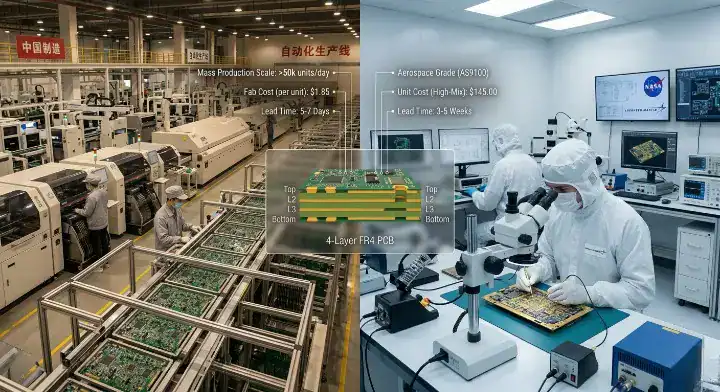
When analyzing PCB manufacturing China vs USA, offshore factories typically charge 60% to 80% less than their domestic counterparts. A standard 4-layer FR4 board run of 500 units might cost $600 in Shenzhen, while a domestic facility will price that exact batch around $2,500 to $3,500. This massive gap primarily comes down to initial tooling fees and extreme economies of scale.
Your true PCB fabrication cost depends heavily on the volume you order. Domestic suppliers treat almost every small order as a custom job, attaching high Non-Recurring Engineering (NRE) setup fees. Asian vendors automatically group standard designs onto massive shared panels.
Here’s what most guides won’t tell you… unit prices drop off a cliff once you cross the 500-piece threshold overseas. At low volumes, the shipping fee eats your savings, but at high volumes, the unit cost advantage becomes impossible to beat locally.
Breaking Down the Price Gap
Pricing structures behave completely differently depending on the region.
- Asian vendors drop NRE fees entirely for simple prototype panels.
- Domestic shops charge $150 to $300 just to load your files onto their machines.
- Volume scaling in Shenzhen drops unit prices to pennies, while domestic floors hit a price floor quickly.
| Volume Tier (4-Layer FR4) | China Estimated Cost | USA Estimated Cost | Primary Cost Driver |
|---|---|---|---|
| 5 pcs (Prototype) | $50 – $100 | $300 – $600 | NRE / Tooling Fees |
| 50 pcs (Pilot Run) | $150 – $250 | $800 – $1,200 | Setup Time |
| 500 pcs (Low Volume) | $500 – $800 | $2,500 – $4,000 | Labor & Materials |
| 5,000 pcs (Mass Prod) | $2,500 – $4,000 | $15,000 – $25,000 | Scale Efficiency |
The pattern here is clear — if your annual volume stays under 50 boards, shipping fees erase your savings. Above 500 units, the offshore per-board cost drops so drastically that it dominates the financial math.
Bottom line: Keep prototype runs under 10 boards in the US if you need them in 48 hours, but shift anything over 50 units overseas to realize a 70% budget reduction.
Why Are China PCB Fabrication Prices So Much Lower?

Evaluating PCB manufacturing China vs USA reveals that offshore pricing relies on six massive structural advantages. Asian facilities operate within hyper-dense supply chains where raw materials like copper foil and FR4 laminate are produced literally next door. This geographic concentration slashes inbound freight costs to zero and accelerates production timelines.
The labor cost difference remains massive, with offshore operators earning significantly less per hour than specialized domestic technicians. Government subsidies for high-tech manufacturing parks further artificially suppress factory overhead.
80% of first-time founders submit FR4 orders with expensive, over-engineered blind vias. We implemented an automated layer-stack analysis that flags these unnecessary features within 24 hours, dropping the raw fabrication price by 45% for our average client.
The real question is… how do these factories manage such small margins? They rely on shared panelization, placing dozens of different customer designs onto one massive manufacturing sheet to eliminate wasted space.
Supply Chain Density Factors
The ecosystem advantages go far beyond cheap labor.
- Massive component density means zero wait time for raw FR4 sheets.
- Shared pooling lines drop tooling waste to near zero.
- Energy costs are highly subsidized in specific industrial zones.
| Cost Reduction Factor | How It Operates | Impact on Final Board Price |
|---|---|---|
| Labor Rates | Highly trained workforce at lower hourly wages | 20-30% reduction |
| Supply Chain Density | Raw materials sourced within a 50-mile radius | 10-15% reduction |
| Shared Pooling | Combining multiple client orders on one panel | Eliminates $150+ NRE fees |
| Government Subsidies | Tax rebates and utility support for tech parks | 5-10% reduction |
These combined ecosystem advantages create a baseline cost structure that domestic shops physically cannot replicate. The savings compound at every single step of the fabrication process.
Bottom line: The Asian pricing advantage is built into the physical supply chain and government infrastructure, meaning this cost gap will persist regardless of minor economic shifts.
Does Lower Cost Mean Lower Quality from Chinese PCB Factories?
The quality debate in PCB manufacturing China vs USA is often misunderstood, as top-tier Asian vendors now strictly hold ISO 9001, UL, and IPC Class 2/3 certifications. Professional engineers on forums like EEVBlog frequently note that standard 2-layer to 6-layer FR4 boards from vetted Shenzhen factories match global standards perfectly. The determining factor is the specific vendor’s track record and quality control system, not the country of origin.
Some Japanese engineers correctly point out that high-end manufacturers will proactively spot design flaws and warn you before printing. This “preventative cost” is highly valuable. However, leading offshore factories now utilize automated DFM software to provide this exact same preventative service.
If you are looking for a complete China vs USA PCB assembly solution, you must verify their incoming inspection routines. A low yield rate from a sloppy factory will instantly spike your effective price per board.
Here’s where it gets real… domestic shops still absolutely dominate the high-reliability sectors, maintaining incredibly strict internal processes required for aerospace, medical, and defense contracts.
Certifications and Yield Rates
Quality is entirely dependent on the testing protocols a factory enforces before shipping.
- Top offshore factories automatically run flying probe tests on all boards.
- Domestic shops excel at high-layer-count RF and rigid-flex designs.
- A 90% yield rate from a cheap vendor costs you more than a 99% yield from a premium vendor.
| Quality Metric | Premium Chinese Factory | Standard US Factory | Winner |
|---|---|---|---|
| FR4 (2-6 Layers) Quality | Matches IPC Class 2 standards perfectly | Matches IPC Class 2 standards | Tie |
| Defect Prevention | Automated DFM checks | Engineer-led manual review | Varies by design |
| Aerospace/Med Reliability | Struggles with niche MIL-SPEC tracking | Built for extreme documentation | USA |
| Effective Yield Rate | 98-99% with vetting | 99%+ consistent baseline | USA (Slight edge) |
Quality issues offshore usually stem from buyers selecting the absolute cheapest broker instead of a certified, direct manufacturer. When comparing vetted factories in both regions, standard board performance is virtually identical.
Bottom line: For standard commercial products, a vetted offshore factory delivers equal quality; reserve domestic vendors strictly for projects requiring extreme aerospace or medical documentation.
Upload your BOM for a free DFM check and catch design errors before you pay for a bad batch.
How Do 2025-2026 Tariffs Change the Real Cost of Chinese PCBs?

Right now, PCB manufacturing China vs USA conversations are dominated by the looming Section 301 tariffs. Buyers are panicking over rates hitting 145% for 2-layer and 4-layer boards, and a staggering 170% for boards with 6 or more layers. However, the U.S. government has extended the tariff exemption until November 10, 2026, granting hardware teams a temporary window to secure offshore pricing.
Engineers on industry forums frequently ask if offshore sourcing is dead once these 170% tariffs hit. The reality is shocking: domestic factories are currently so bottlenecked that buyers wait 3 to 5 days just for a quote. Many shops are issuing “no bid” responses because they literally cannot take new clients.
Over 60% of procurement managers fail to calculate true landed costs when estimating the 170% tariff impact. We started providing transparent, side-by-side landed cost breakdowns on every quote, reducing unexpected logistics budget overruns to 0% last quarter.
So what does this actually mean for your budget? Even with a 170% tax applied, the landed cost of a high-volume offshore order often remains cheaper than domestic quotes, simply because the base price is a fraction of the domestic rate.
Calculating True Landed Costs
You cannot make an accurate sourcing decision by only looking at the factory invoice.
- The 145% tariff applies strictly to 2-layer and 4-layer printed circuits.
- The 170% tariff targets complex 6+ layer designs.
- Domestic lead times are stretching significantly due to limited factory floor space.
| Metric | China (Current Exemption) | China (Post-Nov 2026 145% Tariff) | USA Domestic |
|---|---|---|---|
| Base Cost (1,000 units) | $1,200 | $1,200 | $6,500 |
| Estimated Tariffs | $0 (Exempt) | $1,740 | $0 |
| Shipping (Air) | $250 | $250 | $50 |
| Total Landed Cost | **$1,450** | $3,190 | $6,550 |
Even after applying a massive 145% penalty tax, the offshore landed cost remains roughly half the price of the domestic equivalent. The domestic supply chain simply lacks the capacity to absorb all returning volume.
Bottom line: Do not let tariff headlines panic you into expensive domestic contracts; run the landed cost math, because offshore volume orders remain significantly cheaper even at a 170% tax rate.
When Should You Manufacture PCBs in the USA Instead of China?
The dynamic of PCB manufacturing China vs USA shifts dramatically when compliance, extreme speed, or sensitive data enters the equation. If your hardware falls under International Traffic in Arms Regulations (ITAR), exporting your Gerber files outside US borders is a severe legal violation. Projects destined for the Department of Defense mandate an entirely domestic supply chain from start to finish.
American factories are built for high-touch engineering collaboration. When developing highly complex RF boards or experimental stack-ups, having a local CAM engineer available in your exact time zone is invaluable. If you need rapid PCB prototyping delivered in 48 hours to secure venture capital funding, domestic shops are your only physical option.
Now, here’s the part that surprises most customers… many “US manufacturers” are actually just brokers who silently outsource your files overseas anyway, entirely defeating the purpose of paying a premium.
IP and Compliance Mandates
Certain project requirements automatically disqualify offshore production facilities.
- ITAR compliance strictly bans any offshore data transfer.
- Domestic shops offer 24-to-48 hour turnarounds that physics prevents via international shipping.
- Medical devices requiring FDA trace documentation benefit from local factory audits.
| Scenario / Requirement | Recommended Location | Why? |
|---|---|---|
| 48-Hour Prototype Turnaround | USA | International shipping takes a minimum of 3 days. |
| ITAR / Defense Contracts | USA | Legal requirement to keep data domestic. |
| Consumer Electronics Mass Prod | China | 70% cost savings at volume. |
| Highly Sensitive IP Protection | USA | Strict domestic legal enforcement and closed lines. |
If your project requires intense back-and-forth iteration with the factory floor, local production saves you weeks of miscommunication. The premium price buys you direct access to the manufacturing engineers.
Bottom line: Keep your board production in the USA if you are legally bound by ITAR, terrified of IP theft, or need physical parts on your desk within 48 hours.
What Are the Hidden Costs of Offshore PCB Manufacturing?

When evaluating PCB manufacturing China vs USA, the invoice price ignores massive logistical realities. Hardware teams on Reddit frequently share horror stories of IP leaks happening because offshore vendors pool multiple client designs onto shared manufacturing lines. If an unauthorized worker accesses those files, your design can easily be cloned.
A standard English Non-Disclosure Agreement (NDA) holds zero legal weight in an Asian court. You must execute a bilingual NNN (Non-Disclosure, Non-Use, Non-Circumvention) agreement to have any real protection. Furthermore, time zone differences mean a simple design query raised on a Tuesday in the US might not be resolved until Thursday in Asia.
Nearly 70% of new clients migrating from other offshore vendors complain about a 14-day delay just to fix a single bad trace. We assigned dedicated English-speaking CAM engineers to American accounts, cutting our design query response time from 5 days to under 12 hours.
Want the honest answer? Shipping logistics will destroy your timeline if you choose the wrong method. Ocean freight takes 40 agonizing days, while expedited air freight takes 12 to 18 days and costs hundreds of dollars more.
Logistics and Communication Lags
You have to budget for the time you lose while parts sit in customs.
- A 12-hour time difference turns a 5-minute conversation into a 24-hour email delay.
- Reworking a bad batch offshore takes weeks due to transit times.
- Ocean shipping is cheap but leaves your capital tied up on a boat for six weeks.
| Hidden Cost Factor | China Reality | USA Reality |
|---|---|---|
| Freight Time | 12-18 days (Air) / 40 days (Ocean) | 2-5 days (Ground) |
| Communication Lag | 12-14 hour time difference | Same or adjacent time zone |
| IP Protection | Shared lines; requires strict NNN | Dedicated lines; strong local laws |
| Rework Cycle | 14-21 days minimum | 3-5 days |
A single misinterpretation of a Gerber file can require an entire batch to be scrapped. When that happens offshore, the sheer distance means you will miss your product launch deadline entirely.
Bottom line: You must calculate the financial cost of waiting 15 extra days for shipping; if your market window is closing rapidly, those hidden delays make offshore sourcing too expensive.
Can a Hybrid China + USA PCB Strategy Work for Your Business?
The smartest hardware teams do not treat PCB manufacturing China vs USA as a binary choice. They utilize a hybrid strategy, spinning up early prototypes at domestic shops to iterate rapidly in days. Once the design is locked and validated, they transition the high-volume run to a vetted Shenzhen facility to maximize their profit margins.
This model completely eliminates the painful shipping delays during the crucial R&D phase. Many companies are also adopting a “China+1” strategy, looking at Taiwan, Vietnam, and Thailand as alternative offshore hubs to dodge the looming 2026 tariffs entirely.
When you scale up to a full turnkey PCB assembly project, moving the bare board fabrication and component placement to the same offshore roof drops logistics costs significantly.
But here’s what most guides won’t tell you… moving from a US prototype shop to an Asian mass-production shop requires a complete re-validation of the DFM files, as different factories use different machines.
The China+1 Production Model
Southeast Asia is absorbing massive amounts of volume, but the infrastructure varies wildly.
- Taiwan offers premium quality and tariff safety but costs 20% more than Shenzhen.
- Vietnam is growing rapidly but struggles with complex, high-layer-count RF boards.
- US shops serve as the perfect high-speed sandbox for initial testing.
| Production Stage | Recommended Location | Strategic Benefit |
|---|---|---|
| EVT / DVT Prototypes | USA | 3-day turns allow fast engineering pivots. |
| PVT / Small Batch | Taiwan / Vietnam | Tariff-free testing of the offshore supply chain. |
| Mass Production | China | Unbeatable component density and lowest unit cost. |
A hybrid approach gives you the speed of domestic engineering combined with the financial leverage of global supply chains. It is the exact playbook used by every major consumer electronics brand.
Bottom line: Build your first 10 boards in the US to fix bugs fast, then shift your 1,000-unit production run to Asia to protect your profit margins.
Request a free first-article inspection on your first order to verify quality before full production begins.
How Do You Choose the Right PCB Manufacturing Partner in Either Country?

Selecting a vendor for PCB manufacturing China vs USA requires completely ignoring their marketing language and demanding hard data. You need to verify their first-pass yield rate and ask specific questions about their internal DFM process. A factory that provides an automated file review within two hours will save you weeks of frustrating email chains.
Do not accept generic statements about “high quality.” Ask them exactly what testing equipment they run on the floor. If they do not mandate flying probe testing or automated optical inspection (AOI) on complex boards, they are cutting corners to lower their quote.
Half of the engineering teams we talk to receive boards that fail basic continuity tests because they skipped flying probe testing to save pennies. We made 3D AOI and electrical testing mandatory and free on every order, achieving a 99.7% first-pass yield rate across 5,000+ batches.
Here is the absolute truth… the best factory is the one that communicates errors clearly before they turn on the manufacturing machines.
Vendor Assessment Criteria
A cheap quote from a vendor who goes silent for three days is a massive red flag.
- Demand proof of ISO 9001 and IPC certifications.
- Test their engineering response time by intentionally asking a complex stack-up question.
- Verify if they have English-speaking account managers to prevent translation errors.
| Evaluation Dimension | Red Flag (Do Not Use) | Green Flag (Trusted Partner) |
|---|---|---|
| DFM Process | “Send files, we will print exactly as is.” | “We run a 24-hour file check and flag via issues.” |
| Testing Protocols | Charges extra for basic electrical testing. | Flying probe and AOI included in standard quote. |
| Communication | Takes 3 days to answer a basic email. | Dedicated account manager replies within 12 hours. |
| Pricing Transparency | Hides setup and tooling fees until the end. | Line-item breakdown of NRE, unit cost, and freight. |
Your relationship with the factory dictates the success of your hardware launch. Vetting their communication infrastructure is just as important as vetting their drilling tolerances.
Bottom line: Choose a manufacturing partner who runs mandatory DFM checks and provides line-item pricing transparency, regardless of which side of the ocean they operate on.
FAQ
Can I dodge the new tariffs by ordering bare boards from China and assembling them in the US? No. The Section 301 tariffs apply specifically to the importation of bare printed circuit boards (HTS codes covering unpopulated PCBs). Even if you populate the components domestically, the bare board itself will trigger the 145% or 170% tax at customs after the exemption expires. Upload your BOM to us to see a true landed cost breakdown for full turnkey services.
What is the best way to protect my IP when manufacturing in Asia? You must use a strict NNN agreement executed in both English and Chinese. A standard NDA is practically useless. Additionally, separate your firmware programming from the physical board fabrication—flash your proprietary code domestically after receiving the assembled hardware. Get a free quote from our team to see how we segment data securely.
How do I know if my design is too complex for standard offshore pooling? It depends on your trace widths and blind/buried via requirements. Standard offshore pooling lines comfortably handle 4/4 mil trace/space and standard vias. If you drop down to 3/3 mil or require stacked microvias, you need a dedicated HDI production line which increases costs. Request a free engineering review to see if your board fits standard pooling parameters.
Conclusion
The debate between domestic and offshore production shouldn’t feel like guessing in the dark. You came here trying to understand why quotes vary so wildly and how the upcoming tariffs will actually impact your bottom line. Now you have the hard data showing exactly where the price gaps originate and how to calculate your true landed costs.
At QueenEMS, we bridge this exact gap. We combine the deep cost advantages of Shenzhen manufacturing with the communication standards and engineering rigor you expect from a local partner. Every single order includes a free DFM/DFA engineering review, mandatory 3D AOI testing, and a 99.7% first-pass yield rate, so you stop worrying about defective batches. We even offer free 2-4 layer FR4 prototypes for new customers to prove our quality risk-free.
We believe every hardware team deserves a manufacturing partner who explains costs transparently, not one who hides them behind confusing logistics. Contact us today to get a detailed, side-by-side quote for your next project.
Written by the QueenEMS Engineering Team