
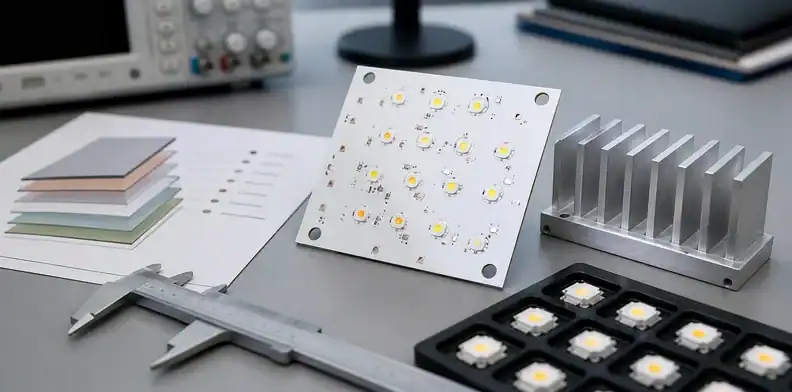
Quick Answer: An aluminum PCB LED stackup is worth quoting when the LED heat path can no longer be handled by FR4 copper area, thermal vias, and enclosure design. Before production, buyers should define LED power, thermal target, dielectric thermal conductivity, copper thickness, surface finish, assembly profile, and whether ceramic or metal-core construction is the safer option. A supplier answer should name the stackup and the evidence it can provide, not only say that aluminum is better for heat.
Key takeaways
- Use FR4 only when the thermal path and enclosure can remove heat with margin.
- Ask for dielectric W/mK, copper thickness, aluminum base thickness, and solder profile limits in the RFQ.
- Choose aluminum PCB before LED junction temperature, warranty exposure, or housing temperature becomes the risk.
- Keep ceramic PCB as a separate higher-power or higher-reliability decision, not as the default answer.
The buyer’s real question is not whether aluminum conducts heat. The order-stage question is whether the product needs a metal-core heat path, what grade of dielectric is enough, and what evidence should be locked before a pilot run becomes production. This article is for LED lighting, drivers, indicators, power modules, and compact hardware where a few degrees of thermal margin can decide life, brightness, solder joint stress, and customer returns. It keeps the boundary clear: FR4 with good copper and thermal vias can work for many low-power LED boards; aluminum PCB becomes the practical route when the heat path must be shorter, flatter, and repeatable.
Table of Contents
- Start with LED heat, not board material preference
- When can FR4 with thermal vias still make sense
- Choose the dielectric W/mK before price comparison
- Match copper, base thickness, and surface finish to assembly
- Use ceramic only when aluminum cannot own the risk
- Ask for evidence before release, not after failure
- Write the aluminum LED RFQ package clearly
- Decide what QueenEMS should review
Start with LED heat, not board material preference
The first decision is the heat budget. A buyer should estimate LED power, allowed junction temperature, housing temperature, duty cycle, ambient condition, and whether the board touches a heat sink. If those inputs are missing, an aluminum board request is only a guess with a metal base.
Thermal call: Choose aluminum PCB only after the LED heat path and the acceptable temperature rise are stated.
A practical RFQ can say, for example, that the board carries a 1 W, 3 W, or higher LED load, must mount to an aluminum housing, and needs the supplier to confirm a metal-core stackup that can survive the assembly profile. That is more useful than asking for the cheapest MCPCB.
FR4 may still be valid when the LED load is light, the copper area is large, and the enclosure can remove heat. Aluminum PCB becomes stronger when the LED is compact, the copper area is limited, brightness stability matters, or the product owner cannot accept a large temperature swing between units.
For a production RFQ, also ask who owns the thermal target. Purchasing can compare price, but engineering must define whether the acceptable result is LED junction temperature, housing temperature, luminous output stability, or customer touch temperature. Those are different acceptance records.
When can FR4 with thermal vias still make sense
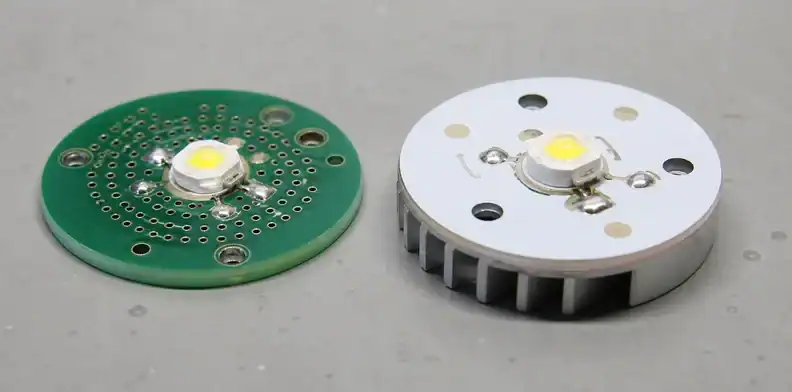
FR4 with thermal vias can be a good choice when heat can spread through copper planes, via arrays, and a metal chassis without exceeding the LED or component limit. It also keeps the process closer to ordinary multilayer PCB fabrication, which can help prototypes and mixed-signal boards.
The risk is that FR4 does not move heat through the dielectric as efficiently as a purpose-built metal-core stackup. A layout that passes a quick bench test may run hotter after enclosure changes, conformal coating, higher ambient temperature, or longer duty cycle.
| Option | Useful when | RFQ evidence to ask for |
|---|---|---|
| FR4 plus copper spreader | Low LED power and enough board area | Copper weight, via plan, enclosure contact |
| FR4 plus thermal via array | LED pad can connect to a heat sink side | Via fill rule, solder wicking control, stackup |
| Aluminum PCB | Short vertical heat path is needed | Dielectric W/mK, base thickness, solder profile |
| Ceramic PCB | Higher heat, insulation, or harsh reliability is the driver | Ceramic type, metallization, assembly limits |
This is where ceramic PCB versus metal-core PCB at the 5 W threshold is a useful boundary. It helps keep ceramic from being used too early while keeping aluminum from being asked to solve a problem that is really a ceramic or module-level problem.
Buyer signal: If FR4 needs complex via tricks, thick copper, and a special heat sink to survive a normal LED load, quote aluminum PCB as the comparison baseline.
When two suppliers give different recommendations, ask each one what design change would let FR4 remain acceptable. A serious answer may mention copper area, via count, chassis contact, thermal pad size, or duty cycle. A weak answer usually repeats that aluminum is better without explaining the boundary.
Choose the dielectric W/mK before price comparison
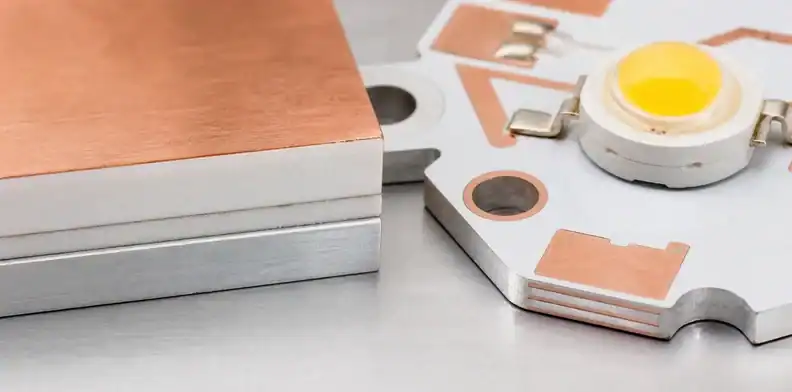
An aluminum PCB is not one single material. The dielectric layer between copper and aluminum base controls much of the useful heat transfer and insulation behavior. Common purchasing choices are often discussed around 1 W/mK, 2 W/mK, or 3 W/mK dielectric classes, but the right value depends on LED load, board area, insulation needs, and cost target.
A buyer should not compare quotes unless the dielectric class is visible. One supplier may quote a basic dielectric and another may quote a higher thermal grade. The cheaper quote may look attractive while hiding higher junction temperature or a narrower process window.
Stackup rule: Compare aluminum PCB quotes only after dielectric W/mK, copper thickness, aluminum base thickness, and solder mask color are named.
The RFQ should also ask whether the supplier can hold the same dielectric on repeat orders. For LED products, a quiet substitution can change brightness, housing temperature, and field life even when the Gerber file is unchanged.
The dielectric choice should also be tied to availability. A high W/mK dielectric that only one supplier can buy quickly may become a schedule risk for repeat orders. Put acceptable alternates into the quote record if the product owner allows them.
Match copper, base thickness, and surface finish to assembly
Copper thickness, aluminum base thickness, and finish are assembly decisions as well as thermal decisions. A thicker copper layer can spread current and heat, but it may affect etching tolerance and fine features. A thicker base may improve mechanical feel while changing screw mounting and weight.
Surface finish depends on LED package, shelf life, soldering plan, and cost. HASL, lead-free HASL, ENIG, and OSP are not interchangeable if the LED pad geometry, storage time, or reflow plan is tight. The buyer should not let finish be chosen silently from the cheapest quote.
| RFQ field | Why it matters | Who should approve |
|---|---|---|
| Copper thickness | Current spreading and etch capability | Electrical engineer and supplier |
| Aluminum base | Mechanical stiffness and heat path | Mechanical/product owner |
| Dielectric | Thermal path and insulation | Design engineer |
| Surface finish | LED solderability and storage | Assembly owner |
If the order includes the driver and LED assembly, connect the bare board decision to the LED driver PCB assembly requirement. A board that looks fine as bare metal can still create assembly risk if the fixture, paste aperture, or reflow profile is not matched.
Assembly call: Do not approve an aluminum PCB LED quote until the finish and soldering route match the actual LED package and assembly process.
Assembly should review solder mask color and LED optical effect as well. White mask is common for lighting products, but the coating, cleaning, and handling process must not create cosmetic fallout or pad contamination near the LED.
Use ceramic only when aluminum cannot own the risk
Ceramic PCB should not be the automatic upgrade for every warm LED board. It is better treated as a separate reliability and thermal decision when power density, insulation, coefficient of thermal expansion, high temperature, or module packaging justifies the premium.
For many commercial LED boards, aluminum PCB gives the useful balance: better heat spreading than ordinary FR4, lower cost than ceramic, and easier supplier availability. Ceramic becomes more convincing when the LED or power device is operating near a boundary where small temperature changes create warranty or safety exposure.
The safe RFQ path is to quote FR4, aluminum, and ceramic only when the product owner can explain what risk each version is meant to solve. Otherwise the comparison becomes a price table without engineering meaning.
Material boundary: Aluminum is the normal LED heat-spreading choice; ceramic belongs in the RFQ only when the thermal or reliability margin cannot be owned by metal-core construction.
If a customer asks why aluminum was chosen instead of ceramic, the answer should be traceable to power level, cost target, assembly method, and reliability margin. This keeps the material decision from becoming a personal preference during later cost reviews.
Ask for evidence before release, not after failure
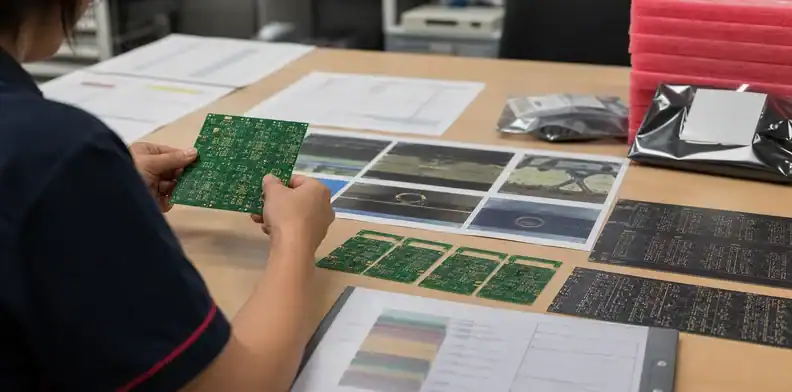
The supplier evidence should match the order risk. For a low-power indicator board, stackup confirmation and standard inspection records may be enough. For an LED product with warranty exposure, ask for stackup, dielectric data, thermal path assumptions, solderability record, packaging label, and any production test or inspection evidence tied to the lot.
A buyer can also ask how the supplier handles mounting holes, screw torque assumptions, exposed aluminum edges, solder mask coverage, and panelization. These details affect assembly and field reliability even though they are not always visible in a normal price quote.
| Evidence | What it proves | Release use |
|---|---|---|
| Stackup note | The quoted construction is defined | Prevents quiet material changes |
| Dielectric data | Thermal class is visible | Allows quote comparison |
| Solderability evidence | LED pads should wet correctly | Protects assembly start |
| Packaging label | Lot and finish are traceable | Supports receiving control |
For repeat production, keep the approved stackup with the purchase record. If the next quote changes only price but not material details, the buyer may miss the real change. This is a common order-stage reason to connect aluminum PCB decisions with PCB quality documents before shipment.
Evidence requests should stay proportional. A lighting prototype may need a clear stackup and supplier note. A production lamp, display module, or outdoor unit may justify incoming checks, controlled packaging, and a repeat-order material record.
Write the aluminum LED RFQ package clearly
The RFQ should include Gerbers or ODB++, assembly drawing if QueenEMS supports PCBA, LED package, LED current, estimated power per LED, copper requirement, dielectric W/mK target, aluminum base thickness, surface finish, solder mask color, mounting method, quantity, and acceptable evidence before release.
A short wording example is useful: Please quote this aluminum PCB LED board with the stated LED current, dielectric thermal conductivity target, copper thickness, aluminum base thickness, finish, and mounting-hole plan. Confirm whether FR4 with thermal vias is still practical or whether metal-core construction should be the baseline for production.
RFQ signal: A supplier that can explain the heat path, stackup, assembly limit, and evidence package is safer than a supplier that only says aluminum PCB is better for LEDs.
That record also gives purchasing a clean comparison. If one quote uses a 1 W/mK dielectric and another uses 3 W/mK, the buyer can see the engineering difference before choosing on price.
The RFQ should state whether supplier-proposed substitutions are allowed. If the buyer wants the supplier to recommend a dielectric change, that is useful; if not, substitutions should require written approval before production.
Decide what QueenEMS should review
A useful review package is small but specific: stackup, Gerbers, LED package, target current, thermal concern, enclosure contact area, finish preference, assembly plan, and any customer temperature limit. With those files, QueenEMS can check whether the order looks like FR4, aluminum, or ceramic before quotation time is wasted.
If your project needs metal-core PCB manufacturing or PCB assembly support, keep the RFQ focused on the heat path and evidence rather than only the material name. That makes the quote faster to compare and easier to defend internally.
Review point: Send the thermal problem, not only the Gerber file; the material decision depends on power, mounting, assembly, and proof.
For QueenEMS review, include any thermal simulation or bench data you already have. Even a simple temperature photo or housing sketch can make the first supplier question more accurate than a Gerber-only quote request.
FAQ
Can FR4 replace aluminum PCB for LED boards?
Yes, FR4 can replace aluminum PCB for low-power LED boards when copper area, thermal vias, enclosure contact, and temperature margin are enough. The buyer should ask for a heat-path review before treating FR4 as a safe production substitute.
What dielectric W/mK should I request for aluminum PCB LED?
Request the dielectric class that matches the thermal target, often by comparing 1 W/mK, 2 W/mK, and 3 W/mK options with cost and availability. The supplier should state the actual quoted dielectric, not only the words metal core.
Is ceramic PCB better than aluminum PCB for LED?
Ceramic can be better when power density, insulation, high temperature, or reliability exposure is high. Aluminum PCB is often the better cost-performance choice for many LED lighting and driver boards.
What files should I send for an aluminum PCB LED quote?
Send Gerber or ODB++ data, LED package, current, power estimate, stackup target, finish, quantity, mounting method, and any temperature limit. Add assembly drawings if the order includes PCBA.
Can QueenEMS review FR4 versus aluminum before RFQ?
Yes, QueenEMS can review the heat path, material boundary, stackup assumptions, and evidence request before you lock the RFQ package.
Related QueenEMS articles
- Metal core PCB manufacturing support
- LED driver PCB assembly service
- Ceramic PCB versus metal-core PCB threshold
- PCB overheating solution decisions
Send QueenEMS the LED thermal RFQ package
If your PCB or PCBA project needs an aluminum, FR4, or ceramic thermal decision, contact QueenEMS with the LED package, current, power estimate, Gerbers, stackup target, finish, mounting method, and quantity. We can help review whether the quote should be based on FR4, aluminum PCB, or a higher-performance material route.
The best package includes the supplier’s stackup reply as well. That lets the review compare real dielectric, copper, base thickness, finish, and assembly evidence rather than broad material names.
Sources
Written by the QueenEMS Engineering Team
Upload your files today · Free DFM check before production · Ship worldwide
Get your PCB prototypes in as fast as 24 hours. We handle FR4, Rogers, and Flex up to 60 layers — free prototypes for 2–4 layer boards, no minimum order.
Just upload your Gerber + BOM — we source every part, assemble, and inspect (AOI + X‑Ray) so you don't have to chase suppliers. Boards ship in as fast as 24 hours.