
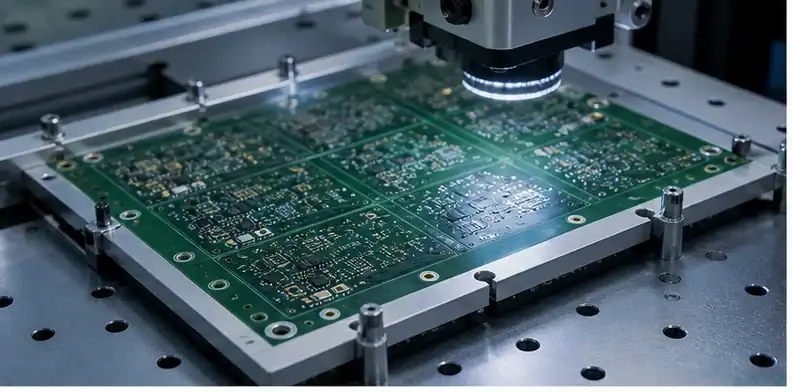
Quick Answer: Decision: tooling-hole definition. Controlled object: panel drawing that identifies every tooling hole by datum, diameter, plating state, side access, and rail ownership. Design-owned boundary: fixture datums, hole count, positional relationship, NPTH or PTH status, and holes required after depaneling. Supplier discretion: supplier-added rail tooling outside the shipped unit when it does not conflict with assembly handling. Stop rule: tooling holes confused with fiducials, plated status left unclear, or required holes placed only in disposable material.
Tooling hole RFQ path
- Why do tooling holes matter before quotation?
- Where should tooling holes be placed?
- What size and plating notes should be stated?
- How do tooling holes relate to fiducials?
- Which tooling-hole changes need buyer approval?
- What should a tooling-hole RFQ include?
Why do tooling holes matter before quotation?
PCB tooling holes requirements matter before quotation because they affect panel handling, drilling, SMT alignment, fixture seating, and repeatable inspection. They are usually panel or rail features, so a quote based only on the single-board outline may miss how the board will actually move through production.
- Tooling holes are normally non-plated alignment features, not electrical vias.
- The final location may depend on panel rails and the assembly fixture.
- A supplier should not place them through a functional board area without approval.
| Use case | RFQ decision |
|---|---|
| Bare PCB only | Let the fabricator propose panel tooling |
| SMT assembly | Coordinate tooling holes with rails and fiducials |
| Customer fixture | Send the fixture drawing or hole coordinates |
Bottom line: Tooling holes are simple only when the panel and fixture assumptions are visible.
Where should tooling holes be placed?
Tooling holes should usually sit in panel rails or supported breakaway areas rather than in the finished board, unless the product design intentionally provides fixture holes. Placement should avoid weak corners, components, copper restrictions, and flexible or unsupported regions.
- Use three or four stable locations when the fixture needs repeatable seating.
- Keep tooling holes clear of V-score lines, tabs, and routed break areas.
- Confirm whether the finished customer board will retain any tooling holes.
| Location | Typical treatment |
|---|---|
| Panel rail | Preferred for assembly handling |
| Finished PCB | Use only when mechanically approved |
| Breakaway tab | Review strength and removal risk |
Bottom line: Good tooling-hole placement supports the panel without changing the product.
What size and plating notes should be stated?
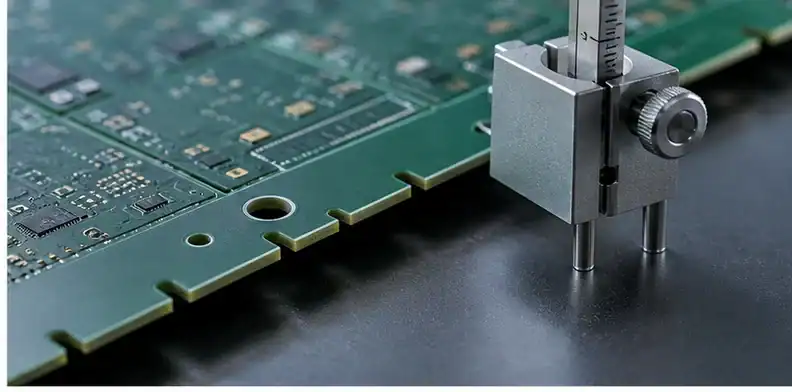
The RFQ should state whether tooling holes are non-plated, whether the size is customer-controlled, and whether the supplier may adjust the hole to fit normal fixtures. Many suppliers have preferred pin sizes, so forcing a special size without reason can add review time.
- Call out finished size only when a customer fixture requires it.
- Use non-plated notation unless the hole has a separate product function.
- Ask whether hole-to-edge clearance is adequate after panelization.
| Requirement | Why it matters |
|---|---|
| NPTH note | Prevents unintended plated alignment holes |
| Finished diameter | Needed for customer fixtures |
| Position tolerance | Controls fixture seating and repeatability |
Bottom line: Size control should follow the fixture need, not a generic copied rule.
How do tooling holes relate to fiducials?
Tooling holes hold or locate the panel mechanically, while fiducials give the vision system optical alignment. A reliable PCBA panel may need both. The RFQ should not replace fiducials with tooling holes or assume that holes alone solve placement accuracy.
- Use panel fiducials for machine vision and tooling holes for mechanical stability.
- Review rail width when both features must fit outside the customer board.
- Keep fixture and optical alignment decisions in the same panel drawing review.
| Feature | Primary role |
|---|---|
| Tooling hole | Mechanical location or holding |
| Panel fiducial | Optical registration for SMT |
| Local fiducial | Fine alignment for dense components |
Bottom line: Tooling holes and fiducials solve different alignment problems.
Which tooling-hole changes need buyer approval?
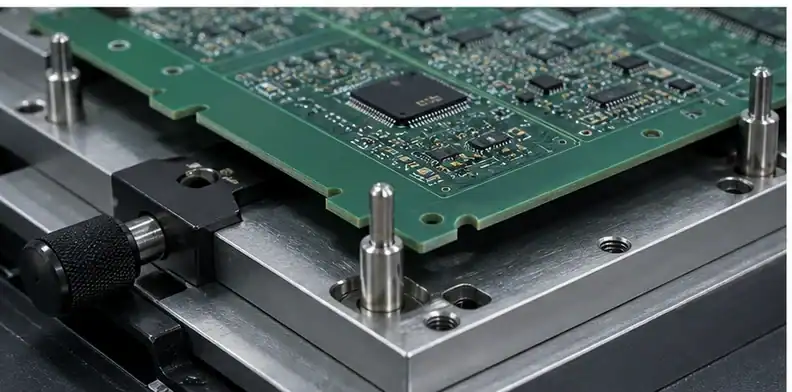
Buyer approval is needed when tooling holes move into the finished PCB, change a customer fixture coordinate, reduce rail strength, conflict with depaneling, or force a change to the panel outline. Supplier-controlled rail holes can often be approved quickly when they do not affect the product.
- Ask for a marked panel drawing before approving fixture-sensitive changes.
- Do not let a tooling-hole change move a board datum without mechanical review.
- Keep assembly-house fixture constraints separate from bare-board fabrication needs.
| Change | Review owner |
|---|---|
| Rail-only tooling moved | Supplier or assembly process review |
| Customer fixture hole changed | Buyer mechanical approval |
| Hole added to finished board | Engineering approval |
Bottom line: The product owner should approve any tooling change that survives into the finished board.
What should a tooling-hole RFQ include?
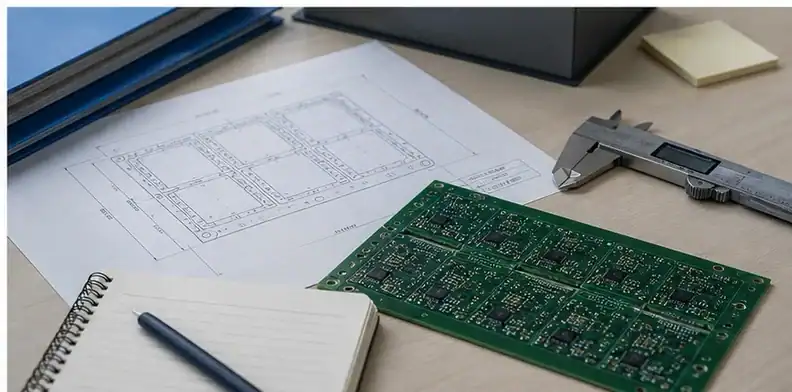
A tooling-hole RFQ should include the panel drawing, finished-board outline, assembly plan, fixture constraints, NPTH/plating note, hole size or supplier-adjustment rule, and approval path. That lets QueenEMS coordinate bare PCB and PCBA assumptions before pricing.
- Send customer fixture drawings when tooling holes must match existing hardware.
- State whether the supplier may add rail-only tooling holes.
- Request evidence only when a fixture or customer acceptance risk exists.
| RFQ item | Include when |
|---|---|
| Panel drawing | Tooling holes are in rails or arrays |
| Fixture file | Hole coordinates are customer-controlled |
| Assembly files | SMT alignment and handling are part of scope |
Bottom line: The RFQ should show whether tooling holes are factory aids or customer-controlled features.
What should the buyer record before release?
Production record for the tooling-hole definition
Controlled object
Controlled object: panel drawing that identifies every tooling hole by datum, diameter, plating state, side access, and rail ownership.
Failure boundary
Failure boundary: fixture mismatch, panel loading error, rotation ambiguity, board damage, or unusable assembly rails.
Design-owned conditions
Design-owned conditions: fixture datums, hole count, positional relationship, NPTH or PTH status, and holes required after depaneling.
Supplier discretion
Supplier discretion: supplier-added rail tooling outside the shipped unit when it does not conflict with assembly handling.
Required proof
Required proof: a processed panel drawing and, for customer fixtures, a first-panel dimensional check against the fixture datum pattern.
Production stop
Production stop: tooling holes confused with fiducials, plated status left unclear, or required holes placed only in disposable material.
Repeat-order baseline
Repeat-order baseline: the panel revision, fixture identifier, datum coordinates, rail-removal rule, and first-build fit result.
RFQ inputs
RFQ inputs: unit Gerbers, panel drawing, drill legend, fixture interface, fiducial plan, delivery format, quantity, and reuse expectation.
FAQ
Can the supplier decide the tooling-hole definition?
Discretion for tooling-hole definition: supplier-added rail tooling outside the shipped unit when it does not conflict with assembly handling. Engineering control for tooling-hole definition: fixture datums, hole count, positional relationship, NPTH or PTH status, and holes required after depaneling.
What stops this tooling-hole definition?
Stop rule for tooling-hole definition: tooling holes confused with fiducials, plated status left unclear, or required holes placed only in disposable material. Disposition owner for tooling-hole definition: the named engineering approver.
Which proof closes the tooling-hole definition?
Evidence for tooling-hole definition: a processed panel drawing and, for customer fixtures, a first-panel dimensional check against the fixture datum pattern. Revision link for tooling-hole definition: the quoted dataset.
What survives into the next order?
Reorder baseline for tooling-hole definition: the panel revision, fixture identifier, datum coordinates, rail-removal rule, and first-build fit result.
For a focused tooling-hole definition, send QueenEMS unit Gerbers, panel drawing, drill legend, fixture interface, fiducial plan, delivery format, quantity, and reuse expectation. Redline request: tooling-hole definition. Open assumptions: tooling-hole definition. Approver: tooling-hole definition owner.
Written by the QueenEMS Engineering Team
Sources
Upload your files today · Free DFM check before production · Ship worldwide
Get your PCB prototypes in as fast as 24 hours. We handle FR4, Rogers, and Flex up to 60 layers — free prototypes for 2–4 layer boards, no minimum order.
Just upload your Gerber + BOM — we source every part, assemble, and inspect (AOI + X‑Ray) so you don't have to chase suppliers. Boards ship in as fast as 24 hours.