
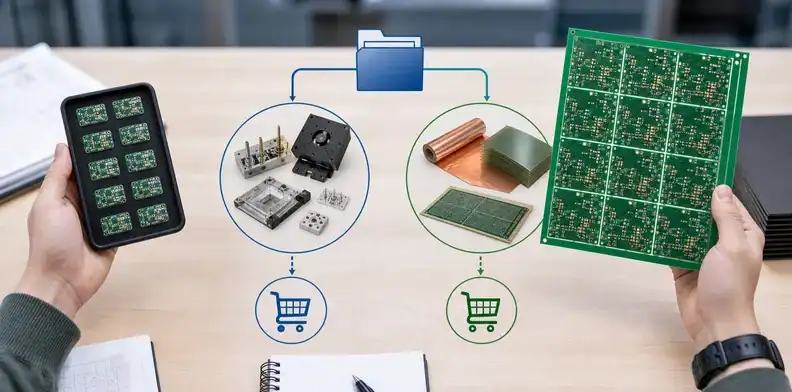
Quick Answer: A PCB prototype quote prices a small, fast learning build; a production quote prices a repeatable process at defined volume, yield, test, quality, packaging, and delivery assumptions. Do not multiply the prototype unit price or compare only the final unit price. Normalize both quotes to the same revision and scope, then separate one-time cost, recurring cost, and risk assumptions.
The prototype board that proves a circuit works is not automatically the same commercial object as the production board. Files may change, panelization may be redesigned, material may be committed differently, and the supplier may add controls that were unnecessary for ten pieces.
This isolated optimization draft expands published source post 2068. It is for review and consolidation, not parallel publication.
The search intent behind this topic is commercial but highly technical. A buyer is usually not asking for a generic definition of prototype and production. They want to know why the second quote changed, whether the supplier is being fair, which costs are normal, and what information must be normalized before they commit to a production order.
Table of Contents
- Why Can’t You Scale the Prototype Price?
- What Must Be Equal Before Comparing Quotes?
- Which Costs Are One-Time or Recurring?
- How Do Panel, Yield, and Material Change?
- What Quality Scope Changes in Production?
- How Should You Compare Volume Breaks?
- What Should a Production RFQ Contain?
Why Can’t You Scale the Prototype Price?
You cannot scale a prototype price because fixed engineering, tooling, expedited handling, panel utilization, and minimum process charges are spread across very few boards. Production changes both the denominator and the manufacturing plan.
Prototype pricing may prioritize speed and available stock. Production pricing may use a dedicated panel, planned material purchase, scheduled capacity, repeat tooling, and a defined sampling or reporting plan. Those changes can lower recurring unit cost while adding qualification or non-recurring engineering (NRE) work.
The practical question is not “Why isn’t 1,000 pieces exactly ten times my 100-piece order?” It is “Which assumptions changed, and will the resulting process repeat?” Use the prototype ordering requirements to identify what the first quote was actually proving.
Prototype pricing buys learning
A prototype quote often includes hidden learning work: CAM review, clarification of drawings, supplier feedback, quick material selection, and small-batch handling. The supplier may accept inefficiency because the order’s purpose is to validate the design quickly. Production has a different goal: repeatable output at a stable cost and risk level.
This is why prototype pricing can look illogical when converted into a spreadsheet. A ten-piece prototype may carry a high unit price because fixed work is spread across ten units. A production quote may lower unit cost but introduce separate tooling, fixture, panel, documentation, or qualification charges. Both can be reasonable if the scope is clear.
Production pricing buys repeatability
Production requires the supplier to decide how the job will run repeatedly. That may mean a dedicated panel, revised rout path, more formal test, controlled document packet, material reservation, process window confirmation, packaging method, and clearer deviation rules. These controls do not always appear in the prototype quote because they were not needed to learn whether the circuit worked.
The buyer should therefore ask, “What process are we standardizing?” If the answer is still changing, the order may need a pilot or qualification lot rather than full production.
What Must Be Equal Before Comparing Quotes?
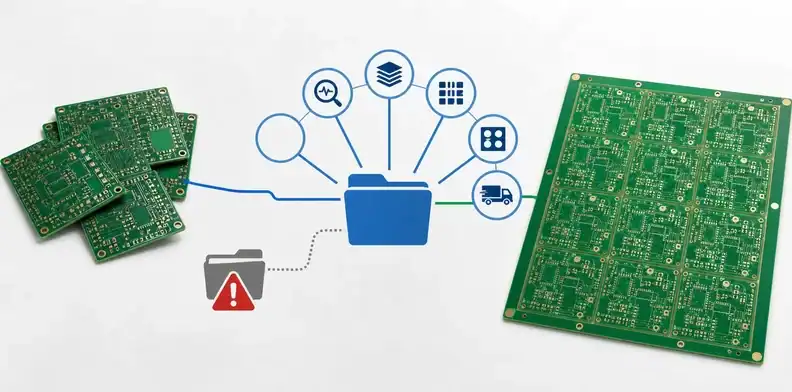
Normalize the quotes to the same revision, board construction, finished quantity, acceptance scope, delivery term, and destination. A lower unit price is meaningless if it excludes tests, reports, tooling, packaging, or freight included elsewhere.
Create a comparison baseline with:
- exact Gerber/ODB++, drill, drawing, BOM and centroid revisions as applicable;
- stack-up, material/equivalent rule, copper, finish, impedance, and tolerances;
- panel or delivery-unit definition;
- electrical and quality test scope;
- scrap, overage, and X-out assumptions;
- lead time, shipment lot size, and Incoterm.
If the design changed after the prototype, treat it as a new baseline. The repeat PCB order revision control process helps prevent the quotation from pointing to a different build than the purchase order.
Normalize delivery units
Production quotes can hide differences in what the unit means. One supplier may quote individual boards after depaneling; another may quote panels containing several images. One may include overage or spare panels; another may quote exact finished pieces. One may price with X-outs allowed; another may require zero X-outs. These quotes are not comparable until the delivery unit is the same.
Ask suppliers to state whether the quoted quantity means shippable individual boards, delivery panels, assembled panels, or usable boards after X-out rules. For PCBA, also define whether the price includes stencil, programming, functional test, packaging, and component attrition.
Normalize time and freight
Lead time and shipping terms can make a lower price more expensive. A quote with a longer lead time may force the buyer to carry more inventory. A quote without freight, duties, or import handling may look cheaper than a delivered quote. For US, Canada, and Mexico buyers sourcing from overseas, landed cost and schedule reliability often matter as much as the unit board price.
When comparing quotes, put lead time, Incoterm, shipment destination, packaging, and quote validity beside the unit price. If these fields are blank, the quote is not ready for a production decision.
Which Costs Are One-Time or Recurring?
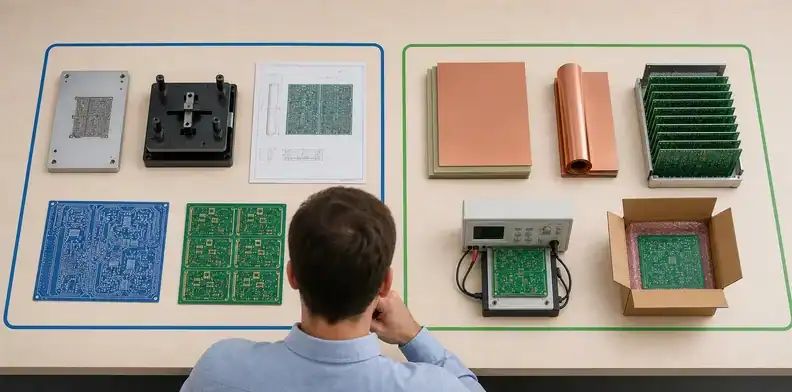
Separate NRE from recurring price so you can compare suppliers and volumes fairly. One-time items can include engineering review, tooling, test fixtures, stencils for PCBA, special coupons, or qualification documentation. Recurring cost includes material, fabrication, routine test, assembly labor, packaging, and lot-specific records.
| Cost item | Prototype treatment | Production treatment |
|---|---|---|
| CAM/tooling | High share per board | Amortized or separately stated |
| Panel design | May use quick standard array | Optimized and controlled |
| Material | Stock or minimum charge | Planned lot/commitment |
| Test fixture | Often unnecessary | Possible NRE plus repeat use |
| Quality records | Basic or first-build focus | Defined per lot |
| Freight | Small urgent parcel | Consolidated lot strategy |
Ask whether NRE is charged once, repeated after a revision, or credited at a volume threshold. A cheap first lot can become expensive when hidden setup charges repeat.
Ask what triggers a new charge
The buyer should know what causes NRE or tooling to repeat. A small silkscreen change may not require new tooling. A panel change, drill change, impedance stack-up change, test fixture change, or component placement change may. The quote should identify which charges are reusable and which are revision-sensitive.
For production planning, this matters because hardware changes are common after prototypes. If the supplier charges a new fixture every time the revision changes, the buyer may choose a smaller pilot lot until the design is stable. If tooling can carry forward after a minor revision, the buyer may be more comfortable approving the first production release.
Separate supplier investment from buyer risk
Some quotes include low or zero NRE because the supplier spreads setup cost into unit price or expects repeat volume. That can be fine, but the buyer should understand the trade. A very low first quote may depend on volume that is not guaranteed, a material commitment, or reduced documentation. A transparent quote shows what is included, what is amortized, and what changes if volume drops.
The best comparison is not “which supplier has the lowest NRE?” It is “which pricing structure matches our revision risk, demand confidence, and quality requirements?”
How Do Panel, Yield, and Material Change?
Production economics depend on panel utilization, expected process yield, material availability, and the cost of containing defects. The supplier may redesign the array after the prototype to improve utilization or fit assembly equipment.
That change should be approved, not hidden. Review the PCB panelization cost decisions and confirm finished panel size, board count, rails, routing, X-outs, and coupons before accepting the production price.
Material rules also matter. A prototype made from an available equivalent may not satisfy a production specification that names one laminate system. If alternates are possible, use a documented material substitution approval path so price savings do not erase traceability or qualification.
Yield assumptions belong in the quote
Production pricing depends on expected yield and how scrap is handled. A supplier may include normal scrap in the quoted price, quote extra overage, or define acceptable X-outs at the panel level. If the buyer does not ask, the first sign of the assumption may appear when shipped quantity or invoice quantity differs from expectation.
For bare boards, clarify whether the quote is for finished good quantity or production start quantity. For assembled boards, clarify component attrition, rework allowance, and whether the buyer or supplier owns shortage risk for consigned parts.
Material planning changes the commercial model
Prototype material may come from stock or a small minimum purchase. Production material may require a larger buy, a lead-time reservation, or approval of alternates if the specified laminate is not available. The supplier may offer a better price if the buyer accepts a material window, but that window must match electrical, mechanical, thermal, flammability, and customer requirements.
If the product has not qualified equivalent laminates, do not accept a generic “FR-4 equivalent” in exchange for a lower price. Ask the supplier to name the allowed material family, approval path, and traceability record.
What Quality Scope Changes in Production?
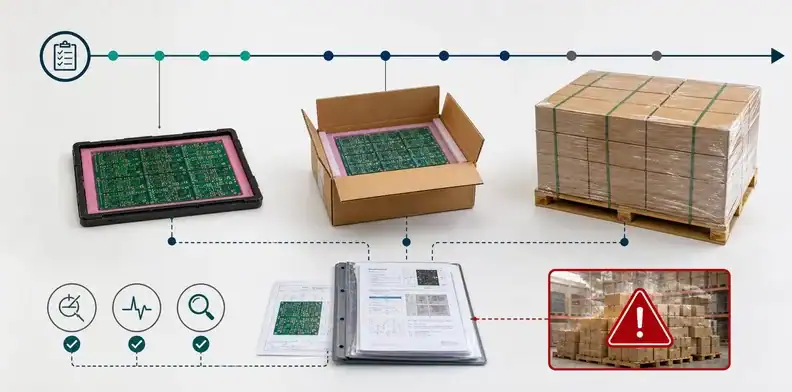
Production quality scope should become more repeatable and more clearly linked to each lot. The right controls depend on the product, but the quote should state electrical test, impedance verification, microsection or coupon requirements, dimensional inspection, first article, sampling, and shipment records.
Do not assume “same quality as prototype” is a measurable requirement. The prototype may have received unusually close engineering attention, while production relies on documented process controls. Conversely, a production qualification lot may require more evidence than the first sample.
For choosing first article versus automated inspection evidence, see first article inspection PCB versus AOI. For a first production release, define which evidence is approval-only and which repeats every lot.
Prototype inspection is not production control
Prototype builds often receive extra attention because the supplier and buyer are still learning. Engineers may manually inspect unusual features, send photos, or discuss issues directly. Production cannot rely on that informal attention. It needs a repeatable control plan: what is inspected, by which method, at which frequency, against which acceptance criteria, and what record is retained.
For bare PCBs, that may include electrical test, impedance coupon testing, microsection, dimensional checks, surface finish evidence, and shipment documents. For PCBA, it may include solder paste inspection, AOI, X-ray where relevant, ICT, functional test, programming, conformal coating inspection, and packaging controls.
Define first lot versus every lot
Not every quality record must repeat every lot. A first production run may need more evidence to prove the production route. Later repeat lots may use a smaller packet if the process remains unchanged. The quote should distinguish first article, pilot lot, routine production, and customer-specific reporting.
This prevents two bad outcomes: paying for unnecessary reports on every order, or assuming a one-time qualification report proves future lots without ongoing traceability.
How Should You Compare Volume Breaks?
Compare volume breaks by annual demand, release lot, inventory risk, cash exposure, lead time, and revision risk—not only by price per board. A large price break may require a material commitment or one shipment that becomes obsolete after an engineering change.
Use a normalized table:
| Scenario | Quote quantity | Release lot | NRE | Unit price | Test/reports | Delivery term | Validity |
|---|---|---|---|---|---|---|---|
| Pilot | defined | defined | separate | quoted | listed | named | dated |
| Routine | defined | defined | separate | quoted | listed | named | dated |
| Annual | forecast | scheduled | separate | quoted | listed | named | dated |
The PCB quote validity article explains why a volume table still needs an expiration date and fixed assumptions. For landed-cost comparison, also align the shipping basis using DDP versus DAP PCB shipping.
Use release quantity, not only annual forecast
Suppliers may quote attractive prices at annual volume, but the buyer usually releases production in smaller lots. If the annual forecast is 10,000 boards but the first release is 500, the material purchase, setup, freight, and cash timing are different. Ask for both release-lot pricing and forecast-tier pricing.
If the supplier offers a price based on blanket demand, ask what commitment is required. Is material purchased up front? Is price protected for a period? What happens if the design changes? What happens if demand is lower than forecast? These questions make the quote commercially usable.
Compare total cost by scenario
A simple scenario comparison can prevent poor decisions:
| Scenario factor | Why it matters |
|---|---|
| First production lot | Reveals qualification, NRE, and learning cost |
| Routine release lot | Shows normal repeat economics |
| Annual forecast | Shows leverage if demand is stable |
| Revision probability | Decides whether large commitments are risky |
| Inventory carrying cost | Converts unit-price savings into cash exposure |
| Freight and duty | Turns factory price into landed cost |
The winning quote may not be the lowest price at the largest tier. It may be the quote that gives the buyer a controlled first lot, a fair repeat price, and limited exposure if engineering changes continue.
What Should a Production RFQ Contain?
A production RFQ should contain the released design package, revision summary, forecast and release quantities, required panel form, tests, reports, packaging, delivery locations, Incoterm, and target schedule. State what was learned from the prototype and which deviations are no longer allowed.
Ask the supplier to return:
- one-time and recurring charges separately;
- price by release quantity and forecast tier;
- quote validity and material commitment;
- lead time for first production and repeats;
- panel, yield, overage, and X-out assumptions;
- test, quality record, and change-control scope;
- exclusions and approval-required items.
Include a prototype learning summary
The production RFQ should not simply resend the old prototype files. Include a short summary of what changed after prototype: design revisions, DFM decisions, approved material rules, panel decisions, test failures, customer feedback, and any requirements that were waived for prototype but must apply to production.
This summary helps the supplier quote the actual production risk. It also reduces the chance that a prototype exception quietly becomes a production default. For example, a manually reworked prototype may prove the circuit, but production should not depend on that manual rework unless it is documented and priced.
Ask for assumptions in writing
Every production quote should return an assumptions section. It should list file revision, material, finish, copper, stack-up, panel, test, documentation, packaging, delivery term, validity, and exclusions. If a supplier’s quote has no assumptions, the buyer should ask for them before comparing price.
For an AI-assisted procurement workflow, this is a useful prompt: “Convert this PCB prototype quote into production RFQ questions by separating one-time cost, recurring cost, revision assumptions, quality evidence, panel assumptions, material risks, and quote validity.” The output should then be reviewed by engineering and purchasing before it reaches the supplier.
When this draft should update the existing page
Because this is a review copy for source post 2068, the strongest use is to fold these production-quote comparison sections into the published prototype-to-production article. The existing page can keep its switch-signal concept, then add normalized quote baselines, NRE triggers, release-lot pricing, quality-scope differences, and production RFQ requirements. That improves AI-answer coverage without creating another page for the same decision.
Related QueenEMS resources
- How to order a PCB prototype
- PCB supplier qualification order
- PCB fabrication quote files
For a normalized production quotation, send the prototype job reference, final revision, forecast, release quantities, test and document requirements, panel constraints, and delivery destination through the QueenEMS contact page.
FAQ
Should prototype tooling be charged again for production?
Sometimes. A production panel, test fixture, revision, or process may require new tooling; ask the supplier to identify exactly what changes and whether the charge can be reused.
Is the lowest production unit price the best quote?
No. Compare the same technical scope, NRE, test, reports, delivery term, validity, and inventory commitment before judging unit price.
When should I request the production quote?
Request it when the design revision and production assumptions are stable enough to compare. If key learning from the prototype is still open, use a pilot or qualification lot first.
Sources
Written by the QueenEMS Engineering Team
Upload your files today · Free DFM check before production · Ship worldwide
Get your PCB prototypes in as fast as 24 hours. We handle FR4, Rogers, and Flex up to 60 layers — free prototypes for 2–4 layer boards, no minimum order.
Just upload your Gerber + BOM — we source every part, assemble, and inspect (AOI + X‑Ray) so you don't have to chase suppliers. Boards ship in as fast as 24 hours.