
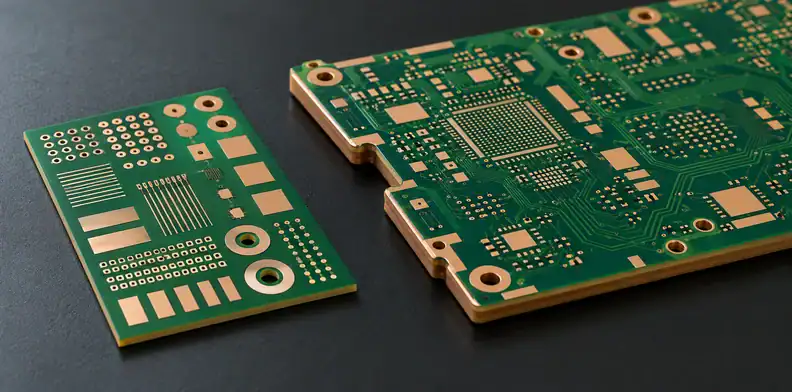
Quick Answer: Only remove nonfunctional internal pads where the design owner has approved it in writing, for named hole populations and layers. Functional connections and lands kept for support or controlled relationships are never on the list. Any reliability evidence the fabricator offers must match your actual construction and thermal history before it can justify the change.
A CAM query reading “remove unused pads?” leaves the buyer with an incomplete decision. It does not identify the affected holes, layers or released data. PCB nonfunctional pad removal needs a defined scope that the design and quality owners can assess before fabrication starts. The two suggested records below turn that query into a reviewable instruction without setting a universal retention policy.
What exactly is a fabricator proposing to remove?
The proposal concerns copper lands on internal layers where a plated hole has no electrical connection. The hole and its plated barrel remain. Classify each land as a functional connection, an unconnected removal candidate, or an exception retained by requirement before anyone reviews a proposed deletion.
An unused land can appear in the design database, the exported fabrication data or a fabricator's CAM preparation. Ask which data set the proposal changes. An instruction accepted during layout review may not describe the final export, and an unchanged file name does not establish that its copper features stayed unchanged.
Start with the hole population and layer map. Backdrilling removes a different part of the via structure; microvias, press-fit qualification and outer-layer component lands each need their own review. Keep those decisions outside an NFP removal instruction.
Which internal lands should stay off the removal list?
Keep every functional connection outside the removal scope, including trace connections, plane connections, thermal-relief spokes and land-to-trace junctions. Also identify unconnected lands retained for support or a required geometric relationship. A lack of electrical connectivity alone does not establish that a land serves no design purpose.
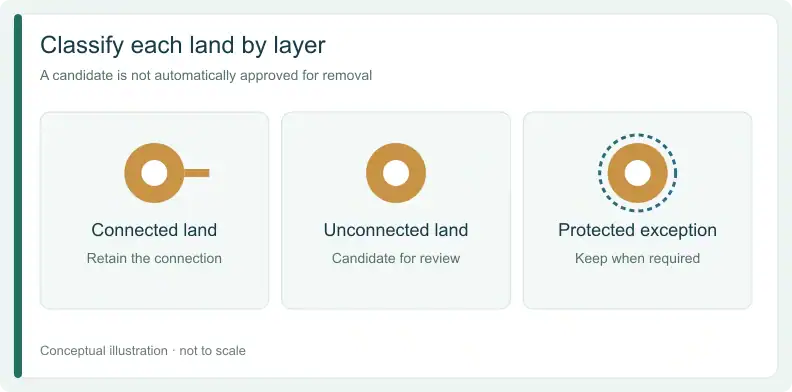
The buyer's map should distinguish the three classes visibly. Label a connected land by its connection, a candidate by the proposed deletion, and a retained exception by the reason it stays. This makes an ambiguous “all unused pads” instruction easier to challenge before CAM work proceeds.
QueenEMS' guidance on stepped-thickness stackups specifically preserves apparently unused pads when they provide support or maintain a controlled relationship. Carry that exclusion into the removal record for the affected zone. Do not let a general supplier preference override a drawing-specific exception.
Does removing unused pads change electrical behavior?
Removing a land can change the electrical behavior of the via, but the direction and size depend on its geometry, surrounding copper, stackup and operating frequencies. Ask the signal owner to evaluate the proposed padstack against the released design. A general claim that deletion improves signal integrity cannot approve the change.
Altium's design explanation states that “there is no generalized rule about the use of non-functional pads.” It also describes layer-selective padstacks. That supports specifying individual layers, without proving that any particular selection meets your electrical requirements.
Attach the signal owner's conclusion to the identified before-and-after padstack. Record which geometry and frequency range the assessment covers. If the supplier changes the proposed layer population afterward, send that revised population back for review rather than carrying the earlier approval forward.
What does published reliability evidence actually show?
Published evidence shows that an NFP change can affect reliability in a particular construction. A 2009 NPL and PWB Interconnect Solutions study found better results with pads removed in its specimens, while placing that effect below plating and material quality. Its findings cannot establish a deletion policy for unrelated boards.
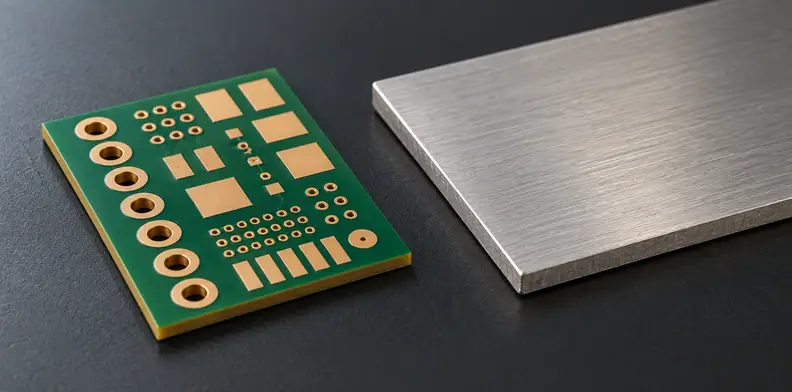
The original paper hosted by IPC describes a 2.5 mm, 10-layer board with 10:1 plated through-holes, phenolic-cured high-Tg glass-epoxy and immersion silver. Conditioning included six reflows at 260°C. These details define the experiment; they are not acceptance requirements for your order.
The methods also used different failure criteria. Thermal cycling monitored resistance exceeding 5 kΩ for more than 200 ns; IST used a 10% resistance increase. Comparing the results requires retaining those endpoints. Neither a cycle conversion nor a field-life prediction follows from their rankings.
Use the historical experiment to frame questions about the supplier's evidence. It is research hosted by IPC, rather than a current normative IPC requirement or a QueenEMS qualification result.
How should an approved removal scope be written down?
Write a revision-controlled instruction that identifies the permitted hole populations and layers, the retained exceptions and the reason for each proposed change. Connect the instruction to the fabrication drawing or purchase order. The approvers should be able to locate the same scope in the released data and the supplier's acknowledgment.
The authors of a 2014 PCD&F survey recommended recording the acceptance instruction on the drawing or purchase order. Their historical survey found differing supplier practices; it does not establish what suppliers generally do today.
Use this suggested NFP removal scope record as a buyer's working form. Complete the blank fields for the actual job. It is an authored procurement aid, not an IPC form.
| Scope field | Entry for the released job |
|---|---|
| Hole population and net group | |
| Board zone and relevant transition | |
| Layers with functional connections | |
| Layers proposed for land removal | |
| Retained layers and support or relationship requirement | |
| Signal owner's electrical assessment | |
| Gerber and drawing revisions before and after | |
| Design and quality approval roles, names and dates | |
| Fabrication drawing note or purchase-order reference |
The supplier's acknowledgment of the PCB nonfunctional pad removal should identify this record and its revision. “DFM accepted” leaves the approved land population unclear.
For a quotation and free DFM review, send QueenEMS your Gerber files, stackup and fabrication drawing, including the proposed NFP scope and retained exceptions. Request confirmation of project-specific manufacturing and evidence needs before approving a data change. Add a BOM if assembly is also requested.
When does supplier test evidence apply to your board?
Supplier evidence supports a removal approval when the tested specimen represents the relevant features of your released construction. Compare the materials, thickness, hole geometry, plating, pad population and thermal history, together with the test method and failure endpoint. Record each mismatch or unknown before deciding how far the evidence applies.
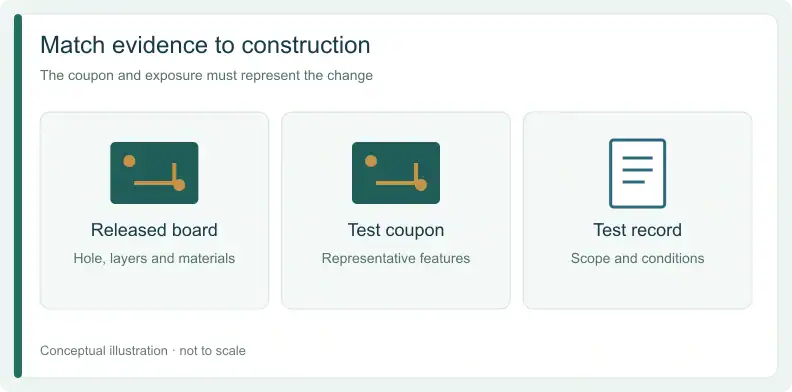
The following comparator is a suggested review aid. Enter the drawing requirements and the report's stated conditions side by side; leave no unknown disguised as a match. The study's construction and differing endpoints explain why these fields belong together. A high-layer board with a different thickness, aspect ratio or land population is not represented by a 10-layer coupon simply because the hole type matches.
| Comparison field | Released board | Tested coupon | Match, mismatch or unknown |
|---|---|---|---|
| Materials and resin system | |||
| Thickness and layer count | |||
| Hole aspect ratio and finished geometry | |||
| Plating basis and surface finish | |||
| Layers with lands retained or removed | |||
| Preconditioning and reflow exposure | |||
| Thermal test method | |||
| Failure endpoint | |||
| Features represented by the coupon | |||
| Report source, date and qualification owner |
A quality owner may request additional evidence or restrict the approved population when the comparison exposes a gap. Mixed-material plated holes need an evidence plan for that construction. This form supplies no universal pass count and does not turn a supplier report into approval by itself.
Who should sign off, and what if nobody approves?
The design-release authority should approve the affected lands and layers, with the quality or reliability owner judging whether supporting evidence is sufficient. CAM can propose the edit and document its implementation. If the responsible owners have not approved the scope, hold that change and ask for a recorded decision before fabrication.
This is a recommended release arrangement; your purchase agreement should identify the responsible roles. Keep the design instruction, evidence disposition and supplier acknowledgment together so another reviewer can reconstruct what was authorized.
After approval, check the final fabrication data against the scope record. Deleting an unconnected land does not remove the hole or its registration requirements. Continue to apply the drawing's annular-ring and breakout acceptance requirements to the finished construction. A later change to the permitted layers or hole population needs a fresh disposition.
Frequently Asked Questions
Is a nonfunctional pad the same as an antipad?
No. A nonfunctional pad is a copper land without an electrical connection on that layer. An antipad is a clearance around a hole in a plane. Keep these features separately identified in the proposed edit. Removing a land does not authorize a change to the plane clearance.
Does removing nonfunctional pads remove the via stub?
No. The plated barrel remains when internal lands are deleted. A via-stub or backdrilling decision concerns a different part of the structure and needs its own defined scope. Do not accept a claim of stub removal when the submitted change only deletes unconnected lands from selected layers.
Can CAM remove unused pads automatically at data preparation?
Removal can occur during design, data export or CAM preparation. Ask which stage and revision the proposal affects, then compare the final data with the agreed scope. Set the authorization rule with the supplier before release; a CAM operation or software default does not identify who accepted the design change.
Does IPC Class 3 require keeping nonfunctional pads?
This article establishes no IPC Class 3 rule for retaining or removing these lands. Check the applicable requirements in the exact documents and revisions invoked by your drawing. Record the agreed instruction and exceptions on the drawing or purchase order instead of treating a forum statement as a requirement.
QueenEMS has more than 10 years of experience. For a quotation and free DFM review, upload your Gerber files, stackup and drawing with the NFP scope record and evidence requirements. Add a BOM for an assembly request. Confirm the proposed construction and documentation scope for your project before release.
Upload your files today · Free DFM check before production · Ship worldwide
Get your PCB prototypes in as fast as 24 hours. We handle FR4, Rogers, and hybrid boards, with standard builds up to 24 layers and higher layer counts subject to engineering review — free prototypes for 2–4 layer FR-4 boards, no minimum order.
Just upload your Gerber + BOM — we source every part, assemble, and inspect (AOI + X‑Ray) so you don't have to chase suppliers. PCB assembly typically takes 5–8 working days once all components are in stock. The confirmed delivery schedule is subject to your quotation.