
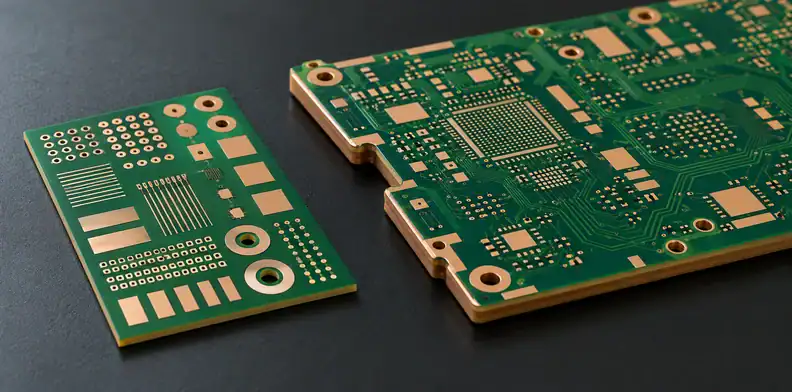
Quick Answer: Approve RCC or prepreg and foil as a named construction for a specific HDI build-up layer, with its pressed dielectric target and finished copper build defined. Check the product’s resin, reinforcement and any removable carrier rather than relying on the route label. A proposed substitution needs a fresh review of geometry, via-process qualification, adhesion evidence and the electrical model before release.
A stackup line marked “RCC” can leave several physical inputs unspecified. The same problem occurs when a quote offers “PP + foil” without naming the prepreg, copper and ply arrangement. An HDI RCC vs prepreg decision becomes reviewable when both alternatives describe the layer you intend to buy. Start by identifying those alternatives, then decide which evidence supports the proposed substitution.
What does each HDI build-up construction physically supply?
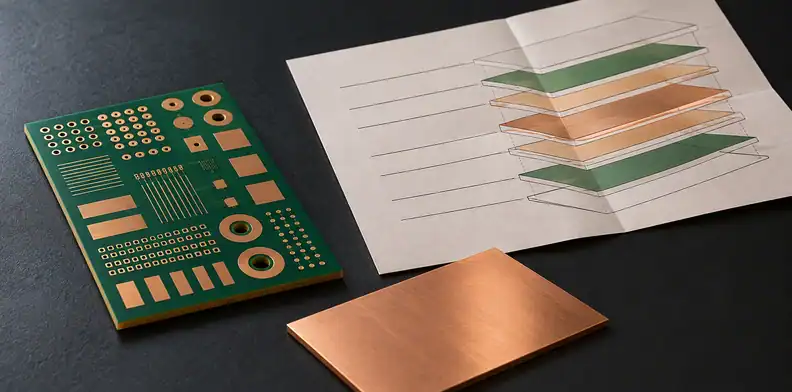
RCC supplies copper with resin already attached, while a prepreg-and-foil lay-up uses separate, partially cured prepreg plies and copper foil. Approve the physical inputs for the named build-up layer pair. The route name alone does not identify the reinforcement, temporary support or the geometry of the finished layer.
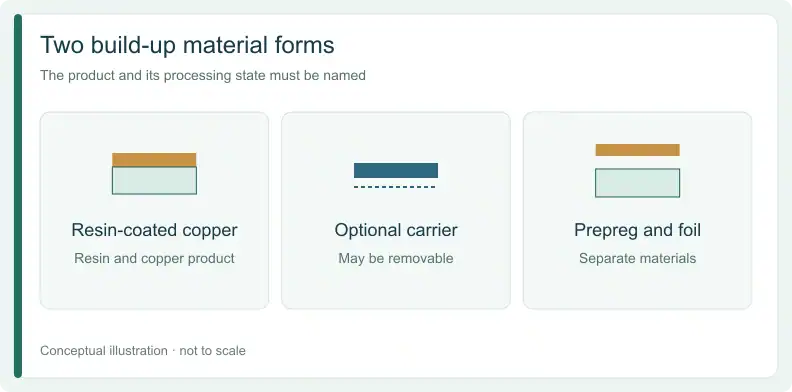
Prepreg already contains resin before it enters the press. JLCPCB's prepreg manufacturing explanation describes the impregnated, partially cured reinforcement. Lamination lets that material flow and cure; it does not begin by adding resin to dry reinforcement.
An undated historical AlliedSignal technical paper hosted by Isola describes coated copper constructions that combine resin and foil. Use that distinction to identify the supplied parts, without carrying its historical processing speeds or economics into a current order.
This build-up layer identity card is an author-proposed worksheet. Complete both options from the actual suppliers' documents. Empty cells mean information is still needed; they do not establish equivalence.
| Identity field | Named RCC or RCF option | Named prepreg and foil option |
|---|---|---|
| Target layer pair and function | ||
| Manufacturer, product, part and revision | ||
| Resin system and reinforcement | ||
| Product copper thickness | ||
| Carrier or film and removal stage | ||
| Nominal supply dielectric thickness | ||
| Pressed dielectric datum and tolerance owner | ||
| Finished copper build |
Why doesn’t the RCC label identify the material you will get?
The RCC label leaves the product construction unspecified. Identify the manufacturer, part and revision, then verify the resin build, reinforcement and support layers from that product's documentation. A description of one unreinforced grade cannot settle the reinforcement of every product offered under the same broad label on a quotation.
The historical AlliedSignal paper distinguishes single-coated and dual-coated resin constructions. It provides context for asking which resin structure arrives, rather than a current list of interchangeable materials.
Ventec's VT-770 RCC and RCF datasheet documents an unreinforced example. Keep its grade and product form attached to any values taken from it. “Equivalent RCC” on a revised quotation leaves the proposed replacement unidentified until the supplier names the product and provides its documentation.
Ask for the corresponding prepreg datasheet and ply arrangement too. The worksheet does not preselect a prepreg; the named option and its datasheet come from your fabricator or laminate supplier.
Which copper and carrier layers stay in the finished board?
Separate retained product copper from any temporary carrier or backing film. Carrier-supported products use a removable support that must be identified in the lay-up record, while other product forms may use a film instead. Record the removal stage and the retained copper separately before accepting a drawing of the finished construction.
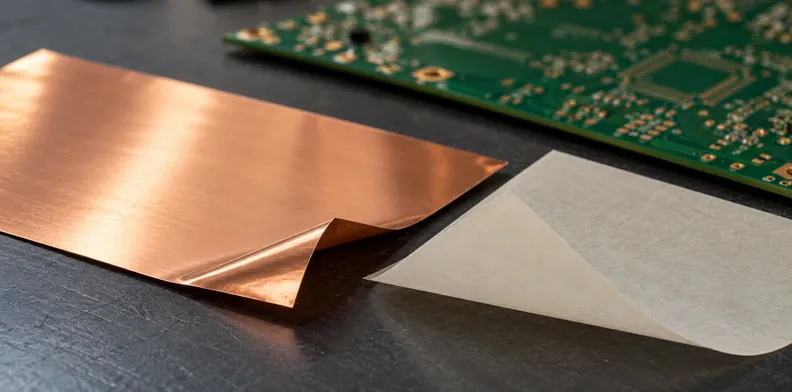
Ventec's example lists thin product copper of 1.5–5 µm on an 18 µm carrier, and describes an RCF form supplied on PET. These identify documented supply options within that family. They do not describe every RCC product or establish the copper build of your finished circuit.
The identity card therefore has separate entries for product copper, temporary support and finished copper. Ask the fabricator to resolve any drawing that appears to retain the carrier as circuit copper. Also record whether later plating changes the retained copper build; the incoming foil thickness cannot answer that question by itself.
How does nominal supply thickness relate to the pressed layer?
Nominal supply thickness identifies an incoming material option; the released stackup needs a finished dielectric target with a defined datum. Ask the fabricator to relate those two stages for the actual resin and underlying copper distribution. Record who owns the pressed tolerance before the electrical model uses that layer height.
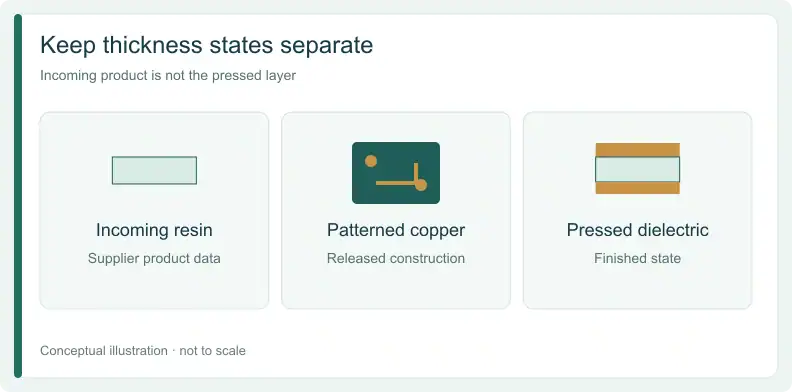
The Ventec availability list includes nominal resin thicknesses of 25, 50 and 75 µm. Treat those as supply information, rather than as a tolerance statement for a pressed layer over patterned copper.
Sierra Circuits discusses copper percentage and pressed-out thickness in its laminate manufacturing comparison. For the broader material roles, use QueenEMS' core and prepreg explanation. This release decision still needs the finished layer's drawing definition, including the copper feature and measurement locations used to judge it.
What evidence should approve an HDI RCC vs prepreg swap?
Review a substitution against the named replacement construction and the target layer it must produce. Check pressed geometry, underlying copper fill demand, the scope of via preparation and metallization qualification, adhesion evidence and the electrical model. Keep unresolved items assigned to an owner rather than accepting a route label as their disposition.
Use this suggested route-substitution evidence sheet with the identity card. Each row must name the construction on which the evidence was generated. Until a reviewer compares the evidence with the ordered construction, its status remains Open. Mark Transfers when the evidence was generated on the same named product, copper build and test condition as the ordered layer. Mark Partial when the product matches but the specimen, condition or copper build differs, and record what reconciles the difference. Mark Must re-prove when the evidence came from a different product form or material. These are review dispositions, not a requirement to repeat every test.
| Evidence item | Construction named in the evidence | Status | Gap, action and owner |
|---|---|---|---|
| Pressed geometry and copper fill | Open | ||
| Laser, desmear and metallization qualification | Open | ||
| Adhesion and specimen copper build | Open | ||
| Dk and Df method, frequency and specimen | Open | ||
| Electrical model update | Open | ||
| Representative coupon and inspection | Open | ||
| Disposition sign-off | Open |
An approval should close a specific gap. For example, a via-process report must identify which replacement material and copper interface it covers before the process owner decides whether it supports this layer. A report generated only on the original prepreg-and-foil route would be Must re-prove for an RCC replacement. The worksheet supplies no press cycle, laser setting or automatic substitute.
Send Gerber files and the proposed stackup to QueenEMS for a quotation and free DFM review. Include the named build-up options and unresolved substitution items. Request confirmation of project-specific material, route and evidence availability; add a BOM if assembly is part of the request.
Which supplier data transfers to your layer?
Supplier data applies within its stated product, specimen and test conditions. A typical material value can inform selection while leaving finished-layer acceptance unresolved. Compare the report's method, frequency and copper build with the ordered construction, then record which claim transfers and which still needs evidence for the proposed layer pair.
Ventec identifies its tabulated properties as typical values rather than specification values. Its peel-strength specimen uses 5 µm foil plated to 20 µm. Preserve that specimen description when reviewing adhesion evidence for a different copper build.
Two entries illustrate how to use the sheet. A typical Dk value has Partial status for a finished impedance requirement until the test method, frequency and specimen are reconciled with the impedance model. The documented peel specimen also has Partial status when the proposed product uses a different copper build; the quality owner must decide what further evidence resolves the difference. Neither entry establishes a failed board or a mandatory retest.
Who approves the construction before stackup release?
Assign the electrical model to the design owner, construction feasibility and process qualification to the fabricator, and evidence sufficiency to the quality owner. The buyer should preserve the agreed material identity on the order. Release the named layer construction only after each open item has an owner and a recorded disposition.
This is a suggested division of responsibility. Identify the actual approving roles in your project documents, and carry the identity-card revision into the supplier's acknowledgment. A new part number, support layer or pressed target should return to the relevant reviewer.
Patterning is a separate decision, covered in QueenEMS' guide to choosing between SAP and mSAP. Selecting an RCC supply form does not establish that patterning route or qualify a laser-via process. Keep those process decisions attached to their own evidence when the stackup is released.
Frequently Asked Questions
Is RCC cheaper than prepreg and foil for HDI?
Obtain quotations for the two named constructions against the same target layer and acceptance requirements. The sources here establish no universal cost ratio. Include the work needed to support a substitution in that comparison rather than comparing incoming material prices while leaving qualification and finished geometry unresolved.
Is all resin-coated copper glass-free?
Check the documented reinforcement of the product being offered. VT-770 is an unreinforced example, which does not establish a rule for every RCC label on a quote. Request the actual manufacturer's part and construction details before completing the reinforcement field or accepting a proposed replacement.
Does choosing RCC mean the board uses mSAP or laser vias?
No. The supplied resin-and-copper construction does not establish the patterning or via-process route. Confirm those choices with the fabricator, including the scope of applicable qualification. A thin product foil or familiar material designation alone cannot show that the proposed combination is approved for the board.
Is prepreg resin applied during lamination?
Prepreg enters the lay-up with resin already impregnated into its reinforcement and partially cured. During lamination it flows and cures further. Identify the actual prepreg product and ply arrangement before relating its incoming state to the pressed dielectric required by the released stackup.
QueenEMS has more than 10 years of experience. To request a quotation and free DFM review, upload the Gerber files, stackup and fabrication drawing with the named layer construction and substitution evidence sheet. Add a BOM only if you also need assembly. Confirm material and process scope for the individual project before release.
Upload your files today · Free DFM check before production · Ship worldwide
Get your PCB prototypes in as fast as 24 hours. We handle FR4, Rogers, and hybrid boards, with standard builds up to 24 layers and higher layer counts subject to engineering review — free prototypes for 2–4 layer FR-4 boards, no minimum order.
Just upload your Gerber + BOM — we source every part, assemble, and inspect (AOI + X‑Ray) so you don't have to chase suppliers. PCB assembly typically takes 5–8 working days once all components are in stock. The confirmed delivery schedule is subject to your quotation.