
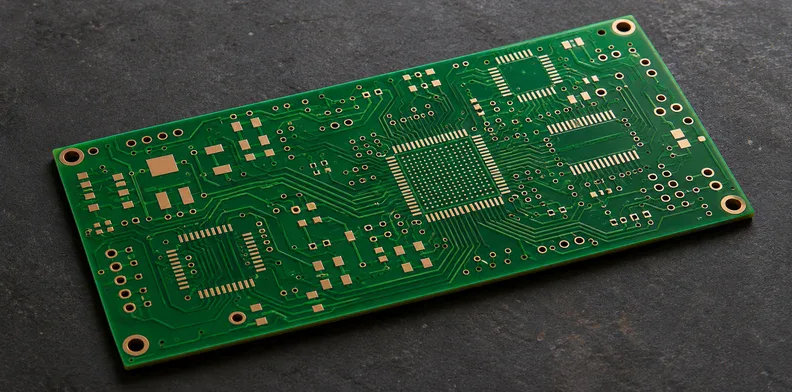
Quick Answer: Before accepting a low outgassing PCB for vacuum hardware, match the evidence to the exact materials, cure and manufacturing condition of the board you are buying. A laminate report or NASA database entry covers its tested specimen, so added bond films, solder mask, legend and processing need an explicit evidence review. Record the project’s acceptance criteria, unresolved gaps and authorized disposition before releasing the construction.
A supplier may send a recognizable laminate data sheet while your drawing specifies several additional materials. Start with the delivered construction and work backward to the reports. That makes the discussion concrete: which evidence applies, which materials remain uncovered, and which decision is still open?
What does an ASTM E595 test measure?
ASTM E595 measures specimen mass loss and collected condensable material under a defined vacuum exposure. Its public scope specifies a specimen at 125°C for 24 hours and a collector at 25°C. The reported percentages describe that specimen under those conditions; they are neither a gas-load rate nor a prediction of years in service.
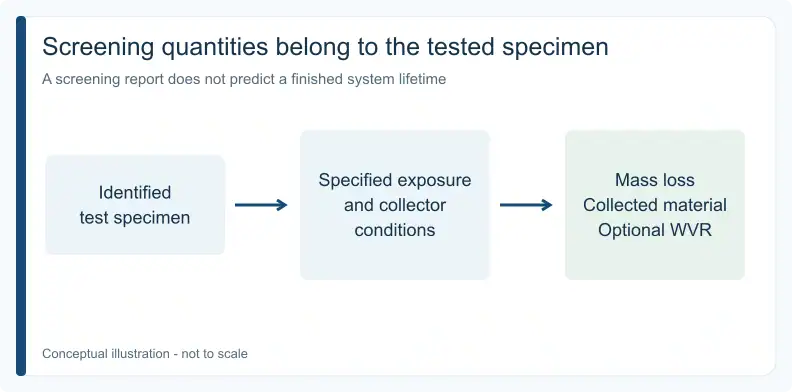
The public method scope specifies pressure below 7 × 10⁻³ Pa, or 5 × 10⁻⁵ torr. Total mass loss, TML, expresses lost specimen mass as a percentage of its starting mass. Collected volatile condensable material, CVCM, expresses the collector's mass gain relative to the same starting specimen mass.
The NASA user guide also describes optional water vapor regained, WVR, after exposure to controlled humidity. Keep these results separately identified. The collector condition also limits what is detected: substances that condense only below its temperature can escape that measurement. A screening report therefore needs interpretation against the contamination problem you are trying to prevent.
Is a NASA database entry an approval for your board?
No. A NASA outgassing database entry supplies material-selection evidence for an identified sample and processing condition. It does not establish acceptance of your finished PCB. Compare the entry's material designation, cure and test reference with the ordered construction, then record whether those details match, differ or remain unknown.
The database and its guide identify fields such as cure time, temperature, atmosphere and data reference. Some entries have unknown cure information. Several entries for a similarly named material can describe different preparation conditions, so a trade name alone cannot settle which result applies.
The guide also warns that products, formulations and manufacturing locations can change after testing. For critical applications, it recommends considering tests on individual batches. Keep the date and sample identity with the result. A historic entry can help select a candidate without establishing that a current lot, alternate cure or finished circuit has the same behavior. An entry also does not mean the material met a screening level; the guide applies the historical TML and CVCM screen as a separate filter on its compilation.
Why does a laminate report leave construction gaps?
A laminate report represents the material specimen and preparation described in that report. It does not automatically represent additional bonding materials, mask, legend or finished-board processing. Read the specimen description before using a reported value to release a construction, especially when the submitted sheet removes materials that your board will retain.
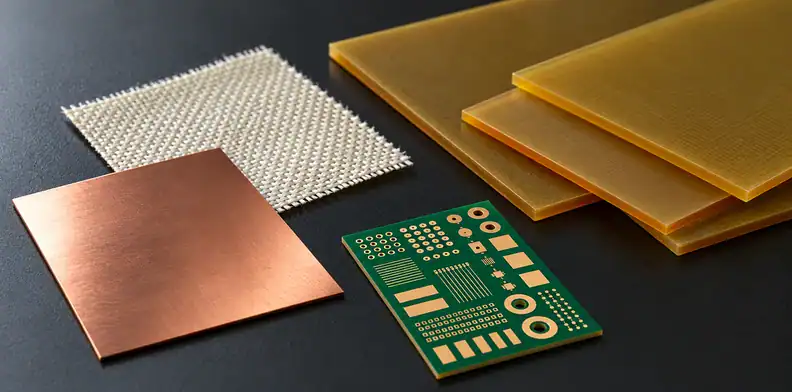
Rogers' laminate outgassing data, publication 92-304, revision 112624, states that its specimens were etched free of copper foil. Its reported conditions include pressure at or below 10⁻⁶ torr. Preserve that specimen and pressure description rather than silently replacing it with a different report's conditions.
That sheet can support a laminate-selection decision. It does not characterize every subsequently added constituent or the fabricator's delivered process condition. Ask what the specimen included, what it excluded, and which parts of your drawing the report actually represents. A familiar material brand does not answer those questions by itself.
Which low outgassing PCB materials need evidence?
Review every constituent and process condition that your actual construction uses. Identify the exact core, cured prepreg or bond film, mask, legend and any fill, adhesive or coating, then map each to applicable evidence. Mark materials absent from the drawing as not used, so the review does not create unnecessary test requirements.
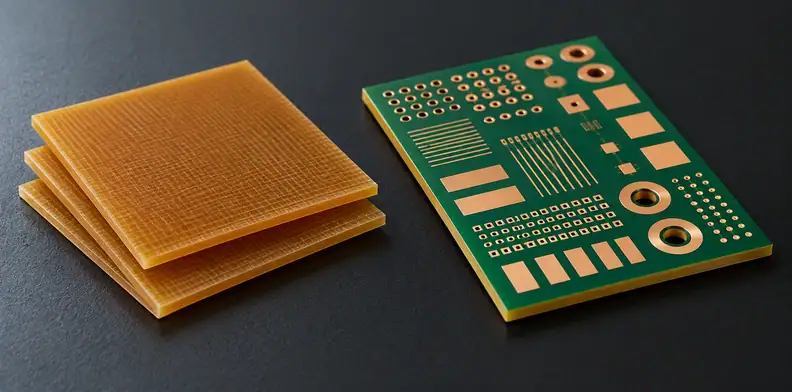
The following coverage map is a suggested procurement aid. Complete it against the released drawing and the proposed manufacturing record. A blank cell remains an open question; a laminate report does not close unrelated rows.
| Construction item | Identity to record | Evidence comparison | Disposition to record |
|---|---|---|---|
| Core | Grade and revision | Tested material and specimen preparation | Matched, different or missing |
| Prepreg or bond film | Product and cured condition | Reported cure versus proposed cure | Covered, open or not used |
| Solder mask | Exact product and cure | Applicable material or representative-build evidence | Covered, open or not used |
| Legend ink | Product and application condition | Whether evidence includes this constituent | Covered, open or not used |
| Fill, adhesive or coating | Each added material actually used | Identity, preparation and report scope | Covered, open or not used |
| Finished-board condition | Lamination, cleaning and handling record | Whether the evidence represents delivered processing | Reviewer, decision and rationale |
Retain report identifiers, test conditions and results beside the completed map. A polyimide trade name still requires a separate material-grade selection decision; this table checks evidence applicability after the construction is defined.
For a quotation and free DFM review, send your Gerber files, stackup drawing and exact material, mask and legend requirements. Include your program’s outgassing evidence requirements; add a BOM only if assembly is requested. Material availability and project-specific documentation scope require confirmation with the RFQ.
Who sets low outgassing PCB acceptance criteria?
The purchaser's project sets acceptance criteria against its component or system requirements. ASTM E595 identifies 1.00% TML and 0.10% CVCM as historical spacecraft-material screening levels, while leaving acceptance or rejection to the user. Those figures do not automatically release a finished PCB for every vacuum environment or contamination-sensitive instrument.
Define the applicable criteria, report conditions, representative construction and decision authority before ordering. The standard's public scope explains that configuration, temperature and processing differences limit direct application to a system. Using acceptable materials alone does not guarantee that the system remains uncontaminated.
Separate the bare-board boundary from later assembly. Components, fluxes, coatings and cables added afterward need their own place in the project's evidence scope. The broader harsh-environment fabrication review addresses mission-profile questions; an outgassing report addresses a narrower measured condition. Neither replaces the system's required functional or qualification work.
How should you resolve missing or mismatched evidence?
Keep a missing or mismatched item open until an authorized reviewer records its disposition. Obtain evidence for the matching material and cure, define representative testing, or document an accepted rationale against the project's criteria. Treat an unknown preparation condition as an uncertainty to resolve, rather than silently labeling the material or board a pass.
Use this suggested decision branch with the coverage map:
- Identity and preparation match: record the report and its applicable boundary.
- Identity matches but cure differs or is unknown: retain an open item and define what evidence would resolve it.
- A constituent or delivered process is unrepresented: ask the customer's materials reviewer to define representative evidence, a coupon or finished-board test, or a documented disposition.
- The construction changes after review: reopen affected rows before relying on the previous decision.
Constructed purchasing example: a supplier submits the specified laminate's manufacturer sheet, but the drawing also includes bond film, solder mask and legend. Record the laminate evidence; leave the other three constituent rows open. This example contains no measured board result. Averaging the constituents' percentages would not reproduce a test on that finished construction.
When should a change reopen the evidence review?
Reopen the review when a change could alter the material, preparation or delivered condition represented by the evidence. Relevant changes include formulation or revision, cure schedule, mask or legend product, bonding or fill material, cleaning, baking and storage exposure. Review the affected evidence before extending an earlier disposition to the changed construction.
This is a suggested change-control practice derived from the source limitations, rather than a universal requirement to repeat every test after every change. Identify the changed row, explain why its existing evidence still applies or what is missing, and retain the authorized decision with the construction revision.
Keeping that record makes a repeat order reviewable. A purchasing description that still says the same material family can conceal a different mask, preparation or supplier process. The relevant question is which tested condition the new delivery represents.
Frequently Asked Questions
Does a NASA outgassing database listing certify a PCB material?
No. The listing provides material-selection data for the identified specimen and processing condition. Match those details to the proposed material and construction; database presence does not establish a certification or your project's acceptance decision.
Can WVR be subtracted from TML automatically?
No automatic substitution should be assumed. Report WVR separately and apply the criterion your project specifies. Replacing TML with TML minus WVR changes the reported quantity and needs an explicit basis in that criterion.
Does baking a board make it low outgassing?
Not by itself. A bake changes the board’s process condition, so acceptance still depends on evidence that represents the baked and subsequently exposed construction against your project’s contamination requirement. The sources here provide no universal bake recipe for a finished PCB.
Is a vacuum compatible PCB the same as passing ASTM E595?
No. The screening test describes one specimen and exposure condition. Compatibility with a vacuum instrument also depends on the project's temperatures, sensitive surfaces, configuration and required system testing, including limitations of what the screening collector detects.
QueenEMS has more than 10 years of experience. For a quotation and free DFM review, upload your Gerber files and stackup with the exact construction and evidence requirements; add a BOM only if assembly is requested. Confirm project-specific material and documentation needs before release.
Upload your files today · Free DFM check before production · Ship worldwide
Get your PCB prototypes in as fast as 24 hours. We handle FR4, Rogers, and hybrid boards, with standard builds up to 24 layers and higher layer counts subject to engineering review — free prototypes for 2–4 layer FR-4 boards, no minimum order.
Just upload your Gerber + BOM — we source every part, assemble, and inspect (AOI + X‑Ray) so you don't have to chase suppliers. PCB assembly typically takes 5–8 working days once all components are in stock. The confirmed delivery schedule is subject to your quotation.