
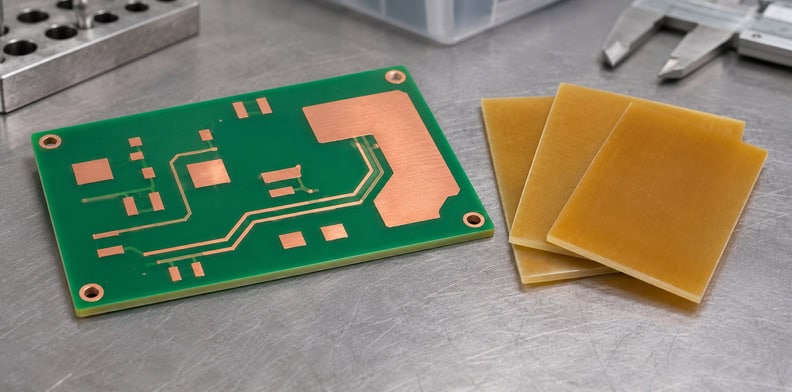
Quick Answer: For CTI PCB material specifications, name the rating system, its declared basis and an identifiable laminate grade. A CTI value in volts, a UL performance level category (PLC) and an insulation material group express different information. Check the source declaration before interpreting a quoted category, and keep the finished board’s voltage and spacing requirements under the product’s safety review.
A purchasing line that says “high-CTI FR-4” leaves several decisions open. The supplier could return a voltage value, a PLC number or a material-group label, and the buyer still needs to determine whether that answer addresses the drawing. This guide to CTI PCB ratings explains those labels and shows how to turn them into a readable fabrication requirement.
What does a CTI rating tell a PCB buyer?
A comparative tracking index describes an insulating material’s relative resistance to surface tracking under a defined test. Tracking can form a conductive path across a contaminated insulating surface. For a PCB buyer, the rating helps identify the material information needed for the design’s insulation requirements; it does not assign the completed board a working voltage.
Think about what the supplier is describing. A laminate declaration concerns an insulating material. A fabricated board also has conductor geometry, exposed surfaces, openings and a particular construction. The designer uses the relevant material information within the product’s electrical requirements. Purchasing needs a clear way to identify that information in the material being offered.
A number such as “600” becomes useful only after its label is known. In a material document it might accompany CTI; elsewhere on the order a voltage could describe an electrical test or operating condition. Keep the property name and units with the value when transferring it from engineering to a quotation request. A spreadsheet column headed only “voltage” cannot preserve that distinction.
Keep the design’s required rating separate from the supplier’s declaration about the offered grade.
This article stops at interpreting and specifying the material rating. The high-voltage PCB design and RFQ guide covers the broader safety inputs, including the design’s spacing assumptions. Keep those decisions with the responsible engineering team when preparing the board order.
How are CTI PCB ratings expressed in volts, PLC categories and material groups?
A CTI value states a material result in volts, while a PLC category or material group places a declared result into a range. Their numbering systems differ. Read the range and its source instead of comparing the labels as numbers, and confirm the declaration’s basis before using a category to answer a requirement written in another form.
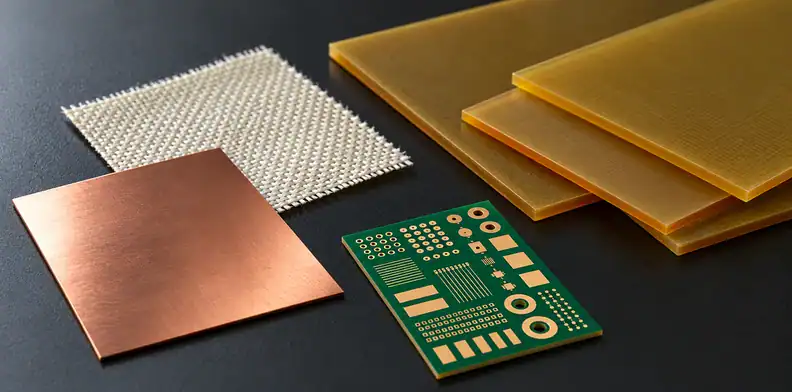
UL Solutions’ IEC 60112 service page describes relative tracking resistance and lists four insulating material groups. UL Prospector’s CTI reference lists six PLC categories and explains that categories avoid excessive implied precision. The table below separates the published ranges; it does not establish interchangeability between methods, recognition records or certificates.
| Information received | Published numerical description | How to read it on an order |
|---|---|---|
| CTI value, in volts | A stated result rather than a category number | Keep the property, units and declaring document together. |
| UL PLC category | 0: at least 600; 1: 400–599; 2: 250–399; 3: 175–249; 4: 100–174; 5: below 100 | A lower category number describes a higher published tracking-index range. |
| Insulating material group | I: at least 600; II: 400 to below 600; IIIa: 175 to below 400; IIIb: 100 to below 175 | Use the named group and declaration basis. These are not PLC category numbers. |
Which boundaries align, and what can a category leave unresolved?
Numerically, the published boundaries coincide at 600, 400, 175 and 100 volts. The PLC table adds a boundary at 250. The IIIa band, from 175 to below 400, spans the PLC 2 and PLC 3 ranges. Using that comparison to read a particular declaration still depends on its stated basis. A label such as “group 3” loses the distinction between a PLC category and a Roman-numeral material group.
Category information also has limited resolution. If a design requires a value within a category’s range, the category alone may leave the requirement unsettled. For an explicitly hypothetical example, a declared PLC 2 covers the published 250–399 band. That category alone cannot show whether a separate requirement of CTI at least 300 is met. This example explains the information gap; 300 is not a recommended design threshold.
At a shared boundary, the numerical ranges may align while the documents still require review. Retain the test or declaration basis printed in the source. The arithmetic in a range table cannot supply missing material identity, establish an equivalence between test methods, or approve a recognized construction. Below 100, the Prospector table lists PLC 5; the material-group table cited here does not assign another group.
Why does CTI answer a different question from Tg or dielectric strength?
CTI concerns surface tracking, Tg describes a material’s glass transition, and dielectric strength concerns breakdown through an insulating specimen. A finished-board electrical test addresses the tested construction under its specified conditions. These properties and results cannot replace one another merely because they appear together in a laminate table or supplier quotation.
For example, “high Tg” describes a thermal property. It gives purchasing no CTI category by itself. A supplier may offer a material with a thermal description that sounds more demanding than the drawing’s original grade, yet still leave the tracking requirement unanswered. Ask for the missing property rather than inferring it from the adjective.
A dielectric-strength figure is reported with its own units and test conditions; entering it in a CTI field changes the meaning of the material line. Keep each property under its original heading, with its units and source. When a technical comparison needs the properties together, give each its own entry.
The same separation applies after fabrication. An electrical-test record does not automatically supply the laminate’s CTI declaration. Conversely, a laminate rating does not show that the finished board has the required electrical separation or has passed a product-specific withstand test. Each requirement needs the evidence that actually addresses it.
Which laminate identity details make a CTI requirement checkable?
Identify the material manufacturer, grade and document that declares the rating, then state whether the quoted information is a CTI value, PLC category or material group. Include the document revision or date and its stated basis. Ask the supplier how that declaration applies to the insulating materials in the proposed stackup.
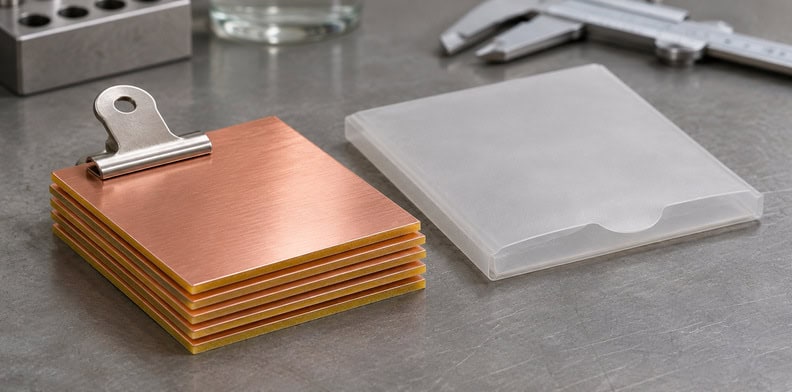
“FR-4” names a broad material class, so it cannot replace a grade designation. Preserve suffixes and other identifiers that distinguish the proposed product. If the quotation names only the material family, ask which specific product the fabricator intends to buy before treating a separate datasheet as applicable.
Read the document heading as well as the number. A typical-property datasheet, a material recognition record and a project-specific declaration may provide different kinds of information. Record what the source actually says. Do not relabel a typical value as a guaranteed minimum or describe a document as a certification that it does not claim to be.
A multilayer stackup can include cores and bonding materials under different product identifiers. Ask which insulating material the CTI declaration describes and which portions of the proposed construction it covers. A result copied from the core’s datasheet should not silently become a statement about every other material in the build. Where the answer depends on a material system or recognition record, request that explanation from the supplier.
Keep an unresolved item visible. If the offered grade is identifiable but the declaration does not state a CTI result, category or group, purchasing has a precise question to send back. Writing “meets high-voltage requirements” in its place removes the information needed to evaluate the offer.
How should a buyer read a quoted material line?
Read the quoted material line against the exact form of the drawing’s requirement. Identify what the supplier declares, what the supporting document covers and what remains unanswered. Stop at a clear clarification or engineering-review request when the evidence is incomplete; a quotation comparison should not silently approve a different laminate.
The following example is hypothetical. It uses invented descriptions rather than actual grades or suppliers. Assume engineering has already written a CTI requirement and wants an identifiable laminate. The task is to determine what each quotation tells the buyer, without choosing a new safety requirement.
| Hypothetical quoted line | What can be checked? | Clarification needed |
|---|---|---|
| “High-CTI FR-4” | No named grade, rating system or declaring document | Request the actual grade and the stated rating. |
| Named grade; PLC category; dated source | The category’s published range can be identified. | Check whether that range settles the drawing’s value-based requirement and whether the source applies. |
| Named grade; stated CTI value; identified declaration | The stated value can be read against the requirement. | Confirm the declaration basis and its applicability to the proposed construction. |
What clarification does each quoted line need?
The first line needs basic identification. Requesting only “a better CTI” could produce another ambiguous response. Ask for the material designation and the source wording so the next answer can be read against the drawing.
For the second line, compare the complete declared band with the required minimum. A band wholly above it can settle that numerical question; a band that crosses it leaves the answer open; a band wholly below it cannot substantiate the minimum. Ask for the missing information when needed, without estimating an exact result from the band. This reading remains conditional on an applicable declaration and does not establish recognition, equivalence or production approval.
Read the requirement and the declaration in the correct direction. If the drawing requires material group IIIa and the supplier declares PLC 2 or PLC 3, both declared bands fall numerically within IIIa. The exact CTI value is not needed to resolve that particular range question, although the declaration’s basis and applicability still need confirmation.
In the reverse case, a drawing might require a particular PLC category while the supplier declares only IIIa. That group alone cannot distinguish PLC 2 from PLC 3. Request the category information needed to address the drawing rather than treating the broader group label as the missing declaration. This is an interpretation of the published ranges, not approval of a test-method conversion.
The third line is checkable, but that does not make it approved. Other design properties, construction requirements and the status of the proposed grade remain relevant. When the offer involves a changed material, use the separate PCB material substitution approval process. This comparison ends with the CTI-specific question that engineering needs to resolve.
How should the CTI requirement appear on the fabrication drawing?
Write the selected rating form explicitly, keep its basis with it, and identify the material designation where engineering has specified one. Use the design owner’s chosen requirement rather than a supplier’s default. A drawing note should let the supplier answer the same question without translating an undefined phrase such as “high tracking resistance.”
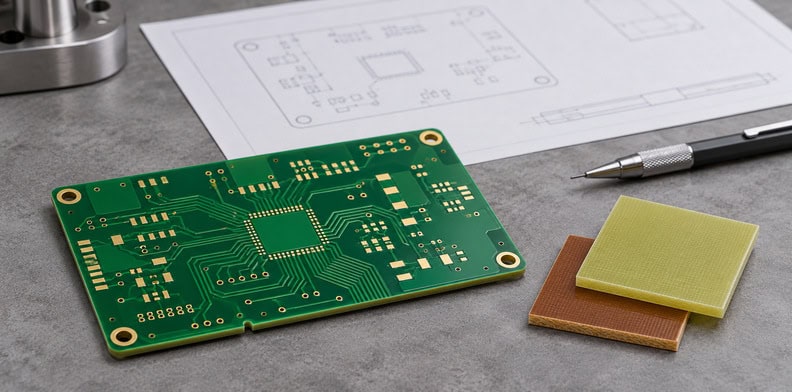
One possible value-based format is: “Laminate grade: [manufacturer and designation]. CTI requirement: [minimum] V, on the stated [test or declaration basis]. Supporting material document: [identifier and revision].” The blanks require project decisions. They are not a recommendation for a minimum CTI or a claim that a particular grade is available.
If engineering instead specifies a PLC category or material group, name that system in full and define the accepted category or group without relying on an unexplained “or better.” Keep any rule for acceptable alternatives with the responsible engineering decision. Avoid combining a PLC number and a group label as though they were the same designation.
How can the drawing separate required and offered categories?
For a category-based request, a parallel format is: “Required rating system: [name]. Accepted category or group: [designation]. Material identity: [manufacturer and grade]. Declaration basis: [identified source].” Keep the required designation in the requirement field and the offered designation in the supplier’s response field. That separation makes a mismatch visible without rewriting either statement during quotation comparison. If engineering accepts more than one category, list the accepted designations explicitly rather than asking purchasing to infer the intended order.
Check the exported drawing, material table and quotation request together. A precise note can become ambiguous again if the purchasing form shortens it to a generic material family. Send the same controlled requirement to each fabricator, and ask unresolved rating questions before treating the price as an offer for the required construction.
Frequently Asked Questions
Is CTI 600 required for every high-voltage PCB?
No universal CTI minimum follows from calling a board high voltage. The applicable product requirements and engineering safety decisions establish the material requirement. The published CTI ranges explain a declaration; they do not choose the requirement for a particular product.
Is CTI the board’s working-voltage rating?
No. CTI describes the insulating material’s tracking behavior under a defined test. The finished board’s working voltage depends on its design and applicable requirements. Keep the material rating separate from a finished-board electrical-test specification.
Does solder mask change the laminate’s declared CTI?
The laminate declaration describes the material identified in that declaration. It does not automatically characterize the solder mask or the completed surface. Ask the responsible safety engineer which surface and construction the product requirement addresses.
Can a supplier substitute a higher-CTI laminate without asking?
A higher declared CTI does not establish that two laminates are interchangeable. Other properties and construction requirements still apply. Refer a changed grade for the required engineering review instead of treating the CTI number alone as substitution approval.
Send your released files for a quote and free DFM review.
Send Gerber, stackup and the approved laminate designation for review. Include the required CTI evidence and ask us to confirm material feasibility.
For an assembled board, add the BOM and identify material-dependent requirements. Confirm the quoted assembly scope after the laminate choice is agreed.