

Quick Answer: PCBA NCNR components are parts that the supplier cannot cancel or return after purchase. Before approving them, review the exact manufacturer part number, required quantity, supplier pack quantity, MOQ or MPQ, excess units, dollar exposure, lead time, lifecycle risk, ownership, storage, and disposition. Approve line by line and separate firm production demand from forecast demand.
Key takeaways – NCNR describes commercial exposure, not component quality. – The assembly quantity and the component purchase quantity are often different. – Approval should identify the maximum committed amount and what happens to unused stock. – A lower assembly price can hide a larger first-order cash commitment.
The first production PCBA order is often the moment when a successful prototype becomes a working-capital decision. A buyer may request 500 assemblies while reels, trays, factory pack sizes, distributor terms, or lead-time constraints require more components than those 500 units consume. Some parts can be cancelled or returned. Others become PCBA NCNR components as soon as the assembler places the purchase order.
That exposure is not automatically unreasonable. Custom, scarce, long-lead, or allocation-controlled parts may require firm commitment. The problem appears when the buyer approves a turnkey quote without seeing which BOM lines create the commitment, how much inventory will remain, or who owns it. Engineers focus on approved MPNs, purchasing focuses on price and availability, and founders focus on cash. A good approval record connects all three.
Table of Contents
- Read NCNR, MOQ, MPQ, and excess as different terms
- Reconcile build demand with purchase demand
- Inspect the BOM lines that create the largest exposure
- Approve a controlled component commitment
- Decide ownership, storage, and future use
- Handle substitutions and lifecycle changes
- Compare turnkey PCBA quotes on cash exposure
- Release the first production buy in stages
- FAQ
Read NCNR, MOQ, MPQ, and excess as different terms
NCNR means non-cancellable and non-returnable. Once the authorized purchase reaches the point defined by the supplier or distributor, the buyer may remain responsible even when its build changes or stops. NCNR does not necessarily mean the component is obsolete, counterfeit, or technically risky. It describes the commercial reversibility of the commitment.
MOQ is the minimum order quantity accepted for a part or price. MPQ is commonly used for minimum or multiple packaging quantity, though suppliers may use terminology differently. Standard pack quantity describes how the manufacturer or distributor packages the part. Lead-time buy indicates that material must be ordered early to support the requested schedule. Excess inventory is the quantity purchased for the customer that remains after current authorized demand, attrition, and agreed reserve are considered.
These terms can overlap but should not be collapsed. A part may have no technical shortage and still create excess because it is sold only in a reel of 3,000. A distributor may accept a small cut-tape order at a higher unit price, while a full reel is NCNR at a lower price. A long-lead connector may match the exact build quantity yet remain non-cancellable.
Ask the assembler to state the definition used in its quotation and purchasing terms. The approval should be based on the actual line exposure, not on an unexplained “NCNR materials apply” footnote.
Reconcile build demand with purchase demand
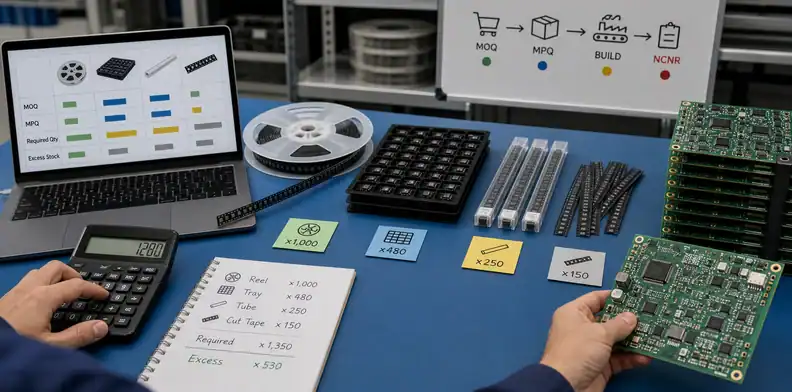
Start with a component demand calculation. Required production quantity equals placements per assembly multiplied by the authorized assembly quantity. Add a justified attrition allowance for setup, feeder loading, process loss, test fallout, and replacement. Then compare that demand with usable customer-owned stock and the proposed supplier purchase quantity.
| Field | Buyer question | Why it matters |
|---|---|---|
| Placements per assembly | Does the BOM quantity match the placement data? | Prevents multiplication errors |
| Authorized build | Is the quantity firm or forecast? | Defines legitimate demand |
| Attrition | Is the percentage or fixed quantity justified? | Avoids hidden padding |
| On-hand stock | Is it usable, traceable, and at the correct location? | Prevents duplicate buying |
| Purchase multiple | Is the part sold in reel, tray, tube, or cut tape? | Explains excess |
| Proposed buy | How many units will be ordered now? | Defines cash exposure |
| Projected balance | What remains after the build? | Supports disposition planning |
Review extended dollar exposure, not just excess pieces. Ten unused low-cost resistors are immaterial; a small number of specialized modules may dominate the risk. Separate purchase value from the assembler’s handling or carrying charge.
The assembler should identify which figures are confirmed by the current supplier quote and which are estimates. Availability and pack sizes can change between RFQ and order. Require reconfirmation before the material purchase is released.
Inspect the BOM lines that create the largest exposure
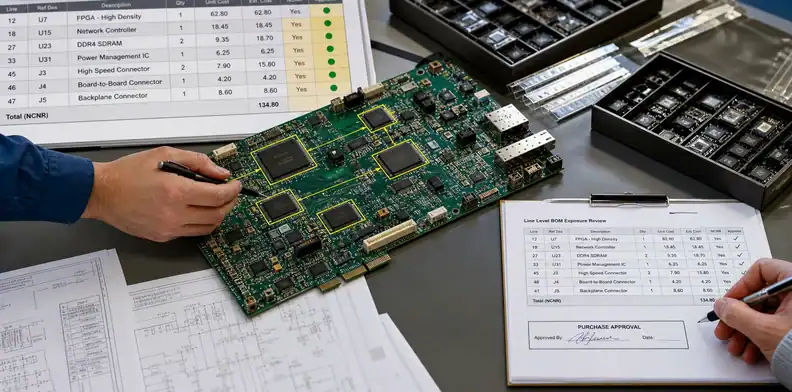
Sort the sourcing report by NCNR exposure, excess value, lead time, and lifecycle risk. The highest unit price is not always the highest decision priority. A lower-cost device with a very large pack requirement can tie up more cash, while a single-source controller can threaten the schedule even with little excess.
For each priority line, confirm the exact manufacturer and MPN, description, approved distributor or source, date-code requirement, lifecycle status, moisture sensitivity when relevant, unit price, currency, quoted validity, lead time, pack quantity, required quantity, proposed buy, excess quantity, and non-cancellable value.
Engineering should confirm that the MPN is truly released. A placeholder, ambiguous suffix, temperature grade, memory density, firmware variant, or package option can turn a commercial commitment into unusable stock. Review manufacturer product-change or end-of-life information for parts with known lifecycle concerns. Do not authorize speculative substitutes under the original MPN approval.
Purchasing should examine source quality. A lower price from an unapproved broker is not equivalent to authorized distribution without a risk-based authentication plan and explicit buyer acceptance. The QueenEMS article on preventing counterfeit components in PCBA explains why source evidence should be decided before procurement.
Quality should identify storage constraints. Moisture-sensitive, temperature-sensitive, programmable, battery, or shelf-life-limited items may lose value during a long forecast gap even when they remain physically on the shelf.
Approve a controlled component commitment
An approval should name the order, BOM revision, line item, manufacturer part number, maximum quantity, maximum extended value, approved source or source class, and latest purchase date needed to protect the schedule. It should state whether the amount is included in the assembly PO or authorized under a separate material commitment.
Avoid open approval such as “buy all long-lead parts.” Long lead time and NCNR exposure are different facts. The buyer may approve one scarce device immediately, request a cut-tape alternative for another, and wait for a forecast decision on a third.
Use four possible dispositions:
- Approve the proposed buy exactly.
- Approve a smaller or staged purchase with a stated schedule effect.
- Approve an alternate source or packaging option after engineering review.
- Reject or hold the commitment until demand is firm.
Record the decision owner. Engineering approves MPN and technical substitution; purchasing approves price and terms; finance or the business owner may approve working-capital exposure above a threshold. The contract or PO should align with those internal decisions.
State the cancellation trigger. Supplier terms differ on when an item becomes non-cancellable: customer approval, distributor order placement, supplier confirmation, shipment, or another milestone. The assembler should not describe the exposure more broadly than its actual upstream commitment.
Decide ownership, storage, and future use
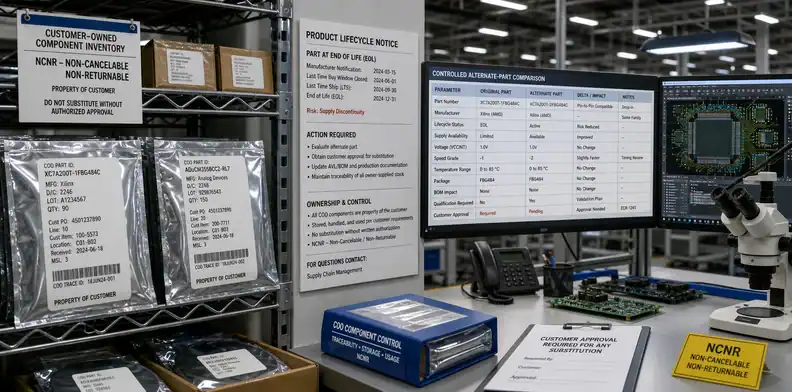
Paying for excess does not automatically answer who owns it, where it will be stored, or how the buyer can retrieve it. Define title, possession, identification, and disposition separately.
Ask how inventory will appear on financial documents. A material deposit, pass-through purchase, customer-owned inventory invoice, and assembly prepayment can have different reconciliation needs. The assembler should connect each charged balance to the approved BOM lines and report whether tax, handling, or currency changes are included. This prevents the same material from being charged once as an NCNR commitment and again as part of a later assembly invoice without a visible credit.
Insurance and loss responsibility also deserve a clear answer for high-value stock. Identify who bears loss while the material is at the assembler, during a transfer, or after a storage deadline. A practical agreement can be short, but it should not leave paid inventory outside both parties’ normal controls.
Request customer-specific labeling or electronic inventory records that connect the balance to the part number, lot or date code, quantity, and purchase authorization. The assembler should keep customer-owned material segregated or traceably controlled. Inventory reports need receipts, consumption, adjustments, scrap, and ending balance.
Agree on storage period and conditions. Components may need dry packing, humidity control, baking rules, ESD protection, security, or periodic inspection. Determine whether carrying charges begin after a defined period and whether the supplier may dispose of inactive material after notice.
Future use should not be assumed. A later BOM revision, EOL event, date-code restriction, storage-life limit, or product cancellation can strand inventory. Set a review date and possible actions: consume in a future build, transfer to another approved assembler, return when permitted, resell with authorization, or scrap with evidence.
When material transfers, specify packaging, documentation, freight, and quantity reconciliation. A list saying “2,000 pieces available” is not enough if the receiving manufacturer cannot verify source, lot, moisture history, or condition.
Handle substitutions and lifecycle changes
An NCNR problem is not solved by substituting another part without approval. The alternate may change form, fit, function, firmware, regulatory status, test coverage, or customer qualification. Use a controlled component substitution process with engineering evidence and a defined effective build.
Ask the assembler to distinguish approved alternates already listed on the BOM from new proposals. For an approved alternate, confirm availability, price, and allocation. For a new proposal, provide datasheet comparison, lifecycle status, source evidence, sample or validation need, and effect on delivery.
When the original component is end-of-life, a last-time buy can create a much larger commitment than one production lot. Treat it as a product-lifecycle decision. Forecast assumptions, service obligations, redesign timing, storage risk, and financing all matter. Do not bury a multi-year last-time buy inside a normal assembly quote.
Excess from the original part should remain visible when a substitution is approved. The decision record should state whether it will be consumed first, retained for service, transferred, or written off. Otherwise the buyer may pay for the old inventory and then fund the new one without seeing the combined exposure.
Compare turnkey PCBA quotes on cash exposure
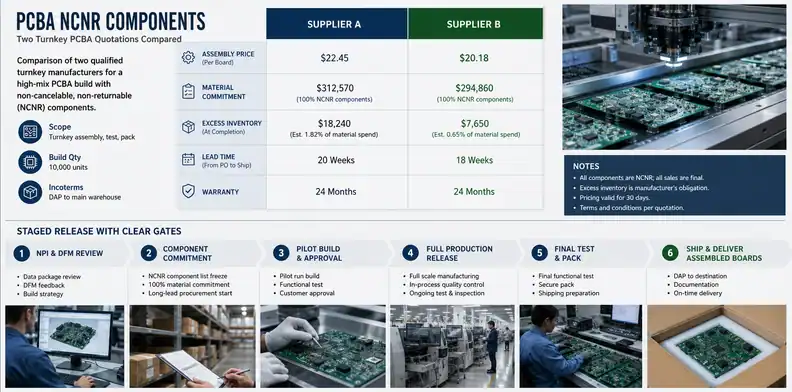
Two suppliers can quote the same assembly quantity and still require very different first-order commitments. Compare at least four numbers: assembly price, one-time engineering/tooling, material cash commitment, and projected unused inventory. Add freight, duties, and test fixtures where they differ.
One assembler may price cut tape for a pilot and avoid excess at a higher component unit price. Another may buy full reels that lower recurring cost but leave a balance. Neither approach is universally better. The right choice depends on forecast confidence, next-order timing, feeder requirements, attrition, and storage risk.
Ask suppliers to use a common BOM and sourcing-date snapshot. Identify whether prices are firm, budgetary, or subject to reconfirmation. Separate unavailable lines and buyer-supplied parts. A low turnkey total that excludes several scarce components is not comparable with a complete quote.
Use a decision table rather than choosing the lowest assembly price:
| Decision measure | Supplier A | Supplier B |
|---|---|---|
| Authorized assembly quantity | ||
| Total assembly PO | ||
| NCNR commitment | ||
| Projected excess value | ||
| Longest confirmed lead time | ||
| Approved-source coverage | ||
| Storage/carrying terms | ||
| Reorder benefit from balance |
The QueenEMS overview of turnkey PCB assembly helps define which procurement and assembly activities belong in the compared scope.
Release the first production buy in stages
A staged release can protect schedule without committing the entire forecast. First, authorize verified long-lead or allocation-constrained lines with capped value. Next, close DFM, test, and pilot evidence. Then release the balance of material and the production quantity when the build gate is met.
The stages must be real commercial limits. Define the maximum value, list of MPNs, allowed purchase activities, cancellation exposure, and decision date for the next gate. Ask the assembler to report orders placed and remaining authority.
Before releasing the balance, review current demand, BOM revision, open substitutions, pilot yield, test readiness, and inventory reconciliation. A passed electrical prototype does not prove that the production BOM, programming, fixtures, packaging, and procurement plan are ready.
After the build, request actual consumption and balance. Compare planned attrition with actual use, investigate unexplained adjustments, and carry the verified inventory into the next quote. This turns the first order into better data instead of repeating the same uncertainty.
QueenEMS can provide a line-level component exposure review with a PCBA quotation. Send the BOM, build quantity, target date, and approved-source rules through the contact page. State whether your priority is minimum first-order cash, shortest lead time, or lower recurring cost.
FAQ
Are all long-lead PCBA components NCNR?
No. Lead time describes availability; NCNR describes cancellation and return rights. A part may be long lead but cancellable before a milestone, or readily available but sold under non-returnable terms. Verify the actual supplier terms.
Who pays for excess components after the build?
That depends on the accepted quotation, purchase terms, and specific authorization. The buyer commonly bears customer-specific or approved NCNR exposure, but the amount, ownership, and disposition should be agreed before procurement.
Can an assembler add an attrition percentage to every BOM line?
Some attrition is normal, but it should reflect packaging and process needs. Expensive, hand-placed, or low-use parts may need a fixed spare quantity rather than a blanket percentage. Ask for the method on material lines with meaningful value.
Should a startup buy full reels to reduce unit cost?
Only after comparing the cash tied up, likelihood and timing of the next build, lifecycle risk, storage, and usable balance. A lower component unit price can produce a higher total first-order commitment.
What files are needed for an NCNR review?
Send the controlled BOM with manufacturer part numbers and approved alternates, assembly quantity, placement quantities, inventory on hand, forecast context, sourcing restrictions, and target date. The assembler can then show required buys and projected balances.
Sources
- Public manufacturing agreement defining MOQ, NCNR and excess inventory concepts
- QueenEMS turnkey PCB assembly
Upload your files today · Free DFM check before production · Ship worldwide
Get your PCB prototypes in as fast as 24 hours. We handle FR4, Rogers, and Flex up to 60 layers — free prototypes for 2–4 layer boards, no minimum order.
Just upload your Gerber + BOM — we source every part, assemble, and inspect (AOI + X‑Ray) so you don't have to chase suppliers. Boards ship in as fast as 24 hours.