
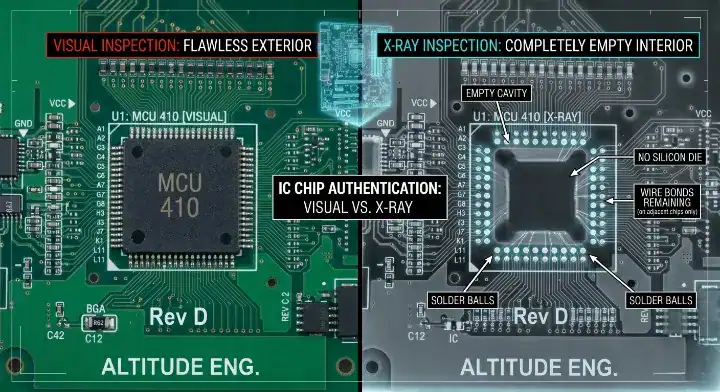
Quick Answer: To prevent counterfeit components PCB assembly failures, control the source before purchasing, inspect evidence before loading parts, and quarantine anything that lacks traceability. A practical buyer gate has 5 layers: approved source, part-data match, receiving inspection, risk-based testing, and written release evidence.
Key takeaways
- Authorized distributors and approved vendor lists reduce risk before the reel reaches the factory.
- Visual inspection is a first screen, not final proof that an IC is authentic.
- High-risk parts need stronger evidence such as traceability, X-ray, XRF, electrical testing, or destructive analysis.
- A CM should not load suspect parts until the buyer accepts the evidence and disposition.
Counterfeit components PCB assembly risk is a sourcing and release-control problem before it becomes a soldering problem. A fake, relabeled, used, poorly stored, or unauthorized component can pass a simple incoming check and still create intermittent failures after the product ships.
The goal is not to turn every PCB buyer into a forensic laboratory. The goal is to define what evidence is required for each sourcing path, so engineering, purchasing, quality, and the contract manufacturer do not rely on price, urgency, or verbal promises.
Table of Contents
- What Is the First Gate Against Fake Parts?
- Which Counterfeit Types Matter in PCBA?
- Why Do Shortages Increase Counterfeit Risk?
- How Should EOL Parts Be Controlled?
- What Documents Prove Component Authenticity?
- When Is Visual Inspection Not Enough?
- How Should Turnkey Sourcing Be Audited?
- How Should Consigned Parts Be Released?
- Which Standards Help Buyers Set Rules?
- What Happens If Suspect Parts Are Found?
What Is the First Gate Against Fake Parts?
The first gate is source control: decide who is allowed to buy the part before a purchase order is placed. If a part is bought from an original component manufacturer, franchised distributor, or buyer-approved supplier, the evidence path is much stronger than an open-market broker with unknown upstream history.
For a buyer, this means the bill of materials should not just list a manufacturer part number. It should identify approved manufacturers, acceptable distributors, lifecycle status, substitutes, and any parts that need engineering approval before purchase. If the BOM is weak, the purchasing team has too much room to improvise under schedule pressure.
Use a simple source-risk ladder:
| Source path | Typical risk | Buyer action |
|---|---|---|
| Original manufacturer or franchised distributor | Lowest | Keep invoice and lot evidence |
| Approved independent distributor | Medium | Require traceability and incoming inspection |
| Unapproved broker or marketplace | High | Escalate to engineering and quality before purchase |
| Unknown source with unusually low price | Critical | Do not buy without formal exception approval |
This gate connects naturally with your BOM for PCB assembly because the BOM is where approved sourcing rules become visible to the CM.
The same source rule should apply to prototypes and production, but the evidence depth can differ. A prototype may accept a small quantity from a buyer-approved independent distributor when the risk is documented and the boards are not for field release. A production order for a medical, industrial, automotive, or telecom product should require a stricter path because one suspect reel can affect many finished units.
The practical rule is simple: do not make the assembler guess what “acceptable source” means. Put the source policy in the RFQ, purchase order, or quality note so the buyer, CM, and procurement team are working from the same definition.
Which Counterfeit Types Matter in PCBA?
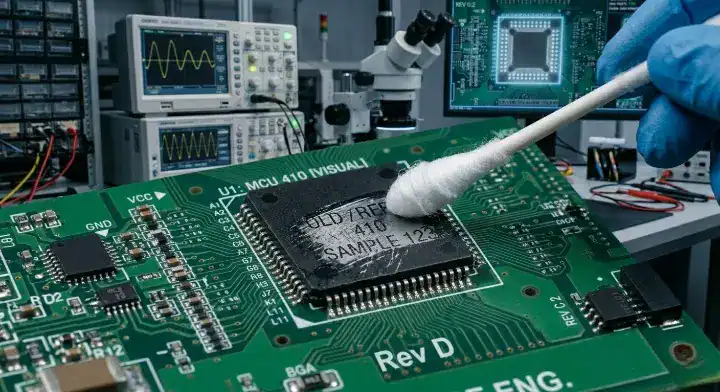
The most important counterfeit categories are relabeled parts, used parts sold as new, wrong-grade parts, unauthorized clones, damaged parts, and parts with false documents. They do not all create the same risk, so the inspection method should match the suspected failure mode.
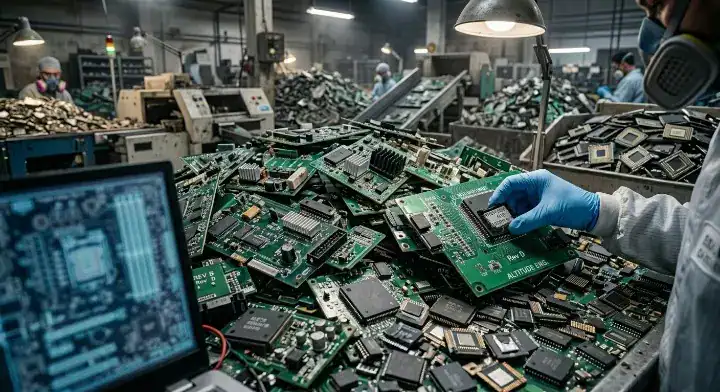
A relabeled commercial-grade IC sold as an automotive-grade IC may look correct externally but fail temperature or reliability requirements. A harvested part from e-waste may have oxidized leads, unknown thermal history, or hidden die damage. A cloned or empty package can look convincing until X-ray or electrical testing reveals the internal mismatch.
Do not treat “counterfeit” as one generic defect. Ask what the false claim is:
- Is the part number wrong?
- Is the manufacturer marking false?
- Is the date code or lot code inconsistent?
- Is the grade, speed, temperature range, or package finish misrepresented?
- Was the part used, recovered, re-tinned, or stored outside its moisture limits?
The answer determines whether visual inspection, solderability checks, X-ray, XRF, electrical comparison, or destructive analysis is appropriate.
Why Do Shortages Increase Counterfeit Risk?
Shortages increase risk because they push purchasing teams away from authorized channels and toward available stock with weaker traceability. When a critical IC is globally constrained, the offer that looks fastest can also be the least verifiable.
The dangerous pattern is familiar: your CM reports a shortage, a broker claims to have exactly the needed quantity, the price is higher or suspiciously low, and production is waiting. If the team accepts the batch without source history, sample inspection, and buyer approval, the shortage problem becomes a field-failure problem.
Use a shortage exception form for any part outside the approved source path. At minimum, record the part number, quantity, source, reason for exception, traceability evidence, inspection plan, test plan, and who approved loading the material. For substitute decisions, keep the deeper review in the PCB component shortage alternative workflow so procurement does not silently change the design.
The exception should also say whether the batch is allowed for prototypes only, pilot builds only, or released production. This prevents a small emergency purchase from becoming the default source for every future order. If the part later fails, the team can trace which assemblies used that lot instead of searching every shipped board.
A good shortage response also includes a stop point. If the offered batch has missing documents, mismatched labels, inconsistent date codes, or a seller who refuses source disclosure, the right answer may be redesign, alternate approval, or schedule change rather than higher inspection spending.
How Should EOL Parts Be Controlled?
End-of-life parts should be controlled before the last authorized inventory disappears. Waiting until an obsolete IC is unavailable creates exactly the purchasing pressure that counterfeiters exploit.
Good EOL control starts during design and pilot production. Flag single-source ICs, parts with declining distributor stock, older date codes, and packages that are common in counterfeit reports. Then decide whether to make a last-time buy, approve alternates, redesign the circuit, or stock safety inventory under documented storage conditions.
For long-life industrial, medical, robotics, and telecom products, EOL review belongs in the normal release process rather than an emergency meeting. The article on end-of-life components in PCB assembly can support that planning; this page focuses on how EOL pressure affects authenticity risk.
What Documents Prove Component Authenticity?
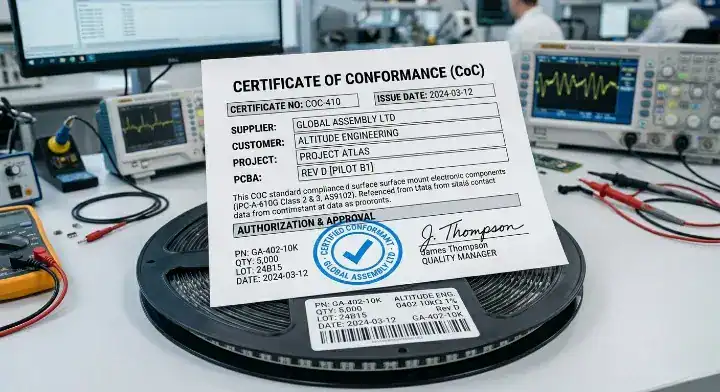
Useful authenticity evidence ties the reel or tray back to a credible source and a specific lot. A generic certificate is not enough if it does not connect to the part number, manufacturer, lot/date code, quantity, supplier, and receiving record.
Ask your CM for a documentation package that fits the part risk. For routine low-risk parts, an authorized distributor invoice and receiving record may be enough. For constrained, obsolete, high-value, or safety-critical parts, the package should be stronger.
| Evidence | What it should confirm |
|---|---|
| Authorized invoice or packing slip | Source, part number, quantity, date |
| Certificate of Conformance | Supplier declaration tied to the shipped lot |
| Lot/date-code record | Consistency between label, packaging, and reel |
| Receiving inspection record | Packaging, marking, quantity, condition |
| Test or screening report | What was tested, sample size, method, result |
| Nonconformance record | What was quarantined and who decided disposition |
If the evidence cannot be tied to the physical material that will be loaded onto your PCBA, it is weak evidence.
For high-risk parts, ask for evidence before the kit is released to the SMT line, not after the boards are already built. Once the part is soldered, the cost of investigation rises and traceability becomes harder. If the CM cannot provide the record before placement, the buyer should decide whether to pause production, approve a controlled sample build, or replace the source.
The format of the evidence also matters. A screenshot of a distributor website is not the same as an invoice tied to the purchased lot. A certificate with no lot, date code, or supplier identity may show a process exists, but it does not prove the actual material in your build is genuine.
When Is Visual Inspection Not Enough?
Visual inspection is not enough when the part source is high risk, the part is expensive or safety-critical, the lot has inconsistent markings, or the failure mode could be hidden inside the package. External appearance can catch many obvious problems, but it cannot prove die identity or full electrical behavior.
Use visual inspection for first-line screening: labels, moisture barrier bags, reel condition, surface texture, mold marks, lead condition, date-code consistency, and marking permanence. If anything looks inconsistent, stop before SMT loading and escalate.
Then choose stronger methods based on risk:
- X-ray can reveal missing die, unexpected lead frames, voided bonds, or internal structural differences.
- XRF can help verify lead finish or material composition.
- Solderability testing can reveal aged or reworked leads.
- Electrical comparison can identify functional mismatch against known-good behavior.
- Decapsulation can expose the die when non-destructive checks are inconclusive, but it destroys the sample.
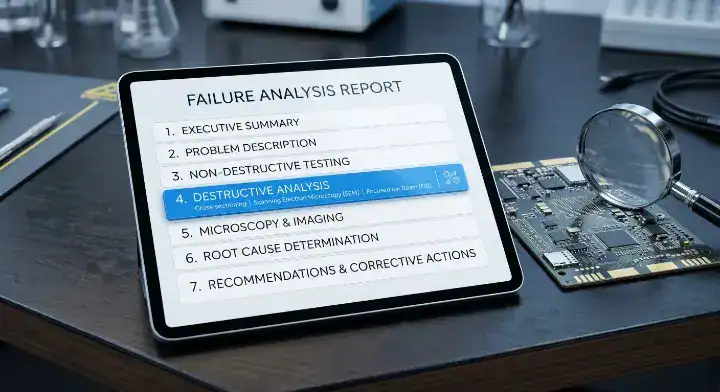
For assembled-board problems, use the PCBA failure analysis report process to separate counterfeit evidence from assembly-process defects.
Testing should be planned before parts arrive. If the buyer waits until a suspect batch is already on the production schedule, every test decision feels like a delay. Define in advance which parts need 100% documentation review, which need sample X-ray, which need electrical comparison, and which should never be accepted from an open-market source.
Also separate screening from qualification. A sample may pass an electrical test at room temperature, but that does not automatically qualify it for the product’s full temperature, lifetime, or regulatory requirements. Screening reduces counterfeit risk; it does not rewrite the design specification.
How Should Turnkey Sourcing Be Audited?
Turnkey sourcing should be audited by reviewing the CM’s approved vendor list, purchasing records, substitution rules, and receiving inspection records. The buyer may not purchase each component directly, but the buyer still owns the product risk.
Before production, ask how the CM handles parts that are unavailable through authorized channels. A strong answer will describe escalation, buyer approval, alternate sourcing, receiving quarantine, and additional testing. A weak answer sounds like “we can find it” without naming the evidence that proves authenticity.
For higher-risk builds, define purchasing restrictions in the RFQ or purchase agreement:
- Buy from authorized or buyer-approved sources whenever available.
- Do not use brokers without written approval.
- Report any part with changed source, date code, manufacturer, or substitute MPN.
- Hold suspect material out of production until disposition is approved.
- Preserve component evidence with the job traveler or quality record.
This is one reason the choice between turnkey and consigned PCB assembly should include quality evidence, not only price and convenience.
Ask the CM how purchasing exceptions are approved internally. In a controlled process, buyers, sourcing staff, incoming quality control, and engineering do not work in isolation. A shortage note should trigger review before an alternate supplier is used; an incoming-quality concern should prevent kitting until disposition is complete; and the final build record should show which source was used.
If the CM cannot show how it prevents unauthorized source changes, the buyer should lower the risk by restricting sourcing, requiring pre-build evidence, or supplying critical components directly with receiving requirements.
How Should Consigned Parts Be Released?
Consigned parts should still pass a receiving gate, even when the buyer supplies them. A CM should not assume that owner-supplied material is authentic, properly labeled, dry-packed, or suitable for automated placement.
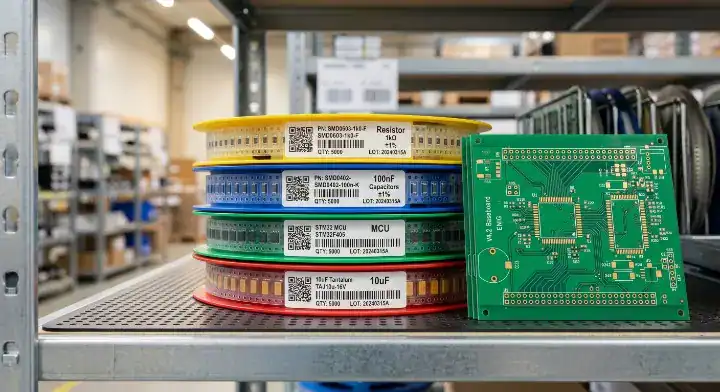
The buyer should send a packing list, source documents, MPN, quantity, date/lot codes, moisture sensitivity level when relevant, and any handling limits. The CM should verify the physical material against those records before kitting. If a reel arrives damaged, mixed, unsealed, relabeled, or missing traceability, it should be quarantined until the buyer decides.
Consignment also needs substitution control. If a buyer ships one approved part and later authorizes a different one, the change should appear in the BOM, AVL, assembly drawing, and revision record. Do not let informal email changes create a mixed build.
Owner-supplied parts can create a blind spot because each side assumes the other side already checked authenticity. Avoid that by assigning responsibilities clearly. The buyer owns source selection and purchase evidence; the CM owns receiving verification, handling, storage, and release to production; both sides should agree what happens when evidence is incomplete.
Which Standards Help Buyers Set Rules?
Standards help buyers define the control plan, but they do not replace project-specific judgment. SAE AS5553 is commonly referenced for counterfeit electronic parts avoidance, detection, mitigation, and disposition. IDEA-STD-1010 focuses on external visual inspection and acceptability criteria for open-market electronic components.
Use standards as a language for requirements. For example, a buyer can require a counterfeit avoidance process, trained receiving inspectors, approved supplier controls, documented risk assessment, quarantine rules, and defined disposition of suspect parts. For critical components, the buyer can also specify whether advanced testing follows a recognized lab method or customer-approved plan.
Do not simply ask, “Are you certified?” Ask:
- Which counterfeit avoidance procedure applies to my build?
- Which sources are approved for this BOM?
- What happens if authorized stock is unavailable?
- Which parts require additional inspection or testing?
- What records will be returned with the shipment?
This turns a standard name into a usable manufacturing requirement.
For many commercial PCB assembly projects, the buyer does not need a full aerospace counterfeit-control program. What the buyer does need is a risk-based version of the same thinking: prevent risky purchases first, inspect the material that does arrive, document exceptions, and make suspect-part disposition traceable. The higher the product risk, the closer the project should move toward formal standard-based controls.
Standards also help avoid vague language. “Use genuine parts” is hard to audit. “Buy from approved sources, retain traceability, inspect open-market parts to defined criteria, quarantine suspect lots, and return evidence with the build record” is much easier to verify.
What Happens If Suspect Parts Are Found?
If suspect parts are found, the CM should stop use, quarantine the material, preserve evidence, notify the buyer, and document disposition. The worst response is to keep building while the team “checks later.”
A useful suspect-part report should include photos, labels, quantity affected, source, purchase record, receiving findings, test results, affected job numbers, and whether any assemblies may already contain the suspect lot. Engineering and quality can then decide whether to reject, return, test further, build a limited sample, or redesign around an alternate component.
For QueenEMS review, the most useful inputs are the BOM, approved vendor list, current distributor evidence, shortage notes, target production quantity, and any compliance or customer traceability requirement. Send those with your Gerber and assembly files through the RFQ checklist for PCB assembly so sourcing risk can be reviewed before the build is released.
Do not mix suspect parts with accepted stock while waiting for a decision. Label and segregate the material physically and digitally. If a sample was removed for testing, record how many parts remain, where the sample went, and whether the remaining quantity is still sealed.
The closeout should be just as clear as the quarantine. If the lot is rejected, record return or disposal evidence. If the lot is accepted after testing, record who approved the exception and whether the approval applies only to that lot or to future purchases. This prevents the same question from being reopened during the next build.
FAQ
Can a counterfeit component pass functional testing?
Yes. A relabeled, aged, or marginal part can pass a short functional test and fail later under temperature, vibration, moisture, or long operating time. That is why source evidence and risk-based screening matter before assembly.
Is X-ray inspection always required for counterfeit components?
No. X-ray is usually reserved for high-risk, high-value, constrained, or suspicious parts. Low-risk passives from authorized sources usually need documentation and normal receiving inspection rather than advanced screening.
What is the best first step if a broker is the only source?
Stop and create an exception record before buying. Record the broker, quantity, traceability offered, why authorized stock is unavailable, what inspection or testing will be done, and who accepts the risk.
What documents should I ask my PCB assembly supplier for?
Ask for authorized invoices or packing slips, Certificates of Conformance, lot/date-code records, receiving inspection results, and any test or X-ray reports required by the component risk level.
Does QueenEMS accept customer-supplied components?
Yes, when the material can be checked against the BOM, packing list, quantity, condition, and handling requirements. High-risk or poorly documented consigned parts may need buyer approval, extra inspection, or replacement before production release.
Sources
- SAE AS5553 standard page
- DLA ASSIST AS5553 document detail
- ERAI IDEA-STD-1010B glossary
- NASA/JPL Counterfeit Parts Awareness and Inspection
Written by the QueenEMS Engineering Team
Upload your files today · Free DFM check before production · Ship worldwide
Get your PCB prototypes in as fast as 24 hours. We handle FR4, Rogers, and Flex up to 60 layers — free prototypes for 2–4 layer boards, no minimum order.
Just upload your Gerber + BOM — we source every part, assemble, and inspect (AOI + X‑Ray) so you don't have to chase suppliers. Boards ship in as fast as 24 hours.