
Quick Answer: A PCB partial discharge requirement needs a record of discharge activity; a passing hipot result alone answers the reported withstand criteria. Identify whether the evidence gives inception voltage, charge at a stated voltage or only a withstand outcome. Before release, have the project owner resolve whether the tested geometry, specimen state and waveform apply to the ordered board.
Consider a multilayer power-board order whose specification asks about partial discharge, but whose returned report says “hipot pass.” The immediate purchasing task is to identify what was measured. A missing PD record and a PD record for another construction need different follow-up. Neither can be resolved by an instrument's feature list.
What does a passing hipot test actually establish?
A passing hipot report establishes that its specimen met the stated withstand criteria at the reported voltage and duration. Read those criteria rather than treating “pass” as a complete description. The result alone supplies neither a discharge inception voltage nor a recorded charge measurement, even if the instrument can perform both functions.
The Chroma instrument description separates AC hipot measurement of leakage current and flashover from PD measurement of charge in pC. That distinction identifies different reported quantities. It supplies no acceptance limit for your PCB.
As a buyer suggestion, keep the specimen identity, AC or DC condition, applied level, duration and criterion source with a withstand result. If those fields are absent, ask what the pass statement actually covers.
What does a partial discharge record report instead?
A PD record can report inception voltage or discharge charge at a stated voltage. Those quantities answer different questions. Inception identifies the voltage at which detectable activity begins under the stated criterion. A charge reading describes activity at its reported condition. Interpreting either requires the specimen, waveform and measurement conditions, rather than a bare number.
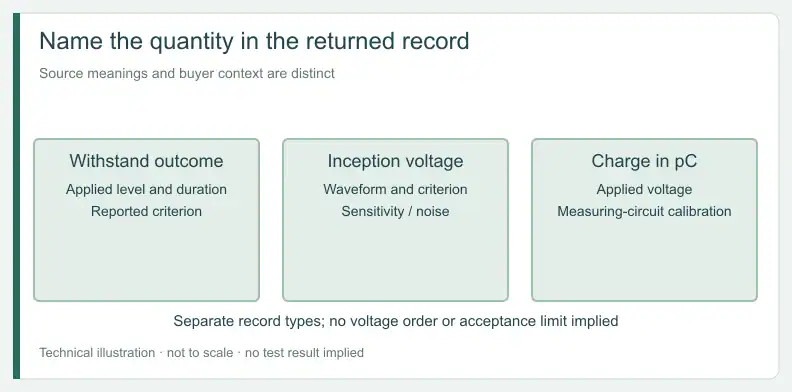
The HAL v1 author manuscript on PCB discharge inception, listed as in press for IEEE TDEI, studies PCB geometries under a 50 Hz sinusoidal voltage. It defines PDIV as the minimum applied voltage at which PD appears and reports it in Vrms under its detection procedure.
The study also describes calibration and noise control. A calibration charge checks the measuring circuit; it is not the project's acceptance limit. Phase-resolved patterns and optical observations add diagnostic context, but they do not supply an order-release decision by themselves.
Which quantity is in the record you were given?
Classify the evidence by its reported quantity before comparing it with the specification. A voltage associated with inception is different from a voltage applied during a withstand test. Likewise, a charge reading needs its applied voltage. If the only document lists instrument functions, no specimen result has yet been supplied.
Insulation record quantity key
| Record | Reported quantity | Context to retain | Unanswered question | Disposition |
|---|---|---|---|---|
| Hipot / withstand | Pass/fail, leakage or flashover outcome | AC/DC, voltage, duration, criterion source, specimen | Whether PD occurred or where it began | Withstand evidence only |
| PDIV | Inception voltage | Waveform, detection criterion, sensitivity/noise, method, environment, specimen | Inception under another waveform or condition | Answers inception as tested; missing criterion prevents comparison |
| Charge at a stated voltage | Discharge charge (pC) | Applied voltage, waveform, measuring-circuit calibration, specimen | Inception or acceptance without a project criterion | Interpret against the named project criterion |
| Pattern / optical record | Pattern or location observation | Instrument, voltage, specimen and interpretation | Order acceptance by itself | Diagnostic context |
| Equipment datasheet | Available instrument functions | Actual measurement record still needed | Whether any specimen reading was taken | Capability statement only |
For example, a combined tester may support both channels while the returned sheet contains only a withstand pass. Request the actual PD result if the specification requires it; do not reconstruct a missing measurement from the equipment brochure.
Was the tested copper, dielectric and air geometry yours?
Compare the location of the high-field region, not just the stated insulation distance. An exposed pad edge, a buried conductor pair and an outer conductor under coating meet different surrounding materials. A result for one geometry does not automatically describe another, even when their nominal separations appear easy to compare.
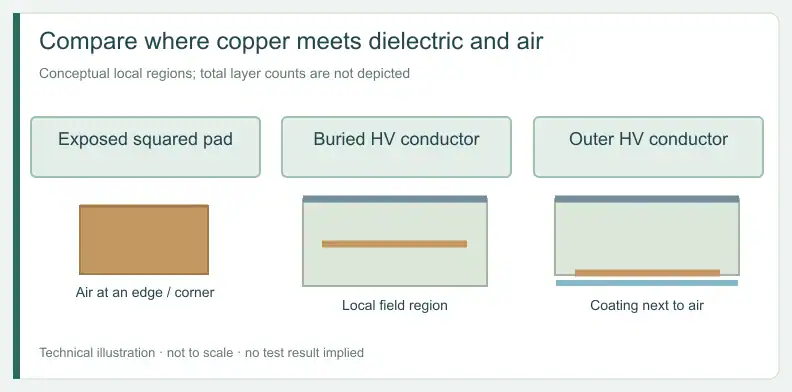
The HAL study examines exposed pads, face-to-face conductors and coated parallel tracks. On the squared pads, PD first appeared at corners; the circular pad lit up around its whole edge. In its strip comparison, the largest separation placed the high-voltage conductor on an outer layer beneath coating. Its inception was lower than that of the intermediate buried pair, although still higher than that of the most closely spaced one.
That observation does not select a preferred stackup. The conductor location, its proximity to air and the board's layer count changed along with separation. Keep the relevant layer section with the result so the project owner can judge that difference. A distance entered without its field location loses part of the evidence.
Does the specimen’s surface and defect state match?
Read how the specimen was made, prepared and selected before applying its result to the order. Surface condition, coating and excluded specimens affect what population the report describes. A study's average may omit findings that matter to a buyer. Keep those exclusions visible rather than treating the average as an unqualified construction rating.
In the HAL work, specimens were cleaned to avoid contaminant-initiated PD. A pad sample was discarded after early edge discharge that the authors attributed to a possible defect. Two strip samples whose discharge patterns indicated an internal cavity were excluded from the averages and replaced. The coated-track boards were made in the laboratory and coated by an outside company. These are study conditions, not proposed production instructions.
A useful return identifies the tested specimens and any exclusions, with the reason for each. Do not infer that the ordered lot received the same preparation or selection.
Does a 50 Hz sine result apply to your waveform?
A result under a 50 Hz sine wave describes that excitation and its recorded conditions. It does not establish the response to DC or fast switching edges. Compare the test waveform with the released application and leave any transfer unresolved until the project authority has evidence or a justified interpretation for it.
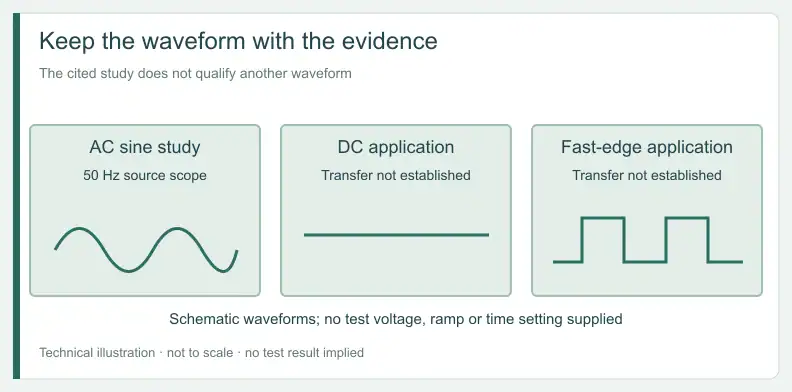
The HAL paper covers sinusoidal AC in ambient air. It identifies fast-rising bipolar and unipolar pulses, and temperature, as future work. Its introduction also identifies temperature, humidity and pressure as influences on PD.
Record the waveform and environment beside the quantity. Avoid turning a research inception value into a working-voltage rating or a prediction of service life.
Who decides whether the evidence applies before release?
The named project insulation or reliability authority should decide applicability after the record's quantity and tested object are identified. Purchasing can collect the missing information and preserve the decision. Neither a fabrication drawing nor a laboratory result alone assigns that authority or resolves a difference between the tested specimen and the released construction.
PD evidence comparability check
| Attribute | Compare record with board | Reason to retain it | Basis | Disposition |
|---|---|---|---|---|
| HV conductor location | Buried, exposed or under coating | Air proximity changed strip behavior | HAL observation | Select below |
| Metal–solid–air junction | Pad edge or corner location | Squared-pad activity began at corners | HAL observation | Select below |
| Insulation path | Through laminate, surface or both | Identify the claimed test boundary | Buyer suggestion | Select below |
| Coating state | Material and recorded thickness | Track results changed with coating thickness; material was not varied | HAL observation | Select below |
| Construction identity | Stackup and drawing revision | Connect result to the ordered board | Buyer suggestion | Select below |
| Specimen state | Preparation, defects, exclusions | Source averages excluded some findings | HAL observation | Select below |
| Waveform | Shape and frequency | Source covers sinusoidal AC only | HAL scope | Select below |
| Environment | Recorded conditions and intended use | Keep transfer assumptions visible | Buyer suggestion | Select below |
| Detection basis | Criterion and sensitivity statement | Explain what counted as detected activity | Buyer suggestion | Select below |
| Applicability owner | Named decision and unresolved differences | Preserve the release decision | Buyer suggestion | Select below |
Keep spacing, CTI and certification inputs for high-voltage boards with their separate design review. This article addresses board-level evidence; it does not qualify a complete transformer or isolation component.
Frequently Asked Questions
Can a hipot tester also measure partial discharge?
Some instruments support both functions. A withstand pass alone does not show that a PD reading was recorded; check the actual returned measurements.
Is the calibration charge the acceptance limit?
No. It checks the measuring circuit. Acceptance requires the applicable project criterion and the conditions attached to the result.
Does a PD-free result at one voltage predict service life?
No. It describes the tested specimen and stated conditions. It does not establish performance throughout the operating life.
Is SIR or insulation resistance the same evidence?
No. Those measurements concern insulation resistance under their stated conditions. SIR involves moisture and bias; it does not report discharge activity.
Send your released files for a quote and free DFM review.
Send Gerber, stackup and insulation requirements for review. Identify partial-discharge and hipot evidence separately in the quotation request.
For assembly, add the BOM and insulation-related drawing notes. Agree which checks apply to the board and who owns the application-level test evidence.