
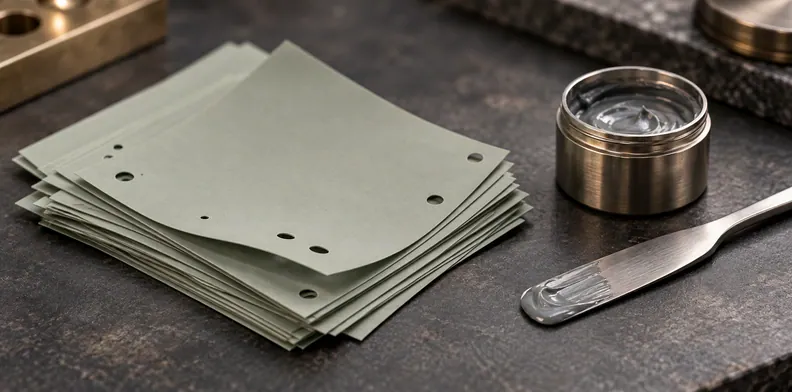
Quick Answer: Check LTCC via fill paste compatibility by naming the dielectric tape, via fill and co-fired conductor materials separately, with their roles and document revisions. A supplier data sheet can identify intended system members, but it does not accept the finished lot or approve mixing another material family. The project owner decides whether the evidence covers the proposed build.
A released LTCC stack can list a ceramic tape while leaving the via paste or a conductor layer to be filled in later. That leaves the buyer unable to tell whether the supplier has quoted the same material set. Start with the identity of each member, then connect any proposed substitution to the person who can approve it.
What does “conductor tape” mean in an LTCC material system?
In the cited DuPont examples, the only tape is the dielectric: GreenTape 9K7 LTCC tape forms the ceramic layers. The via fill and the co-fired conductors are separate compositions, each with its own product code. Name every one, with its document revision and layer role, so no member is left to interpretation.
A line on a stackup might identify the tape family while a separate fabrication note names the conductive paste. Neither label automatically identifies the material used in every via or on every conductor layer. The released stack needs enough detail to connect the physical feature to the corresponding product record.
If the technology itself is still under discussion, start with choosing between HTCC and LTCC. The decision here comes later: which named materials belong in this particular LTCC order, and what evidence supports that identification?
Which members must be named before an LTCC stack is released?
Name the dielectric tape, the via fill and each conductor material used in the released design. Give their product codes, suppliers, document revisions and physical roles. An internal signal, ground plane, external conductor or solderable feature may have a different material identity even when all are part of one system.
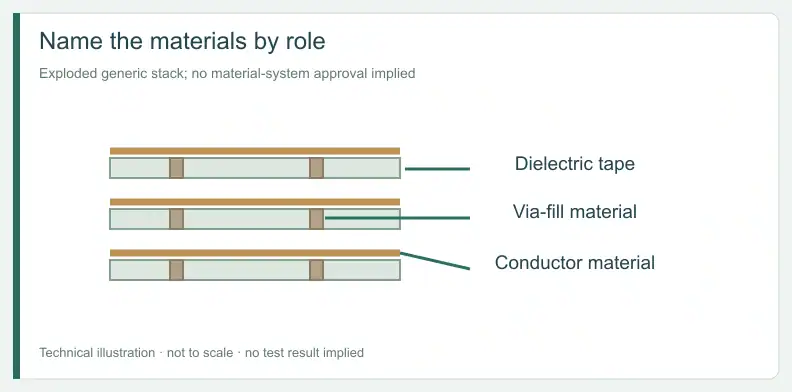
The following matrix is a buyer aid, not a standard form. The two examples are historical vendor descriptions, not an offer, a current availability statement or a proposed QueenEMS build. Add the actual layer and approval references from the order.
| Role and layer | Code and document | Companions named; documents referenced | Current confirmation | Status |
|---|---|---|---|---|
| Dielectric tape, all layers | GreenTape 9K7, named on both sheets below | 9K7 system data sheet referenced, not reviewed here | Unknown | Confirm current version before release |
| Via fill, gold example | LL502; K-28898 (4/15) | LL505 internal signal lines, LL507 external signal lines, LL509 cofirable external solderable; GreenTape 9K7 Product Selector Guide and GreenTape LTCC Design Guide, not reviewed | Unknown | Named together: identification only, pending current confirmation |
| Via fill, silver example | LL601; MCMLL601 (12/2012) | LL602 ground plane, LL612 signal line, LL617 solderable; same two guides, not reviewed | Unknown | Named together: identification only, pending current confirmation |
| Your member not named on the document in hand | — | None | — | Unverified: hold |
| Your project approval | Approval record ID | Scope and owner | — | Approved only within the stated scope |
“Supplier to propose” can be a useful note during quotation. Before the order is released, replace it with the named proposal and the decision record. Otherwise, two quotes may refer to different materials without making the difference visible.
What do the DuPont LL502 and LL601 sheets actually establish?
The historical LL502 sheet identifies a gold via fill with GreenTape 9K7 and names gold companion conductors for specific roles. The historical LL601 sheet identifies a silver via fill with the same tape and names a separate set of silver-based companions. Each sheet therefore records a stated set of members; it does not certify a build.
The LL502 data sheet names LL505 for internal signal lines, LL507 for external signal lines and LL509 as a cofirable external solderable member. The LL601 data sheet names LL602 for a ground plane, LL612 for a signal line and LL617 as a solderable member.
The LL601 document also describes an automated via-fill context using a punchable carrier film. The two sheets show why a tape name alone does not identify the whole set. They do not establish that a gold-family member and a silver-family member can be mixed. Nor do the historical sheets establish current supply or suitability for a particular design.
What can a material data sheet not prove about your stack?
A sheet that names compatible members does not demonstrate the performance of your finished stack. It describes materials in a stated context, while the design, build and acceptance record belong to the actual project. Use the document to identify what it says, then identify the evidence it refers to or leaves open.
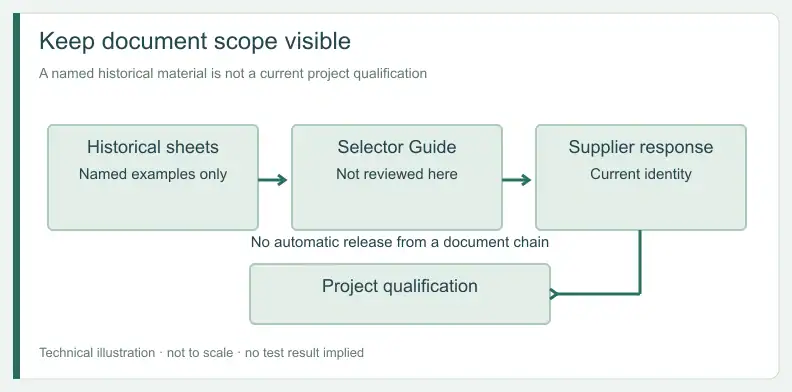
Both sheets refer readers to the GreenTape 9K7 Product Selector Guide for compatible co-fired and post-fired conductor compositions, and to the GreenTape LTCC Design Guide for processing. The LL601 sheet adds that its typical values are not specifications. Those referenced documents are not assessed here; their contents and current revisions remain to be confirmed.
Both sheets leave suitability testing to the user. A product code on a vendor sheet therefore cannot substitute for the project owner's qualification or for the agreed acceptance record. It also cannot establish a universal process setting, sampling plan or limit for a different stack.
How should buyers record revisions and supplier confirmation?
Keep the material code, supplier, sheet identifier and date beside the controlled stack revision. Ask for written confirmation of the current document, available material and proposed member roles. A historical sheet can explain a previously stated relationship; it should not be treated as proof that the same products are available today.

Store the supplier's response with the quotation and any released drawing. A useful reply identifies the actual tape, via fill and conductors by code and explains which current document supports the proposed combination. If the reply names only “compatible paste,” return it for the missing identities.
Note which party's statement the order relies on.
How should a proposed paste or tape change be dispositioned?
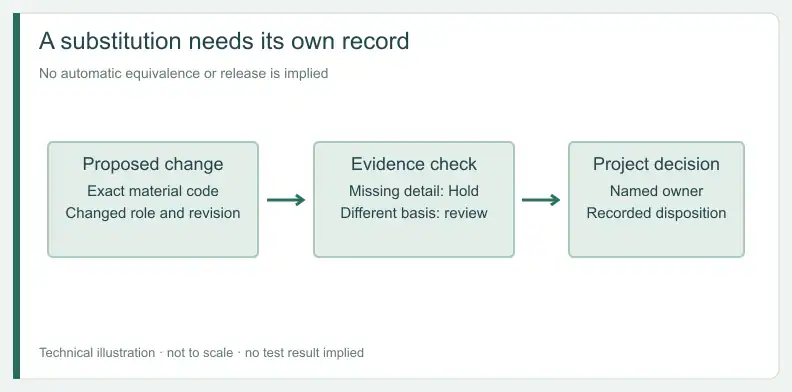
Record the proposed replacement and the evidence that names the revised set before changing the released stack. A current supplier document may support identification of members in one system. A different family, an unnamed equivalent or an unknown revision remains unverified until the responsible parties provide and review the missing evidence.
| Proposed change | Evidence present | Source type | Suggested disposition |
|---|---|---|---|
| Member named on the same current system document | Current supplier document identifies the proposed roles together | Supplier statement | Identification only; send for owner review |
| Gold and silver family members combined | No document in hand names this combination | No supporting document | Hold; seek written supplier confirmation and owner-defined qualification |
| Different tape or claimed equivalent | Proposal without supporting system record | Buyer or fabricator suggestion | Hold until supported and approved |
| Same code, unknown revision | Historical sheet only | Historical supplier document | Confirm current version and availability |
| Change covered by an approval record | Record identifies the changed materials and scope | Customer qualification | Accept only within the stated approval scope |
If a proposed replacement is named on a supplier document, check whether the record covers its actual role and the other members in the order. If it does not, the correct status is “unverified,” even when the product name looks similar. Record who will resolve the gap and whether the proposal applies only to one order or to a controlled revision.
For a quote or free DFM review, send the Gerber files and stackup or drawing with the tape, via-fill and conductor codes and revisions. Material availability, process route and evidence availability are confirmed for each project after review.
Who decides whether the identified material set is acceptable?
The project owner decides whether the identified set and its qualification evidence are acceptable for the intended build. The fabricator can identify its proposed materials, and a material supplier can confirm what its documents describe. Neither statement by itself replaces the customer's approval for the specific construction and application.
Before release, reconcile the approved material list with the drawing revision and the supplier's written proposal. Record any open question, the decision owner and the approval scope. When a later lot uses a changed member or document, compare the change with that scope instead of assuming the earlier approval automatically follows it.
Frequently Asked Questions
Can a silver via fill be used with gold conductors if both sheets name 9K7?
The cited sheets do not establish that combination. Each names its own companion family. Ask for written supplier confirmation and project-owner qualification for the proposed set.
Is a 2012 or 2015 data sheet still valid evidence?
It is evidence of what the historical document stated. Confirm the current document and availability with the supplier before relying on it for a new order.
If the supplier confirms compatibility, is testing still needed?
Supplier confirmation does not replace it. The cited sheets leave suitability testing to the user, and the project owner determines the qualification and acceptance needed for the actual construction.
Can a fabricator substitute an equivalent paste?
Treat the proposed replacement as a controlled change. Identify its role and supporting supplier evidence, then obtain the project owner’s approval for the stated scope.
For a PCB quote or free DFM review, share the Gerber files and controlled stackup or drawing. If assembly is also needed, include the BOM.
Upload your files today · Free DFM check before production · Ship worldwide
Get your PCB prototypes in as fast as 24 hours. We handle FR4, Rogers, and hybrid boards, with standard builds up to 24 layers and higher layer counts subject to engineering review — free prototypes for 2–4 layer FR-4 boards, no minimum order.
Just upload your Gerber + BOM — we source every part, assemble, and inspect (AOI + X‑Ray) so you don't have to chase suppliers. PCB assembly typically takes 5–8 working days once all components are in stock. The confirmed delivery schedule is subject to your quotation.