The ceramic construction guide places co-fired packages alongside metallized substrates. Start there when the project has not yet established a need for buried ceramic layers.
Quick Answer: HTCC and LTCC co-fire ceramic layers with compatible conductors. HTCC commonly uses refractory-metal systems; LTCC can use lower-resistance conductors with suitable lower-temperature ceramic systems. Choose from the actual fired stack, RF and thermal requirements, package interfaces and qualification evidence. Neither firing label guarantees a hermetic seal or makes every RF circuit suitable.
Key takeaways:
- HTCC is a candidate for multilayer packages, including RF packages, when its conductor and sealing system meet the requirements.
- LTCC can integrate RF and sensor functions; check the grade-specific heat path before using it under a power device.
- If the job is mainly heat removal, DPC, DBC, AMB, or another ceramic process may fit better than either co-fired option.
- Before quoting, buyers should release frequency, power, thermal path, layer count, package sealing, metallization, tolerance, and test requirements.
HTCC vs LTCC Ceramic PCB is a process decision before it is a price decision. If you choose the co-fired route for the wrong reason, the board can become too resistive for RF, too insulating for heat, or too expensive for a package that never needed hermetic sealing.
The useful question is not “which ceramic is better?” It is “which physical requirement forces this process?” HTCC and LTCC both use unfired ceramic tape, printed conductors, lamination, and co-firing, but they solve different problems. QueenEMS reviews the drawing, stack requirement, heat path, RF target, and sealing requirement before recommending a ceramic PCB route.
Table of Contents
- What Does HTCC vs LTCC Ceramic PCB Mean?
- Why Does Firing Temperature Decide the Process?
- Which Conductors Can HTCC and LTCC Use?
- How Do Thermal and Hermetic Requirements Compare?
- When Is LTCC the Better RF Choice?
- When Is HTCC the Better Package Choice?
- When Should Buyers Avoid Both Co-Fired Options?
- Which Stack and Test Requirements Decide the Choice?
- Which Claims Should Buyers Treat Carefully?
- When Should You Choose HTCC or LTCC?
What Does HTCC vs LTCC Ceramic PCB Mean?
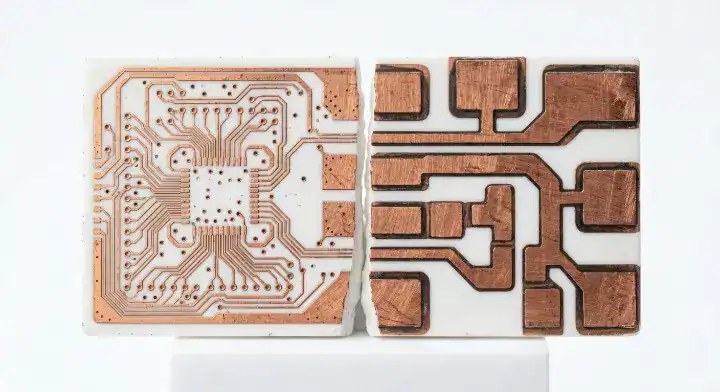
HTCC vs LTCC Ceramic PCB compares two co-fired ceramic routes. HTCC means high-temperature co-fired ceramic, while LTCC means low-temperature co-fired ceramic. In both routes, ceramic tape and conductive paste are patterned, stacked, laminated, and fired together into a multilayer structure.
That makes co-fired ceramic different from DBC, DPC, AMB, thick film, and thin film processes. Those routes usually start from a fired ceramic substrate and then add metal by bonding, plating, brazing, printing, or deposition. Co-fired ceramic builds the ceramic and internal conductors together, which is why it can support dense buried routing and package-style interconnects.
| Decision point | HTCC | LTCC | Better question |
|---|---|---|---|
| Firing class | High-temperature co-fired | Low-temperature co-fired | What temperature can the ceramic and metal survive together? |
| Typical role | Hermetic packages and harsh environments | RF modules and embedded passive integration | What does the package need to prove? |
| Main tradeoff | Package construction with refractory-metal conductor trade-offs | Compatible low-resistance conductors; grade-specific glass-ceramic properties | Is sealing, RF loss, or heat the real driver? |
Use this comparison only after you know a co-fired structure is actually required. If the design only needs a simple heat-spreading ceramic board, the broader ceramic PCB manufacturing process guide should be checked first.
Why Does Firing Temperature Decide the Process?
The firing profile must suit both the ceramic tape and the conductor pastes. HTCC commonly uses alumina-based systems and refractory conductors; LTCC uses compatible lower-temperature material systems. Orbray describes its LTCC family as glass ceramic co-fired below 1000°C. That is a fabrication category, not an allowable operating temperature for an assembled module.
Firing, later metallization, die attachment and lid sealing are separate operations. A metal that cannot survive the internal co-firing profile may still be used as a post-fired surface finish if the supplier supports it. Specify buried conductors separately from solderable or bondable surface layers.
For example, refractory internal conductors and a plated external finish can belong to the same package. Ask for a cross-section or layer schedule that identifies where each metal appears. A statement such as “gold metallization” is incomplete unless it distinguishes the buried conductor from the external attachment finish.
| Process | Firing implication | Buyer impact |
|---|---|---|
| HTCC | High-temperature ceramic system | Assess package requirements and compatible refractory conductors |
| LTCC | Low-temperature glass-ceramic system | Assess integrated RF functions and the grade-specific heat path |
| DPC/DBC | Post-fired ceramic metallization | Often better when the main job is thermal conduction, copper thickness, or simple power routing |
Which Conductors Can HTCC and LTCC Use?
HTCC usually relies on refractory conductor systems such as tungsten or molybdenum because those metals can survive the high firing environment. LTCC can use lower-resistance silver, gold, or copper conductor systems when the material set and process support them. This conductor difference is one of the main reasons RF designers care about LTCC.
For high-frequency routing, conductor properties, dielectric data, geometry and transitions all contribute to performance. Egide’s HTCC technology page includes an RF package example, so HTCC cannot be excluded from RF solely because its buried conductor differs from an LTCC system. Compare the proposed interconnect, not a process-wide ranking.
The conductor decision should still be documented by the actual material system, not by a generic HTCC or LTCC label. Buyers should ask which metal paste is proposed, whether the vias and buried conductors use the same system, and what design rules apply after firing shrinkage.
Consider an illustrative LTCC revision in which a replacement tape is proposed while the existing conductor paste and layer artwork are retained. A similar nominal dielectric constant does not establish that the combination can use the old firing or dimensional compensation. Put the tape designation, conductor and via-fill materials, fired dimensions and subsequent attachment operations beside the proposed change before authorizing tooling.
A useful trial includes a via chain and a buried conductor path alongside the features that register to the cavity and outline. Agree how the supplier will examine those features after firing. If the via chain is open, compare layer registration with the intended via-to-pad overlap and inspect the interconnect construction before blaming conductor resistivity. If continuity passes but resistance is outside the agreed range, review the fired conductor dimensions and material/process record separately. Those observations distinguish different questions; they do not establish a cause on their own.
Retain a baseline made with the qualified material set when a meaningful comparison is possible. Measure the revised fired part against the same functional datums, then evaluate the attachment and RF requirements affected by the substitution. A dimensionally acceptable sample is not proof that its buried circuit or later package assembly is acceptable. Approve the combined material system only after those separate checks agree.
| Record | Check before release | Why the reader needs it |
|---|---|---|
| Tape and paste revision | Supplier confirms the combination, firing atmosphere and profile | Prevents independently approved materials becoming an unqualified co-fired pair |
| Fired dimensions | Datum, X/Y/Z tolerance, registration and compensation responsibility | Keeps pre-fire artwork scaling distinct from accepted dimensions |
| Post-fired assembly | Finish, die attach, braze or solder and lid sequence | Prevents firing temperature being mistaken for an assembly limit |
| Seal evidence | Completed package, method, condition and acceptance criterion | Prevents a dense ceramic body being accepted as proof of package hermeticity |
Do not copy a general shrinkage percentage into purchase drawings. Orbray describes a constrained-shrinkage LTCC process, which is a counterexample to assuming every co-fired part contracts identically in-plane. Release finished dimensions and require the fabricator to own the validated compensation for its material set.
| Requirement | Safer direction | Why |
|---|---|---|
| Low-loss RF routing | LTCC candidate | Lower-temperature firing can support lower-resistance conductors |
| Hermetic microelectronic package | HTCC candidate | Package reliability and sealing may matter more than conductor loss |
| Thick copper power path | DPC/DBC/AMB candidate | Post-fired copper processes may provide a better heat and current path |
For detailed RF layout after the process is chosen, use the QueenEMS guide to ceramic PCB RF layout rules.
How Do Thermal and Hermetic Requirements Compare?
Thermal behavior and hermeticity require different evidence. The heat path depends on the fired material, geometry, conductor and attachment. Hermeticity belongs to the completed package, including ceramic, feedthroughs, brazed joints and lid seal. Neither HTCC nor LTCC is a leak-test result.
Do not choose LTCC only because it is ceramic if the dominant problem is heat. Glass-ceramic LTCC systems can be much less attractive for high-power heat spreading than alumina, AlN, DBC, DPC, or AMB routes. If the heat must move quickly from a die, MOSFET, LED, laser, or power module, the process should be checked against thermal path, copper thickness, die attach, and module assembly needs.
Hermeticity is also not a marketing word. If a product truly needs hermetic sealing, the buyer should define leak-test expectations, sealing method, package outline, metallization, pin/feedthrough needs, and environmental exposure. A project without a seal requirement may still have other reasons for HTCC, such as its specified feedthrough or multilayer package architecture.
| Main requirement | Likely direction | What to verify |
|---|---|---|
| Hermetic package | HTCC | Seal design, package construction, metallization, leak-test expectations |
| Compact RF module | LTCC | Dielectric properties, conductor system, shrinkage control, embedded passives |
| High heat flux | DPC/DBC/AMB or AlN route | Thermal conductivity, copper thickness, die attach, thermal cycling |
When Is LTCC the Better RF Choice?
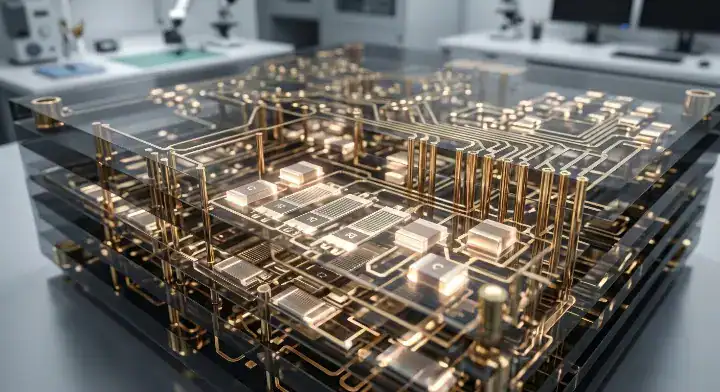
LTCC deserves consideration when compatible low-resistance conductors and integrated passive structures help a compact RF or microwave design meet its loss and size targets. Confirm those benefits in the proposed stack; HTCC can also support RF packages.
Typical LTCC-fit questions include: Does the module need buried filters or passives? Does it need short RF transitions? Is the operating band sensitive to conductor loss and dimensional variation? Does the package need to shrink compared with a discrete assembly?
LTCC is not automatically the best choice for every 5G, radar, or microwave product. A simpler RF ceramic board, PTFE laminate, hydrocarbon ceramic laminate, or DPC ceramic design may be enough. The selection depends on frequency, power, insertion-loss budget, layer count, tolerance, assembly method, and volume.
For RF projects, QueenEMS usually asks for the target frequency band, impedance targets, package outline, grounding scheme, via transitions, and expected assembly stack. That keeps the conversation practical instead of turning LTCC into a buzzword.
When Is HTCC the Better Package Choice?
Consider HTCC when a supplier can demonstrate a compatible multilayer package, conductor system, interfaces and environmental qualification for the design. Compare any LTCC alternative against the same package requirements. Industry or application labels do not establish which construction is more reliable.
The decision should be evidence-based. A buyer should not write “HTCC” into the RFQ unless the drawing or product requirement explains why high-temperature co-fired ceramic is needed. Useful drivers include hermetic packaging, ceramic feedthroughs, severe environmental exposure, high operating temperature, or a known package standard.
The risk is over-specification. If the product is an industrial sensor in a protected enclosure, a high-reliability co-fired package may not be necessary. If the product is a sealed package for a harsh environment, however, choosing a lower-cost non-hermetic route can create qualification trouble later.
| HTCC driver | Evidence to request |
|---|---|
| Hermetic package | Leak-test requirement, package drawing, seal material, feedthrough details |
| Harsh environment | Temperature, pressure, moisture, vibration, and lifecycle exposure |
| High-reliability interconnect | Via structure, metallization, plating, inspection, and acceptance criteria |
When Should Buyers Avoid Both Co-Fired Options?
Buyers should avoid both HTCC and LTCC when the real requirement is a simpler ceramic board, a thermal substrate, or a metallized ceramic process. Co-fired ceramic is valuable when buried multilayer integration or package construction matters. It is not the default answer for every ceramic PCB.
If the design mainly needs heat spreading, compare DPC, DBC, AMB, alumina, AlN, and Si3N4 options before forcing an LTCC or HTCC path. If the design mainly needs surface precision, thick film or thin film may be the better conversation. If the design mainly needs low-cost thermal improvement over FR4, a ceramic-versus-FR4 or metal-core comparison may come first.
Choose HTCC or LTCC when the design needs a co-fired structure and the proposed material system meets the routing, thermal and packaging requirements. If co-firing is unnecessary, compare DPC vs DBC ceramic PCB or thick film vs thin film ceramic PCB. Review the ceramic PCB price drivers after establishing the required construction.
| If the design needs… | Check first |
|---|---|
| High heat removal | DPC, DBC, AMB, AlN, Si3N4 |
| Fine surface metallization | Thick film or thin film |
| RF layout rules | Ceramic RF layout and impedance review |
| Broad process selection | Ceramic PCB manufacturing process comparison |
Which Stack and Test Requirements Decide the Choice?
A useful HTCC or LTCC quote needs more than a part outline. The supplier needs enough information to judge whether the co-fired route is technically justified and manufacturable. Missing RF, thermal, sealing, or tolerance inputs can make early pricing look clean while hiding a major redesign.
Release the stack concept, layer count, ceramic material preference if known, conductor system, via size, minimum trace/space, metallization finish, package outline, surface-mount or die-attach method, operating temperature, heat source, and environmental requirement. For RF designs, include frequency band, impedance target, insertion-loss concern, and grounding transition details.
For hermetic designs, include seal expectations, feedthrough requirements, package cavity or lid details, and any required leak or reliability test. For high-power designs, include heat source location, power dissipation, thermal interface, and assembly boundary conditions. QueenEMS can then decide whether HTCC, LTCC, DPC, DBC, or another ceramic route should move forward.
| Quote input | Why it matters |
|---|---|
| Frequency and impedance | Defines the RF acceptance targets for either co-fired construction |
| Power and thermal path | Checks that the proposed fired stack satisfies the thermal budget |
| Hermetic requirement | Defines the complete seal and package acceptance requirement |
| Layer count and via structure | Confirms whether co-fired multilayer density is needed |
| Acceptance evidence | Defines inspection, dimensional control, metallization, and test records |
Which Claims Should Buyers Treat Carefully?
Buyers should treat fixed cost multipliers, guaranteed lead times, universal yield numbers, and absolute process claims carefully. HTCC, LTCC, DPC, DBC, AMB, thick film, and thin film are process families, not single materials with one universal price or performance value.
For example, “LTCC is always better for RF” is too broad. It may be true for a compact multilayer module with embedded passives and low-loss routing needs. It may be unnecessary for a simpler RF board that can use a suitable laminate or a post-fired ceramic process. “HTCC is always more reliable” is also too broad unless the reliability requirement is defined by the package environment and test plan.
Also be cautious with thermal numbers. A datasheet property does not automatically represent the full assembled thermal path. Die attach, copper thickness, ceramic thickness, via structure, surface finish, mounting method, and airflow all affect the actual junction temperature.
The safer way to compare HTCC and LTCC is to write a requirement-to-evidence table. If no row clearly requires a co-fired route, the buyer should reconsider the process before ordering tooling.
When Should You Choose HTCC or LTCC?
QueenEMS should review HTCC vs LTCC Ceramic PCB as a decision tree: first define the function, then choose the process, then quote the build. The function may be hermetic sealing, RF miniaturization, embedded passives, harsh-environment packaging, or thermal management. Each function points to different evidence.
For LTCC candidates, the review should focus on RF target, conductor system, embedded passive need, shrinkage tolerance, via transition, layer count, and module assembly. For HTCC candidates, the review should focus on package structure, hermetic requirement, feedthroughs, metallization, sealing, temperature exposure, and qualification evidence.
For designs that do not clearly need co-fired ceramic, QueenEMS should challenge the assumption and compare DPC, DBC, AMB, thick film, thin film, AlN, alumina, or Si3N4 alternatives. The selected process should solve the documented constraint without adding unnecessary package complexity.
For a construction-specific quotation, send the drawing, stack concept, thermal requirement, frequency band, package notes and target quantity to the QueenEMS ceramic fabrication team. The review should establish which route is feasible for those requirements; a generic manufacturing claim does not establish HTCC or LTCC capability.
FAQ
What is the main difference between HTCC and LTCC ceramic PCB?
HTCC uses higher-temperature ceramic/conductor systems, commonly with refractory metals. LTCC uses compatible lower-temperature systems; Orbray’s cited LTCC family is fired below 1000°C. Conductor, fired geometry and subsequent assembly requirements determine the actual choice.
Is LTCC better than HTCC for RF applications?
LTCC can be a useful candidate for embedded RF functions and compatible low-resistance conductors. Compare the specific loss, phase, transitions, temperature and package requirements before choosing it over an HTCC construction.
Is HTCC better than LTCC for hermetic packages?
Not from the firing label alone. Compare the completed seal, feedthroughs, cavity, lid attachment and specified leak test. HTCC has established packaging applications, but a package still needs construction-specific evidence.
Can LTCC be used for high-power ceramic PCBs?
Yes, if the selected material and construction meet the heat-load model and package requirements. Compare the complete attachment and cooling path with suitable post-fired ceramic alternatives; “LTCC” alone does not state its thermal performance.
When should I choose DPC or DBC instead of HTCC or LTCC?
Choose DPC or DBC first when the design mainly needs copper thickness, heat spreading, and a simpler ceramic substrate rather than buried co-fired multilayer routing or a hermetic package. The QueenEMS DPC vs DBC guide can help define that boundary before quotation.
Sources
Written by the QueenEMS Engineering Team
Upload your files today · Free DFM check before production · Ship worldwide
Get your PCB prototypes in as fast as 24 hours. We handle FR4, Rogers, and Flex up to 60 layers — free prototypes for 2–4 layer boards, no minimum order.
Just upload your Gerber + BOM — we source every part, assemble, and inspect (AOI + X‑Ray) so you don't have to chase suppliers. Boards ship in as fast as 24 hours.