
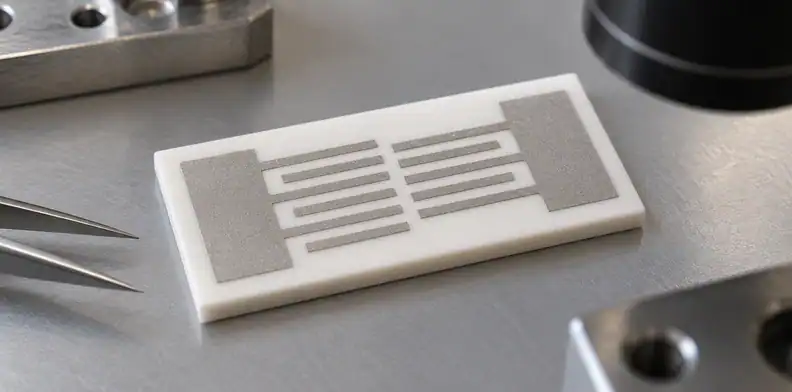
Quick Answer: Check thick film silver migration against a named fired conductor system on its ceramic, in the condition that will be supplied. Compare the geometry, moisture, polarity, biased exposure and agreed electrical criterion, then identify the metal behind any bridge. A short-free sample or a “500-hour pass” alone cannot qualify every construction or operating condition.
A ceramic circuit can leave production electrically intact while its behavior under prolonged moisture and DC bias remains unexamined. Before accepting a supplier report, establish which conductor system it describes and which product condition still needs investigation. The useful outcome is a defined test question for the actual construction.
What must thick film silver migration evidence actually prove?
The evidence must connect a named fired conductor system to its ceramic, finished condition and agreed humidity-and-bias requirement. A silver designation or a passing result on another construction leaves that connection open. Review the specimen identity, exposure and electrical criterion together before deciding what the report supports.
For this review, start with the gap between two biased conductor features. Moisture-assisted electrochemical migration (ECM) can create a conductive bridge there. The purchasing question is whether the supplied ceramic circuit has evidence relevant to that location, including its final metallization and attachment state.
Keep the fabrication-route decision in the separate comparison of printed and deposited ceramic film systems. Solder dissolving a termination during attachment, internal migration along glass-fibre/resin interfaces and assembly-residue coupon testing answer different questions. This review concentrates on the fired conductor system that will actually enter service.
Which conductor system and finished state should the specimen carry?
Use a specimen that identifies the conductor paste, ceramic and any dielectric or overglaze, together with the intended delivered state. An as-fired conductor, a protected conductor and a soldered termination expose different material combinations. Treat a change between those states as a question for engineering review, rather than transferring the result automatically.
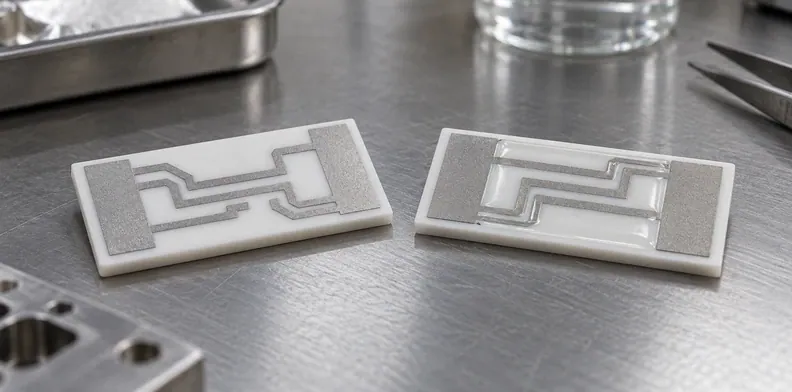
A paste family name is a starting point. Request the designation, revision and lot, the ceramic grade, the firing route and any later processing. Mark where the conductor sits over a fired dielectric and where a protective layer stops. For attached parts, include the solder and termination metals.
The following is a proposed buyer record. It organizes questions for the fabricator and test laboratory; it supplies no standard pass limits.
| Record group | Information to retain |
|---|---|
| System and state | Paste, ceramic and dielectric identities; firing route; overglaze coverage; attached metals. |
| Biased features | Minimum fired gap, measurement location, positive/negative nets and operating bias. |
| Moisture | Temperature, humidity and whether condensation or liquid contact is in scope. |
| Exposure clock | Conditioning time, biased time, total time and interruptions. |
| Electrical readings | Measurement voltage and timing, series resistance, individual readings and exclusions. |
| Acceptance | Sample count, agreed leakage or insulation-resistance criterion and approving owner. |
| Disposition | Identified deposit metal, unresolved conditions and accepted construction changes. |
How should gap, edge, polarity and moisture be recorded?
Record the smallest finished gap at the relevant conductor edges, its location and the positive and negative net assignments. State the operating voltage difference and whether it persists continuously. Then distinguish humid air, condensation and direct liquid exposure, so the laboratory can assess whether its proposed conditions address the product.
A nominal artwork spacing cannot describe an unmeasured fired edge. Mark the critical pair on the drawing and ask how the finished gap will be checked. This is a request to define the specimen, not a universal spacing recommendation.
Moisture conditions need equally precise wording. The September 2000 IPC surface-migration procedure keeps falling condensation droplets off its specimens. A water-drop experiment deliberately introduces liquid instead. Neither label silently covers a product that experiences condensation during its own operating cycle.
Agree the exposure with the product owner and laboratory before testing. Record what remains unexamined when the available chamber report concerns non-condensing humidity alone.
Does 500 hours mean the same biased exposure in every report?
No. The timed Class T procedure in IPC-TM-650 2.6.14 Revision D includes 96 hours of stabilization before 404 hours under bias, giving 500 hours total. The September 2000 procedure in 2.6.14.1 specifies 500 biased hours after 96 hours of stabilization, giving 596 hours total. A duration label alone hides that difference.
Read the timed steps
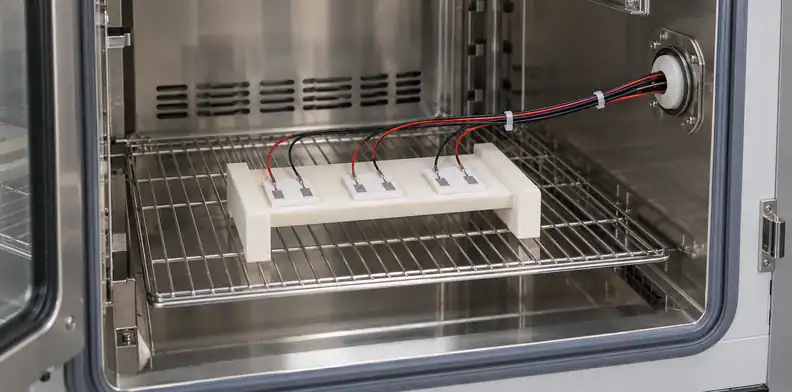
The March 2007 solder-mask method, sections 5.7.4–5.7.7, and the September 2000 surface-migration method, sections 5.2.3–5.2.5, contain the timed steps compared below; both are historical procedures.
| Clock item | Class T, March 2007 | ECM, September 2000 |
|---|---|---|
| Stabilization | 96 hours | 96 hours |
| Applied bias | 404 hours | 500 hours |
| Total | 500 hours | 596 hours |
| Test vehicle | IPC-B-25A comb, solder-mask coated | IPC-B-25 or IPC-B-25A comb, normally bare copper |
| Original purpose | Polymer solder-mask assessment | Surface migration; soldering materials or processes |
Temperature, humidity, bias voltage, measurement voltage and specimen construction still need comparison. Equal biased hours would not make unlike conditions equivalent. Neither document automatically governs a new ceramic order; identify the agreed method and edition in the project specification. Do not turn a chamber duration into a service-life claim.
What leakage criterion and sampling make a result usable?
A useful report identifies the electrical limit agreed before testing, the measurement conditions and the specimen-level results behind any average. Ask how many observations were made, when resistance was measured and why any reading was excluded. The project owner needs those details to decide whether the result satisfies the intended requirement.
The two historical methods use geometric means and permit exclusions for specified assignable causes. An average alone therefore leaves questions about individual locations and excluded observations. Request the individual readings and exclusion reasons, rather than treating the reported average as the whole test population.
Illustrative report review: a supplier offers “500 hours passed” on an as-fired ceramic specimen. Its timing log shows 96 hours of conditioning and 404 biased hours; the product will have soldered terminations, while the report has one unexplained exclusion. Retain the result for its stated specimen and conditions. Obtain the exclusion explanation and leave the soldered-state question unresolved until engineering accepts further evidence.
Which metal formed the dendrite, and why does that change the fix?
Identify the deposit before choosing a material change. A branching shape alone does not establish that silver created the bridge. The relevant material inventory includes the fired conductor, surface finish, solder and attached terminations, so failure analysis should investigate the complete combination rather than assuming the conductor name identifies the migrating metal.
A historical comparison with a limited lesson
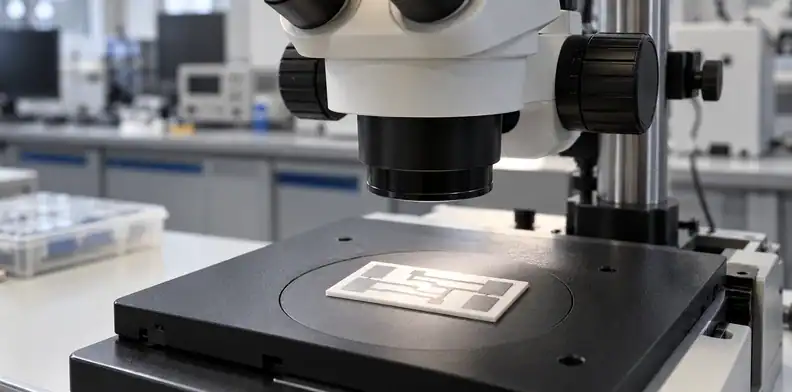
In their 1980 thick-film materials paper, Larry, Rosenberg and Uhler describe a water-drop comparison on alumina. Soldered platinum/gold lines bridged before unsoldered palladium/silver lines; the bridging deposits were mainly lead. Tin deposits were also present but had not completed the bridge at that point.
The conductor systems and solder states differed, so this experiment cannot isolate a universal ranking of the metals. It supports a narrower action: identify what actually bridged the gap. It neither predicts ceramic service life nor establishes that gold or an overglaze eliminates migration.
Preserve the biased-pair location, polarity and processing history for the laboratory. Have it select the examination and chemical-identification methods needed to distinguish a deposit from debris, corrosion or another conductive path.
Which changes should reopen the evidence before release?
Reassess evidence when a change affects the conductor formulation, firing route, ceramic, dielectric, protective coverage, attached metals, gap or operating exposure. Record which construction revision the report covers and who accepted any equivalence argument. A substitution should not inherit migration qualification merely because its drawing still calls the conductor silver.
Use the final row of the proposed record as a change log: identify the old and new conditions, the affected evidence and the engineer’s disposition. For example, adding an overglaze changes the protected surface and its openings; changing solder adds a different attached-metal condition. The responsible engineer decides whether existing evidence remains relevant or additional work is needed.
Separate the supply decision from the testing assignment. A fabrication quotation should say which construction can be supplied, while the buyer and laboratory agree the environmental investigation and acceptance plan. That separation keeps an ordinary electrical inspection from being represented as humidity-bias qualification.
Frequently Asked Questions
Does silver-palladium paste eliminate the need for qualification?
No. Retain the exact paste and finished construction in the test record. An alloy description alone does not establish performance under the project’s moisture, bias and acceptance conditions.
Does an overglaze alone establish migration resistance?
No. Record the actual overglaze, coverage, openings and conductor state. The product owner must decide whether the available evidence addresses that protected construction.
Can a water-drop result predict service life?
No. It describes the tested liquid-contact condition. A service-life prediction needs a justified relationship to the actual environment and failure mechanism; a short accelerated comparison does not provide that relationship.
Must every production lot repeat the qualification test?
Not necessarily. Define qualification, change approval and routine lot evidence separately in the order. The purchase specification should state the frequency and the changes that trigger new testing.
Send your released files for a quote and free DFM review.
Send the substrate and conductor drawings for review. Identify biased features, spacing and the silver-migration evidence required for your application.
For assembly, identify the fitted parts and process conditions relevant to the ceramic circuit. Agree who supplies silver-migration qualification evidence.