
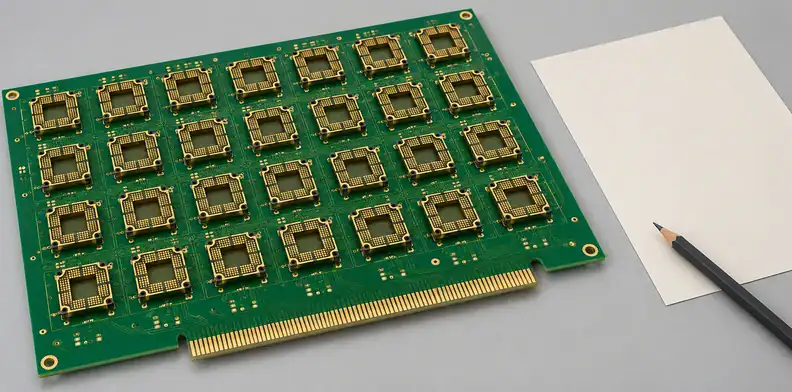
Quick Answer: Before ordering a packaged-device burn-in board, map each tester resource to the DUT positions it feeds. Record the allowed terminal-bias window for the specified pattern/load after thermal stabilization, and identify the evidence for each shared resource’s behavior. Leave undisclosed abnormal-DUT effects open for the platform and test owners; a multi-DUT label does not establish per-DUT protection.
Featured image: Generic AI-generated illustration; not a QueenEMS board or test result.
Here, thermally steady means the specified pattern/load after thermal stabilization. Hot switching and DPS transient response need separate requirements. The burn-in pattern may contain activity; this record concerns the agreed stabilized condition and the DUT group supplied by each resource.
What resource scope does the burn-in system give each DUT?
It depends on the platform: a rail may serve a bussed group, a slot or a device-local function. Identify each rail’s resource tier from the exact platform and interface documentation. Keep an unstated tier marked unknown. The number of DUT positions on a burn-in board does not establish how its power resources or protection actions are allocated.
Aehr’s packaged-parts test and burn-in descriptions provide an attributed example. Tahoe provides slot-level resources, while Sonoma localizes power, stimulus and test electronics to each DUT. These descriptions identify different platform arrangements; they do not make the two interfaces interchangeable.
Ask for the applicable platform, interface and resource documentation revision. Record the scope per rail, because one broad system description may leave the particular board connection unspecified. “Device-local” also leaves questions about upstream sharing unless the platform documentation addresses them.
Use the resource names the system owner recognizes. The buyer needs a connection between that platform identity and the board being manufactured, rather than an assumed per-socket supply derived from a product label.
Which DUTs share a rail on the board being ordered?
Map the identified resource to the DUT positions connected by the released board data. Preserve the group identity alongside the board revision and fitted variant. The relevant purchase record is the resource and its connected DUT set; a socket identifier alone cannot show which other devices share that resource.
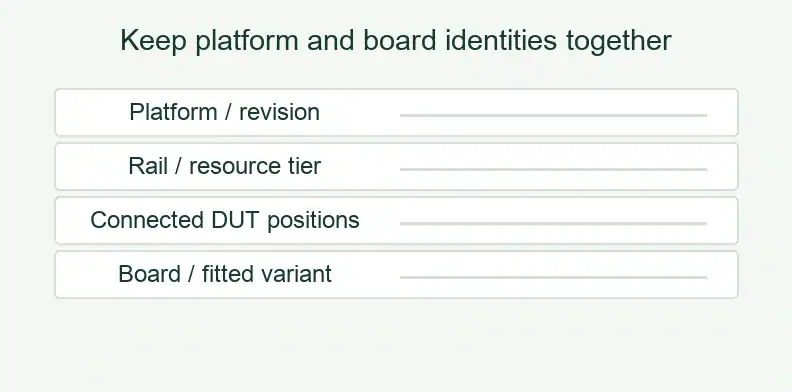
Loranger’s published burn-in and test-board design guidelines describe voltage and ground buses running through device positions in a memory BIB array. This supports a real shared-distribution context. Its vendor-specific layout and process values are not adopted here as current design rules.
For each rail, ask the design owner to identify the connected positions and the source data defining that set. Keep supply and return references associated with the same group. If a fitted link changes the group, identify the applicable population in the record.
Reconcile the platform resource list and board connection list before quotation. An undefined position belongs on an open-item list with an owner; the fabricator should not infer its resource from neighboring sockets or a repeated net label.
How should the DUT bias window be agreed at the thermally steady condition?
Ask the test owner to supply the allowed DUT-terminal bias window, its reference point and the specified pattern/load after thermal stabilization. Associate those requirements with the resource and connected DUT group. Keep path and component inputs tied to their evidence; a missing input remains pending until the responsible owner resolves it.
HIOKI’s burn-in-board testing application describes sockets and both passive and active circuits on assembled BIBs. It confirms that the assembled object contains more than bare copper. The presence of resistors, transistors or diodes does not identify their protection function on a particular design.
For general supply/return and voltage-drop budgeting, use the existing power-distribution design guide. This record consumes the design owner’s inputs without teaching conductor sizing, remote-sense design or resistance measurement.
The resource-to-DUT hot-bias record below is an editor recommendation. Complete its fields from the approved platform, circuit and test requirements. It contains no numerical example or default bias limit.
| Field | Customer or platform-owner entry |
|---|---|
| Rail and platform | Resource ID and platform/interface revision. |
| Resource tier | Bussed, slot-level, device-local or unknown, with document reference. |
| Connected DUT group | Position IDs, board revision and fitted variant. |
| Source setting | Approved setpoint and its physical reference. |
| Steady condition | Specified pattern/load and per-DUT input from the test owner after thermal stabilization. |
| Allowed DUT window | Terminal-bias requirement and reference supplied by the test owner. |
| Path and component inputs | Applicable supply/return and fitted-part evidence, or pending items. |
| Disposition | Decision, restriction, evidence reference and approving owner. |
Keep the source setting and DUT window as separate fields. Ask the owner to identify the evidence connecting them for the stated group and condition. An instrument display supplies no missing board or loaded-device evidence.
What is known about neighboring DUTs when one becomes abnormal?
For each shared resource, ask whether the platform’s detection, limiting or shutdown action applies to one DUT, a slot or a larger group. Record the supporting statement and any undisclosed impact. The test owner must decide whether the available information supports the intended use; a shared connection alone proves neither isolation nor failure propagation.
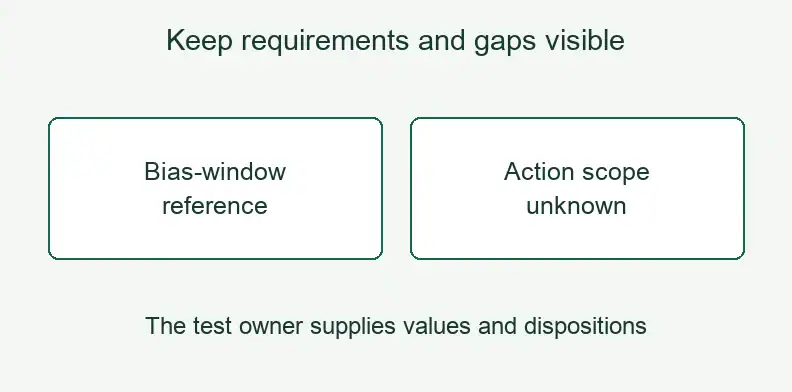
Do not turn a resource-placement description into a protection claim. The documentation may identify device-local electronics without explaining every upstream dependency or abnormal-device response. Request the applicable evidence for the exact platform configuration and DUT group.
The shared-resource exception ownership card is a second editorial recommendation. It records a disclosure gap and the person responsible for its disposition. It does not prescribe a resistor, fuse, current limiter or fault-isolation topology.
| Exception field | Information to return |
|---|---|
| Shared resource | Resource ID and connected DUT-group reference. |
| Action scope | DUT, slot, larger group or unknown; identify the action described. |
| Platform evidence | OEM statement, interface document and applicable configuration. |
| Unresolved impact | What remains unknown about other connected DUTs. |
| Test-owner decision | Accepted scope, restriction or further evidence required. |
| Order consequence | Required approved board variant or report, if applicable. |
| Approval | Named owner, date and unresolved follow-up. |
Leave “unknown” visible when the platform owner has not provided the information. A completed PCB connection check cannot replace that disclosure or establish that neighboring DUTs remain unaffected.
What should the board order cover, and what stays with the test owner?
Define the released board configuration and the fabrication or assembly checks included in the quotation. The supplier can return the agreed construction and population evidence. The platform and test owners retain the actual DUT-bias and abnormal-device behavior decisions, including which results apply to the specified thermally steady pattern and connected DUT group.
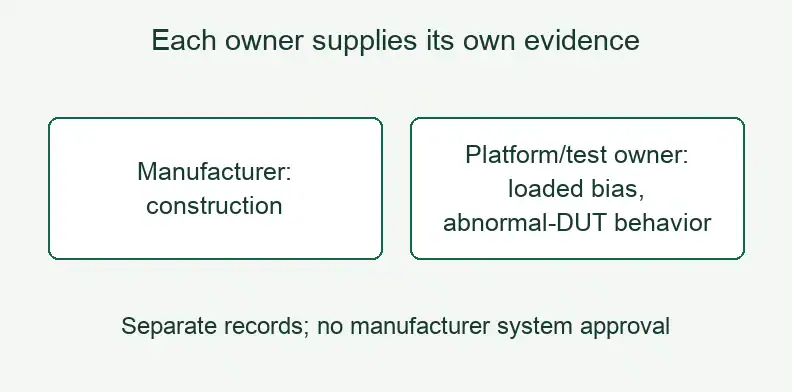
The ATE PCB manufacturing page covers the manufacturing inquiry. Add the approved BOM and assembly data when requesting a populated board. Required checks should identify the board, BOM and connection-data revisions they cover.
A board-test result concerns its stated object and method. It does not establish the loaded DUT bias under burn-in conditions or complete device qualification. Return those requirements to the system or test owner, with the resource/group identity retained in the evidence.
What else should a burn-in board buyer confirm? (FAQ)
Confirm the resource tier, connected DUT group and approved steady condition before using a supplier reply to close the bias requirement. The remaining questions concern evidence and responsibility. Keep missing platform information distinct from a missing manufacturing file, so the appropriate owner can resolve each item before release.
Does a slot-level supply establish per-DUT protection?
No. Ask which DUTs it feeds and whether detection, limiting or shutdown acts on the DUT, slot or a larger group. Keep undocumented behavior unknown.
Does hot bias mean hot switching or DPS transient response?
Here it means the specified pattern/load after thermal stabilization. Relay transitions and DPS transients require their own approved requirements and evidence.
Can a passing bare-board electrical test confirm the DUT bias?
No. It checks the supplied board data within the agreed method. The loaded bias window for the stated resource, DUT group and condition needs the test owner’s evidence.
Who supplies the per-DUT load input?
The customer or test owner supplies the input for the specified part, pattern and thermally stabilized condition. Missing values remain pending rather than being invented by the fabricator.
Send your released files for a quote and free DFM review.
Send released Gerber, drill data, stackup and drawings for a PCB quote. Include tester-rail and DUT-position references; flag open connection questions.
For assembly, add the BOM and fitted-position data. Agree board checks; loaded DUT-bias validation and fault decisions stay with your test team.