Quick Answer: Decision: copper-thieving approval. Controlled object: layer-by-layer thieving proposal showing density purpose, panel or unit location, electrical connection, spacing, and exclusion zones. Design-owned boundary: antenna and RF keepouts, impedance corridors, creepage zones, exposed edges, optical targets, and copper intentionally connected to ground. Supplier discretion: supplier-generated balancing copper only inside released thieving zones and under the approved connectivity rule. Stop rule: thieving inside a protected electrical area, an unspecified ground connection, or copper added without a reviewable before-and-after file.
Copper balance RFQ path
- When does copper thieving belong in an RFQ discussion?
- Where should copper thieving be allowed or blocked?
- How should buyers approve a thieving proposal?
- Can copper thieving change cost or lead time?
- What evidence should buyers request for copper balance?
- What should the copper thieving RFQ include?
When does copper thieving belong in an RFQ discussion?
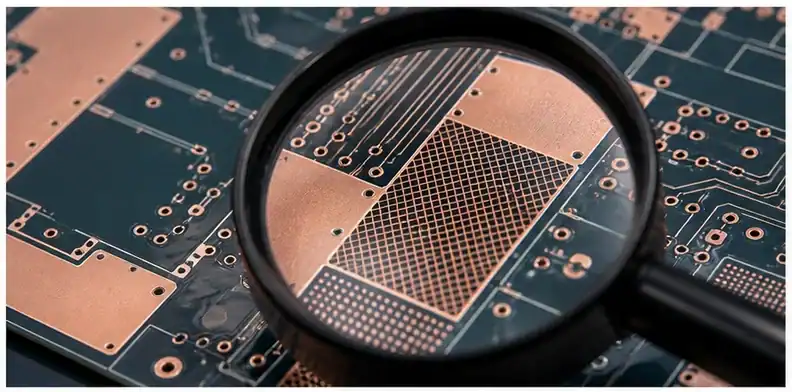
Copper thieving belongs in an RFQ discussion when copper balance, plating uniformity, etching stability, or panel yield could affect the finished board. The buyer does not need to design every thieving shape, but the RFQ should say whether the supplier may add nonfunctional copper and where it is forbidden.
Top SERP results and engineering discussions describe thieving as nonfunctional copper used to improve copper distribution, especially where outer-layer plating or etching balance is sensitive. The RFQ should therefore separate process copper from product copper: process copper may help yield, but it must stay electrically isolated, outside keepout zones, and away from impedance, RF, antenna, high-voltage, and customer-visible areas unless the design owner approves it.
- Heavy copper imbalance can create plating or etching variation.
- RF, antenna, high-voltage, and clearance areas may need strict keepouts.
- Panel-level copper balance may differ from board-level artwork.
| Board condition | Buyer decision |
|---|---|
| Large copper imbalance | Allow supplier DFM proposal |
| RF or antenna zone | Require keepout approval |
| Customer-controlled artwork | Define whether nonfunctional copper is allowed |
Bottom line: Copper thieving is useful only when it improves process control without changing the product intent.
Where should copper thieving be allowed or blocked?
The drawing should identify keepout areas where extra copper is not allowed and allow supplier-proposed thieving only in safe nonfunctional regions. This matters because added copper can affect impedance, capacitance, isolation, creepage, antenna behavior, or customer visual acceptance.
- Keep thieving away from controlled impedance and RF regions unless reviewed.
- Respect high-voltage clearance and creepage rules.
- Clarify whether panel rails may contain copper balancing features.
| Area | Typical rule |
|---|---|
| Panel rails | Often acceptable with supplier control |
| RF/antenna region | Requires engineering approval |
| High-voltage gap | Block unless the design owner approves |
Bottom line: The supplier can suggest balance copper, but the buyer should own functional keepouts.
How should buyers approve a thieving proposal?
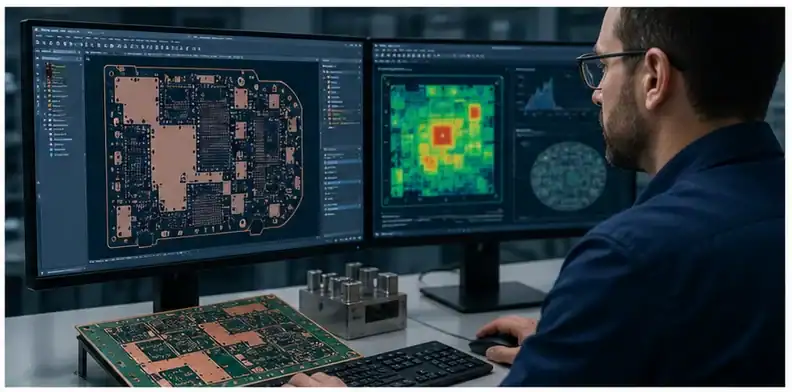
A thieving proposal should show the location, layer, clearance to functional copper, and reason for the change. Approval should confirm that the added copper is nonfunctional, outside restricted areas, and does not change impedance, isolation, RF behavior, or visual acceptance.
- Ask for a marked screenshot or revised fabrication view.
- Approve layer-by-layer when the design has sensitive zones.
- Treat large copper additions as a revision-controlled DFM decision.
| Proposal detail | Why to ask |
|---|---|
| Layer and region | Prevents hidden copper on sensitive layers |
| Clearance to features | Protects electrical and mechanical rules |
| Process reason | Shows whether change is yield, plating, or etch driven |
Bottom line: Approve copper thieving as a documented process change, not as an invisible factory edit.
Can copper thieving change cost or lead time?
Copper thieving can change cost or lead time when the supplier needs extra CAM review, customer approval, panel redesign, or first-article evidence. The feature itself may not be expensive, but the review path can affect release timing if the keepout rules are unclear.
- Fast prototypes may accept supplier-standard balancing if risk is low.
- Production or customer-controlled designs need clearer approval.
- Unclear keepouts can delay CAM release more than the copper edit itself.
| Quote impact | Typical cause |
|---|---|
| No visible change | Supplier-standard panel balancing |
| Small schedule hold | Buyer approval needed for marked changes |
| Requote | Panel redesign or evidence package changes |
Bottom line: The main cost is usually decision time, so define approval rules before CAM hold.
What evidence should buyers request for copper balance?
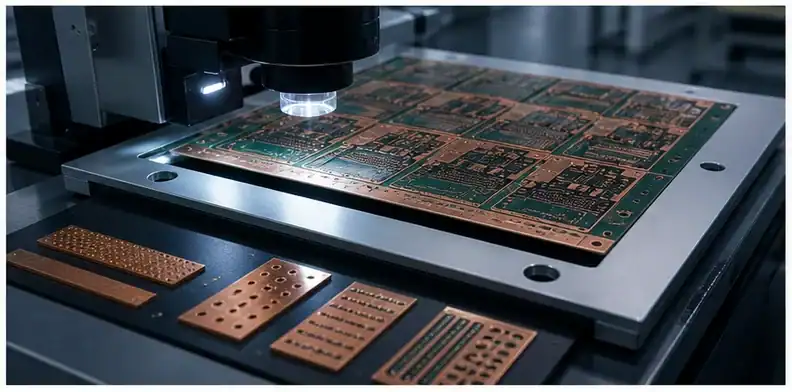
Evidence should show that the approved copper-balancing decision was followed and did not enter restricted zones. For most orders, a CAM note or marked view is enough; for high-risk panels, outgoing inspection or first-article confirmation may be useful.
- Do not request heavy paperwork for harmless panel rail copper.
- Request marked evidence when thieving is near functional regions.
- Keep evidence tied to the approved revision.
| Risk | Evidence |
|---|---|
| Standard panel balance | CAM assumption note |
| Near sensitive routing | Marked screenshot or approval view |
| Customer-audited order | Revision-controlled outgoing note |
Bottom line: Ask for proof where added copper could be mistaken for a design change.
What should the copper thieving RFQ include?
The RFQ should include PCB data, stack-up, copper weight, controlled impedance or RF notes, keepout zones, panel preference, approval contact, and evidence request. That lets QueenEMS review copper balance without adding nonfunctional copper where the design cannot accept it.
- Flag layers or areas where extra copper is forbidden.
- State whether supplier-standard panel balancing is acceptable.
- Record final approval with the production release package.
| RFQ item | Purpose |
|---|---|
| Keepout zones | Protects functional design intent |
| Panel preference | Shows where balance copper may be placed |
| Approval owner | Prevents purchasing-only technical approval |
What should the buyer record before release?
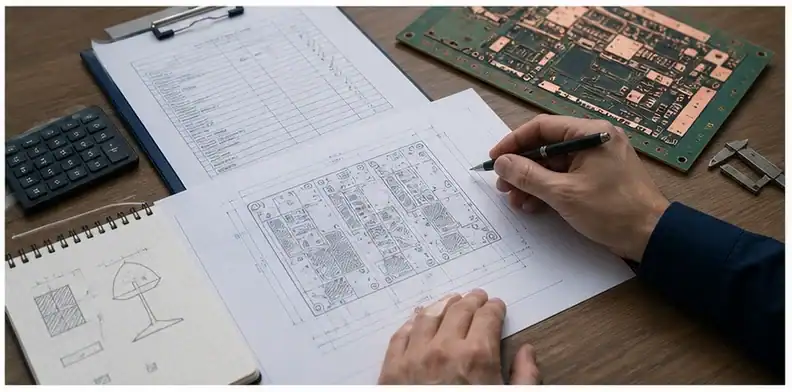
For copper thieving decisions, the release record should define restricted zones clearly. Extra copper near RF structures, high-voltage clearances, antenna areas, impedance traces, or customer-visible regions is not the same as balancing copper in panel rails. The supplier needs room to control plating and etching, but the buyer must protect the functional design boundary.
The buyer should also decide whether supplier-standard copper balancing is allowed on future lots. Without that note, one supplier may add balancing copper during CAM while another builds exactly as supplied. Both boards may work, but the quote comparison is not clean because the manufacturing assumptions are different.
Production record for the copper-thieving approval
Controlled object
Controlled object: layer-by-layer thieving proposal showing density purpose, panel or unit location, electrical connection, spacing, and exclusion zones.
Failure boundary
Failure boundary: detuned RF structures, antenna coupling, high-voltage clearance loss, AOI confusion, floating copper behavior, or inconsistent plating balance.
Design-owned conditions
Design-owned conditions: antenna and RF keepouts, impedance corridors, creepage zones, exposed edges, optical targets, and copper intentionally connected to ground.
Supplier discretion
Supplier discretion: supplier-generated balancing copper only inside released thieving zones and under the approved connectivity rule.
Required proof
Required proof: a processed copper comparison with density intent, clearance checks, connection status, and representative plating evidence where risk justifies it.
Production stop
Production stop: thieving inside a protected electrical area, an unspecified ground connection, or copper added without a reviewable before-and-after file.
Repeat-order baseline
Repeat-order baseline: the allowed-zone map, thieving rule, connected or floating status, protected structures, and accepted CAM dataset.
RFQ inputs
RFQ inputs: all copper layers, net and keepout information, panel drawing, impedance and high-voltage constraints, finish, quantity, and approval boundary.
FAQ
Can the supplier decide the copper-thieving approval?
Discretion for copper-thieving approval: supplier-generated balancing copper only inside released thieving zones and under the approved connectivity rule. Engineering control for copper-thieving approval: antenna and RF keepouts, impedance corridors, creepage zones, exposed edges, optical targets, and copper intentionally connected to ground.
What stops this copper-thieving approval?
Stop rule for copper-thieving approval: thieving inside a protected electrical area, an unspecified ground connection, or copper added without a reviewable before-and-after file. Disposition owner for copper-thieving approval: the named engineering approver.
Which proof closes the copper-thieving approval?
Evidence for copper-thieving approval: a processed copper comparison with density intent, clearance checks, connection status, and representative plating evidence where risk justifies it. Revision link for copper-thieving approval: the quoted dataset.
What survives into the next order?
Reorder baseline for copper-thieving approval: the allowed-zone map, thieving rule, connected or floating status, protected structures, and accepted CAM dataset.
For a focused copper-thieving approval, send QueenEMS all copper layers, net and keepout information, panel drawing, impedance and high-voltage constraints, finish, quantity, and approval boundary. Redline request: copper-thieving approval. Open assumptions: copper-thieving approval. Approver: copper-thieving approval owner.
Written by the QueenEMS Engineering Team
Sources
Upload your files today · Free DFM check before production · Ship worldwide
Get your PCB prototypes in as fast as 24 hours. We handle FR4, Rogers, and Flex up to 60 layers — free prototypes for 2–4 layer boards, no minimum order.
Just upload your Gerber + BOM — we source every part, assemble, and inspect (AOI + X‑Ray) so you don't have to chase suppliers. Boards ship in as fast as 24 hours.