
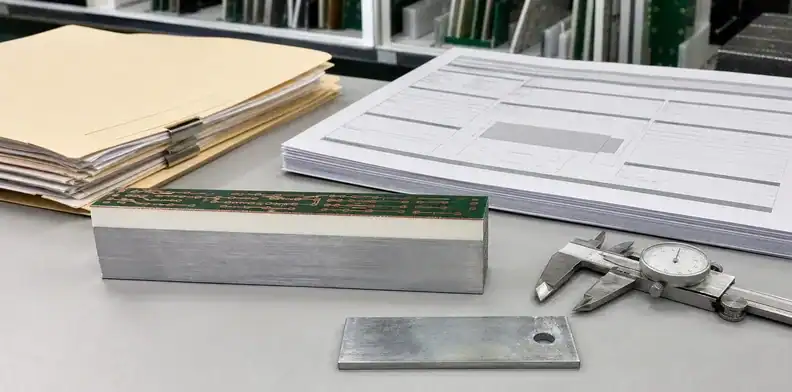
Quick Answer: “Bergquist PCB material” is now a legacy sourcing phrase for the Thermal Clad insulated metal substrate product line, which TCLAD acquired from Henkel in 2021. A buildable RFQ should identify the current TCLAD material family and grade, dielectric thickness, copper foil, base metal, performance metric and datasheet revision instead of naming Bergquist alone. It should also prohibit unapproved substitutions and define the evidence needed for prototypes, production lots and repeat orders.
Bergquist PCB material searches often begin with a familiar brand name but end with an incomplete laminate callout. That gap matters because “Bergquist” can describe a historic Thermal Clad drawing note, a current Henkel thermal interface material, or a buyer’s general expectation for an insulated metal substrate (IMS).
The quotation should resolve that ambiguity before a supplier prices material, tooling or thermal performance. This article focuses on identity, specification and change control. For a broader comparison of metal-core constructions and applications, use the metal-core PCB manufacturing overview as the separate topic owner.
Table of Contents
- Translate the legacy name into a current material identity
- Separate Thermal Clad laminate from Bergquist interface materials
- Write an exact material callout instead of a brand note
- Compare thermal claims on the same measurement basis
- Freeze the full IMS construction around the dielectric
- Control substitutions, availability and revision changes
- Define fabrication and lot evidence before approval
- Release a quote-ready package and preserve it for reorders
Translate the legacy name into a current material identity
Identity check: Treat “Bergquist Thermal Clad” as a historical product-line reference, then confirm the current TCLAD product name and current technical data before releasing a purchase order.
The commercial history explains why old drawings, distributor listings and current datasheets can appear inconsistent. Bergquist developed Thermal Clad beginning in the late 1980s. Henkel acquired Bergquist in 2014, and TCLAD states that it completed the purchase of the Bergquist Thermal Clad product line from Henkel in May 2021. TCLAD now presents the IMS laminate portfolio and its current product documentation.
That ownership sequence does not automatically invalidate a qualified legacy design. It does mean that the name on an old fabrication drawing may not identify the current orderable grade, source, construction or document revision. Procurement should translate the historical callout into a controlled contemporary record rather than asking a fabricator to guess what “Bergquist or equivalent” means.
Start the translation with four questions:
- What exact product family and grade did the original qualification use?
- Which company and manufacturing source supplied that qualified material?
- What thickness, copper and base-metal construction was tested?
- Which current datasheet or supplier declaration maps to that record?
Keep the original material certificate, drawing revision and approval evidence if the legacy configuration must be maintained. If the original grade is unavailable, classify the replacement as a material change and reopen the affected thermal, electrical, mechanical and regulatory decisions.
This identity step is deliberately narrower than general aluminum PCB material selection. The design may already require IMS; the unresolved issue is whether the quoted laminate is the same controlled material the design intended.
Separate Thermal Clad laminate from Bergquist interface materials
An IMS laminate is part of the printed circuit board, while a thermal interface material sits between assembled surfaces. Similar thermal language does not make them interchangeable.
Current Henkel pages still use the Bergquist name for products such as gap pads, phase-change materials, adhesives and bond-ply thermal interface materials. Those products can be important in a thermal assembly, but they are not automatically the dielectric layer of a Thermal Clad circuit board. A sourcing request that says only “use Bergquist material” can therefore point two suppliers toward different bill-of-material categories.
A typical Thermal Clad IMS construction contains circuit copper, a thermally conductive electrically insulating dielectric and an aluminum or copper base. The dielectric is bonded into the board laminate and influences isolation, thermal impedance, adhesion and fabrication behavior. A separate interface pad or compound fills an assembly gap between the PCB, component, heat spreader or enclosure.
The drawing and bill of materials should place each item in its physical location:
| Item | Where it belongs | Minimum identity to control |
|---|---|---|
| IMS laminate | PCB fabrication drawing and stackup | Current family, grade, dielectric thickness, copper, base metal and revision |
| Interface pad or film | Assembly drawing and BOM | Manufacturer part number, thickness, compression and approved alternates |
| Adhesive or bonding film | The joint it creates | Grade, bond line, cure condition and surface preparation |
| Thermal compound | Defined assembly interface | Product, application thickness or coverage and process controls |
Do not let one generic thermal-material note govern all four rows. The PCB fabricator needs a laminate construction, while the assembler needs a separate interface-material specification and application process.
Write an exact material callout instead of a brand note
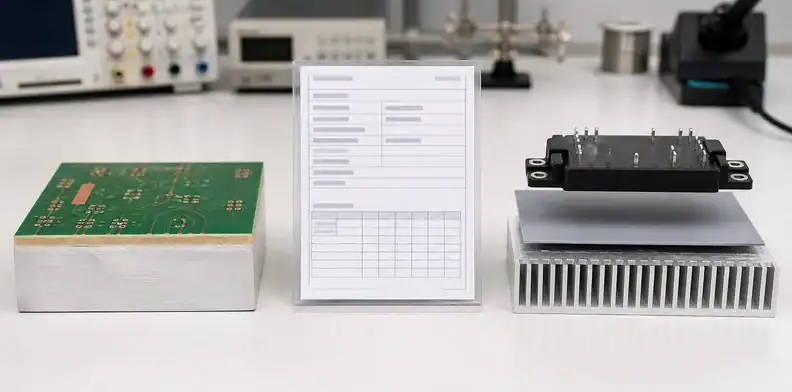
Callout rule: Name the current manufacturer, product family, exact grade, construction and controlled document revision; never rely on the word “Bergquist” to carry those decisions.
TCLAD’s current material table lists multiple dielectric families with different thickness options and reported properties. Even within one family, a thickness change alters thermal resistance and electrical isolation behavior. A supplier therefore cannot convert a brand-level note into a unique stackup without assumptions.
A useful controlled callout contains:
- current supplier and product family;
- exact dielectric formulation or grade;
- nominal dielectric thickness and allowed tolerance;
- circuit copper type, starting weight and finished requirement;
- base-metal alloy or grade, thickness and temper when relevant;
- total finished board thickness and tolerance;
- surface finish and copper-plating implications;
- technical data sheet number or title and revision/date;
- approved source or manufacturing-location restriction, if qualification requires it;
- substitution and change-notification rule.
For example, a buyer-controlled note can state: “Use TCLAD Thermal Clad [approved family and grade], [specified] dielectric thickness, [specified] copper foil and [specified] aluminum or copper base per the named current TDS revision. No change to dielectric formulation, thickness, base-metal grade, manufacturing source or construction without written engineering approval.” The bracketed values must come from the actual design record; they are not universal recommendations.
Do not copy a product-table value into a drawing without checking whether the selected grade and thickness combination is currently offered. Do not use a distributor’s abbreviated description as the controlling technical record. The supplier stackup sign-off process should capture the supplier’s returned construction before fabrication begins.
The result should be a callout that a second buyer, fabricator and quality engineer can interpret in the same way months later.
Compare thermal claims on the same measurement basis
Compare the property, test method, specimen construction and thickness together. A larger conductivity number does not by itself prove a lower junction temperature.
Thermal marketing frequently compresses several different measurements into one number. TCLAD’s HT technical data, for example, distinguishes “product thermal conductivity” from “dielectric thermal conductivity.” It also reports thermal resistance for specific dielectric thicknesses. Those are related values, but they do not describe the same measurement boundary.
Thermal conductivity is an intrinsic material property expressed in W/m-K. Thermal resistance describes opposition to heat flow through a defined thickness and area, commonly reported for a test specimen in units such as degrees C-in²/W. The assembled temperature rise also depends on copper spreading, dielectric thickness, board area, base metal, interface resistance, heat-sink geometry, airflow and power distribution.
Use the QueenEMS PCB materials guide to place IMS in the broader landscape of FR-4, RF, low-loss and hybrid laminate families. That guide helps establish the material-class decision, while the current manufacturer TDS and approved stackup must control the exact Bergquist or Thermal Clad construction.
Ask suppliers to return the following beside every thermal claim:
| Comparison field | Why it changes the decision |
|---|---|
| Property name | Conductivity, resistance and impedance are not synonyms |
| Test method | Different fixtures and calculations can produce non-equivalent results |
| Dielectric thickness | A thicker electrical barrier generally changes through-thickness resistance |
| Complete specimen | Copper and base metal can influence a product-level result |
| Nominal or guaranteed value | A typical data-sheet value may not be a lot acceptance limit |
| Data revision | Formulations and published methods can change over time |
Use a thermal model or representative test vehicle when the assembly has a tight temperature margin. A datasheet helps select candidates; it does not reproduce the finished product’s component footprint, copper coverage or cooling boundary. For designs near the architectural boundary between IMS and another substrate, the ceramic PCB versus metal-core decision addresses that broader choice.
The buyer’s comparison table should therefore show normalized, like-for-like inputs rather than ranking materials by the largest isolated number.
Freeze the full IMS construction around the dielectric
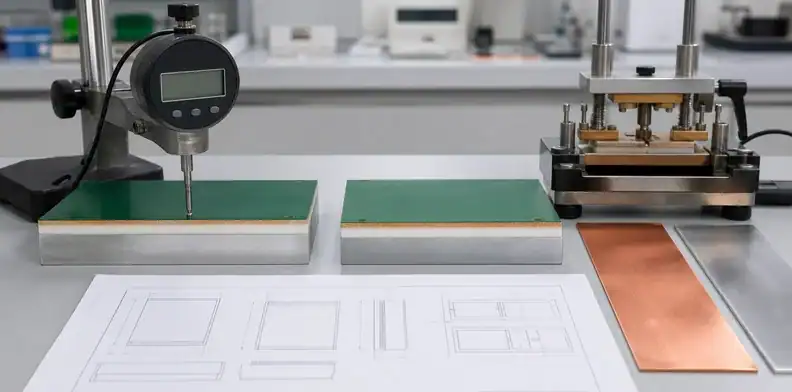
Stackup check: The approved dielectric is only one layer in the thermal path; copper, plating, base metal, solder mask and finished geometry must be frozen with it.
TCLAD describes a standard IMS as circuit copper over a dielectric layer bonded to an aluminum or copper base. Its current IMS page notes a broad range of copper options, but availability does not mean every combination has the same fabrication behavior. Heavy copper, fine spacing, small isolated pads and a thick metal base affect imaging, etching, drilling, profiling, flatness and heat spreading.
The RFQ stackup should distinguish starting copper from finished copper. Finished thickness can include plated copper in holes and on exposed features, while many simple IMS designs use single-sided circuitry without plated through-holes. If the design needs vias, multilayer features, countersinks, formed metal, cavities or selective dielectric removal, identify them explicitly because they can move the board outside a supplier’s standard route.
Base-metal details deserve the same discipline as the dielectric. Record whether the base is aluminum or copper, its grade or alloy requirement, thickness, temper or mechanical condition where needed, and any exposed-surface finish. The base influences mass, stiffness, machining, galvanic compatibility, thermal spreading and assembly attachment.
Coordinate these related requirements:
- finished board and local thickness tolerances;
- circuit copper and conductor-spacing capability;
- dielectric keepouts at routed or machined features;
- hole type, plating status and burr limits;
- surface finish thickness on exposed copper;
- solder mask temperature and adhesion needs;
- flatness and mounting-surface requirements;
- isolation distances around fasteners and exposed base metal.
The PCB surface-finish thickness requirements should own the deposit callout rather than leaving “ENIG” or another finish as an unmeasured label. For unusually concentrated heat flow that has already exceeded the IMS architecture, review embedded copper coin acceptance separately; a coin construction is not an automatic substitute for Thermal Clad.
Freezing the complete stack prevents a supplier from meeting the dielectric name while changing another layer that the thermal or mechanical model assumed.
Control substitutions, availability and revision changes
An “equivalent” IMS is acceptable only after the buyer defines equivalence, receives comparable evidence and approves a named replacement construction.
Material availability can change between prototype and production or between repeat orders. A fabricator may propose a stocked IMS with a similar conductivity value to protect lead time or panel utilization. That proposal may be reasonable, but matching one headline property does not establish equivalent insulation, adhesion, thickness, processability or long-term behavior.
Build a substitution matrix around product function and qualification history:
- Identity: manufacturer, family, grade, manufacturing location and current revision.
- Thermal: comparable conductivity and resistance data at the specified thickness and method.
- Electrical: dielectric breakdown evidence, insulation resistance and design-specific spacing or safety needs.
- Mechanical: peel strength, base-metal condition, total thickness, flatness and attachment geometry.
- Environmental: temperature exposure, moisture, chemical and assembly-process compatibility.
- Fabrication: copper profile, adhesion system, drilling, routing, etching and solder-mask compatibility.
- Compliance: required flammability, material declarations, traceability or customer approvals.
Dielectric breakdown from a material test is not the product’s continuous working-voltage rating. Working voltage depends on the applicable safety standard, spacing, contamination, aging, edge geometry, assembly environment and system design. Route that decision through the product’s safety owner and use the high-voltage PCB requirements for the board-level documentation boundary.
Require a deviation request to show the original and proposed part identities, property comparison, affected qualification evidence, proposed validation, lot scope and return-to-baseline plan. An email saying “same thermal conductivity” is not a controlled approval.
Define fabrication and lot evidence before approval
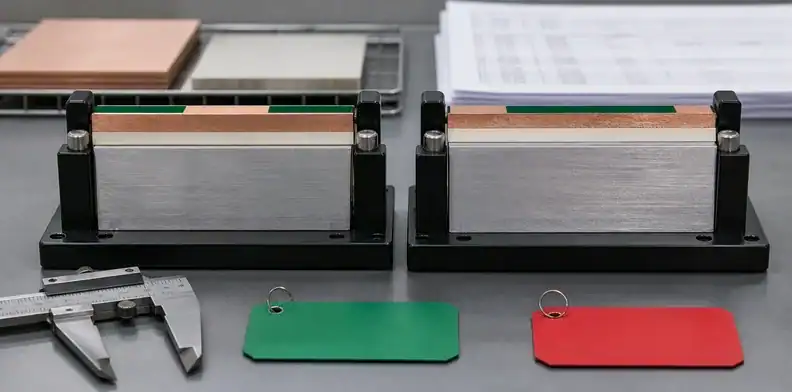
Evidence rule: Decide which records prove material identity and board performance before the first lot is built, then tie each record to the purchase order, panel or production lot.
A certificate of conformance can confirm a supplier’s declaration, but its value depends on the fields it contains. For a controlled Bergquist PCB material replacement or current TCLAD build, request enough traceability to connect the finished boards to the laminate family, grade, thickness, source and lot. If a regulatory or customer qualification names a manufacturing site, record that site rather than assuming brand continuity is sufficient.
Incoming laminate and in-process controls can include material labels, purchase records, storage life, surface condition, thickness measurements and lot segregation. Finished-board evidence can include total thickness, conductor geometry, surface finish, isolation testing, peel or bond evidence when specified, flatness and a representative cross-section. The exact plan should follow product risk; not every order needs every destructive test.
Use acceptance evidence with a named decision:
- Material identity: purchase and receiving records match the approved construction.
- Geometry: copper, dielectric, base and finished dimensions meet the drawing.
- Electrical isolation: the specified test method, voltage, dwell and pass criteria are recorded.
- Thermal validation: a defined coupon, test vehicle or assembly result supports the modeled heat path when required.
- Change status: deviations and substitutions have explicit lot scope and approval.
- Shipment traceability: reports reference the purchase order, part revision and affected lot.
The buyer can align receiving checks with the PCB incoming inspection process and select shipment records through the PCB quality-document package. These pages own the general inspection and document-control methods; the present article defines which material facts the records must preserve.
For a new grade or changed source, ask QueenEMS to review the stackup, TDS revision, comparison matrix and proposed validation before the quote is locked. This contextual review is useful when the drawing still contains an old Bergquist note but purchasing has received a current TCLAD or alternate proposal.
Release a quote-ready package and preserve it for reorders
The quote package is complete when material identity, construction, evidence and change authority can be read without relying on private email history.
Assemble one controlled package containing the fabrication files, mechanical drawing, IMS stackup, exact laminate callout, applicable datasheet revision, copper and base-metal requirements, surface finish, solder mask, dimensional tolerances, isolation requirements and order quantity. Add the thermal model or validation target when performance depends on more than a material-table value.
Ask each supplier to return a compliance statement beside the quoted construction:
| RFQ return field | Required supplier response |
|---|---|
| Material identity | Current manufacturer, family, exact grade and source |
| Stackup | Copper, dielectric thickness, base metal and total thickness |
| Thermal basis | Property, value, test method and document revision |
| Electrical basis | Applicable material data plus proposed board test, if required |
| Availability | Stock, minimum order, lead-time assumption and approved source |
| Fabrication exceptions | Geometry or process changes needed for the quoted route |
| Evidence | First-article and recurring lot records included with the order |
| Change control | Notification trigger and approval owner before substitution |
Compare quotations using those returned fields, not the brand name in the first column. Two offers that both say “Bergquist equivalent” may use different dielectric thicknesses, base alloys, data revisions and test assumptions. A technically lower-risk quotation is the one that exposes those differences before order release.
After approval, archive the accepted supplier stackup, material declaration, datasheet revision, deviations and first-article evidence under the part revision. Repeat orders should reference that baseline and require notification before any change to family, grade, thickness, source, base metal or copper construction. This prevents a one-time prototype concession from becoming an undocumented production standard.
For a QueenEMS quotation, send the Gerber or ODB++ package, drawing, target current material or legacy callout, dielectric thickness, copper, base metal, thermal requirement, isolation test, expected quantity and substitution restrictions through the QueenEMS contact page. The returned construction can then be compared against one explicit material and evidence baseline.
FAQ
Is Bergquist Thermal Clad still a current PCB material brand?
Use the current TCLAD product identity for the IMS laminate. TCLAD states that it acquired the Bergquist Thermal Clad product line from Henkel in 2021, while Henkel continues to use the Bergquist brand for other thermal-management products.
Can I specify “Bergquist or equivalent” on a drawing?
Yes, but define equivalent properties, construction, source restrictions, evidence and approval authority. Without those controls, suppliers can satisfy the phrase with materially different thicknesses, formulations or test bases.
Is higher thermal conductivity always better for an IMS PCB?
No. Compare thermal resistance at the selected dielectric thickness and model the complete heat path, because copper spreading, interface resistance, base metal, cooling and power distribution also affect component temperature.
Can dielectric breakdown voltage be used as working voltage?
No. Breakdown is a material-test result, while continuous working voltage depends on product safety requirements, geometry, environment, aging and the applicable standard.
What should be requalified when the IMS material changes?
Review every requirement affected by the change, including thermal performance, electrical isolation, adhesion, board geometry, assembly temperature, regulatory evidence and manufacturing source. The validation depth should follow the product’s risk and prior qualification basis.
Sources
- TCLAD, History of Thermal Clad and current company ownership
- TCLAD, Thermal Clad dielectric materials and current product data
Written by the QueenEMS Engineering Team
Upload your files today · Free DFM check before production · Ship worldwide
Get your PCB prototypes in as fast as 24 hours. We handle FR4, Rogers, and hybrid boards up to 40 layers in volume production, with advanced builds subject to engineering review — free prototypes for 2–4 layer FR-4 boards, no minimum order.
Just upload your Gerber + BOM — we source every part, assemble, and inspect (AOI + X‑Ray) so you don't have to chase suppliers. Boards ship in as fast as 24 hours.