
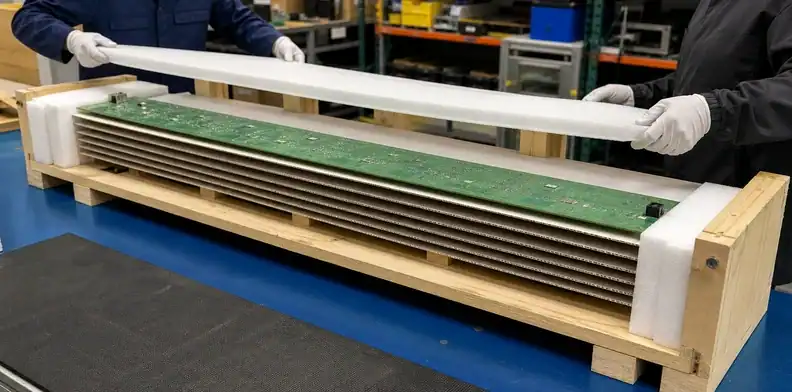
Quick Answer: Oversized PCB packaging should immobilize the board, support its full span, protect corners and edges, control moisture and ESD where required, and transfer load through the package rather than through the PCB. Define board condition, stack height, interleaving, rigid support, bagging, crate/carton, labels and receiving checks before shipment.
Oversized PCB packaging is part of product acceptance because a flat, electrically tested board can arrive bowed, cracked or edge-damaged if the package lets it flex. Long thin boards are especially vulnerable to point loading, vacuum-bag pressure, vertical storage and impacts at unsupported corners.
This article gives buyers and suppliers a packaging specification for large bare boards. It separates moisture/ESD protection from mechanical support and adds receiving evidence so transport damage can be distinguished from manufacturing defects.
Table of Contents
- Define the delivered board condition
- Support the full span and control stack load
- Protect surfaces, moisture and ESD
- Prevent corner, edge and connector damage
- Choose carton, case and pallet by transport risk
- Validate packaging before the production shipment
- Label the package for correct handling
- Inspect and document receipt
- Close the loop after any transport damage
Define the delivered board condition
Decision point: Packaging design starts with the condition that must exist at receiving: individual board or panel, clean and dry, protected surface, controlled flatness and undamaged functional edges.
Record finished dimensions, thickness, weight, quantity per stack, surface finish, exposed contacts, fragile edge features and permitted handling zones. State whether breakaway rails remain attached and whether the board can be stored vertically. If a flatness requirement applies, identify the measurement condition so shipping support protects the same state.
IPC’s IPC-1601 standard addresses printed-board handling and storage. Use the current customer contract and applicable standard revision to define moisture, contamination and storage controls rather than copying a generic bagging instruction.
The Large Format PCB manufacturer page can review packaging with the board construction and shipping lane. Thin one-meter boards require a different support plan from thick power backplanes.
| Product input | Packaging consequence | Required record |
|---|---|---|
| Length, width and thickness | Span support and pack stiffness | Approved support dimensions |
| Surface finish | Interleaf and contamination control | Contact-safe material specification |
| Edge features | Corner/edge clearance | Protective-zone drawing |
| Shipping lane and quantity | Carton, pallet and handling risk | Pack-out and transport plan |
Support the full span and control stack load
Bottom line: The PCB should not bridge distant supports or carry the compression load of the package.
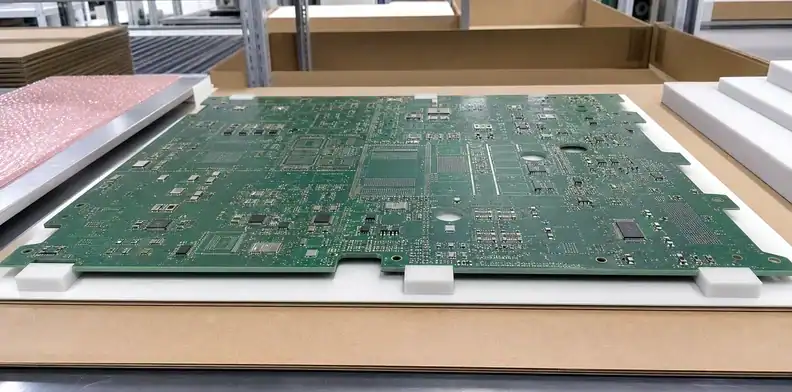
Use a rigid flat support larger than the finished outline, with material and thickness selected for the board weight and transport environment. Prevent the board from sliding while avoiding clamps or straps that create point loads. Long stacks need distributed separators and a defined maximum stack height.
Do not place a thin long board on two end blocks. Its own weight and package vibration can create repeated flexure. A top support or compression plate may be appropriate when it transfers load around the PCB and does not force the board against protruding features.
Vacuum packaging can compress a stack unevenly when excess film gathers at edges or when a thin board lacks a stiff backing. Validate the complete bag-and-support combination rather than assuming vacuum improves mechanical protection.
Carry the load through rigid packaging members, never through unsupported PCB spans.
Choose support flatness and cleanliness with the product requirement in mind. Rough corrugated surfaces can emboss or abrade a finish through thin interleaves, while warped backing can preload the PCB before transport begins. Inspect reusable supports between shipments and replace them when damaged or contaminated.
Protect surfaces, moisture and ESD
In practice: Barrier bags, desiccant and ESD materials solve environmental risks but do not replace mechanical support.
Use clean, nonabrasive interleaves compatible with the surface finish. Keep paper fibers, reactive foam, plasticizers and adhesive residue away from contacts. When moisture-barrier packaging is required, define bag type, seal integrity, desiccant and humidity indication according to the applicable product requirement.
ESD protection depends on the shipped product and customer requirement. A bare unpopulated PCB may still contain exposed structures or embedded devices that need controls. Do not use ordinary bubble wrap as a universal solution.
Seal only after the boards reach the specified clean and dry condition. Condensation depends on surface temperature relative to the surrounding air’s dew point, not on a board merely being warm. A cold shipment opened in warm, humid air can collect moisture; define an approved acclimation procedure that keeps the moisture-barrier package closed until opening conditions are met. Packaging a contaminated board preserves the contamination. Define the maximum time between final cleaning/inspection and sealing, and keep desiccant away from direct contact with the PCB.
Limit handling contact with finished surfaces. Gloves, clean work areas and controlled pack-out reduce fingerprints and contamination. Identify storage temperature, humidity and shelf-life needs when relevant.
Prevent corner, edge and connector damage
Evidence check: Edge protection should absorb impact without touching plated contacts, bevels, press-fit areas or fragile routed features.
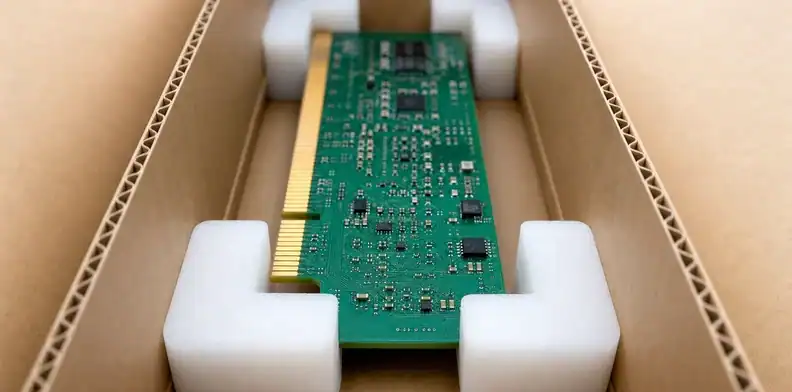
Corners concentrate transport impact. Use protectors that locate the board inside the package and maintain clearance from the outer wall. Select nonabrasive, low-shedding materials. Where a board has card-edge fingers, plated edges or fragile routed projections, create dedicated cavities or keep-out zones.
Interleaves should extend far enough to prevent board-to-board rubbing but should not wrinkle under pressure. Immobilize the stack in both long and short directions. If removable rails provide handling protection, state whether they may remain through shipment and how the customer removes them.
The general PCB packaging and labeling requirements provide baseline controls. Oversized PCB packaging adds full-span support, bending prevention and large-edge impact management.
Protective material may contact approved support zones, not functional surfaces by convenience.
Use retention that tolerates package vibration without creating a hard point. Foam blocks should be dense enough to hold position but not so rigid that impact transfers directly into a corner. Test the protection with the heaviest stack and the thinnest board included in the shipping family.
Choose carton, case and pallet by transport risk
Decision point: Package strength should follow board mass, span, shipment quantity, handling method, stacking and transport lane.
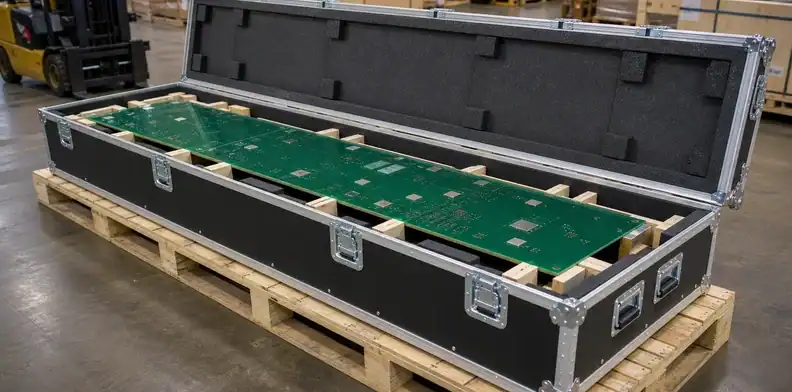
A double-wall carton may be adequate for a supported domestic sample but not for a heavy export stack with multiple transfer points. Long packages are easy to cantilever from conveyors or forklift tines. Use a rigid case, crate or pallet when the outer package cannot resist bending and puncture.
Design lift points and pallet engagement so handlers do not grab the package at one end. Keep the load inside the pallet footprint and prevent overhang. If cartons are stacked, define maximum layers and compression load. Protect the package from rain and condensation during transfer.
ASTM publishes D4169, Standard Practice for Performance Testing of Shipping Containers and Systems. Select any distribution test program with a packaging engineer and the actual shipment environment; do not claim compliance from an untested carton specification.
Consider partial shipments. A crate designed for a full stack may allow movement when half empty. Use modular spacers or a defined alternative pack-out so load restraint does not depend on quantity. Record maximum gross weight and center of gravity where handling equipment needs them.
Validate packaging before the production shipment
Validate the filled package, not an empty carton or a single component in isolation.
Start with a representative pack-out and measure board condition before and after handling. Appropriate validation may include controlled drop, vibration, compression or climatic exposure based on the shipping lane and customer requirement. Inspect flatness, corners, edges, surfaces and bag integrity afterward.
For a new large-board program, ship a small qualification lot with data loggers or impact indicators when the risk justifies it. Their readings are diagnostic, not automatic proof of product damage. Correlate them with receiving inspection.
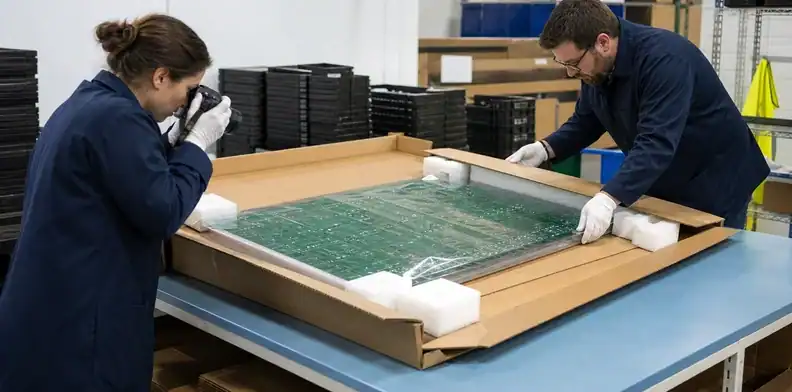
Photograph the approved pack sequence: bottom support, interleave, stack orientation, top support, bagging, immobilization, inner carton and outer case. Use the images as work instructions, not marketing decoration.
Include the operator checks that are not obvious in a photograph: support flatness, approved materials, bag seal, desiccant count, stack quantity, restraint clearance and outer-package condition. A signed pack-out traveler gives the shipment a traceable configuration.
| Validation item | Failure signal | Corrective direction |
|---|---|---|
| Span support | Changed bow/twist or cracked laminate | Increase stiffness or support continuity |
| Immobilization | Scuffed edges or shifted stack | Improve restraint and clearance |
| Outer package | Crush, puncture or bending | Upgrade case/pallet and load path |
| Barrier system | Torn seal or humidity excursion | Improve bagging and pack procedure |
Production pack-out must match the configuration that passed the qualification.
For a new shipping lane, send the board size, thickness, stack quantity and transport method for a pack-out risk review. The useful output is a support, restraint and receiving sequence that can be quoted and photographed.
Label the package for correct handling
Record rule: Labels should identify the product and communicate actions that protect it without relying on ambiguous symbols alone.
Include customer part number, revision, supplier lot, quantity, purchase order and package number. Add orientation, lift, stack, moisture/ESD and fragile instructions where applicable. If the package must remain flat, state it in words and show approved support or lift points.
Place labels where they remain visible after palletization and do not cover inspection seals. Use a packing list that links every inner pack to the shipment. Barcodes should match human-readable text.
Avoid relying on “Fragile” alone. State “Keep Flat,” “Do Not Clamp,” approved lifting direction or “No Top Load” when those actions matter, and design the package so routine handlers can comply. Handling language should match the receiving site and international lane.
| Handling risk | Label instruction | Physical design that supports it |
|---|---|---|
| Span bending | Keep Flat / support full length | Rigid backing and approved lift points |
| Clamp damage | Do Not Clamp | Pallet or case sized for normal handling |
| Stack compression | No Top Load or maximum stack | Load-bearing outer frame |
| Moisture exposure | Keep Dry | Qualified barrier and sealed outer pack |
Labels communicate the action; the package must still tolerate ordinary handling mistakes without transferring load into the PCB.
Define Incoterm and handoff responsibility separately from handling labels. The DDP versus DAP PCB shipping article helps buyers understand logistics responsibility, but it does not replace the physical packaging specification.
Inspect and document receipt
Release rule: Receiving should document the package before disturbing evidence and then inspect the board under the agreed condition.
Check for puncture, crush, water exposure, pallet overhang, broken seals and displaced restraints. Photograph all sides when damage is visible. Record impact or humidity indicators before opening. Preserve the label and shipment identity.
Move the package to a suitable flat surface and follow acclimation instructions. Remove restraints in the specified sequence so stored load is not released into the board. Inspect corners, edges, contacts and surfaces, then measure flatness or critical fit when required.
If only one board in a stack is damaged, record its position. Pattern information can reveal a support, compression or handling problem. Do not discard packaging until disposition is agreed.
Receiving teams should record unpacking time and environmental condition when moisture or temperature is relevant. If measurement must wait for acclimation, keep the board on its approved support. This preserves the evidence chain between sealed package, unpacked product and measured result.
Evidence must preserve the condition at carrier handoff and the condition after controlled unpacking.
Close the loop after any transport damage
What this means: Corrective action should distinguish manufacturing deformation, pack-out error and carrier handling before changing the design.
Compare outgoing inspection with receiving results. Review pack work instruction, support dimensions, stack height, bagging, carton/crate condition and shipping events. Examine damage location and orientation. Reproduce the pack configuration when practical.
Contain remaining inventory and inspect similar packages. Update the packaging drawing, bill of materials and work instruction under revision control. Requalify material or configuration changes that affect load path.
Avoid blaming “rough shipping” without a designed distribution environment. A package that depends on perfect handling is not robust enough for a normal commercial lane.
Use the corrective action to update purchasing documents as well as the warehouse instruction. If the quote does not include the approved support, case or pallet, a repeat order can revert to a cheaper unqualified pack. Name packaging materials or performance requirements, quantity per pack, validation baseline and substitution approval in the controlled specification.
Compare any changed flatness result with the PCB bow and twist acceptance method used at outgoing inspection. For the next purchase order, place the validated pack-out beside the PCB fabrication quote-file requirements so protection is part of the quoted scope.
Review freight partners and intermediate warehouses when damage clusters by lane. The same physical package may face different conveyor lengths, humidity, stacking and forklift practices. Change the distribution assumption or package design based on evidence, then verify the new configuration with a representative shipment.
Maintain a packaging bill of materials with approved substitutes. Foam density, board stiffness, bag thickness and carton grade can change performance even when the pack looks identical. Supplier changes should pass a defined review, and critical supports should carry an inspection dimension or performance check.
Packaging should also be practical to unpack safely. Heavy top plates, tight straps or deep crates can force operators to bend the board while removing it. Validate the receiving sequence with the customer’s available lifting tools and workspace, then include it with the packing list.
FAQ
How should oversized PCBs be packed for international shipping?
Use full-span rigid support, controlled stack height, nonabrasive interleaves, environmental/ESD protection as required, immobilization, edge clearance and an outer case or pallet qualified for the lane.
Can vacuum packaging bend a thin long PCB?
Yes. Uneven film or stack pressure can deform a board that lacks a stiff backing. Validate the complete packed configuration.
Can vertical storage permanently deform a long PCB?
It can contribute to creep or sag when the board is thin, warm, heavily loaded or poorly supported. Use the approved storage orientation and support.
What prevents corner and edge damage?
Rigid oversize support, controlled clearance, nonabrasive corner protection and immobilization keep impact and rubbing away from functional edges.
Should I use a wooden crate for every large PCB?
No. Select the outer package from product span, mass, quantity, handling and shipping lane. A validated reinforced carton may be sufficient for some shipments.
Written by the QueenEMS Engineering Team.
Share your board size, thickness, quantity and shipping lane to define a packaging and receiving plan before dispatch.
Review My Oversized PCB Packaging
Upload your files today · Free DFM check before production · Ship worldwide
Get your PCB prototypes in as fast as 24 hours. We handle FR4, Rogers, and hybrid boards up to 40 layers in volume production, with advanced builds subject to engineering review — free prototypes for 2–4 layer FR-4 boards, no minimum order.
Just upload your Gerber + BOM — we source every part, assemble, and inspect (AOI + X‑Ray) so you don't have to chase suppliers. Boards ship in as fast as 24 hours.