
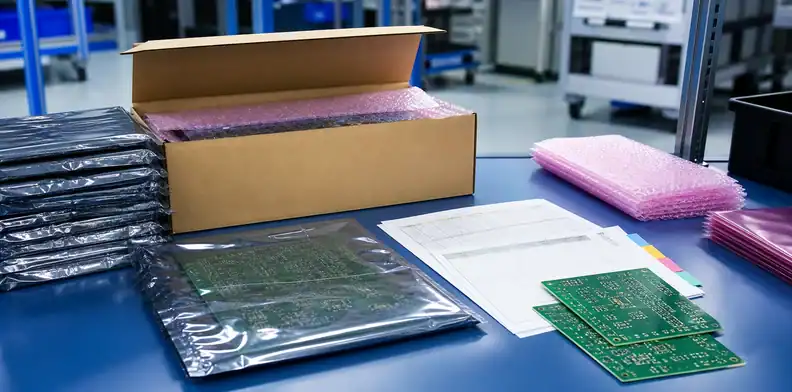
Quick Answer: Decision: PCB packaging specification. Controlled object: packing instruction linking board finish and geometry to bag, separator, desiccant, humidity indicator, carton, label, and pack quantity. Design-owned boundary: part and revision labels, lot identity, pack quantity, surface protection, moisture or ESD controls, and customer-specific markings. Supplier discretion: supplier packaging equivalents that demonstrate the same physical and environmental protection and remain compatible with receiving. Stop rule: mixed parts in one unlabeled pack, exposed critical finish, missing handling mark, or packaging that prevents lot traceability.
Packaging failures often show up at receiving, not at fabrication. The boards may be electrically acceptable, but the carton label may not match the PO, the lot may be split without a clear count, the finish may arrive with abrasion risk, or the receiving team may open moisture-sensitive material without knowing the intended handling rule. That turns a technically good shipment into a production delay.
The order should define packaging before shipment, not after damage or label confusion appears. Engineering defines the sensitive surfaces, finish, thickness, and assembly risks. Purchasing makes packaging part of the quoted scope. Quality or receiving confirms that labels, pack quantities, and shipment documents match the lot that actually arrived.
Table of Contents
- Define what the packaging must protect
- Control labels before the boards leave the factory
- Match pack quantities to inspection and assembly
- Connect packaging to shipping terms and documents
- Write special requirements without over-specifying
- Make packaging part of the PO baseline
Define what the packaging must protect
PCB packaging requirements should match the risk: moisture exposure, electrostatic discharge, surface finish damage, warpage, contamination, label loss, and receiving confusion.
Start with the released fabrication data, drawing notes, finish, thickness, board size, cosmetic requirement, quantity, ship-to location, and receiving expectation. The PCB quality documents before shipment page is the support link because packaging should match the evidence and shipment record, not sit outside the quote.
Packaging is not only a shipping preference. It protects boards during storage, customs handling, internal receiving, and the first pull into assembly. Thin boards, ENIG surfaces, fine-pitch boards, OSP finish, heavy copper, and tight cosmetic requirements may need different protection even when the fabrication process is otherwise routine.
Control labels before the boards leave the factory
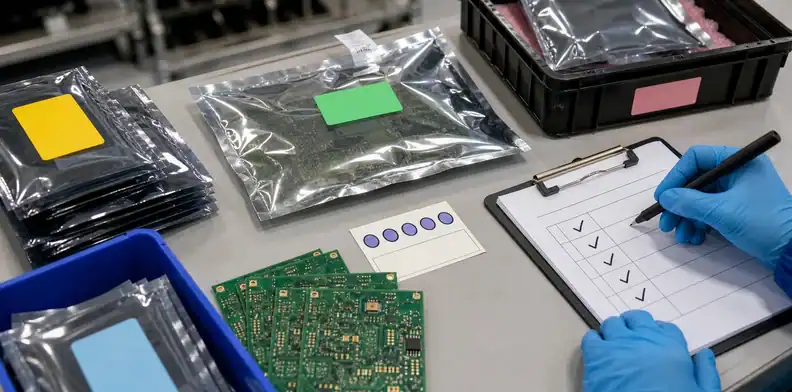
Labels should let receiving identify the correct part, revision, lot, PO, quantity, date, and handling condition without opening every package.
Labels should be written for the person opening the carton, not for the person who placed the order. Receiving may need to confirm part number, revision, PO, quantity, lot, date code, finish, inspection status, and handling condition before the boards enter stock. Missing labels can turn a technically good shipment into a production delay.
For a real receiving process, the outer carton, inner bag, and packing list should carry the same part number, revision, PO, quantity, and lot identity when those fields are used by the buyer’s system. That is not paperwork decoration. It lets the receiving team match the shipment to inspection, quarantine the right lot when damage is seen, and avoid mixing boards from different revisions.
Match pack quantities to inspection and assembly
Pack quantity affects receiving count, traceability, moisture exposure, and the first assembly pull from stock.
Pack quantity is a quiet operational decision. One large bag may reduce packing work but expose all boards when receiving opens it. Smaller packs can support split builds, first-article release, or line-side kitting, but may add handling and documentation. The right answer depends on how the buyer will inspect, store, and consume the lot.
Connect packaging to shipping terms and documents
Packaging, packing lists, cartons, and shipment terms should agree so the buyer can receive the order without reconstructing the lot from emails.
Documents and packaging should agree. A packing list that says 500 pieces is less useful when cartons, inner bags, and lot labels do not show how the quantity is divided. Receiving should not have to count every board to determine which bag belongs to which lot or revision.

Write special requirements without over-specifying
Special handling should be specified where it prevents real damage or receiving delay, not because every order needs the same expensive package.
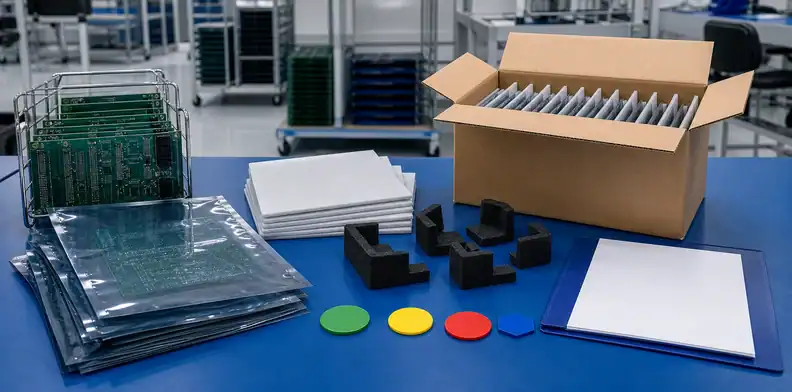
Special packaging should be tied to a real failure mode. A buyer may need separators for delicate finishes, rigid support for thin panels, moisture protection before assembly, ESD shielding for assembled boards, or carton limits for warehouse handling. The PO should name the reason so the supplier does not substitute a visually similar but weaker package.
Make packaging part of the PO baseline
The accepted quotation and PO should state packaging deliverables clearly enough for the supplier, freight forwarder, and receiving team to follow the same rule.
The final instruction should be short enough for both the supplier and the receiving team. State bag type, label fields, maximum or target pack quantity, carton marking, document packet, and what happens when packaging differs from the order. That creates a receiving rule before the shipment arrives.
Production record for the PCB packaging specification
Controlled object
Controlled object: packing instruction linking board finish and geometry to bag, separator, desiccant, humidity indicator, carton, label, and pack quantity.
Failure boundary
Failure boundary: abrasion, oxidation, moisture uptake, ESD exposure, warpage, mixed revisions, or receiving delays caused by incomplete labels.
Design-owned conditions
Design-owned conditions: part and revision labels, lot identity, pack quantity, surface protection, moisture or ESD controls, and customer-specific markings.
Supplier discretion
Supplier discretion: supplier packaging equivalents that demonstrate the same physical and environmental protection and remain compatible with receiving.
Required proof
Required proof: packing photographs, label sample, package count, seal or humidity status where required, and packing-list reconciliation.
Production stop
Production stop: mixed parts in one unlabeled pack, exposed critical finish, missing handling mark, or packaging that prevents lot traceability.
Repeat-order baseline
Repeat-order baseline: approved pack method, label template, units per pack, handling conditions, incoming result, and any transit damage history.
RFQ inputs
RFQ inputs: fabrication drawing, finish, board size and thickness, cosmetic needs, destination, storage duration, receiving labels, quantities, and shipping terms.
FAQ
Can the supplier decide the PCB packaging specification?
Discretion for PCB packaging specification: supplier packaging equivalents that demonstrate the same physical and environmental protection and remain compatible with receiving. Engineering control for PCB packaging specification: part and revision labels, lot identity, pack quantity, surface protection, moisture or ESD controls, and customer-specific markings.
What stops this PCB packaging specification?
Stop rule for PCB packaging specification: mixed parts in one unlabeled pack, exposed critical finish, missing handling mark, or packaging that prevents lot traceability. Disposition owner for PCB packaging specification: the named engineering approver.
Which proof closes the PCB packaging specification?
Evidence for PCB packaging specification: packing photographs, label sample, package count, seal or humidity status where required, and packing-list reconciliation. Revision link for PCB packaging specification: the quoted dataset.
What survives into the next order?
Reorder baseline for PCB packaging specification: approved pack method, label template, units per pack, handling conditions, incoming result, and any transit damage history.
For a focused PCB packaging specification, send QueenEMS fabrication drawing, finish, board size and thickness, cosmetic needs, destination, storage duration, receiving labels, quantities, and shipping terms. Redline request: PCB packaging specification. Open assumptions: PCB packaging specification. Approver: PCB packaging specification owner.
Written by the QueenEMS Engineering Team
Sources
Upload your files today · Free DFM check before production · Ship worldwide
Get your PCB prototypes in as fast as 24 hours. We handle FR4, Rogers, and Flex up to 60 layers — free prototypes for 2–4 layer boards, no minimum order.
Just upload your Gerber + BOM — we source every part, assemble, and inspect (AOI + X‑Ray) so you don't have to chase suppliers. Boards ship in as fast as 24 hours.