
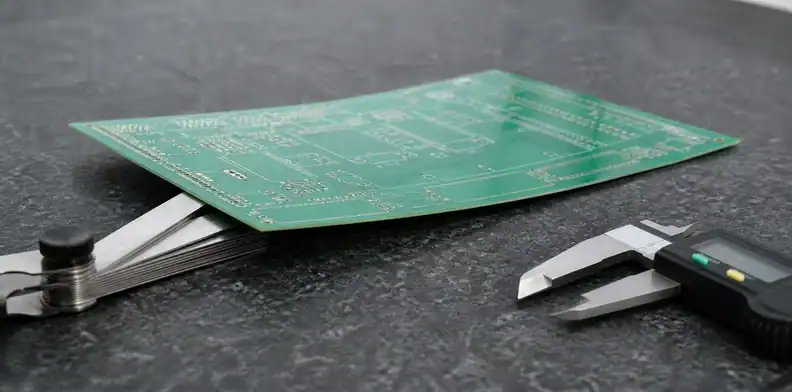
Quick Answer: PCB bow and twist acceptance should not be left as a vague cosmetic complaint. Define the board type, measurement method, percentage limit, assembly risk, and evidence needed before SMT release. For many purchase reviews, 0.75% for SMT boards and 1.5% for non-SMT boards are common IPC-style reference limits, but the drawing, product risk, and agreed inspection method control the final decision.
Key takeaways
- Treat flatness as an assembly release risk, not only a bare-board appearance issue.
- Ask how bow and twist will be measured, which length or diagonal is used, and how many boards will be checked.
- Tie the acceptance rule to BGA pitch, connector fit, test fixture loading, and panel handling.
- Keep photos, measurements, and supplier disposition with the quote or PO record.
Table of Contents
- Start with the assembly risk, not the shape alone
- Separate bow, twist, and ordinary handling variation
- Use percentage limits with a named measurement method
- Connect flatness to BGA, connector, and fixture risk
- Decide what receiving inspection should record
- Handle borderline boards without creating a false reject
- Put the flatness rule into the RFQ package
Start with the assembly risk, not the shape alone
A warped board looks obvious in a photo, but the purchasing decision is rarely obvious from the photo alone. A small bare board may show a visible corner lift and still run safely through SMT. A larger, thinner board may look acceptable on a desk yet lift enough during printing or reflow to create opens under fine-pitch parts. The first question is therefore not whether the board is perfectly flat. It is whether the flatness condition can change paste printing, component seating, reflow contact, fixture pressure, enclosure fit, or customer inspection.
Flatness call: If the board will be assembled, the acceptance rule should be based on the process step that can fail first.
An IPC limit alone does not specify how a board will be measured. The RFQ should state the finished board dimensions, thickness, copper balance, panel format, assembly method, and inspection setup. A thin asymmetric board may need a different agreed release check from a thicker balanced board, even when both are described by the same nominal percentage.
For projects with BGAs, bottom-terminated components, or fixture-loaded testing, connect this review to BGA assembly and the full assembly route. If QueenEMS receives only a Gerber package without assembly context, a board supplier may judge flatness as a bare-board matter while the assembler sees a soldering risk. That gap is where late disputes usually begin.
Flatness also affects schedule. If the issue is discovered after components arrive, the buyer has fewer choices: accept, sort, delay assembly, or reorder. If the acceptance rule is written before the PO, the same issue becomes a normal receiving gate. That difference is small on paper and large in production.
Separate bow, twist, and ordinary handling variation
Bow is a smooth bend along one direction. Twist is a corner-to-corner distortion where the board does not sit evenly on a flat surface. Both can matter, but they do not tell the same story. Bow often points to laminate stress, copper imbalance, panel support, or heat history. Twist can point to diagonal stress, asymmetric construction, or handling after routing. A buyer who uses one word for both problems may receive a reply that is technically correct but not useful.
Evidence check: Ask the supplier to identify whether the condition is bow, twist, or both, and to show the measurement position.
The review should also separate a permanent board condition from temporary handling variation. Thin panels can flex while being lifted from packaging. A board that relaxes on a flat surface after a few minutes is not the same as a board that remains lifted under its own weight. The supplier should not reject or accept the lot based on a handheld photo unless the measurement setup is known.
For an assembly buyer, the language can be simple: place the board on the agreed reference surface, record the maximum lift or gap, identify the length or diagonal used for the calculation, and photograph the setup. That removes most of the subjective debate. When the product will go into an enclosure, add the mating mechanical datum as well. Flatness that is harmless for soldering can still matter if screw holes, card guides, or edge connectors must line up.
For example, a buyer may send a photo of one raised corner while the fabricator says its outgoing check passed and the assembler remains concerned about stencil contact. Resolve that disagreement with the same reference surface, support points, percentage calculation, and release condition for all parties—not with the photo alone.
Use percentage limits with a named measurement method
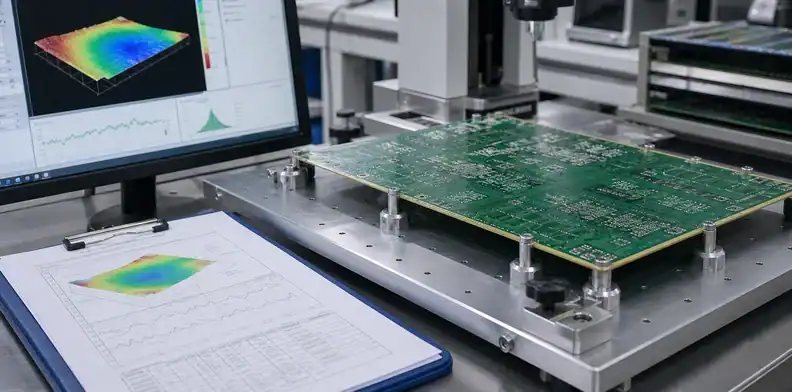
Many teams quote bow and twist limits as a percentage. That is a good start because it scales the allowed lift with board size. A 1.0 mm lift on a small board and a 1.0 mm lift on a large backplane do not represent the same geometry. The problem is that the percentage is not meaningful unless the measurement method is stated. The supplier needs to know the support points, the reference surface, the measured gap, and whether the length, width, or diagonal is used.
Measurement rule: A number without a method is not an acceptance rule; it is only a talking point.
For many commercial discussions, buyers use 0.75% as a practical reference for SMT boards and 1.5% for boards without SMT. Those figures are often associated with IPC-A-600 style acceptance language, while IPC-TM-650 2.4.22 is commonly referenced for bow and twist measurement. Still, the PO should not simply say meet IPC and stop there. The drawing or purchase note should say which class, which product-specific exception, and which evidence format will be accepted.
For a 200 × 300 mm rectangular bare board with an agreed 0.75% limit, IPC-TM-650 2.4.22C gives bow go/no-go gauge sizes of 1.50 mm along the 200 mm side (200 × 0.75 ÷ 100) and 2.25 mm along the 300 mm side (300 × 0.75 ÷ 100). For twist, the diagonal is about 360.6 mm; the production gauge size is 2 × 360.6 × 0.75 ÷ 100, or about 5.41 mm. The factor of two belongs to this twist setup. These method-specific checks apply to a bare board, not automatically to an assembled PCBA; use a tighter drawing or customer limit when required.
A clean RFQ note can look like this:
| RFQ field | Better wording | Why it matters |
|---|---|---|
| Condition | Bow and twist measured after final fabrication and normal cooling | Avoids judging panels while still stressed by processing |
| Method | Use agreed IPC-TM-650 style setup and report max measured gap plus calculated percent | Makes supplier replies comparable |
| Limit | 0.75% target for SMT unless drawing states a tighter value | Connects the number to assembly risk |
| Evidence | Photo of setup, measured gap, calculation, and lot quantity checked | Supports receiving and reorder decisions |
This is also where IPC standards for PCB assembly should be used carefully. Standards give a common language, but they do not know your connector, housing, pick-and-place nozzle, or test fixture.
If the supplier reports only “pass,” ask for the actual measurement. If the supplier reports only a gap in mm, ask for the board size used in the calculation. If the buyer uses a tighter customer limit, send that limit in the RFQ rather than discovering the conflict at receiving.
Connect flatness to BGA, connector, and fixture risk
Flatness matters most when it changes contact. During solder paste printing, a bowed board can create uneven stencil contact. During placement, a twisted board can change local z-height. During reflow, a package may settle differently if the board is already stressed. During test, fixture pins can press a warped board into shape and hide a problem until the product is assembled into a housing.
Assembly signal: If the flatness condition changes contact pressure, treat it as a process risk instead of a cosmetic note.
The highest-risk examples are not always the largest boards. A small board with a board-to-board connector near the edge may fail because the connector does not sit squarely. A board with BGA devices can pass visual receiving inspection and still develop intermittent solder joints if warpage changes during heat. A board that is later screwed into a plastic case may pass SMT but bow the enclosure or stress solder joints after fastening.
That is why the flatness question belongs in the same conversation as PCB assembly quote files. If the supplier sees the bare PCB drawing only, the quoted answer may ignore assembly. If QueenEMS sees the bare PCB data, assembly drawing, connector list, and test fixture notes together, we can identify whether the flatness rule is ordinary, tight, or production-critical.
For BGA work, ask whether first-article X-ray or solder-joint inspection should be tied to the flatness decision. For edge connectors, ask whether a sample should be checked in the mating fixture. For products with screw mounting, ask whether the board should be reviewed both free-state and installed. These are not academic details; they are the checks that turn a doubtful lot into an approved release or a controlled hold.
Decide what receiving inspection should record
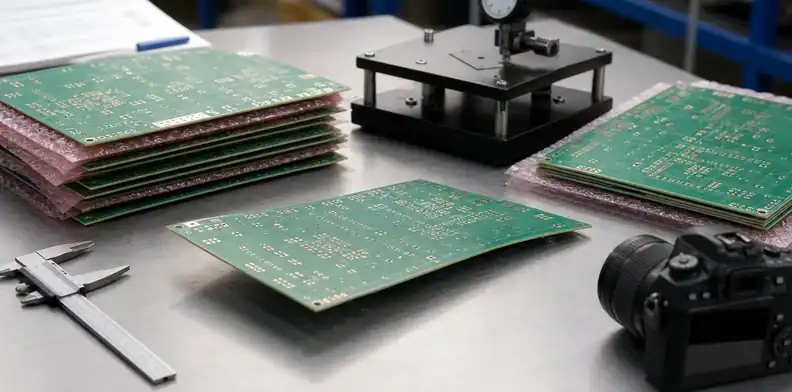
Receiving inspection should not become a courtroom. The goal is to preserve enough evidence to make a fast release, hold, or rework decision. For a small lot, measuring 3 to 5 boards may be enough to confirm whether the issue is isolated. For production, the sampling plan should match the risk and the supplier’s own outgoing inspection data. The record should include the purchase order, lot number, board revision, surface finish, panel or single-board condition, and whether boards were measured before or after unpacking.
Record rule: If a board is held for flatness, record the measurement setup before anyone argues about root cause.
A useful receiving form has three columns: observation, measured evidence, and decision. Observation might say corner lift visible on two boards. Measured evidence might say max gap 1.2 mm on a 160 mm diagonal, calculated 0.75%. Decision might say release for prototype SMT with first-article monitoring or hold until supplier confirms replacement. This keeps a buyer from rejecting a lot only because it looks uncomfortable, and it keeps a supplier from dismissing a real assembly risk as appearance.
When the board will be assembled immediately, also ask whether the first production board should be inspected after reflow. Some warpage risks increase with heat. A bare-board measurement can be acceptable, but reflow behavior can still affect a BGA, module, or edge connector.
Use a consistent language for the disposition:
| Receiving result | Better decision | Evidence to keep |
|---|---|---|
| Within agreed limit | Release | Photo, sample count, measured value |
| Borderline but low-risk prototype | Conditional release | Approval owner and first-article check |
| Above limit near BGA or connector | Hold | Measurement, assembly risk note, supplier reply |
| Mixed lot | Sort or replace affected quantity | Serial, carton, or panel traceability |
Handle borderline boards without creating a false reject
Borderline flatness is where many teams lose time. The supplier may say the boards meet its outgoing check. The assembler may worry about paste release or placement. Purchasing may only see schedule pressure. Instead of turning the issue into a yes-or-no argument, define the next safe action.
Disposition point: A borderline board needs a controlled release path, not a silent assumption.
The next action may be to run a first-article assembly, check paste print on the warped area, inspect BGA soldering, or test the mechanical fit before releasing the whole lot. Another option is to request replacement only for boards outside the agreed limit while using in-limit boards for prototype work. The wrong option is to change the acceptance rule after the lot arrives without recording who approved the change.
When a flatness question appears after a delivery date is committed, make a short decision record: measured value, assembly risk, proposed release condition, and the first-build check. For high-risk boards, a PCB DFM review before ordering can establish those hold points before the lot arrives.
The release note should also say what happens on reorder. If the first lot was approved as an exception, the next lot should not silently inherit that exception. If the first lot passed after a special support or handling method, that method should be part of the future build record.
Put the flatness rule into the RFQ package
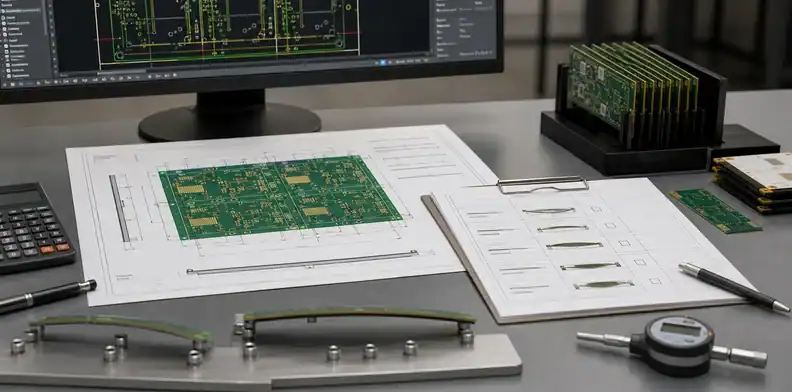
The RFQ should tell the PCB supplier what flatness evidence is expected and tell the assembler what risk has already been reviewed. Add the bow and twist note to the fabrication drawing when it affects acceptance. Add the assembly risk to the quote package when the board has BGAs, fine-pitch connectors, press-fit parts, test fixtures, or enclosure constraints. If the limit is standard, say so. If it is tighter than standard, explain why.
Practical wording can be direct: Report bow and twist on final boards using the agreed IPC-style method. Target max 0.75% for SMT release unless drawing revision states a tighter requirement. Hold shipment and ask approval before shipping boards outside the agreed limit. That wording gives the supplier a clear action and gives purchasing a record to compare quotes.
| Buyer situation | Ask before PO | Good supplier reply |
|---|---|---|
| BGA or fine-pitch SMT | Can you report bow and twist by lot? | Yes, with measured gap, percent, and sample count |
| Mechanical enclosure risk | Can you confirm flatness at screw holes or edge guides? | Yes, with fixture or drawing datum referenced |
| Prototype schedule pressure | What happens if boards are borderline? | First-article release or partial replacement is defined |
| Production reorder | Will the same flatness rule apply next time? | The rule is stored with the released drawing revision |
The buyer does not need to over-specify every board. A simple two-layer prototype without tight assembly risk may only need standard acceptance. A thin board with BGAs, edge connectors, or a mechanical fit stack should receive a written release rule. That is the difference between smart control and expensive over-control.
FAQ
Is PCB bow and twist always a reject reason?
No. It becomes a reject or hold reason when it exceeds the agreed limit or creates a defined assembly, test, or mechanical risk. A visible bend can still be acceptable if the measured percentage and use case are within the approved rule.
Should the buyer use 0.75% for every SMT board?
Use it as a common reference, not as an automatic answer. Some boards need tighter control because of BGAs, edge connectors, enclosure fit, or fixture pressure. Other prototype boards may accept a controlled release with first-article evidence.
Can baking fix PCB bow and twist?
Baking may reduce moisture-related effects in some cases, but it is not a universal flatness repair. It can also affect surface finish or timing. Ask the supplier for root cause and approval before using bake as a disposition.
What should QueenEMS review before quoting?
Send Gerbers or ODB++, stackup, board thickness, copper balance if known, panel preference, assembly drawing, component risk notes, and any enclosure or fixture constraints. QueenEMS can then align the PCB bow twist spec with the assembly route.
Related QueenEMS articles
- How to Apply IPC Standards for PCB Assembly Success
- What PCB Assembly Quote Files Do You Actually Need?
- BGA Assembly
- Free PCB DFM Check
If your PCB or PCBA project has flatness, BGA, connector, or fixture risks, send QueenEMS the released files and the real build conditions. We can help review the PCB bow twist spec, quote assumptions, production hold points, and evidence needed before the lot moves forward.
Written by the QueenEMS Engineering Team
Sources
- IPC, IPC-TM-650 Method 2.4.22C, Bow and Twist (Percentage)
- IPC, IPC-A-600 standard page: https://shop.ipc.org/ipc-a-600
Upload your files today · Free DFM check before production · Ship worldwide
Get your PCB prototypes in as fast as 24 hours. We handle FR4, Rogers, and Flex up to 60 layers — free prototypes for 2–4 layer boards, no minimum order.
Just upload your Gerber + BOM — we source every part, assemble, and inspect (AOI + X‑Ray) so you don't have to chase suppliers. Boards ship in as fast as 24 hours.