
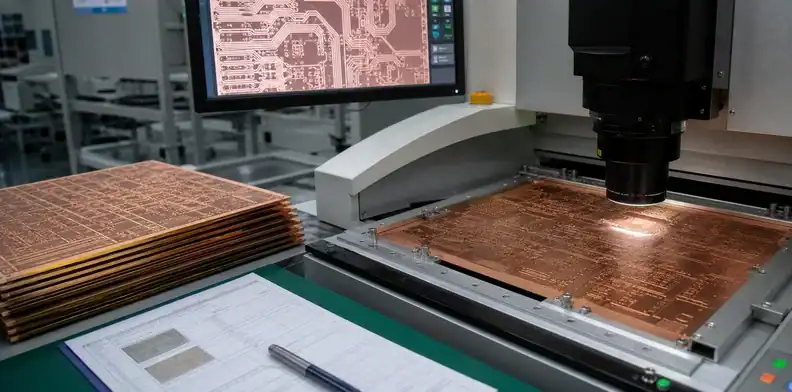
Quick Answer: Inner-layer AOI checks etched conductor artwork before the layer is buried in lamination. It can help find image-related opens, shorts, spacing, and pattern defects, but it cannot replace electrical test, microsection, or lamination-quality evidence. Ask for revision control, lot traceability, defect disposition, and a defined exception path instead of a pile of raw AOI screenshots.
Key takeaways
- AOI evidence is most valuable before internal copper is inaccessible.
- Inspection program control must match the released artwork revision.
- A false call, rework, or accepted defect needs an owner and traceable disposition.
Inner-layer AOI is often mentioned as a capability claim, but the buyer question is narrower: what evidence proves that the etched layers were checked against the released design before they were laminated into a finished board? A useful answer connects artwork revision, panel identity, defect handling, and lamination release. It does not pretend that an image inspection proves every later reliability attribute.
Table of Contents
- Place AOI at the correct manufacturing stage
- Define what AOI can see
- Bind inspection to the released artwork
- Handle false calls and real defects differently
- Preserve traceability before layers are buried
- Connect AOI to lamination release
- Choose the evidence level by risk
- Send an RFQ that asks a usable question
- Make inner-layer AOI evidence useful in a production investigation
Place AOI at the correct manufacturing stage
Inner-layer AOI happens after inner copper is imaged and etched, before multilayer lamination makes the feature inaccessible. It is valuable because an artwork defect can be found while correction is still possible. It should be treated as pre-lamination inspection evidence, not as a substitute for final electrical verification.
Inner-layer AOI is valuable because it happens after imaging and etching while the copper pattern is still accessible. Once lamination buries a defective layer, the options become containment evidence or destructive analysis rather than a straightforward correction. The inspection request should therefore identify the layer construction and artwork revision that AOI is meant to protect, instead of treating AOI as a generic factory badge.
AOI rule: The useful record ties an etched layer to its released artwork revision.
Define what AOI can see
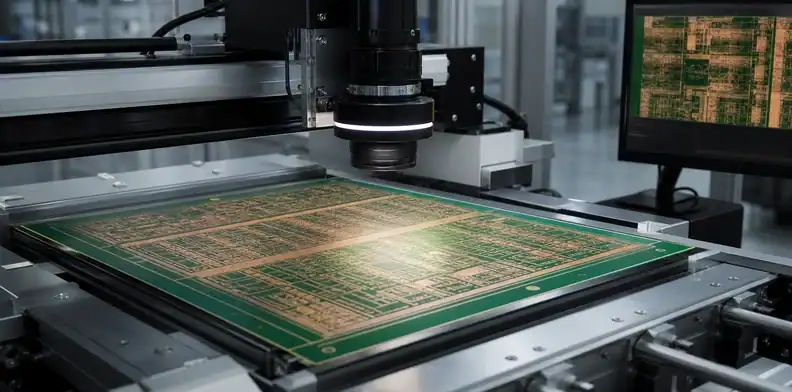
AOI can compare conductor patterns with the approved image data and identify many opens, shorts, line-width, spacing, and unwanted-copper conditions. The exact detection boundary depends on the program, image quality, and process. Do not claim that it proves hole-wall plating, resin voids, impedance, or post-lamination registration.
An AOI system compares etched conductors with controlled image data and can find many opens, shorts, spacing concerns, and unwanted copper conditions. It does not prove plated-through-hole quality, resin fill, final impedance, or finished-board electrical continuity. Keeping that boundary explicit helps the buyer request the right companion evidence when the actual concern lies in lamination, drilling, or plating.
Scope rule: Do not use AOI evidence to claim proof of plating, resin, or final electrical performance.
Bind inspection to the released artwork
The inspection program and job traveler need the same controlled design revision used by CAM. A board cannot be accepted merely because an AOI system ran. The record must connect the inspected inner layer to the released artwork and the manufacturing lot.
The program identifier, film or digital artwork revision, layer number, and panel or lot reference should agree before the inspection result is accepted. A pass report without this chain cannot show which design state was examined. For a revision that changes only one inner layer, the record should still make that changed layer visible; otherwise a prior AOI setup can appear valid while checking obsolete geometry.
| Situation | Preferred treatment | Drawing fields that matter |
|---|---|---|
| Etched open or short | AOI program and disposition | Contain before lamination |
| Fine-line geometry concern | Artwork revision and first-article evidence | Engineering review |
| Suspected registration issue | Layer identity and CAM review | Check against lamination plan |
| Lamination-quality concern | Microsection or process evidence | Do not treat AOI as proof |
Handle false calls and real defects differently
AOI systems can flag conditions that require human review. A real defect needs containment and disposition; a false call needs a controlled explanation so it does not become a hidden program weakness. A rework or engineering waiver should not disappear once the panel goes to lamination.
False calls are not automatically harmless. They should be reviewed according to a controlled rule so a genuine etch issue is not normalized as a nuisance alert. A confirmed defect needs containment and disposition before the panel reaches the press. An approved exception must identify the specific conductor condition and the responsible engineering authority, not disappear into a general note that the panel was visually reviewed.
Disposition rule: A false call and a confirmed conductor defect need different documented outcomes.
Preserve traceability before layers are buried
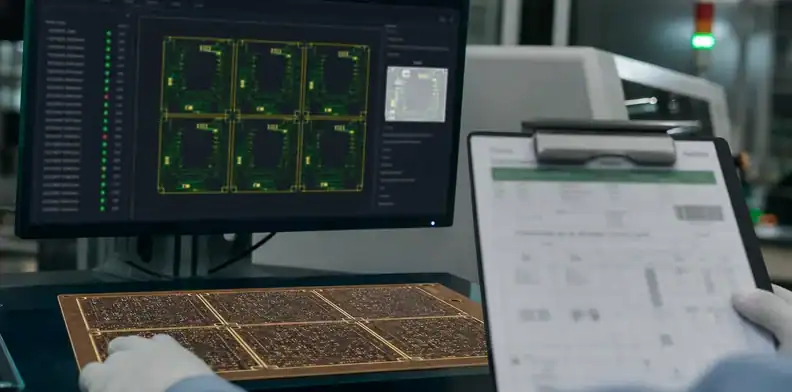
Panel ID, lot, layer identity, artwork revision, and any exception record are the useful evidence set. Raw image archives may be appropriate for a special contract, but most buyers gain more from a concise certificate and a retrievable disposition path than from thousands of uncontextualized captures.
Panel traceability matters most before the copper is buried. Retain the layer identity, job traveler reference, inspection status, and any nonconformance record in a form that can be retrieved later. Raw AOI images may be useful for a special contractual program, but a well-linked disposition record is usually more actionable than a large unlabelled archive of inspection screenshots.
The related LDI imaging registration control page covers LDI registration; it should be read separately from evidence that the etched inner pattern passed AOI.
Connect AOI to lamination release
The factory should not advance a panel with an unresolved critical defect. Engineering decides whether a documented deviation is acceptable. The release record should say which issue was found, what action was taken, who approved it, and whether the condition changes the product’s qualification status.
Lamination release should be gated by unresolved critical findings, not by the mere fact that AOI was run. The factory can state whether the panel passed its defined program; product engineering decides whether a documented deviation can advance. This distinction prevents an inspection tool from being treated as the owner of a product acceptance decision that has electrical or reliability consequences.
| Inner-layer AOI check | Evidence | Decision owner |
|---|---|---|
| Artwork linkage | Layer and revision record | Data-control owner |
| AOI finding | Panel-specific disposition | Quality engineering |
| Exception before pressing | Approved deviation record | Product engineering |
| Evidence retention | Lot traceability plan | Customer quality |
Lamination rule: Critical unresolved findings must block the panel from entering the press.
Choose the evidence level by risk
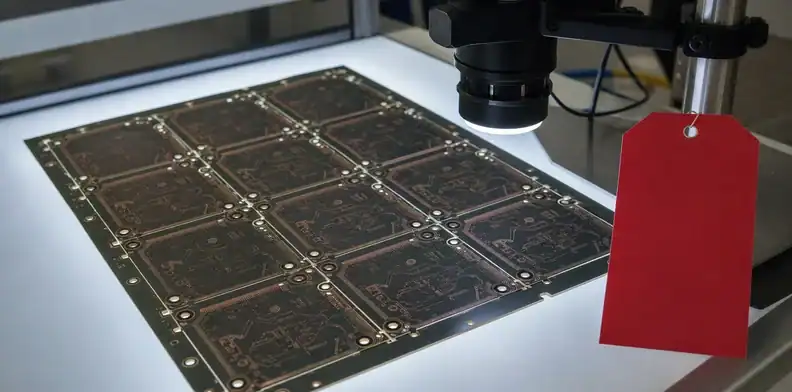
A consumer prototype may need only a standard process confirmation. A high-layer, fine-line, automotive, medical, or high-cost assembly may justify a retained first-article record, a selected defect disposition report, or explicit customer approval. Match the evidence to the consequence of an unseen internal error.
Evidence level should follow the failure consequence. A low-risk prototype may only need a standard process confirmation, while fine-line multilayers or high-cost assemblies can justify retained first-article results and selected exception records. Ask for a report that names the inspected layer and result rather than requesting every generated image by default. That keeps the requirement auditable without burying the useful signal in data volume.
Where construction evidence is also required, coordinate it with high-layer lamination review instead of asking an AOI report to prove a microsection result.
Send an RFQ that asks a usable question
Provide the controlled artwork, layer stackup, required class or customer requirement, critical net or geometry context, and evidence level. QueenEMS can explain whether the requested inner-layer AOI evidence is feasible and identify the decision that must be closed before lamination.
For an RFQ, provide controlled inner-layer artwork, stackup, applicable class or customer criteria, the features of concern, and the requested retention level. QueenEMS can distinguish inner-layer AOI evidence from LDI registration checks and microsection evidence so the order asks for a coherent set of proofs. Any condition that prevents lamination should be identified before the panel becomes an irreversible multilayer assembly.
Retention rule: Keep traceable layer and lot evidence at the level justified by product risk.
Make inner-layer AOI evidence useful in a production investigation
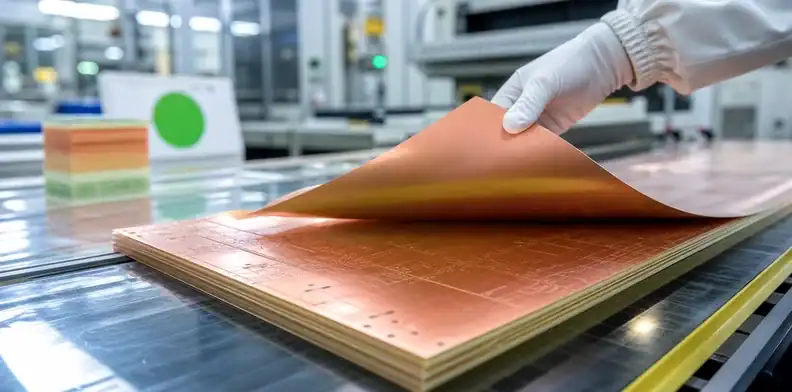
A fine-line multilayer may have several inner layers that look similar in the finished stackup, yet only one has a revised power island or narrow isolation gap. The AOI record needs enough identification to show that the revised layer was inspected against the correct artwork. Job number alone may be insufficient when a factory holds multiple revisions or panel variants. Link the panel, layer designation, controlled image revision, and final disposition. This gives a later reviewer a defensible answer to a focused question: whether the etched copper pattern now buried inside the board was examined before it entered lamination.
AOI findings should lead to a defined action path. A machine call may be confirmed as an unwanted copper bridge, judged as a permissible image artifact after review, or escalated because the design data itself is ambiguous. Each outcome needs a different record. A real conductor defect must be contained; a false call should be explained in a controlled way; a design ambiguity should return to engineering or CAM. Treating all three as a visual inspection pass removes the evidence that purchasing, quality, and the customer may need if a finished board later fails electrical test or shows a layer-specific issue.
The inspection request must also avoid claiming too much. Inner-layer AOI is not proof of via plating, dielectric integrity, controlled impedance, or solderability. Pair it with other evidence only when those risks exist: microsections for construction questions, coupons or electrical tests for relevant electrical requirements, and a controlled stackup for material control. A concise evidence plan is stronger than an order that asks every process for an undefined certificate, because each retained record has a known failure mode and release decision behind it.
An AOI requirement becomes auditable when it names the decision it supports. List the affected inner layer or layers, the controlled artwork revision, the panel or lot identity, and whether a standard pass record, retained first-article evidence, or selected exception disposition is needed. Define how a confirmed conductor defect is contained and who may approve a deviation before lamination. Keep the request narrow: AOI evaluates the etched pattern, so it should not be used as a catch-all certificate for plating, resin, impedance, or final electrical test. Those conditions have their own evidence routes when required. During a build review, compare the AOI program linkage with the released artwork and ensure any real finding has a visible outcome. A machine alert that was dismissed without a traceable rationale should not look identical to a clean pass. Likewise, an approved design waiver should be accessible to the people who release the panel to the press. This record structure preserves the important signal after the layer is buried and lets a later investigation establish what was inspected, which design state was used, and whether a deviation was consciously accepted rather than lost in a production handoff.
For a repeat order, compare the new AOI linkage with the approved job rather than assuming that the process name guarantees continuity. A changed artwork revision, a new layer count, or a different panel variant can require a revised inspection program. The owner of the controlled data should make that connection visible before the panel is inspected. Quality can then verify that exceptions were handled and that any critical result was closed before lamination. This modest amount of traceability is more valuable than retaining large volumes of images without a revision context. It ensures inner-layer AOI remains evidence of a particular manufacturing check rather than a generic phrase reused across unrelated board builds. Review our inspection and test capabilities.
FAQ
Is inner-layer AOI the same as electrical test?
No. AOI checks an imaged conductor pattern; electrical test checks a different final-board question.
Can AOI prove lamination quality?
No. It cannot prove resin quality, plating structure, or other post-lamination conditions.
Do buyers need every AOI image?
Usually no. Revision, lot, exception, and disposition evidence are more useful unless a contract requires image retention.
What should stop lamination?
An unresolved critical defect or an unapproved deviation should stop the panel from advancing.
Define the inner-layer inspection evidence
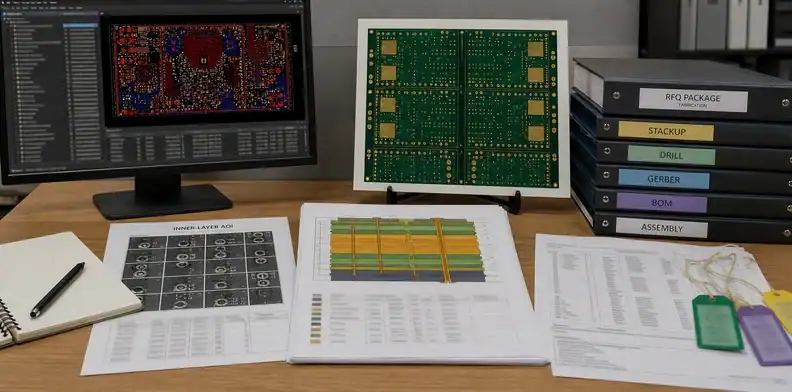
Send the controlled inner-layer artwork, layer map, stackup, applicable quality criteria, and record-retention need to QueenEMS. The review can align AOI evidence with the correct pre-lamination release decision.
Sources
Written by the QueenEMS Engineering Team
Upload your files today · Free DFM check before production · Ship worldwide
Get your PCB prototypes in as fast as 24 hours. We handle FR4, Rogers, and hybrid boards up to 40 layers in volume production, with advanced builds subject to engineering review — free prototypes for 2–4 layer FR-4 boards, no minimum order.
Just upload your Gerber + BOM — we source every part, assemble, and inspect (AOI + X‑Ray) so you don't have to chase suppliers. Boards ship in as fast as 24 hours.