
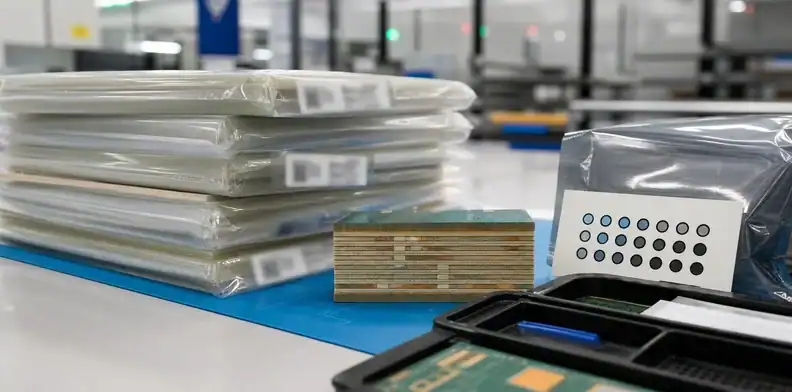
Quick Answer: Prepreg handling is a lamination-material control, not a finished-board shelf-life rule. The buyer should lock the approved prepreg family and stackup, require the fabricator to review storage or exposure deviations against the material supplier’s instructions, and define when a deviation needs engineering approval. Do not prescribe a blanket bake without material-specific evidence.
Key takeaways
- Prepreg and finished-board storage are separate decisions.
- Material identity, lot history, and controlled deviation matter more than a generic bake note.
- A supplier response should state the review boundary without exposing a proprietary press recipe.
A finished PCB can be vacuum packed after fabrication, but prepreg is still uncured resin and glass reinforcement before lamination. Treating both as the same storage question creates bad RFQ language. The practical control is to preserve the approved material system, avoid unreviewed exposure or substitution, and make the lamination release record clear when a deviation could affect resin flow, bond quality, or construction stability.
Table of Contents
- Keep prepreg and finished boards separate
- Understand the risk without inventing a press recipe
- Freeze material identity before release
- Set a receiving and storage evidence boundary
- Use deviation records as hold triggers
- Do not make routine baking the answer
- Link prepreg control to lamination release
- Quote the material-control package
- Control prepreg condition as part of the released stackup
Keep prepreg and finished boards separate
Finished-board storage focuses on surface finish, contamination, packaging, and assembly readiness. Prepreg storage concerns an uncured material that will become part of the multilayer construction. Its handling belongs to the approved stackup and laminate supplier guidance, not to the customer’s warehouse rule for completed boards.
Prepreg is an uncured resin-and-glass material, so storage control is about preserving a defined lamination behavior rather than keeping a finished circuit cosmetically dry. Material identity, manufacturer storage limits, package state, and elapsed exposure history must remain connected. A generic instruction to keep material cool and dry is not enough when the stackup relies on specific resin flow and cure behavior.
Material rule: Prepreg handling evidence must name the approved material family and lot.
Understand the risk without inventing a press recipe
Moisture history, resin content, material age, exposure condition, and construction can affect lamination behavior. A purchaser does not need to prescribe temperature, pressure, or dwell time. The useful requirement is that the fabricator reviews a deviation against the approved material data and identifies whether it affects feasibility or qualification.
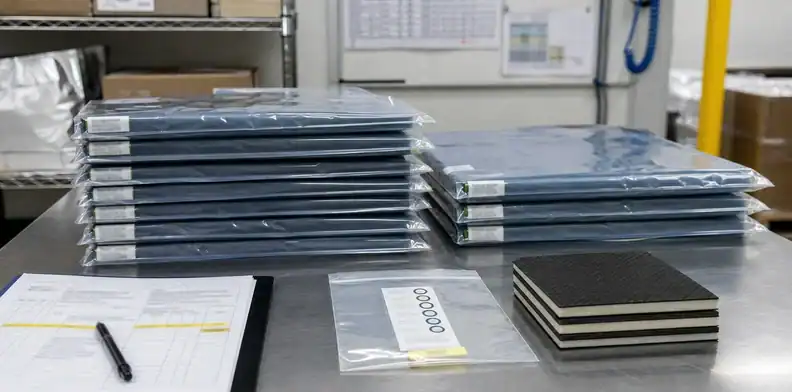
Receiving should confirm the exact prepreg style, resin system, lot, and the supplier documentation that governs shelf life. A similar glass style or a material with a familiar trade name may not have the same flow window. Record when sealed packaging was opened and where the material was staged. This protects against an unnoticed substitution before the layup reaches the press.
Exposure rule: A reported storage deviation requires a supplier-reviewed disposition, not a casual bake note.
Freeze material identity before release
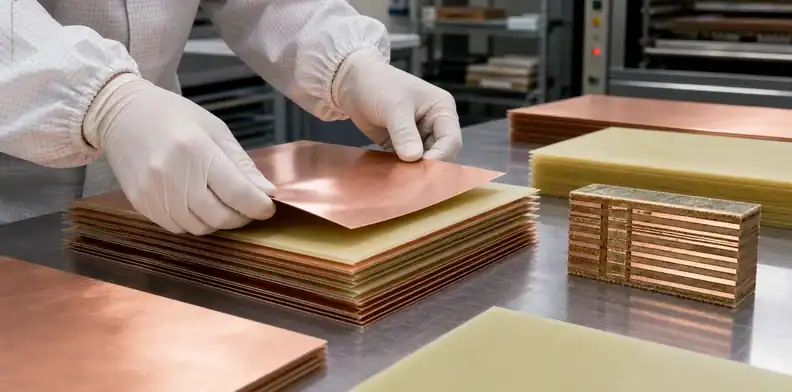
Name the laminate and prepreg family, approved construction, copper weights, and stackup revision. A substitute that looks electrically similar may carry different flow behavior or handling instructions. The material approval route should be visible before panels are built, especially for low-loss, rigid-flex, or high-layer constructions.
Humidity exposure can affect resin behavior and moisture-related risk, but the allowable response is material-specific. Do not add an improvised bake instruction to an RFQ and assume it restores every property. The fabricator should review the laminate supplier guidance and decide whether the material remains usable, needs a validated conditioning step, or must be replaced. That conclusion belongs in the deviation path for a controlled construction.
| Situation | Preferred treatment | Drawing fields that matter |
|---|---|---|
| Standard multilayer | Approved prepreg family and stackup | Deviation review if condition changes |
| Low-loss stackup | Named material and revision | Material-substitution approval |
| Rigid-flex no-flow area | Construction-specific material | Lamination feasibility confirmation |
| Repeat production | Lot traceability scope | Defined release record |
Set a receiving and storage evidence boundary
For a controlled build, ask for material lot traceability, supplier-approved storage handling, and a recorded review of any out-of-condition event. Do not demand continuous factory telemetry unless the product contract truly requires it. The evidence should support a later decision, not become a stack of unread logs.
The stackup makes the issue more than a warehouse detail. Thin dielectrics, high copper imbalance, filled structures, rigid-flex transitions, and tight impedance targets can all be sensitive to resin movement during lamination. If a material condition changes, the review should identify which layer pair and which dielectric zone are affected. That is more useful than a statement that the panel was processed under normal press conditions.
Stackup rule: Evaluate condition changes at the dielectric layers that carry the design risk.
Use deviation records as hold triggers
An exposure or storage concern should produce a named material, affected lot, stackup, technical review, and disposition. Engineering may accept the lot, request a controlled action, or require replacement material. Purchasing should not receive a vague message that the material is probably fine.
Purchase orders should preserve the material route where it matters. Name the approved prepreg family and call out any customer restriction on substitution, shelf-life evidence, or exposure reporting. Leave routine factory process controls to the supplier, but request notification when a condition leaves the validated route. This distinction avoids both blind trust and unnecessary disclosure of proprietary press recipes.
The existing rigid-flex no-flow prepreg control page discusses rigid-flex no-flow lamination; it should not be used to assume the storage route for this prepreg construction.
Do not make routine baking the answer
A bake can be a controlled response under the right material guidance, but an automatic bake can introduce a different material risk. The decision should follow the supplier data, the construction, and the documented condition rather than a generic belief that more heat always improves prepreg.
For a first build, ask for evidence that can be traced to the actual layup: material lot, controlled storage status, and any approved exception. A full environmental data log is rarely necessary unless a contract requires it. The goal is to make a later reliability investigation able to answer which prepreg was used and whether it entered lamination under its documented handling limits.
| Prepreg release check | Evidence | Decision owner |
|---|---|---|
| Approved material family | Stackup and material route | Materials engineering |
| Lot and storage condition | Receiving and handling trace | Factory quality |
| Reported deviation | Supplier disposition | Engineering authority |
| Lamination release | Controlled job record | Program quality |
Purchase rule: Require notification when the material route leaves the controlled construction.
Link prepreg control to lamination release
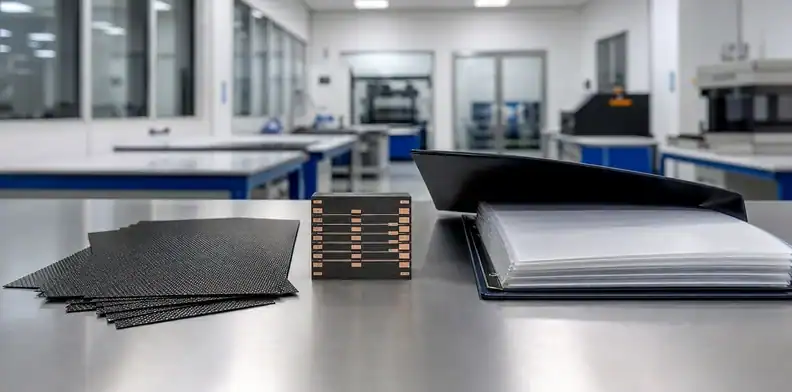
The fabricator can retain proprietary press settings while confirming the approved material, stackup revision, and disposition of a relevant deviation. That creates a useful boundary: the buyer controls the qualified design and acceptance decision; the factory controls its validated process window.
Engineering should decide whether a reported material deviation affects qualification, impedance verification, coupon review, or only documentation. Quality can hold the lot until that decision exists; purchasing can prevent the same condition from repeating on the next order. This separation prevents a warehouse observation from being dismissed as a minor handling note when it actually changes the approved construction.
Compare the released material route with supplier stackup signoff when the build also carries an explicit shelf-life or storage requirement.
Quote the material-control package
Send the stackup, approved material family, material substitution rule, rigid-flex or high-speed constraints, and any required first-article evidence. QueenEMS can review whether the requirement is clear enough to quote without turning a material-handling question into an unworkable process demand.
A usable RFQ contains the controlled stackup, laminate and prepreg families, finished thickness target, copper distribution concerns, required evidence, and any customer-specific storage rule. QueenEMS can review the request for fabrication feasibility and identify where material handling must be agreed before lamination. The resulting note should refer to a named material route, not a broad promise about moisture control.
Release rule: Do not laminate a questioned material lot before engineering closes the deviation.

Control prepreg condition as part of the released stackup
In a multilayer build, a prepreg entry is not simply an item on a bill of materials. Its resin content, glass style, and cure behavior help establish dielectric thickness, resin fill, and the finished relationship between copper features. When a stackup uses thin dielectric layers or uneven copper distribution, the lamination outcome can be sensitive to the material route. The manufacturing package should therefore identify the approved family and any restrictions on alternates. A supplier can then assess availability, storage status, and press feasibility against a named construction rather than making a substitution that happens to match a broad thickness label.
Suppose a sealed prepreg package arrives near the end of its documented storage period and is opened for a partial job. The right question is not whether someone can make it dry again. The relevant questions are what the material supplier permits, how long it was exposed, whether the condition is within the fabricator’s validated handling route, and whether the stackup has special risk. Any proposed conditioning must come from controlled guidance, not from a habit borrowed from another resin system. The disposition should state the material lot, the observed condition, the proposed action, and the authority accepting the action for this build.
Traceability should be practical. For a normal commercial job, it may be enough to retain the material lot and standard process confirmation. For a qualification build, high-frequency construction, or reliability-sensitive assembly, request the additional record that lets engineering connect the panel to the layup material and any exception. This is not a demand for a factory’s proprietary press curve. It is a way to preserve the information needed when a later coupon, impedance result, or field observation raises a question about the actual dielectric construction used.
The stackup release should say more than a nominal dielectric thickness when material condition matters. Identify the laminate and prepreg family, glass style or construction where it controls the design, intended layer locations, and any no-substitution requirement. State the evidence level in plain terms: standard material traceability, lot identification for a first build, or a customer-specific record for a qualification program. When storage or handling information is reported, ask for the material-specific disposition rather than a generic assurance that the prepreg was dried. This protects the process window without directing the factory to disclose its validated press recipe. The review must also distinguish a routine logistics fact from a construction change. An unopened lot within documented limits may need no extra action, while an expired, exposed, substituted, or specially conditioned lot may require engineering review before lamination. Keep the resulting decision with the job record and the approved stackup. If a later test coupon, impedance result, or reliability investigation raises a concern, the team can then determine the actual material route used rather than debating whether an informal handling note was relevant.
The same discipline applies when the factory must propose an alternate material route. A nominally similar prepreg thickness is not proof that the resin system will meet the intended flow, dielectric, and cure behavior. The response should identify the alternate, its position in the stackup, and the reason the change is being requested. Engineering can then decide whether coupon work, impedance confirmation, or a qualification update is required. The useful outcome is not a blanket ban on every material change; it is a traceable decision that matches the design risk. That is especially valuable for a repeat order, where the previous approved stackup may look familiar while current material availability introduces a materially different lamination condition.
FAQ
Is prepreg shelf life the same as PCB shelf life?
No. Prepreg is uncured lamination material; a finished board has different storage and solderability concerns.
Should every prepreg lot be baked?
No. Use the material supplier’s handling guidance and a documented review of the actual condition.
What should purchasing request?
Request the approved material identity, stackup revision, and a defined deviation/approval path.
Does high Tg eliminate moisture concern?
No. Material selection changes the construction, but handling and qualification still need review.
Review the material route before lamination
Provide the stackup, named prepreg and laminate families, thickness target, copper-distribution notes, and requested traceability to QueenEMS. The review can identify a material-handling question before the layup is pressed.
Sources
Written by the QueenEMS Engineering Team
Upload your files today · Free DFM check before production · Ship worldwide
Get your PCB prototypes in as fast as 24 hours. We handle FR4, Rogers, and hybrid boards up to 40 layers in volume production, with advanced builds subject to engineering review — free prototypes for 2–4 layer FR-4 boards, no minimum order.
Just upload your Gerber + BOM — we source every part, assemble, and inspect (AOI + X‑Ray) so you don't have to chase suppliers. Boards ship in as fast as 24 hours.