
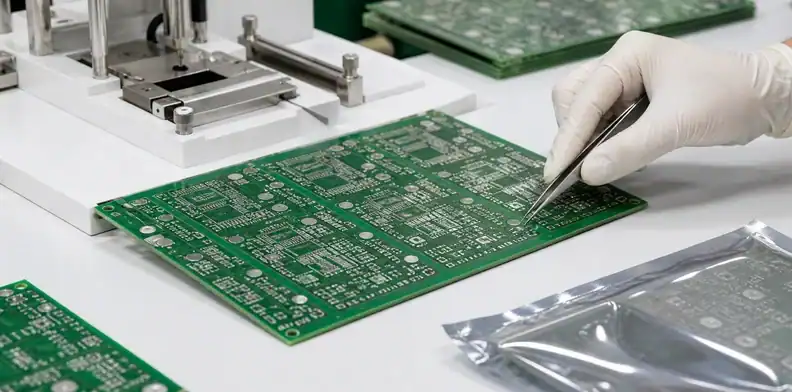
Quick Answer: A PCB immersion tin finish is acceptable when the specified deposit, coverage, adhesion, storage condition, and solderability performance are demonstrated for the ordered lot. Because copper-tin intermetallic compounds grow with time and heat, the quote must define the finish requirement, assembly delay, planned heat exposures, and the evidence that remains valid at shipment.
Key takeaways – Immersion tin is a flat solderable coating whose usable free tin changes during storage. – Total tin thickness and solderability answer different questions; both may be needed. – Baking, repeated reflow, hot storage, and an unclear manufacturing date weaken a release decision. – Whisker policy belongs to the product risk assessment, not a generic bare-board certificate.
PCB immersion tin finish is often selected for flat pads, lead-free assembly, press-fit features, or a cost position below nickel-gold finishes. The deposit sits directly on copper, which creates the feature that controls this article: copper and tin continue to interact after plating. An order that only says “immersion tin” does not tell purchasing how much usable tin must remain when assembly starts.
This article covers lot acceptance and RFQ control rather than a general finish comparison. Teams still selecting between surface treatments can use the HASL versus ENIG finish comparison. Once immersion tin is selected, the practical task is to align its deposit, age, heat history, solderability evidence, and application with the production schedule.
Table of Contents
- Understand what ages in immersion tin
- Define the deposit requirement correctly
- Match the finish to the pad function
- Budget storage and thermal exposure
- Request evidence that proves solderability
- Handle whisker and high-reliability concerns
- Compare supplier quotations on the same basis
- Freeze immersion-tin controls in the order
Understand what ages in immersion tin
Immersion tin protects copper with a thin metallic tin deposit, but the interface does not remain static. Copper-tin intermetallic compounds grow beneath the surface, reducing the amount of free tin available for soldering as storage time and temperature accumulate.
Fresh boards can wet well even when the order record is weak. The commercial risk appears later: the boards wait through transport, customs, inventory, prototype changes, or a component shortage, then arrive at assembly with an unknown deposit age. A supplier statement made at plating does not automatically represent the finish after months of storage and added heat.
The fabrication date, plating date when separately controlled, packaging date, and intended assembly date create the timeline. Purchasing should also know whether the boards will see a drying bake, double-sided reflow, selective soldering, wave soldering, or rework. Those events influence how much margin the finish needs.
Intermetallic growth is not itself a defect; it is part of the copper-tin system. The acceptance problem is whether enough solderable tin remains for the product’s planned life before assembly. That is why a finish thickness number, shelf-life statement, and solderability test cannot be treated as interchangeable evidence.
Buyer call: Approve immersion tin against the assembly date and heat history, not only its condition on the plating day.
Define the deposit requirement correctly
The fabrication note should name the applicable immersion-tin specification or customer requirement and identify the revision when contract control needs it. IPC-4554 was developed specifically for immersion tin on printed boards and addresses deposit, solderability, and quality assurance concerns.
IPC’s Plating Subcommittee review of IPC-4554 (2007) states a 1.0 µm [40 µin] minimum at -4σ from the process mean on the specified measurement pad; it gives 1.15-1.3 µm [46-52 µin] as the typical range. The 2011 amendment addressed solderability stressing and flux conditions. Apply those values only when the controlled purchase package invokes that document, and still define the measurement and sampling method rather than copying an isolated thickness number into the drawing.
X-ray fluorescence measurements can be useful, but copper diffusion complicates interpretation. The report should state what is measured, how the instrument is calibrated, which standards are used, where the readings were taken, and whether the result represents total deposit or another defined value. A single unlabelled number is not enough for incoming acceptance.
Ask the supplier to explain how the selected chemistry and bath control support the required usable life. The buyer does not need proprietary process recipes. It does need a clear statement that the quoted finish, thickness control, packaging, and shipment window meet the released order.
| Order field | Why it matters |
|---|---|
| Named finish specification | Establishes the acceptance basis |
| Deposit requirement and units | Prevents “standard tin” ambiguity |
| Measurement and sample rule | Makes lot reports comparable |
| Coating durability or shelf-life need | Connects plating to assembly timing |
| Deviation approval owner | Stops silent changes to chemistry or evidence |
The PCB finish-thickness evidence review provides the wider measurement framework. For immersion tin, keep the report tied to remaining solderability rather than presenting thickness as the only release criterion.
Match the finish to the pad function
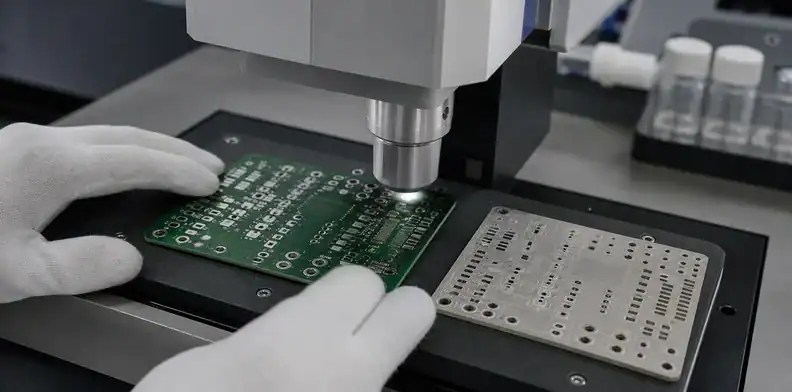
Immersion tin is mainly a solderable finish, and its flat surface can support fine features when the assembly process is compatible. It may also be specified for certain press-fit or zero-insertion-force applications, but those uses require product-specific contact and wear review.
The same finish should not be assumed suitable for every exposed copper function. Membrane switches, repeated mating contacts, wire bonding, long-life unsoldered test contacts, and corrosive service environments can impose requirements that a normal solderability certificate does not address. If the board mixes solderable pads with a contact area, define each function and decide whether a selective finish is required.
Press-fit work deserves its own acceptance path. The connector drawing, finished-hole range, plating stack, insertion forces, repair policy, and environmental requirement govern fit. A general immersion-tin note cannot compensate for an uncontrolled hole. Link the finish decision to the existing press-fit hole tolerance review when connector compliance depends on both surfaces.
For soldered pads, the BOM and process plan matter. Fine-pitch packages benefit from flatness, yet they also expose weak wetting quickly because paste volume and pad contact are less forgiving. Through-hole assembly may require confidence that hole walls and pad surfaces remain clean and wettable after storage.
Acceptance rule: Use a solderable-finish qualification for soldered pads; write separate acceptance criteria for contacts, press-fit zones, or unsoldered interfaces.
Budget storage and thermal exposure
The usable window for immersion tin depends on process chemistry, deposit condition, storage temperature, packaging, and thermal history. The supplier’s shelf-life declaration should state its assumptions instead of presenting a bare number with no storage conditions.
Warehouse temperature matters because diffusion processes accelerate with heat. A board stored under a controlled sealed condition is not equivalent to one left in an opened carton near assembly equipment. Repeated opening also adds handling and contamination risk, even when the nominal calendar age remains inside a supplier’s stated period.
Baking is not neutral. It may be required to manage laminate moisture, but heat can accelerate intermetallic growth and oxidation. Assembly engineering should define whether to bake, for how long, at what temperature, and how the boards are protected after removal. The decision belongs in the traveler or process plan before operators improvise a generic cycle.
Multiple soldering steps also consume margin. A top-side reflow, bottom-side reflow, wave process, selective soldering operation, and repair exposure create a different finish demand from one reflow. The supplier should know the planned sequence when coating durability is part of the quote.
| Timeline question | Evidence to retain | Risk if missing |
|---|---|---|
| When was the finish produced? | Lot or manufacturing date | Unknown starting age |
| How was it sealed? | Bag, label, desiccant, and pack record | Uncontrolled exposure |
| When will assembly begin? | Build schedule and allocation | Finish ages beyond quoted assumptions |
| What heat will precede soldering? | Bake and reflow plan | Accelerated loss of usable tin |
| Will stock be split? | Sealed sub-lot quantities | Repeated opening of the full lot |
Broader aged-stock disposition is covered in the PCB shelf-life storage rules. This immersion-tin review adds the copper-tin interface and thermal-budget questions that generic storage guidance cannot resolve.
Request evidence that proves solderability
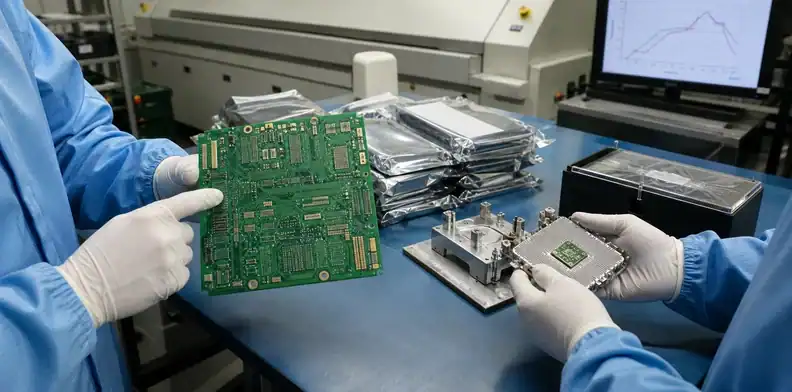
Solderability evidence must represent the production lot and the condition in which it will be assembled. A certificate that names only the finish is weaker than a report that identifies lot, conditioning, method, sample size, alloy, flux, observed wetting, and disposition.
IPC J-STD-003 is often referenced for printed-board solderability. The order should state whether testing is required for every lot, qualification only, aged inventory, or a defined trigger such as delayed assembly or damaged packaging. Sampling and frequency are commonly agreed between user and supplier, so buyers should not assume the quote includes a report.
Select a method that reflects the risk. Dip-and-look or wetting-balance evidence may support a general solderability decision. Solder-paste printing and reflow on representative fine-pitch geometry can reveal a different problem. Through-hole applications may need evidence that the finish and hole condition support the intended soldering process.
When a stored lot is in dispute, test samples from that lot and document any preconditioning. Do not accept a fresh laboratory coupon as proof for old boards. The bare-board solderability testing page helps define report fields and release triggers across finish types.
A useful report answers five questions:
- Which production lot and board condition were tested?
- Which method, flux, solder alloy, and thermal exposure were used?
- What constituted a pass or failure?
- Were all samples conforming, and where are exceptions recorded?
- Who released the lot for the planned assembly process?
Test rule: A solderability report is valid for the stated lot and conditioning; it should not be generalized to unknown storage histories.
Handle whisker and high-reliability concerns
Tin whisker risk should be evaluated at product level rather than treated as a universal reason to reject immersion tin. The concern depends on finish system, stress, environment, conductor spacing, electrical consequence, service life, and the program’s mitigation policy.
JESD201 provides environmental acceptance methods for tin and tin-alloy surface finishes, while high-reliability programs may impose additional procurement controls. Those component-oriented and finish-oriented requirements do not automatically prove the behavior of every printed-board immersion-tin application. Engineering should identify the actual exposed tin regions and the consequence of conductive growth before assigning tests.
Soldered immersion-tin pads change during assembly because the deposited tin participates in the solder joint. Unsoldered contacts or long-term exposed features present a different risk. Conformal coating, spacing, alternate finishes, environmental controls, or program-specific testing may be considered, but none should be promised as a guaranteed cure without supporting qualification.
Medical, aerospace, defense, transportation, and other controlled products often have customer-specific restrictions. Purchasing should bring those requirements into the RFQ instead of asking the board supplier for a generic “whisker-free” declaration. That phrase is not a measurable acceptance criterion.
Reliability boundary: High-consequence products need an approved tin-mitigation plan; a routine RoHS declaration cannot replace it.
Compare supplier quotations on the same basis
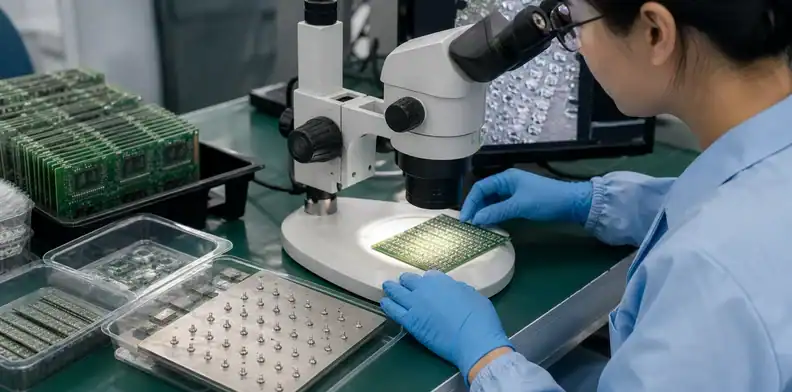
Two immersion-tin prices are comparable only when they include the same finish requirement, storage assumption, packaging, report package, test frequency, and thermal exposure expectations. A lower quote may simply omit lot evidence or assume immediate assembly.
Review each proposal for chemistry or proprietary finish name, governing specification, deposit control, standard lead time, manufacturing-date definition, packaging quantity, stated storage conditions, solderability testing, XRF evidence, and deviation handling. Ask whether the quoted process supports the number of planned assembly heat cycles.
| Quote item | Comparison question |
|---|---|
| Finish control | Are specification, chemistry, and deposit evidence equivalent? |
| Time assumption | Does the price cover the same plating-to-assembly interval? |
| Packaging | Are sealed quantity, date label, and storage conditions included? |
| Lot evidence | Are measurement and solderability reports included or optional? |
Commercial terms should reflect the evidence burden. Qualification testing, per-lot solderability, special sub-lot packaging, controlled reports, or customer-source inspection can change price and schedule. Recording those items makes a later cost comparison fair and prevents surprise document charges before shipment.
Do not allow a supplier to substitute OSP, HASL, ENIG, or another finish because it seems electrically similar. A finish substitution can change pad flatness, shelf life, assembly profile, contact behavior, and customer compliance. Route any proposed change through the PCB material and process substitution approval record before CAM release.
Quote check: The winning proposal should preserve the same deposit, timing, packaging, test, and approval assumptions used by engineering.
Freeze immersion-tin controls in the order
The final purchase package should carry the drawing note, finish standard, board revision, assembly timing, heat exposure, packaging plan, evidence list, and exception path. Keep these fields in the PO or controlled attachment so a repeat order does not depend on an old email.
A practical fabrication note may read:
Apply immersion tin to exposed solderable copper per the specified drawing requirement. Identify the production lot and manufacturing date, protect the finish in sealed labelled sub-lots, and provide the agreed deposit and solderability evidence. Obtain written approval before changing finish chemistry, report scope, packaging, or the quoted assembly-storage assumption.
Receiving should compare the shipment with that package. Verify finish identity, bag labels, lot dates, packaging condition, required reports, and any deviations before releasing boards to inventory. The PCB incoming-inspection process can incorporate these finish-specific checks without duplicating fabrication inspection.
For an immersion-tin quotation, provide QueenEMS with the Gerber or ODB++ files, fabrication drawing, applicable standard and revision, board quantity, pad functions, assembly start date, expected bake and soldering sequence, packaging quantity per bag, and requested XRF or solderability records through the QueenEMS engineering contact form. The quotation can then show which controls are included and which application questions must close before order release.
Release rule: Release production only when the finish requirement and the time-to-assembly assumption appear in the same controlled package.
FAQ
Is immersion tin the same as lead-free HASL?
No. Immersion tin is a chemical displacement coating deposited directly on copper, while lead-free HASL applies molten solder and levels it with hot air. Their thickness distribution, thermal exposure, flatness, and aging mechanisms differ.
Does a passing XRF reading prove solderability?
No. XRF supports deposit measurement, but wetting also depends on oxidation, contamination, storage, heat exposure, chemistry, and the remaining usable tin. Request a solderability test when that functional risk needs proof.
Can old immersion-tin boards be baked and released?
Only after engineering reviews the reason for baking and the lot’s existing age. Heat may manage laminate moisture while consuming finish margin, so a representative solderability check may be needed after the approved bake.
Should every immersion-tin order include whisker testing?
No. Testing should follow the product’s reliability policy and exposed-tin risk. High-consequence applications may require special controls, while ordinary soldered pads may be governed by the normal printed-board and assembly qualification plan.
Sources
Written by the QueenEMS Engineering Team
Upload your files today · Free DFM check before production · Ship worldwide
Get your PCB prototypes in as fast as 24 hours. We handle FR4, Rogers, and hybrid boards up to 40 layers in volume production, with advanced builds subject to engineering review — free prototypes for 2–4 layer FR-4 boards, no minimum order.
Just upload your Gerber + BOM — we source every part, assemble, and inspect (AOI + X‑Ray) so you don't have to chase suppliers. Boards ship in as fast as 24 hours.