
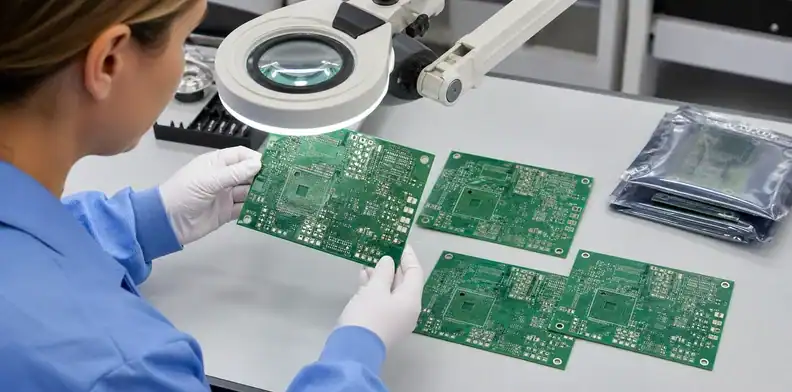
Quick Answer: A PCB immersion silver finish should not be accepted or rejected from color alone. Confirm the specified finish, lot identity, packaging history, exposed-pad condition, and solderability result; hold the lot when discoloration is localized, transferable, contaminated, accompanied by exposed copper, or linked to poor wetting.
Key takeaways – Tarnish is a symptom to investigate, not a complete acceptance test. – Sulfur-bearing packaging, fingerprints, moisture, and delayed resealing can damage the finish after fabrication. – The RFQ should define the finish standard, packaging materials, lot evidence, and the test that resolves a disputed appearance. – A solderability result must identify the lot, conditioning, flux, method, and acceptance decision.
PCB immersion silver finish disputes usually begin with a photograph of a yellow, brown, or dark pad. The photograph is useful for containment, but it cannot establish whether the silver remains solderable or whether contamination has reached the copper interface. A practical review separates cosmetic change from functional risk and preserves enough evidence to decide whether the lot can enter assembly.
This page starts after immersion silver has already been selected. The broader surface-finish thickness evidence page explains how finish reports are controlled, while the PCB shelf-life and storage review covers aged-board release across several finishes. Here the narrower question is what to inspect, test, and record when an immersion-silver lot looks questionable.
Table of Contents
- Separate appearance from solderability
- Trace the discoloration before cleaning
- Inspect packaging and handling evidence
- Decide when visual inspection is enough
- Use solderability and XRF evidence
- Disposition a suspect production lot
- Write an RFQ that prevents the dispute
Separate appearance from solderability
Visible tarnish does not automatically prove that a PCB immersion silver finish is unsolderable, and a bright surface does not prove that its packaging and handling were correct. Acceptance should connect appearance to the intended pad function, storage exposure, contamination clues, and an agreed test when visual evidence is inconclusive.
Immersion silver is a thin metallic coating over copper. It protects the copper before assembly and provides a flat solderable surface, but silver reacts with sulfur-bearing environments and is sensitive to fingerprints and residues. That chemistry explains why two boards from the same shipment can look different after one was handled, exposed, or stored beside unsuitable paper.
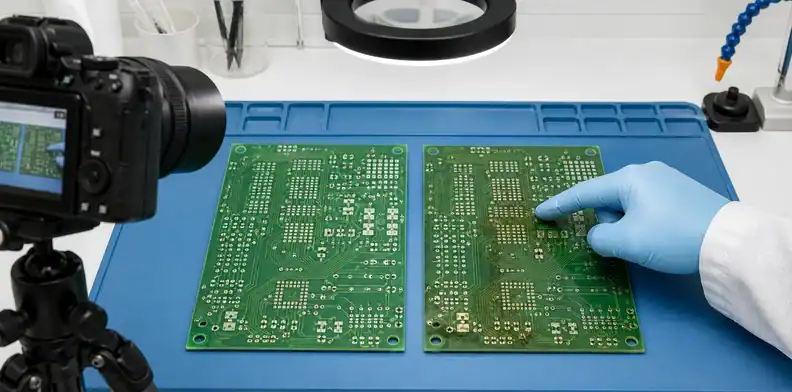
The location of the color change matters. Uniform, light discoloration across all exposed pads suggests a different investigation from dark spots near mask edges, fingerprints on isolated pads, abrasion marks, or black areas inside an opened bag. Inspectors should photograph the complete board, identify the affected pad type, and record how many boards and bags show the same pattern.
Do not define a universal color chart unless the drawing or customer specification already owns one. Lighting, camera white balance, solder-mask color, and the underlying copper topography can distort a photo. The release question is whether the finish meets the agreed workmanship and solderability requirements for this product.
Acceptance rule: Color alone may trigger containment, but rejection should be tied to a specified visual condition, contamination evidence, exposed copper, or failed solderability.
Trace the discoloration before cleaning
Preserve representative boards before wiping, baking, rebagging, or applying flux. Cleaning can remove evidence, spread contamination, or change the surface that a laboratory needs to examine.
Start with the pattern. Sulfur exposure may affect boards near paper, cardboard, rubber, foam, or another packaging material. Fingerprints follow handling locations. Incomplete rinsing or drying may appear across process-related zones, while abrasion follows separators or stacked-board contact. Mask-edge staining deserves attention because small exposed-copper areas and residual chemistry can behave differently from open pads.
Record the following while the package is still available:
- lot number, part number, revision, and finish callout;
- bag number and board position inside the stack;
- seal condition, desiccant, humidity indicator, and separator material;
- date the bag was first opened and the time until inspection;
- affected area, pad function, quantity, and whether residue transfers to clean material;
- any local bake, wash, handling, or assembly trial already performed.
This evidence distinguishes a fabrication concern from transport or local storage exposure. It also prevents a supplier response from being based on a cropped image with no lot context. For shipments already at receiving, the PCB incoming inspection workflow provides the containment and sampling framework around this finish-specific review.
Proof boundary: Keep at least one untouched sample from each affected packaging condition until the cause and disposition are agreed.
Inspect packaging and handling evidence
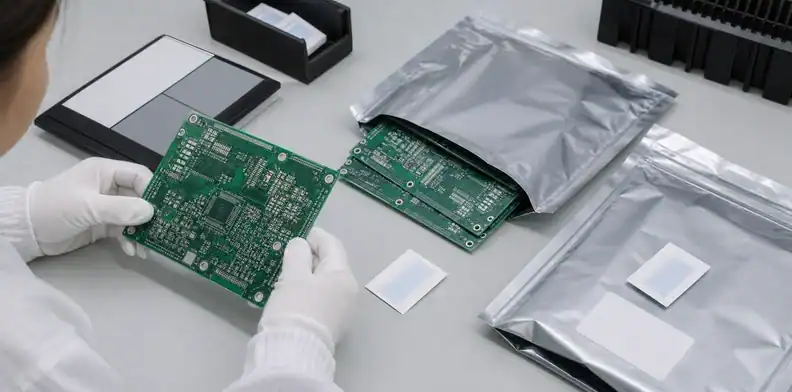
Immersion-silver packaging should isolate the boards from air circulation, moisture, fingerprints, and sulfur-bearing materials. The buyer should verify what touched the boards, not merely whether a bag was described as vacuum packed.
Useful shipment evidence includes a clear bag label, sealed sub-lot count, packaging date, bag-condition photographs, separator description, and confirmation that paper or other materials in direct contact with the finish are suitable for silver. Gloves and clean handling should continue at incoming inspection and assembly. A resealed bag with no opening record is weaker evidence than a smaller unopened sub-lot dedicated to the next build.
Packaging design should match the assembly schedule. One large bag may be cheaper to prepare, yet it exposes every remaining board when a pilot build consumes only a small quantity. Separate sealed quantities let purchasing release one build without repeatedly cycling the rest of the lot through ambient air.
Baking needs special caution. Heat may remove absorbed moisture from the laminate, but an unsuitable oven atmosphere or unnecessary exposure can worsen surface condition. Engineering and assembly should decide whether baking is required, define the cycle, and protect the finish from contamination rather than treating baking as a default cure for tarnish.
| Evidence item | What it answers | Hold trigger |
|---|---|---|
| Sealed bag and label | Which lot and quantity were protected | Broken seal with no opening history |
| Separator declaration | What directly contacted the silver | Unknown paper, rubber, foam, or sulfur risk |
| Humidity and desiccant condition | Whether the pack remained controlled | Indicator excursion or saturated desiccant |
| Opening and reseal record | Length of ambient exposure | Unrecorded repeated opening |
| Handling photographs | Whether bare hands or dirty surfaces touched pads | Visible prints or transferred residue |
The table turns a storage claim into observable facts. A supplier may still need to explain its packaging process, but the receiving team can immediately separate intact bags from suspect ones.
Decide when visual inspection is enough
Visual inspection is enough only when the acceptance requirement is visual and the observed condition is clearly inside it. Once solderability, contamination, exposed copper, or customer reliability is in question, photographs should lead to testing or supplier analysis rather than a subjective argument.
A practical inspection uses controlled lighting, a clean background, magnification appropriate to the feature, and comparison between affected and unaffected boards from the same lot. Examine solderable pads, test points, press-fit contacts, connector areas, and mask edges separately because their functions are different. Note scratches that penetrate the silver, bare copper spots, particulate residue, stains that follow fingerprints, and local darkening that correlates with packaging contact.
Cosmetic acceptance should come from the purchase drawing, customer specification, or agreed workmanship standard. Purchasing should not invent a stricter appearance rule after delivery, and the supplier should not dismiss a functional pad concern as cosmetic without evidence. The same surface can be acceptable for soldering yet unsuitable for a visible customer-facing product if appearance was contractually controlled.
Sampling also needs purpose. Inspect all opened bags and enough boards to understand distribution; expand the sample when the issue changes by bag, board position, or panel location. A single clean board cannot release a lot when discoloration clusters in one package.
Inspection call: Visual acceptance closes only a visual requirement; suspected wetting or contamination requires a method that measures that risk.
Use solderability and XRF evidence
Solderability testing should answer whether the suspect finish can support the planned assembly process after its actual storage and handling history. IPC J-STD-003 is a common printed-board reference, but the purchase requirement, product class, and agreed test details control the release.
The test request should identify the affected lot, sample selection, preconditioning, flux, solder alloy, method, acceptance criteria, and number of thermal exposures. A fresh coupon from a different process batch does not resolve an aged production-lot concern. Similarly, one manually tinned pad may show local wetting without representing fine-pitch printing and reflow.
Choose evidence that matches the assembly risk. A simple wetting assessment may suit a low-risk through-hole product. Fine-pitch SMT may justify a solder-paste print and reflow evaluation on representative features. A customer-controlled program may require the exact test and conditioning named in its specification. The dedicated bare-board solderability test requirements page explains how to specify that evidence without turning it into an undefined request for a certificate.
Test results should include more than “pass.” Keep the part and lot identity, method, sample count, date, conditioning, observations, failures, and disposition owner. Photographs of wetting can support the record, but the report must connect them to the boards under review.
Release test: Use representative production-lot samples and the intended assembly conditions; unrelated coupons cannot release a tarnished shipment.
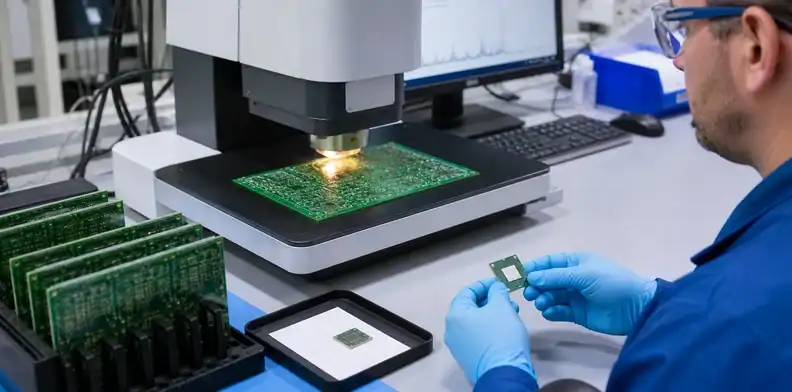
X-ray fluorescence (XRF) can support immersion-silver thickness control, but a thickness number does not replace solderability or contamination review. The report is useful only when the instrument, calibration approach, measurement locations, units, lot, and applicable finish specification are clear.
IPC-4553A covers immersion-silver plating requirements, including aspects beyond a single thickness value. Its status and the customer’s named revision should be checked during contract review rather than assumed from an old drawing note. Where the customer specifies a different document or internal requirement, that requirement controls the order.
Silver deposits are thin, so measurement setup matters. Ask whether the report describes total deposit thickness, how standards were selected, how pads were chosen, and whether the values represent the current lot. A report copied from a process qualification cannot prove a production shipment.
Thickness evidence is strongest when paired with process and functional evidence. A lot can be inside a stated thickness range and still require investigation for contamination, poor rinsing, packaging exposure, or solderability. Conversely, a visual color change does not establish that the deposit is below specification.
| Question | Useful answer |
|---|---|
| Which requirement controls? | Named standard edition or customer drawing note |
| What was measured? | Current lot, pad locations, units, and sample rule |
| How was XRF controlled? | Relevant calibration standard and instrument record |
| What does the result prove? | Deposit measurement only, not automatic solderability release |
This distinction keeps purchasing from treating a laboratory-looking number as a universal quality certificate.
Disposition a suspect production lot
A suspect lot should move through containment, technical review, and a documented disposition. Possible outcomes include release, expanded sampling, solderability testing, supplier rework when technically valid, use under deviation, rejection, or replacement.
Containment starts by separating bags and board quantities. Mark samples that were tested, cleaned, baked, or assembled so they cannot be confused with untouched boards. Preserve the delivery packaging and identify whether unaffected sub-lots remain sealed. Assembly should not consume the lot while engineering is still deciding whether the discoloration is functional.
The supplier response should address the observed distribution and evidence. A useful analysis might connect discoloration to packaging contact, handling, rinse quality, drying, or environmental exposure and then show why the proposed disposition is appropriate. “Tarnish is normal” and “the boards look bad” are both incomplete statements.
When use-as-is is proposed, engineering owns the functional decision and quality owns the acceptance record. Purchasing records the commercial outcome, replacement timing, and whether the next order needs a revised packaging or evidence requirement. The quality-document package before shipment helps carry the corrective action into repeat orders.
Disposition rule: Release only the identified quantity and condition supported by the evidence; do not let one passing sample silently approve mixed exposure histories.
Write an RFQ that prevents the dispute
An immersion-silver RFQ should name the finish requirement, product function, packaging controls, expected storage window, inspection evidence, and the method used when appearance or solderability is disputed. This makes supplier quotes comparable and prevents quality requirements from appearing after shipment.
Include the fabrication files and drawing note, board quantity, panel or single-board packaging, assembly timing, number of expected thermal cycles, pad functions, cosmetic restrictions, and required lot records. Name any customer-controlled standard edition. For delayed assembly, ask for sealed sub-lots sized to the build schedule and clarify whether solderability evidence is required before shipment or only after a defined storage trigger.
A concise RFQ note can read:
Finish exposed copper with immersion silver to the specified drawing requirement. Package boards in sealed, labeled sub-lots using materials suitable for contact with silver; provide lot identity and requested finish evidence. Notify the buyer before shipment of exposed copper, transferable residue, abnormal discoloration, packaging damage, or any condition that may affect solderability.
Avoid writing a universal shelf-life promise into every order. The applicable finish chemistry, packaging method, transport, customer requirement, and assembly plan should support the chosen window. A realistic requirement that can be verified is more useful than a long period copied from a generic finish chart.
For a quotation review, send QueenEMS the Gerber or ODB++ package, fabrication drawing, immersion-silver note, pad-function details, expected assembly date, thermal-cycle plan, packaging quantity per bag, and required solderability or XRF evidence through the QueenEMS contact page. The returned quote can identify finish assumptions, packaging scope, report inclusions, and any condition that needs engineering approval before production.
RFQ signal: A comparable quote states what finish is built, how it is protected, which lot records are included, and what test resolves a disputed surface.
FAQ
Is light tarnish on immersion silver always rejectable?
No. Light discoloration can be cosmetic, but it still needs review against the agreed visual requirement and the lot’s packaging history. Hold and test the lot when the color change is localized, contaminated, associated with exposed copper, or accompanied by poor wetting.
Can a bright silver PCB still have solderability problems?
Yes. Bright appearance does not prove deposit quality, cleanliness, storage control, or wetting after thermal exposure. Use representative solderability evidence when the product risk or storage history justifies it.
Should immersion-silver boards be baked before assembly?
Only when the laminate moisture condition or assembly plan requires it and an approved cycle protects the finish. Unnecessary baking can add heat exposure and contamination risk, so it should not be used as a default cosmetic treatment.
What should an immersion-silver lot report contain?
Request the part and lot identity, finish requirement, sample or measurement locations, units, results, date, method, and acceptance statement. Add packaging and solderability evidence when those items are part of the purchase requirement.
Sources
- IPC, IPC-4553A Table of Contents and scope
- IPC, Assembly Verification of an Immersion Silver Finish with Enhanced Tarnish Protection
Written by the QueenEMS Engineering Team
Upload your files today · Free DFM check before production · Ship worldwide
Get your PCB prototypes in as fast as 24 hours. We handle FR4, Rogers, and hybrid boards up to 40 layers in volume production, with advanced builds subject to engineering review — free prototypes for 2–4 layer FR-4 boards, no minimum order.
Just upload your Gerber + BOM — we source every part, assemble, and inspect (AOI + X‑Ray) so you don't have to chase suppliers. Boards ship in as fast as 24 hours.