

Quick Answer: Choose a ceramic PCB manufacturer by matching the supplier’s proven material and process route to your project type before you compare unit price. An AlN heat-spreading board, an Alumina general-purpose circuit, a DBC or AMB power substrate, and an LTCC or thin-film RF module need different evidence, so the RFQ should ask for project-specific capability, sample proof, production controls, and the point where a prototype supplier must hand off to a production-ready route.
The ceramic material and process overview explains the construction terms used to describe each supplier category.
Key takeaways
- A good supplier shortlist starts with the project load: heat, voltage, RF behavior, layer structure, reliability class, and production quantity.
- Do not accept “we can make ceramic PCB” as proof. Ask for the exact substrate, metallization route, copper thickness range, inspection evidence, and production transfer rule.
- An application shortlist should explain which failure mode each requested test or capability addresses.
- Prototype success is not the same as production fit; volume capability must be checked before the first purchase order locks the route.
Table of Contents
- Which project type should define your supplier shortlist?
- Which ceramic PCB supplier fits an AlN thermal project?
- Who belongs on an Alumina general-purpose shortlist?
- Which supplier capability comes first for DBC and AMB?
- Where do LTCC and thin-film RF projects need a specialist?
- What belongs at the top of your capability checklist?
- Which quote and prototype signals disqualify a supplier?
- When should you switch from prototype to production supplier?
Which project type should define your supplier shortlist?
The first supplier screen should be the application load, not the word “ceramic” in a supplier profile. A buyer handling a high-power AlN heat path, an Alumina sensor board, a DBC inverter substrate, an AMB traction-module part, or an LTCC RF package is buying a different manufacturing problem.
For available fabrication and assembly scope, start with the ceramic PCB manufacturer capability page. Use the application sections below to decide which technical evidence to request first from a proposed supplier.
| Project type | Supplier priority | Evidence to request first | Wrong first question |
|---|---|---|---|
| AlN thermal board | Substrate and heat-path experience | AlN grade, thickness range, metallization route, flatness and test plan | “Can you make ceramic PCB?” |
| Alumina board | Cost-controlled repeatability | Alumina purity, conductor method, line width, finish, panel handling | “Is AlN better?” |
| DBC power substrate | Copper bonding and high-current reliability | Copper thickness range, bond quality evidence, isolation plan, warpage control | “Can I use normal PCB rules?” |
| AMB power substrate | High-reliability bonding route | Active brazing route, ceramic family, thermal cycling evidence, production controls | “Is AMB always better than DBC?” |
| LTCC or thin-film RF | Specialist RF ceramic capability | LTCC: fired layers, shrinkage and vias; thin film: substrate and metal stack; both: RF test basis | “Can my PCB factory try it?” |
Which ceramic PCB supplier fits an AlN thermal project?
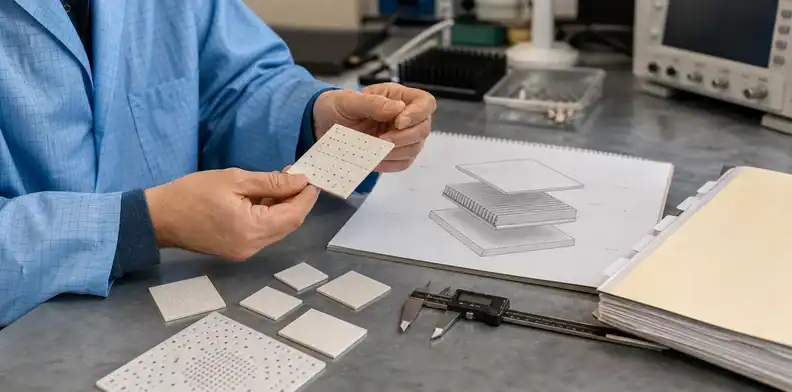
An AlN project needs a supplier that can show real Aluminum Nitride handling, not only a line card that lists AlN beside Alumina. A useful AlN RFQ asks for substrate grade, thickness range, conductor route, flatness control, thermal intent, and whether the supplier has built similar heat-spreading geometry before.
The practical pain is easy to recognize. A supplier may say “we can do AlN,” yet return a quote that looks copied from an Alumina order. The buyer should ask what changes in material sourcing, metallization, handling, and inspection when the job moves from Alumina to AlN. If the answer is vague, the quote is not ready for production comparison.
For a named example, Rogers lists its curamik Thermal AlN material at 170 W/mK at 20 °C in the 2026 curamik data sheet. That material value does not establish the thermal resistance of the finished module. Ask which grade, thickness, copper build and attachment conditions the supplier’s evidence represents.
For LED, laser, power semiconductor, and compact high-heat products, include a heat-path note in the RFQ: component side, backside attachment, expected heat sink interface, finish, assembly temperature exposure, and whether the ceramic board is a bare board or part of a later PCBA build.
Who belongs on an Alumina general-purpose shortlist?
An alumina ceramic circuit supplier may fit projects where electrical insulation, temperature stability, mechanical strength, or moderate heat transfer matters more than maximum thermal conductivity. In many buyer situations, Alumina is the practical shortlist because it is more common, easier to source, and often enough for the application.
QueenEMS already has a separate page on using Alumina versus AlN for ceramic LED cost control. The supplier-selection point is narrower: an Alumina project needs a supplier that can control the conductor system, substrate quality, hole or edge requirements, finish, and repeat lot handling at the quantity you intend to buy.
Alumina is often used for sensor boards, LED modules, heater circuits, hybrid circuits, and simpler high-temperature products. The wrong supplier fit appears when the quote focuses only on low sample price and does not state conductor thickness, pattern method, finish, electrical test, inspection, or packaging.
For buyers, the clean RFQ package includes Gerber or ODB++ files, drawing notes, material preference, conductor thickness requirement if known, surface finish, quantity ladder, assembly exposure, and any customer acceptance requirement. A supplier that asks useful DFM questions early may be safer than a supplier that returns a fast quote with no assumptions.
Which supplier capability comes first for DBC and AMB?
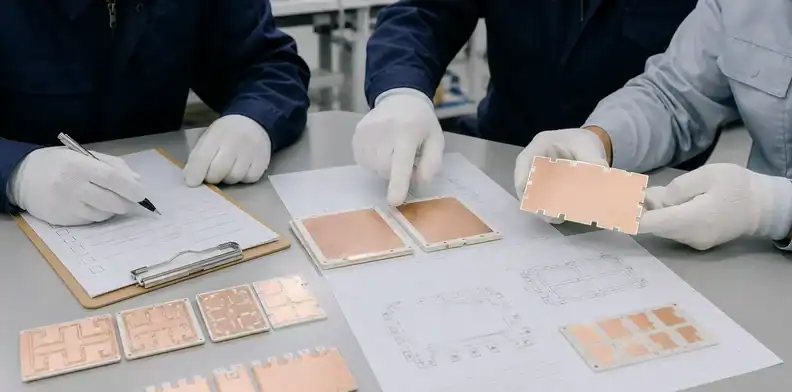
DBC and AMB projects should be shortlisted around power-substrate capability, not ordinary PCB fabrication comfort. The supplier must understand thick copper, ceramic bonding, isolation, heat spreading, warpage, and the production evidence needed for the power module or high-current assembly.
Buyers often ask whether DBC or AMB is the better route. That decision belongs in the material and reliability review, and QueenEMS already separates the substrate choice in the AMB versus DBC comparison. Supplier selection starts after that: once engineering has chosen or narrowed the route, purchasing must ask which supplier can prove the route at prototype and production scale.
For DBC, ask for copper thickness range, ceramic family, isolation test plan, copper adhesion or bond evidence, surface finish, flatness and warpage control, and how samples are inspected before shipment. For AMB, add the brazing route, ceramic choice, thermal cycling expectation, and whether the supplier can support the reliability evidence your customer expects. For automotive or traction-related work, check whether the supplier’s quality-system scope and production control records match the actual site and part type rather than accepting a logo on a PDF.
For power substrates, require the supplier to connect copper geometry and bonding evidence to the chosen ceramic and thermal loads. A peel or thermal-cycle report with a different construction may be useful background, but its applicability to the quoted part needs explanation.
| DBC or AMB RFQ item | Why it matters | Buyer action |
|---|---|---|
| Copper thickness and pattern limits | Controls current path and manufacturability | Ask for quoted range and exceptions |
| Ceramic family | Changes heat path, strength, and reliability route | Tie material to engineering approval |
| Bond or braze evidence | Separates process capability from sales language | Request available lot evidence |
| Isolation and inspection plan | Reduces shipment dispute risk | Define required records before PO |
| Prototype-to-production route | Prevents sample success from hiding volume risk | Ask what changes at production quantity |
Where do LTCC and thin-film RF projects need a specialist?
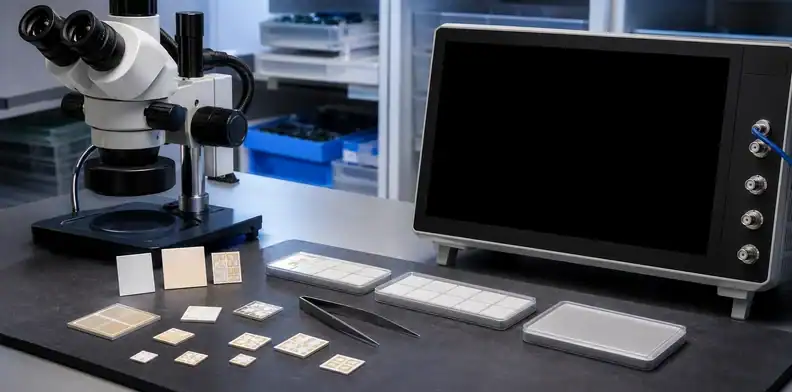
LTCC and thin-film RF require different process checks. An LTCC supplier should document its tape, co-firing, conductor and via system; a thin-film supplier should document the already-fired substrate and deposited or plated metal stack. Both need geometry and electrical evidence appropriate to the application.
Kyocera describes thin-film ceramic circuits made using deposited and plated metal features. Murata’s LTCC technical leaflet describes its co-fired multilayer process and constrained-sintering approach. These examples show why a supplier’s process documents should match the RF construction being ordered; neither document proves another fabricator’s capability.
Do not ask an LTCC supplier only for minimum line width. Ask how many layers the process can support, what fired shrinkage compensation the supplier expects, whether vias are available, how conductor choice affects soldering or wire bonding, and what RF or dimensional evidence can be returned after the first article. For thin-film RF, add conductor stack, substrate choice, surface finish, edge quality, and whether the supplier can support the packaging or assembly boundary.
QueenEMS already discusses ceramic process families in the ceramic PCB manufacturing process article. Keep that article for process background. For supplier selection, the sharper question is whether the supplier can quote the exact RF route without reducing it to a standard ceramic PCB sample.
What belongs at the top of your capability checklist?
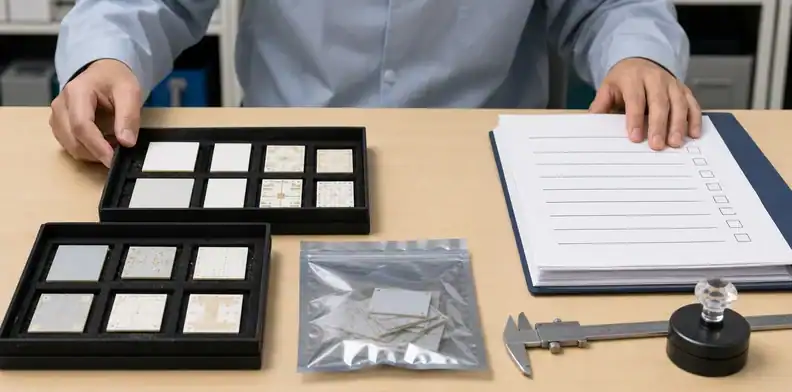
The capability checklist should be different for each project type, but every version should produce a comparable supplier answer. A strong checklist asks for material route, process route, design limits, inspection evidence, quality-system fit, production transfer, and the decision owner for exceptions.
Many existing articles answer “what questions should I ask a ceramic PCB manufacturer?” in a broad way. For a broader supplier audit, see the general ceramic manufacturer evaluation questions. The checklist below focuses on application-specific capabilities.
| Checklist field | AlN thermal | Alumina general | DBC or AMB power | LTCC or thin-film RF |
|---|---|---|---|---|
| Material proof | AlN grade and thermal class | Alumina grade and purity | Ceramic family and copper route | Ceramic tape or substrate system |
| Process proof | Metallization and flatness | Conductor method and finish | Bonding or brazing evidence | Fired layer, via, or thin-film route |
| Design limit | Thickness, flatness, copper | Line/space, holes, edge | Copper thickness, isolation, warpage | Layer count, shrinkage, RF geometry |
| Evidence | Inspection and test record | Visual, electrical, dimensional | Isolation, bond, thermal-cycle plan | RF, dimensional, fired-feature record |
| Approval owner | Thermal or hardware engineer | Hardware and purchasing | Power electronics and quality | RF engineer and packaging owner |
If a supplier leaves a field blank, ask whether it is not applicable, excluded from the quotation or unsupported by the process. These answers lead to different actions: remove an irrelevant requirement, price missing work or choose another route.
Match the Evidence to the Application Risk
| Application concern | Useful evidence | What it cannot establish alone |
|---|---|---|
| AlN heat path | Named material properties plus an assembly thermal measurement or model with declared interfaces | A conductivity number does not prove junction temperature |
| Power-substrate insulation | Drawing boundaries and the specified withstand or insulation test | A material breakdown value does not rate the whole module |
| LTCC or thin-film RF geometry | Process-specific dimensions and a representative electrical test structure | A general microscope image does not prove RF performance |
Suppose an RF project receives two thin-film quotations. Both accept the circuit drawing, but one includes only dimensional inspection while the other includes the requested electrical test structure. In this illustrative comparison, rejecting the first supplier immediately would confuse an omitted deliverable with a process limitation. Ask whether it can add the structure and measurement, or whether testing would need another organization.
Have the RF engineer identify which features the test must represent: the intended substrate, conductor stack and relevant line or transition geometry. Return that marked requirement to both candidates. A test structure built with a different metal stack may answer a different question, even if the report uses the requested frequency range. The supplier should explain any differences before the engineer accepts the evidence.
Compare the amended quotations for sample identity, measurement responsibility, stated conditions and report contents. If one candidate cannot supply the agreed evidence, keep that limitation visible in the shortlist instead of counting an attractive micrograph as an electrical result. If both can supply it, evaluate the actual sample results before granting technical approval. This approach tests application fit without turning a paperwork omission into an unsupported accusation about fabrication quality.
Which quote and prototype signals disqualify a supplier?
A ceramic PCB quote becomes risky when the supplier’s answer does not match the project type. The fastest warning is a quote that says “ceramic PCB” but does not name the substrate, process route, inspection evidence, or production assumptions.
Before rejecting a supplier, distinguish an unanswered question from a demonstrated mismatch. The following checks are application-specific review prompts, not quoted customer cases.
RF geometry: Does the quoted process support the line, via and layer structure that controls the RF result, and can the test structure represent those features?
Power and isolation: Do the substrate, copper pattern and insulation test correspond to the intended module and voltage paths?
Thermal interfaces: Does the evidence identify the backside attachment and assembly state, or does it report only a bare material property?
The same logic applies to AlN. If a supplier claims AlN capability but cannot explain how the quote differs from Alumina in material, handling, metallization, inspection, or production risk, keep that supplier in the prototype-only bucket until the evidence improves.
| Supplier signal | Risk | Buyer response |
|---|---|---|
| Quote does not name substrate or process route | Scope may be generic | Ask for material and route in writing |
| Prototype price has no production ladder | Sample may not scale | Request prototype and production assumptions separately |
| No evidence statement | Shipment dispute may be hard to resolve | Define records before PO |
| Supplier avoids material-specific questions | Capability may be shallow | Move to backup or limited sample only |
| Supplier proposes substitution without approval path | Engineering intent may change silently | Require written owner approval |
When should you switch from prototype to production supplier?
When the next build introduces repeat demand or new validation requirements, ask whether the same supplier can meet them. A separate production supplier is needed only if the required construction, capacity or evidence cannot be supported. The prototype-to-production transfer article covers that assessment in detail.
This decision often appears after a good first sample. Engineering is relieved, purchasing sees a unit price, and the schedule pushes toward production. The safer release record asks one more question: what must remain unchanged for the next lot, and what changes when quantity, panel size, material lot, inspection level, or shipment evidence increases?
For a first ceramic prototype, use the earlier QueenEMS article on ceramic PCB prototype files and ordering mistakes as file-package support. For production supplier selection, add a transfer note that names the accepted material, process route, conductor thickness, surface finish, inspection evidence, packaging condition, and approval rule for any substitution.
| Switch trigger | Prototype supplier may still fit | When further production controls are needed |
|---|---|---|
| One-time thermal sample | Use the inspection and thermal evidence required by the sample objective | Not needed unless customer evidence is required |
| Customer qualification lot | Needs stored inspection and revision record | Yes, if documents and repeatability matter |
| DBC or AMB power order | Only if process evidence is clear | Yes, when isolation, bond, and volume controls matter |
| LTCC or thin-film RF order | Only if specialist route is proven | Yes, when layer, via, or RF evidence must repeat |
| Repeat order after design freeze | Only if same route is documented | Yes, if the first build was a loose sample route |
The handoff note protects both sides. It tells the supplier what must not change, tells purchasing what quote assumptions are locked, and gives quality a record to check when the next shipment arrives.
FAQ
Can one ceramic PCB manufacturer handle AlN, Alumina, DBC, AMB, and LTCC?
Sometimes, but the buyer should verify each route separately. A supplier may be strong in Alumina or DPC and still be weak in AMB, DBC, LTCC, or thin-film RF work.
How do I know whether an AlN ceramic PCB supplier is real?
Ask what changes from Alumina to AlN in material sourcing, metallization, flatness, inspection, and production control. A real answer will name the AlN route and evidence, not only repeat the material name.
Should I choose a DBC ceramic PCB manufacturer by price?
No, not until the quote confirms copper thickness, ceramic family, bonding evidence, isolation test plan, warpage control, and production transfer. A cheaper quote may be quoting a smaller evidence package.
Is AMB always the safer choice for power ceramic PCB projects?
No. AMB may be attractive for higher-reliability power applications, but the right choice depends on the project requirement and should be approved by engineering. This article only explains how to check supplier capability after the route is chosen.
What should I send QueenEMS before asking for supplier selection support?
Send the Gerber or ODB++ files, drawing notes, material preference, target application, quantity ladder, thermal or RF constraint, customer evidence requirement, and any prototype result already received.
Sources
- Precision Ceramics, Aluminum Nitride material data for public AlN thermal-conductivity context.
- Sandia LTCC thick-film process characterization for LTCC process factors such as print location, print thickness, drying, shrinkage, and via topography.
Send QueenEMS a project-type ceramic PCB RFQ
For a project-specific supplier discussion, send QueenEMS the application and fabrication package. Identify the required process, quantity stages and the thermal or RF constraint. Request a clear account of fabrication, outsourced operations, inspection and assembly responsibilities in the proposed quotation.
Written by the QueenEMS Engineering Team
Upload your files today · Free DFM check before production · Ship worldwide
Get your PCB prototypes in as fast as 24 hours. We handle FR4, Rogers, and hybrid boards up to 40 layers in volume production, with advanced builds subject to engineering review — free prototypes for 2–4 layer FR-4 boards, no minimum order.
Just upload your Gerber + BOM — we source every part, assemble, and inspect (AOI + X‑Ray) so you don't have to chase suppliers. Boards ship in as fast as 24 hours.