
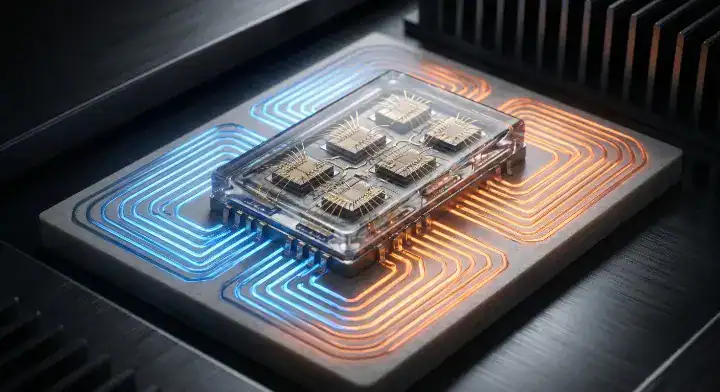
Quick Answer: AMB uses an active-metal braze to join copper and ceramic; DBC uses a copper–oxygen bonding process. Compare the complete substrate construction and its test evidence, not the process name alone. Si₃N₄ AMB is a candidate for demanding power modules, but no universal junction-temperature, copper-thickness or cycle-count threshold makes AMB compulsory.
Copper delamination in a power module is a reason to investigate the failed interface before choosing a replacement substrate. Changing from DBC to AMB may address part of the problem, but ceramic grade, copper geometry, die attach and mounting all affect the result. The ceramic PCB guide provides a broader comparison of the available routes.
Table of Contents
- What Is AMB, and How Does It Differ from DBC?
- How Does the AMB Manufacturing Route Work?
- Which Ceramic Materials Should You Compare?
- How Should Copper Bonding Strength Be Compared?
- How Do Thermal Cycling Results Translate to the Module?
- When Is an AMB Evaluation Worthwhile?
- How Should You Compare AMB and DBC Cost?
- Where Are AMB Substrates Used?
What Is AMB, and How Does It Differ from DBC?
Active Metal Brazing, or AMB, introduces a braze between the ceramic and copper. An active constituent, such as titanium, promotes bonding at the ceramic surface. Direct Bonded Copper, or DBC, bonds copper using a copper–oxygen process without the same active-braze layer. Both are metal-to-ceramic joining technologies; describing only AMB as a “true” bond is misleading.
Rogers describes its AMB technology as high-temperature vacuum brazing of copper to a silicon-nitride ceramic. Other suppliers’ alloy systems and process conditions need their own documentation. A furnace temperature or dwell time from one process is not an instruction for manufacturing every AMB substrate.
| Comparison | AMB | DBC |
|---|---|---|
| Joining route | Active-metal brazing | Copper–oxygen bonding |
| Construction to specify | Ceramic grade, braze system, copper build and finish | Ceramic grade, bonding route, copper build and finish |
| Evidence to compare | Adhesion, dimensions and reliability for the offered construction | The same requirements, using comparable methods |
| What the name alone cannot establish | Lifetime, peel strength or module operating limit | Lifetime, peel strength or module operating limit |
Keep the ceramic and process as separate fields in an RFQ. An AlN request, for example, should not silently allow the supplier to choose a different metallization route or copper thickness.
How Does the AMB Manufacturing Route Work?
The general route is to prepare the ceramic and copper, place the braze material, assemble the stack, run the qualified brazing cycle and form the required circuit pattern. Finishing and inspection follow according to the supplied part specification. The exact sequence depends on the supplier’s technology.
The Interface and the Finished Circuit Are Separate Controls
The braze chemistry, surface preparation and thermal cycle affect the bond. Copper patterning, edge geometry and finish then determine whether the bonded substrate can meet the electrical and assembly drawing. A strong unpatterned coupon does not prove that a finished circuit has suitable clearances or dimensional tolerances.
Kyocera describes several ceramic-to-metal joining approaches. This is why a universal recipe specifying one alloy, one reaction layer and one furnace time would be inappropriate. Request the qualified construction and its acceptance results rather than prescribing undocumented furnace settings.
Warpage also needs a finished-part requirement. Top and bottom copper patterns, metal thickness, ceramic thickness and the cooling history interact. Equal nominal copper thickness on both faces does not automatically eliminate stress when their patterns differ.
Which Ceramic Materials Should You Compare?
Silicon nitride, aluminum nitride and alumina offer different combinations of thermal and mechanical properties. Choose a particular grade and qualified copper construction, not only a generic chemical name.
Si₃N₄ AMB is an established commercial route. NGK, for example, describes a silicon-nitride plate bonded to copper on both sides for power-module substrates. That supports considering this construction for demanding modules; it does not prove that AMB is the only physically possible metallization method for silicon nitride.
AlN is also offered in DBC and AMB constructions. Its suitability depends on the thermal path and mechanical conditions. Alumina DBC remains an option where it meets the application requirements. There is no basis for rejecting it solely because a semiconductor is labeled SiC or GaN.
Use the Si₃N₄ material discussion for the ceramic selection question. In the process comparison, keep the grade, thickness and geometry visible so a claimed improvement is not incorrectly attributed to the braze alone.
How Should Copper Bonding Strength Be Compared?
Compare peel results only with their specimen and test conditions. Copper thickness, strip width, peel angle, test speed, conditioning and fracture location can affect the result. The number is not an intrinsic constant for the letters “AMB” or “DBC.”
One documented example shows why conditions matter. The 2026 Rogers curamik data sheet gives a minimum of 4.0 N/mm at 50 mm/min for DBC with 0.3 mm copper, and 10.0 N/mm at 50 mm/min for AMB with 0.5 mm copper on Si₃N₄. These are the supplier’s stated constructions, with different copper thicknesses; they are not a controlled measure of the benefit of switching only the bonding process. See the current product information and data sheet.
Record Where the Specimen Failed
A strip may separate at an interface, fracture within the ceramic, or fail elsewhere in the test arrangement. Report that mode with the force trace. A higher measured force does not by itself identify the weakest interface during the module’s operating cycle.
Avoid a universal AMB minimum of 50 N/mm or a blanket “IPC Class 3” peel limit for ceramic power substrates. Use the agreed specification for the offered part and assess adhesion after relevant conditioning when the qualification plan requires it.
Decide Whether You Are Comparing Processes or Purchasable Parts
The Rogers example supports a limited conclusion: those named constructions have the listed supplier requirements under their stated conditions. Dividing 10 by 4 does not establish a 2.5-fold improvement in module life, or even a 2.5-fold improvement caused only by brazing. The figures are specified minima, not measured averages from a matched experiment.
Two different comparison questions are legitimate, but they need different evidence:
| Question | Comparison design | Defensible conclusion |
|---|---|---|
| What changes when only the joining route changes? | Match the relevant ceramic, copper geometry, conditioning and measurement method wherever physically and commercially possible | A process-effect conclusion limited to the matched experiment |
| Which available substrate best fits this module? | Evaluate each proposed complete construction against the same application requirements | A choice between those constructions, even when their materials or dimensions differ |
A perfectly matched process experiment may not be available from commercial product ranges. That does not prevent selecting a substrate. It means the result should be described as a comparison of complete candidates rather than proof that one joining mechanism caused every observed difference.
Before ordering comparison samples, agree which differences are intentional. Keep a construction sheet for each candidate with its ceramic grade, metal thickness, pattern revision and surface finish. If one candidate needs a different attachment process, include that change in the evaluation scope. Testing an optimized AMB assembly against an unsuitable DBC attachment would answer a narrower question than the process comparison suggests.
How Do Thermal Cycling Results Translate to the Module?
A thermal-cycling report describes the tested samples under the recorded conditions. It does not convert directly into years of field service or establish that AMB always lasts five or ten times longer than DBC.
Compare ceramic grade, copper thickness and pattern, mounting, temperature range, dwell, transitions, sample size and failure criterion. Also check whether the test used a bare substrate, a populated module or a powered device. Changing several of these at once prevents a simple process-only comparison.
DBC reliability is not fixed. Rogers’ curamik Endurance product information describes stress-relief changes to copper geometry in a DBC product. This is evidence that construction details matter; its results must still be checked for the proposed design.
Include Copper Edges in the Comparison Drawing
A large copper area, its perimeter and nearby ceramic edges deserve attention when interface damage is the concern. Rogers’ Endurance document describes reducing stress near etched copper sidewalls through its particular geometry. The practical lesson is to request the candidate’s edge and pattern rules, not to copy a proprietary shape without its manufacturing and electrical constraints.
Reducing or reshaping copper also changes the circuit geometry. Review current paths, die-attach area and required clearances before treating a stress-relief feature as a harmless mechanical addition. Similarly, a larger isolation gap may compete with the space needed for a power conductor. Resolve these changes on the actual drawing before the thermal-cycling samples are made; otherwise the tested layout may not represent the layout ultimately purchased.
Keep mounting and cooling boundary conditions visible in the report. A freely supported bare tile and a tile attached to a cooler answer different mechanical questions. Neither configuration is automatically wrong, but a successful free-tile result needs an applicability review before it supports the constrained assembly.
When a failed module is available, locate the failure before choosing the remedy. Copper-edge cracking, die-attach fatigue and wire lift-off call for different investigations. The separate article on thermal mismatch at solder joints addresses an interface that a substrate change alone may not repair.
When Is an AMB Evaluation Worthwhile?
Evaluate AMB when the existing construction cannot meet the required thermal, mechanical or insulation performance, or when a selected ceramic and supplier route use AMB. Treat these as reasons to compare candidates, not automatic pass/fail thresholds.
| Project condition | What to establish before changing the substrate |
|---|---|
| Copper or ceramic damage during qualification | Failure location and whether a different grade, copper pattern or bonding route addresses it |
| High operating junction temperature | Actual substrate temperatures and the limits of every assembly material |
| Heavier copper needed | Finished conductor geometry, clearances, warpage and stress assessment |
| Si₃N₄ selected | Available qualified construction and its assembly requirements |
| Existing DBC part passes the program | Whether another route provides a measurable benefit worth requalification |
A claimed improvement should be checked on a representative build using the same acceptance criteria. Keep the original DBC construction as a comparison where practical. This makes it easier to distinguish a material benefit from a change in copper layout or attachment process.
Use a Staged Decision Instead of a Blanket Upgrade
Consider a hypothetical design review in which a DBC-based module develops damage during testing and an AMB replacement is proposed. No performance result is assumed. First confirm the damaged layer or interface. If the observed problem is in the die attach, the review should explain why changing the substrate is expected to help and which attachment conditions will be controlled.
Next check whether the AMB candidate fits the existing assembly: finished outline, thickness, copper pattern, bonding surface and fixture contact. A candidate that needs different tooling or an altered layout can still be useful, but those changes belong in the decision. They should not appear after qualification samples have already been ordered.
The evaluation can then end in one of three practical dispositions:
- Retain the current construction when it meets the requirements and the proposed change has no demonstrated benefit for the identified problem.
- Proceed with representative AMB samples when the offered construction plausibly addresses the failure mechanism and the comparison plan can test that hypothesis.
- Revise the assembly or test plan first when the failure location, operating loads or acceptance criteria remain uncertain.
These are review outcomes, not universal material-selection rules. Define the evidence needed to move from evaluation to release, including who reviews unexpected fracture modes or a new failure elsewhere in the stack. A candidate that improves one measured characteristic while failing another requirement has not completed the selection task.
An EV electronics assembly can contain several different board and module types. Its vehicle voltage label does not determine one substrate process for every circuit.

How Should You Compare AMB and DBC Cost?
Request quotations for clearly defined constructions and quantities. Ceramic grade and area, copper thickness, patterning, finish, inspection, tooling, sample requirements and delivery schedule all affect the offered price. Generic per-piece prices cannot establish the premium for a particular design.
Compare substrate price separately from qualification and assembly cost. A change may need a new fixture, a different bonding process or additional tests. Do not claim warranty savings without a supported failure model and relevant field data.
For a project considering ceramic substrates in IGBT modules, the quotation should identify what each supplier has included: bare substrate, finish, inspection reports, packaging and any testing samples. A lower price with a different ceramic grade or acceptance scope is not a like-for-like quotation.
Decide the commercial trade-off after the candidate meets the required performance. Paying more for a process name is not evidence of better reliability.
For a proposed substitution, separate the cost of establishing equivalence from the recurring price difference. Ask which qualification specimens will be consumed, whether existing assembly tooling remains usable, and which inspection methods must change. Record these items even when another team pays for them. An attractive substrate quotation can otherwise omit the work needed to release the new construction.
Use confirmed quotations and the agreed test scope for that comparison. If requalification scope is still open, show it as an unresolved cost rather than assigning an unsupported allowance. This lets the project decide whether to fund evaluation without pretending that the final production economics are already known.
Where Are AMB Substrates Used?
Power modules for electric vehicles, renewable-energy converters and industrial inverters are documented applications. NGK’s March 2024 capacity announcement describes its silicon-nitride AMB products and automotive demand. That is a manufacturer’s dated statement, not proof that every market or module is replacing DBC.
Application labels help identify relevant suppliers, but they do not replace construction data. A rail converter, traction inverter and industrial drive may impose different cooling, mounting and service loads. Request the evidence that matches the proposed part rather than a generic list of industries served.
FAQ
Can an existing DBC assembly process be used with AMB? Review the new substrate’s finish, dimensions, thermal response and interconnection requirements. AMB does not inherently mean a harder copper alloy, nor does it automatically require a different solder profile. Validate the actual replacement construction.
Is AMB always better than DBC? No. The useful comparison is whether each offered construction meets the thermal, electrical, mechanical and production requirements. Neither a fixed cycle count nor a device junction temperature decides the answer alone.
How long does an AMB order take? Obtain a schedule for the specified ceramic, copper build, tooling and inspection scope. Separate material availability, fabrication, qualification samples and transport instead of assuming a universal three- or four-week lead time.
For a DBC–AMB comparison, send QueenEMS the current substrate drawing, observed failure evidence or qualification target, copper pattern and attachment stack. Discuss the candidate constructions through the ceramic PCB manufacturing page so the quotation is tied to the actual module requirements.
Written by the QueenEMS Engineering Team
Upload your files today · Free DFM check before production · Ship worldwide
Get your PCB prototypes in as fast as 24 hours. We handle FR4, Rogers, and Flex up to 60 layers — free prototypes for 2–4 layer boards, no minimum order.
Just upload your Gerber + BOM — we source every part, assemble, and inspect (AOI + X‑Ray) so you don't have to chase suppliers. Boards ship in as fast as 24 hours.