
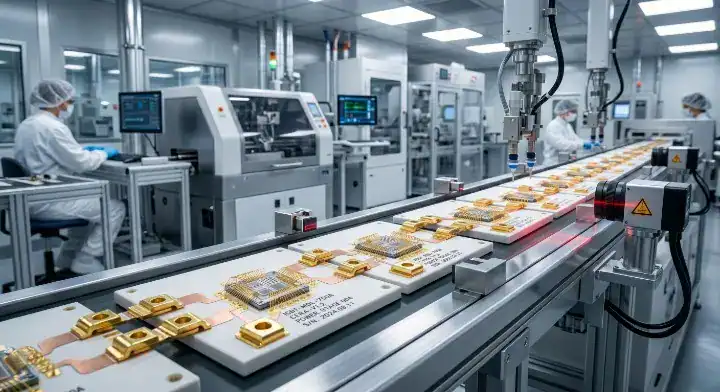
Quick Answer: The ceramic PCB manufacturing process is not one fixed flow. DBC, DPC, AMB, thick film, thin film, LTCC and HTCC create different copper or conductor structures, so process selection must start with substrate, conductor thickness, finished geometry, layer/cavity needs, assembly interface and qualification evidence.
Start with the ceramic PCB guide when the substrate itself is still undecided. This comparison begins after the product requirements are ready to screen manufacturing routes.
Key takeaways:
- DBC is evaluated for bonded copper-foil power structures.
- DPC is evaluated for deposited/plated copper, finer geometry and plated features.
- AMB is evaluated when a brazed ceramic-copper system supports the required mechanical and thermal-cycle qualification.
- Thick film, thin film, LTCC and HTCC serve different printed-film, precision or co-fired multilayer requirements.
Table of Contents
- What Are the 7 Technologies in the Ceramic PCB Manufacturing Process?
- How Does the Direct Bonded Copper (DBC) Process Work?
- When Does DPC Fit Better Than DBC?
- When Should You Choose Active Metal Brazing (AMB) for Ceramic PCBs?
- What Are the Differences Between Thick Film and Thin Film Ceramic PCB Fabrication?
- How Do LTCC and HTCC Ceramic Substrate Manufacturing Processes Compare?
- How Do DBC, DPC and AMB Compare?
- How to Choose the Right Ceramic PCB Manufacturing Process for Your Design?
- What Are the Key Design for Manufacturing (DFM) Tips for Each Process?
- How Does the Ceramic PCB Manufacturing Process Impact Your Final Cost?
If you are still choosing between DBC, DPC, AMB, or film processes, start with a ceramic PCB prototype review before committing tooling.
What Are the 7 Technologies in the Ceramic PCB Manufacturing Process?
Seven common technology families appear in ceramic circuit sourcing, but their capability ranges overlap and vary by supplier. Treat every public value as a screening reference until the supplier confirms the finished design.
Seven Process Families at a Glance
Post-fired routes add metal to a fired ceramic, co-fired routes build conductor and ceramic layers together, and film routes print or deposit conductors onto ceramic. That distinction controls the file set, tooling, dimensional behavior and inspection plan.
Ask which object enters the conductor process. A DBC order starts from an already fired ceramic plate and bonds copper to it; the ceramic is not manufactured from powder again for every order. LTCC or HTCC forms the multilayer ceramic body together with its internal conductors. This distinction is documented in Rogers’ bonded-substrate information and Egide’s co-fired package overview.
| Stage boundary | Post-fired metallization order | Co-fired multilayer order |
|---|---|---|
| Incoming ceramic | Grade and fired blank dimensions | Approved tape/material and compatible paste set |
| Holes or cavities | Confirm any machining before or after metallization | Define layer openings, via fill and fired registration |
| Dimensional release | Finished outline plus metal-to-edge relationship | Fired outline and layer positions; supplier controls compensation |
| Later assembly | Solder, die attach or wire-bond interface | Post-fired finish, attachment and any package sealing |
An illustrative drawing review begins with a buried interconnect and a recessed die area, but its process note says that every hole must be drilled after ceramic firing. Before accepting that note, trace the interconnect through the section view. A co-fired proposal may form its internal connections during layer preparation, whereas machining an already fired plate is a different manufacturing route. A familiar drilling instruction can therefore exclude the construction the drawing actually needs.
Ask the fabricator to mark when the via, recess, conductor and final outline are created on its proposed flow. Keep the required finished opening, electrical connection and die position on the product drawing; resolve any mandatory process restriction explicitly with the designer. For the co-fired option, distinguish supplier tooling compensation from the finished dimensions accepted by the buyer. For a post-fired option, identify how any connection through the ceramic receives its metal.
Check a representative section or other agreed inspection evidence for via alignment and metallization, together with electrical continuity and the finished cavity measurements. If the alternative flow cannot demonstrate the hidden connection, an acceptable outside shape is insufficient. The useful outcome is a route that explains how each functional feature is made and checked, with no unexplained manufacturing instruction left in the released drawing.
- Post-fired routes create conductors or bonded metal after the ceramic has been fired.
- Co-fired routes build patterned layers, vias and cavities into a fired multilayer body.
- Neither family guarantees a specific thermal, electrical or layer-count result without grade- and supplier-specific data.
Confirm Capability on the Finished Drawing
Start with the hardest non-negotiable requirements: finished conductor thickness, minimum line/space, layer count, vias/cavities, ceramic grade, thermal/mechanical load and assembly interface.
Eliminate processes only from supplier-confirmed incompatibilities; do not rely on a universal layer-count or current threshold.
| Family | Processes | What it controls |
|---|---|---|
| Bonded/plated on fired ceramic | DBC, DPC, AMB | Copper structure, geometry, interface and power-module fit |
| Printed/deposited film | Thick film, thin film | Conductor system, resolution, functional pastes and RF surface |
| Co-fired multilayer | LTCC, HTCC | Layer integration, shrinkage, cavities, conductor material and package function |
A multilayer requirement may point toward LTCC or HTCC, while a power substrate may remain a post-fired construction. Confirm cost and manufacturability after the architecture is stable.
How Does the Direct Bonded Copper (DBC) Process Work?
DBC forms a copper-to-ceramic bond using a controlled high-temperature copper-oxygen process. Finished copper, isolation geometry, edge profile, ceramic type and interface qualification must be confirmed for the actual artwork.
DBC Interface and Copper Structure
The process bonds copper foil to a fired ceramic, then patterns the copper. Thicker copper increases etch and edge-shape sensitivity, which is why the finished rather than nominal line/space matters.
Etch Geometry to Confirm
A DBC RFQ should identify ceramic grade and thickness, copper on each side, minimum isolation, edge clearance, flatness, finish and required interface evidence.
- Confirm finished line/space for the selected copper thickness.
- Review undercut, copper-edge profile and isolation clearance.
- Specify any through-ceramic feature as a separate drilling/metallization requirement.
Evaluate it when bonded heavy copper and a direct thermal path are more important than fine routing or plated-feature complexity.
| DBC field | RFQ input | Acceptance evidence |
|---|---|---|
| Ceramic/copper | Grade, thickness and copper on both sides | Material and lot identity |
| Pattern | Finished line/space, isolation and edge clearance | AOI/dimensional report as required |
| Interface | Bond and flatness requirement | Agreed interface/adhesion evidence |
Do not release a fine-pitch DBC design until the supplier has confirmed the finished copper geometry and assembly land pattern.
When Does DPC Fit Better Than DBC?
DPC deposits an adhesion/seed system and builds copper by plating before final pattern definition. It is commonly evaluated when finer conductors, precision pads or plated features control the design.
Where DPC Changes the Design Window
DPC can combine ceramic thermal behavior with finer circuit geometry, but the released design still needs supplier-confirmed line/space, copper thickness, via construction, flatness and surface finish.
Treat DPC as its own ceramic plating process, not as FR-4 fabrication transferred unchanged to a ceramic panel.
DPC Evidence to Request
A common DFM conflict occurs when the requested copper build and conductor spacing cannot be produced by the same route. Resolve it by changing geometry, copper, process or architecture before tooling; record the approved change in the stackup and fabrication drawing.
Evaluate DPC when deposited/plated copper, finer geometry, precision pads or defined via metallization are central requirements.
| Process | Conductor route | Capability evidence to request |
|---|---|---|
| DBC | Bonded copper foil followed by patterning | Finished copper, isolation, conductor edge, flatness and interface evidence |
| DPC | Adhesion/seed system followed by plated copper build-up | Finished line/space, thickness uniformity, pad geometry, vias and adhesion evidence |
Select DPC only after the supplier confirms the ceramic, conductor system, feature limits and inspection plan for the released revision.
For a two-route decision, use the detailed DBC and DPC ceramic PCB comparison before approving the copper structure, finished line/space and via assumptions.
When Should You Choose Active Metal Brazing (AMB) for Ceramic PCBs?
Automotive AMB ceramic PCB fabrication uses an active-metal braze system to bond copper to a ceramic such as silicon nitride or aluminum nitride. Its value is an application-specific combination of copper interface, ceramic strength and thermal-cycle behavior, which must be qualified against the real power-module load case.
AMB Interface and Qualification
The braze contains an active element that reacts with the ceramic under controlled atmosphere or vacuum. Buyers should specify ceramic and copper, braze/interface requirements, surface finish, flatness, pattern geometry and the reliability test profile.
- Define the ceramic, copper and braze system in the stackup.
- Provide the temperature range, ramp, dwell, cycle count and failure criteria.
- Review interface evidence, flatness, copper geometry and lot traceability.
Automotive Evidence Boundaries
An automotive power-module review should compare DBC and AMB using the same ceramic, copper pattern, attachment design and thermal/mechanical test conditions. A supplier claim without the test profile, sample size and failure criteria is not comparable evidence.
Use the AMB versus DBC ceramic substrate comparison to examine the bonding route, ceramic choice and application-specific reliability evidence in more detail.
Add AMB to the shortlist when the required ceramic-copper system and reliability profile justify brazed-interface cost and qualification.
| Comparison field | DBC question | AMB question |
|---|---|---|
| Interface | How is the copper-ceramic bond controlled? | How is the braze and active-metal interface controlled? |
| Ceramic/copper | Which grade, thickness and pattern were qualified? | Which grade, thickness and pattern were qualified? |
| Reliability | What exact thermal/mechanical profile was tested? | What exact thermal/mechanical profile was tested? |
Engineering should approve AMB from measured application evidence, not from an automotive, aerospace or military label alone.
What Are the Differences Between Thick Film and Thin Film Ceramic PCB Fabrication?
Thick film prints and fires a conductive or functional paste on ceramic, while thin film starts with a vacuum-deposited metal system that may include a later plated build. The choice affects conductor material, resistance, geometry, adhesion, surface condition and cost.
Printed and Fired Thick Film
Thick-film processing screen-prints conductor, resistor or other functional pastes and fires them onto the ceramic. The supplier should identify the paste system, screen basis, fired thickness, resistance and adhesion controls used for the product.
Thick-film results depend on paste, screen, print thickness, firing profile and substrate. It can also integrate resistor or other functional pastes when the design and trim/qualification plan support them.
Deposited Thin-Film Metallization
Thin-film processing is selected for precision conductors and controlled metal stacks, but the supplier must confirm finished thickness, geometry, adhesion and finish for the required substrate size.
For primary examples, Vishay’s thin-film design guide includes deposited and plated conductor stacks, while DuPont’s 7484 conductor datasheet specifies a printed paste and its own firing/compatibility conditions. Those documents describe particular material systems. Do not transfer a firing profile, final thickness or compatible finish from one to the other.
- Confirm finished conductor width and thickness rather than a generic thin-film label.
- Specify the metal stack, surface finish and attachment interface.
- Define sheet resistance, adhesion or RF evidence when the design depends on it.
Choose thick film for a qualified printed-paste function; choose thin film when deposited-metal precision and surface control justify the process.
| Field | Thick film | Thin film |
|---|---|---|
| Metal formation | Printed and fired paste | Deposited seed/metal stack, with plated build where specified |
| Design focus | Functional paste, conductor/resistor integration | Precision geometry and controlled surface |
| Evidence | Paste, firing, thickness/resistance and adhesion | Metal stack, geometry, thickness, adhesion and finish |
For RF or precision analog work, model the actual conductor system and request measured sheet resistance or RF evidence where it affects acceptance.
How Do LTCC and HTCC Ceramic Substrate Manufacturing Processes Compare?
LTCC and HTCC co-fire patterned ceramic layers and conductors into a multilayer structure. They differ in ceramic system, firing conditions, conductor options, shrinkage behavior, electrical resistance, thermal properties and package capability.
LTCC Material and Fired-Stack Data
LTCC formulations contain glass/ceramic systems that enable lower firing temperatures and compatible conductor choices. Use the exact fired material data rather than a generic LTCC thermal value.
Some LTCC systems trade thermal conductivity for multilayer integration, cavities and embedded functions. That trade may be correct for an RF package and wrong for a direct heat-spreading substrate.
HTCC Conductor and Package Trade-offs
HTCC uses a higher-temperature ceramic/conductor system, often with refractory-metal conductors. Its value can include mechanical, high-temperature or hermetic package functions, but conductor resistance and assembly interfaces must be modeled.
- Confirm conductor material and finished resistance for the routed length.
- Control fired X-Y dimensions, layer registration, cavities and via alignment.
- Specify hermeticity or high-temperature evidence only when the package requires it.
Choose LTCC or HTCC from the fired stack, conductor system, cavity/layer architecture, shrinkage control and package qualification—not from temperature labels alone.
| Field | LTCC review | HTCC review |
|---|---|---|
| Fired material | Grade-specific dielectric/thermal data | Grade-specific mechanical/thermal data |
| Conductor | Compatible low-temperature metal system | Compatible refractory-metal system |
| Control | Shrinkage, registration, cavities and embedded functions | Shrinkage, registration, vias and package/hermetic requirements |
Do not assign a co-fired material until the supplier provides the grade-specific thermal, dielectric, shrinkage and conductor data used in the design.
How Do DBC, DPC and AMB Compare?
DBC, DPC and AMB should be compared on the design’s actual copper, geometry, interface and qualification needs. No process wins every power, RF, automotive or industrial application.
Compare the Three Post-Fired Routes
DBC often fits bonded heavy-copper work, DPC often fits finer plated structures, and AMB is evaluated for a brazed high-reliability interface. Supplier capability and application evidence determine the final choice.
A wrong process choice usually appears as a DFM conflict: unproducible isolation, unsuitable copper, missing via route, excessive stress, wrong finish or incomplete qualification.
Record the Process Decision
Align the controlled stackup, artwork, dimensions, inspection scope and qualification evidence before sending the RFQ. Suppliers can then record deviations against the same revision.
- Fine geometry: compare DPC or thin-film capability against the finished drawing.
- Heavy copper: compare DBC and AMB against isolation, interface and reliability requirements.
- Automotive use: select from the documented module load case and qualification evidence.
Map copper, geometry, via, substrate and qualification requirements together before choosing DBC, DPC or AMB.
| Decision | DBC | DPC | AMB |
|---|---|---|---|
| Primary structure | Bonded copper foil | Deposited/plated copper | Brazed copper-ceramic interface |
| Screen first for | Heavy copper and power area | Fine geometry and plated features | Ceramic/copper reliability load case |
| Evidence focus | Bond, edge and thermal plan | Adhesion, geometry and via plan | Braze/interface and thermal-mechanical plan |
Use the table to frame supplier questions, then record the selected route and exceptions in the controlled stackup and DFM response.
How to Choose the Right Ceramic PCB Manufacturing Process for Your Design?
Choose the ceramic PCB manufacturing process by cross-checking substrate, conductor thickness, minimum geometry, layers/cavities, vias, finish, assembly interface, reliability profile, quantity and cost. One unresolved hard constraint should hold tooling.
Use an Evidence-Led Elimination Review
Treat the choice as an evidence-led elimination review. Each rejected route should have a named technical reason from the drawing or qualification plan.
- Layer/cavity need: compare co-fired multilayer or a split-board architecture.
- Geometry need: compare finished DPC/thin-film or printed-film capability.
- Copper/thermal need: compare DBC, DPC and AMB with the same load model.
- Reliability need: compare test profiles, sample plans and failure criteria.
- Commercial need: compare prototype, pilot and production quotations on one revision.
Resolve Conflicts at Architecture Level
Conflicting requirements may require two substrates or a package-plus-control-board architecture. Record that boundary before detailed routing so one process is not forced to solve incompatible jobs.
Resolve process conflicts at stackup and package level before selecting the lowest compliant manufacturing route.
| Constraint | First routes to compare | Approval record |
|---|---|---|
| Fine conductors or precision pads | DPC or thin film | Finished geometry and inspection |
| Bonded heavy copper | DBC or AMB | Copper/isolation and interface evidence |
| Multilayer cavities/embedded functions | LTCC or HTCC | Fired stack, shrinkage and registration |
| Printed functional paste | Thick film | Paste, firing, resistance and adhesion |
Attach the completed parameter and evidence checklist to the RFQ so suppliers quote the same scope.
What Are the Key Design for Manufacturing (DFM) Tips for Each Process?
DFM rules are process- and supplier-specific. DBC needs copper/etch geometry review; DPC needs plating, via and feature review; LTCC/HTCC need supplier shrinkage, registration and fired-stack control.
Control Fired Dimensions and Registration
Co-fired designs are scaled and tooled for the supplier’s material and firing process. The buyer should release final dimensions and tolerances while the supplier controls approved pre-fire compensation.
Firing can change X-Y and Z dimensions, but constrained-shrinkage processes may limit in-plane change. Obtain the supplier’s compensation and registration basis for the selected material set; approve finished cavity, via and outline positions.
Hold Tooling on Unconfirmed Assumptions
For a multilayer co-fired design, submit layer artwork, via/punch files, cavity dimensions, conductor system, fired tolerances and datum strategy. Hold tooling when the supplier has not confirmed shrinkage and registration assumptions.
Do not reuse FR-4 rules without a ceramic process review; release supplier-confirmed conductor, via, cavity, edge and fired-dimension limits.
| Process | DFM focus | Hold condition |
|---|---|---|
| DBC | Finished isolation, copper edge, flatness and interface | Copper/etch geometry not confirmed |
| DPC | Plating, fine geometry, vias and planarity | Finished feature or via route not confirmed |
| LTCC/HTCC | Shrinkage, registration, cavities and conductor system | Fired stack or tolerance basis missing |
| Thick/thin film | Paste/metal stack, geometry, resistance and adhesion | Material system or evidence not defined |
Require a written DFM response that identifies approved assumptions and any drawing changes before tooling.
How Does the Ceramic PCB Manufacturing Process Impact Your Final Cost?
Process cost changes with material, usable area, conductor system, layer count, vias/cavities, tooling, yield exposure, surface finish, inspection, qualification, quantity and delivery. Public fixed tooling prices cannot represent a controlled RFQ.
Build a Comparable RFQ Scope
Material is only one cost driver. Tooling, setup, usable area, process steps, inspection, qualification and revision control can change both non-recurring and unit cost.
Co-fired designs can require layer-specific tooling, printing and firing control, while post-fired routes have their own masks, fixtures, deposition, plating or bonding setup. Ask suppliers to itemize non-recurring and recurring charges.
Separate Recurring and Non-Recurring Cost
Build the budget from one stackup, artwork revision, quantity ladder, inspection scope and delivery plan. Relative process cost can reverse when yield, material utilization or qualification changes.
A reliable cost ranking requires project quotations; do not assume a universal cheapest-to-most-expensive process order.
Compare only routes that meet every released technical and evidence requirement.
| Cost driver | Questions for the quote |
|---|---|
| Material and usable area | Which ceramic grade, thickness, blank size and utilization are priced? |
| Process/tooling | Which masks, screens, punches, fixtures or qualification charges are non-recurring? |
| Inspection/test | Which dimensional, interface, electrical, RF or reliability evidence is included? |
| Volume/revision | How do prototype, pilot, production and future revision charges differ? |
Request prototype, pilot and production quantities separately and show how tooling is reused or changed across revisions.
Every ceramic process represents a different combination of material, conductor, geometry and qualification. Preserve that decision in the controlled stackup, drawing, DFM response and quotation.
QueenEMS can review the controlled file set and flag unresolved process assumptions. Record fabrication route, included inspections, evidence package and schedule basis in the resulting quotation.
Submit the ceramic callout, stackup, Gerber or ODB++, conductor thickness, minimum geometry, via/cavity drawing, finish, assembly interface, quantities and qualification criteria on the QueenEMS project inquiry page. The process screen can then separate DBC, DPC, AMB, film and co-fired candidates before pricing.
Written by the QueenEMS Engineering Team
FAQs
Can I use LTCC for a high-power LED module? Only when the grade-specific thermal path and package design pass the load model. Compare it with a post-fired ceramic power substrate rather than assuming all LTCC materials are unsuitable.
What process should I evaluate for fine conductors on AlN? Start with DPC or thin film, then confirm finished geometry, metal thickness, adhesion, surface finish and usable substrate area with the supplier.
How do I know whether an EV power module needs AMB? Compare DBC and AMB on the same ceramic/copper design using the application’s thermal, mechanical and interface qualification profile.
Is HTCC tooling always more expensive than DPC? There is no universal tooling-cost ranking; the answer depends on layer-specific tooling, material, quantity and qualification. Request itemized non-recurring and recurring charges.
Can a DBC design include plated through-ceramic features? Only with a supplier-confirmed secondary drilling and metallization route. Specify the finished via section and how that feature will be accepted.
Upload your files today · Free DFM check before production · Ship worldwide
Get your PCB prototypes in as fast as 24 hours. We handle FR4, Rogers, and Flex up to 60 layers — free prototypes for 2–4 layer boards, no minimum order.
Just upload your Gerber + BOM — we source every part, assemble, and inspect (AOI + X‑Ray) so you don't have to chase suppliers. Boards ship in as fast as 24 hours.