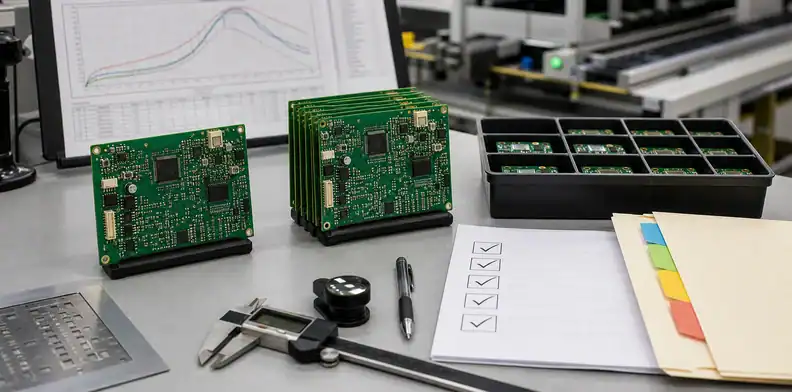
Quick Answer: AI PCB prototype to production readiness means turning a working bench sample into a controlled build package. Freeze revision, stackup, material, DFM decisions, stencil, reflow assumptions, test method, first article inspection, evidence records, and supplier change rules before volume. A prototype can prove direction while still hiding conditions that fail in repeat production.
The common mistake is celebrating the first powered board and skipping the work that makes the next hundred boards behave the same way. This closing spoke focuses on transition control: what to freeze, what to retest, and what evidence should accompany the first production lot.
Table of Contents
- Can an AI prototype go straight to production?
- How does production differ from prototype?
- Why do working prototypes fail in volume?
- Which specifications must be tightened?
- Should you keep the same supplier?
- What FAI and batch evidence do you need?
- How do cost and schedule change while scaling?
- What should the production RFQ include?
- How should engineering freeze changes after FAI?
- What belongs in the repeat-order baseline?
Can an AI prototype go straight to production?
No. A working prototype is evidence that the concept can run, not proof that the build is repeatable.
Prototype success may depend on hand rework, a lab power supply, one operator’s soldering, loose part substitutions, or manual firmware loading. Those hidden conditions must become drawings, process notes, test steps, or design changes.
For a working bench prototype, list every manual adjustment needed to make the sample run. The practical reason is that anything not written down can disappear during the first production lot.
For a working bench prototype, separate what was proven by test from what was manually reworked, patched, or accepted only for a one-off build.
Production rule: Bench success starts the production review; it does not finish it.
How does production differ from prototype?
Prototype builds optimize speed; production builds require controlled inputs and repeatable acceptance. Use the AI-generated PCB release checklist to confirm the prototype handoff has become a controlled build package.
Production needs frozen revision, approved materials, defined stackup, stable BOM/AVL, stencil data, reflow window, packaging, test method, and inspection criteria. Each change needs an owner because uncontrolled substitutions can move yield and reliability.
For a production release meeting, freeze the inputs that affect repeatability, including material, stackup, BOM, stencil, reflow, and test. The practical reason is that volume work punishes assumptions that were harmless in a one-off build.
For a production release meeting, list the frozen files, approved deviations, test limits, and first-article evidence before purchasing asks for lot pricing.
Prototype vs production control:
| Area | Prototype habit | Production need |
|---|---|---|
| Revision | Latest export | Frozen release |
| Assembly | Manual adjustment | Stencil and reflow plan |
| Test | Bench check | Documented acceptance |
| Evidence | Ask later | Planned records |
Prototype purchasing often accepts manual clarification because the goal is a fast learning build. Production needs stable drawings, approved alternates, fixed panel assumptions, inspection requirements, and a repeatable acceptance route. If the prototype depended on informal CAM judgment, a bench-wire fix, or a substituted component, write that lesson into the release package before ordering a larger lot.
Why do working prototypes fail in volume?
They fail when the design depends on manual fixes or unpriced assumptions.
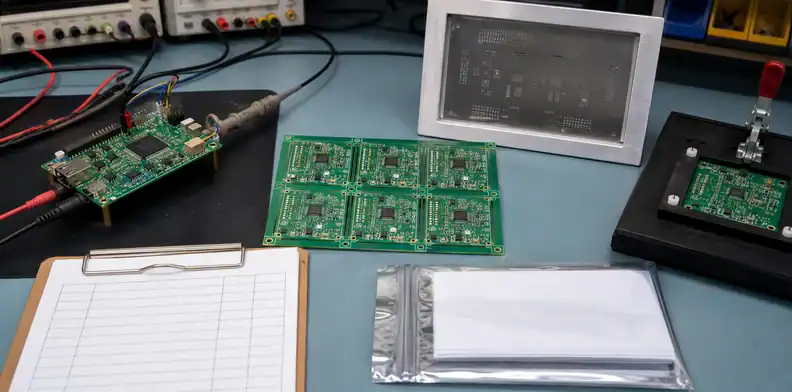
Common examples include insufficient test points, marginal DFM geometry, a footprint that barely solders, hand-tuned component values, rework wires, unapproved material swaps, and assembly settings chosen informally during the first build.
For a prototype with hand rework, turn jumper wires, component swaps, solder touch-up, and firmware shortcuts into controlled changes. The practical reason is that hidden fixes are one of the fastest paths to repeat-lot failure.
Convert any prototype hand rework into a CAD change, deviation note, or test-limit update before the build history is reused.
Failure signal: Any fix performed by hand during prototype must be converted into a file, drawing, BOM, or process update.
A working unit may hide variation that appears only when more boards are built. Material substitutions, plating spread, solder paste tolerance, connector fit, thermal stress, operator interpretation, and component date-code differences can all move a marginal design outside its comfort zone. Production review should look for the parts of the prototype that were lucky rather than controlled.
Which specifications must be tightened?
Tighten the specifications that affect yield, inspection, and acceptance.
Freeze board thickness, copper weight, surface finish, stackup, impedance, solder mask, stencil aperture approach, reflow limits, functional test, firmware programming, packaging, and allowed substitutions. For AI-generated files, also freeze which generated assumptions were reviewed by engineering.
For an AI-generated design history, separate approved design decisions from prompts, chat notes, and old exports. The practical reason is that production cannot rely on informal AI conversation as specification.
For AI-generated design history, carry forward only approved changes and delete prompt notes that never became CAD files or drawings.
Tighten the specifications that affect function, assembly fit, test yield, or field reliability. That usually means stackup, controlled impedance, hole tolerance, copper weight, surface finish, solder mask, component alternates, programming steps, inspection method, and packaging. Leave ordinary cosmetic preferences out of the controlled list unless the product has a real customer-facing requirement.
Should you keep the same supplier?
Keep the supplier when prototype process knowledge matters; change only with a controlled transfer package.
Switching suppliers can reset DFM assumptions, material availability, panelization, stencil behavior, and test evidence. If you change, provide the full released package plus prototype lessons, approved deviations, and known failure fixes.
For a supplier transfer, move prototype lessons into a formal transfer package before changing factories. The practical reason is that a new supplier cannot inherit process knowledge that was never documented.
During supplier transfer, send the accepted CAM edits and prototype lessons as controlled attachments instead of relying on memory.
Production readiness records:
| Record | Why it matters | Owner |
|---|---|---|
| FAI | Confirms first lot | Quality |
| AVL/BOM | Controls sourcing | Engineering/purchasing |
| DFM response | Freezes supplier edits | Engineering |
| COC/evidence | Supports acceptance | Supplier/quality |
Supplier call: A lower volume quote is risky when it discards the learning from the prototype build.
Keeping the same supplier is useful when the prototype record includes DFM comments, CAM edits, approved material choices, and evidence that can be reused. Switching suppliers can still be correct for volume, but the transfer package must explain every prototype exception. Without that record, the new supplier may quote the files as if the first build had no hidden decisions.
What FAI and batch evidence do you need?
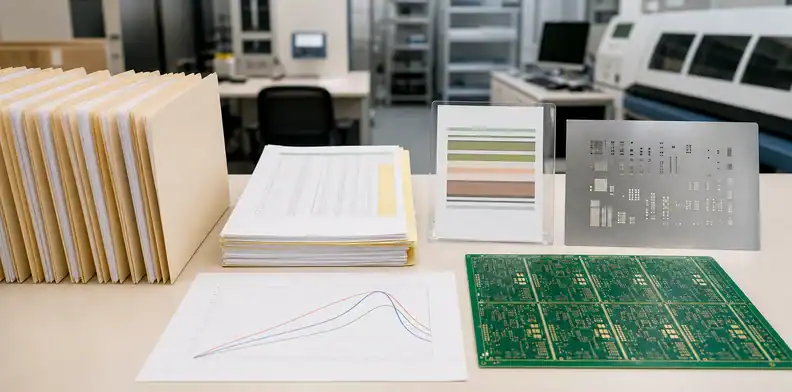
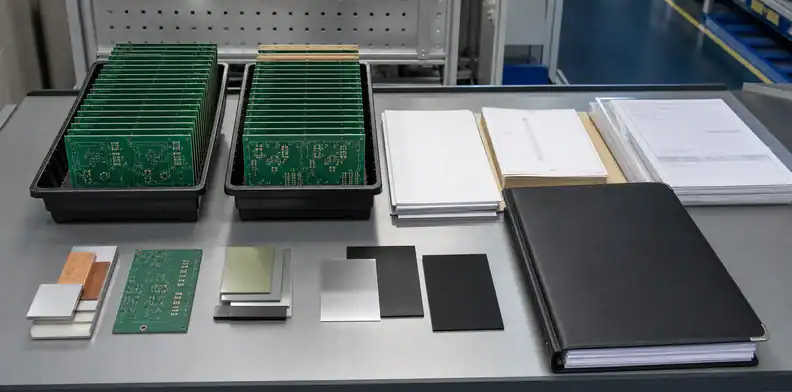
Use first article inspection to confirm the production package before repeated lots. FAI should compare the first build against released files, drawing notes, critical dimensions, BOM/CPL, assembly orientation, test results, and evidence records. For first-lot proof, AI PCB manufacturing evidence explains how microsection, TDR, AOI, X-ray, and COC records support acceptance. Add the reports only when the board risk requires them.
For a first article lot, inspect the first production output against released files and acceptance criteria. The practical reason is that FAI should confirm the process, not just celebrate one passing board.
For a first article lot, tie each deviation to a disposition: accept as is, rework, revise drawing, or block production.
FAI should prove that the first production route matches the released design, not only that one board powers on. Ask for dimensional checks, assembly orientation review, test results, controlled feature evidence, and deviation notes tied to the lot. If a future batch will be compared against this record, store the approved measurements and supplier answers in the repeat-order baseline.
How do cost and schedule change while scaling?
Cost and schedule change when evidence, tooling, panelization, sourcing, and inspection become controlled.
A prototype quote may omit stencil optimization, fixtures, programming, test time, incoming inspection, packaging, or lot documentation. Production should price those items explicitly so the buyer knows what is included.
For a scaled quote, include tooling, fixtures, test time, programming, packaging, and evidence in the comparison. The practical reason is that unit price alone hides the real production scope.
Close a scaled quote by listing tooling, test, inspection, component sourcing, and FAI assumptions separately from prototype history.
Quote rule: Production comparison must include tooling, test, evidence, and sourcing assumptions, not only unit price.
Scaling changes the cost model because tooling, test time, panel use, component purchasing, scrap allowance, and inspection records become more visible. A prototype quote may hide manual handling that is acceptable for a few boards but expensive for a repeat lot. Ask the supplier which cost items disappear, which ones grow, and which assumptions depend on a frozen revision.
What should the production RFQ include?
Send the released Gerber or ODB++, BOM, CPL, drawings, stackup, test plan, evidence list, approved substitutions, and prototype lessons. Use AI PCB Gerber review before quote to clean fabrication data before the production RFQ is compared.
Use the QueenEMS contact page when the prototype was AI-assisted and the production package needs an engineering-readiness review. State whether the request is pilot, first production run, or repeat production baseline.
For a repeat-order baseline, store the approved revision, deviations, evidence, and supplier responses for the next PO. The practical reason is that the second production lot should not restart the same questions.
A repeat-order baseline is controlled when the frozen revision, FAI decisions, supplier deviations, and test evidence can be reused.
How should engineering freeze changes after FAI?
After FAI approval, changes should move through revision control instead of informal build notes.
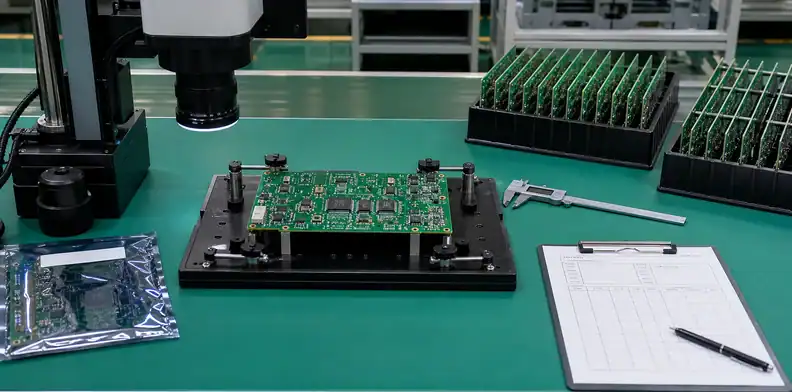
Freeze the released files, BOM/AVL, stackup, stencil, test method, approved supplier responses, and evidence plan. If a later issue requires a change, create a new revision or approved deviation rather than editing the production baseline silently. This prevents the pilot lot from drifting before repeat orders begin.
Freeze rule: FAI approval should create a controlled baseline, not another editable draft.
After FAI, engineering should separate defects from improvements. Defects need disposition before the lot continues; improvements should wait for the next revision unless they affect acceptance or safety. That discipline keeps production from drifting through small well-meant edits that are never captured in the baseline files, test limits, or purchasing record.
What belongs in the repeat-order baseline?
The baseline should include files, supplier approvals, evidence, substitutions, test method, and known production limits.
Repeat orders fail when a buyer sends only Gerbers and forgets the DFM response, approved AVL, panel decision, programming step, or inspection record that made the first lot work. Keep those items together so the next PO can be reviewed against the same assumptions.
Repeat rule: A repeat build should inherit the approved production record, not just the board artwork.
The production handoff should preserve what the prototype taught. If the first board needed reflow adjustment, polarity correction, BOM substitution, hand rework, or firmware-loading changes, those lessons should become released data. A buyer who sends only the final Gerbers loses the context that made the prototype succeed and may pay for the same learning again in the pilot lot.
Use a readiness readback before the first production PO: final revision, stackup, BOM/AVL, assembly drawing, stencil status, reflow notes, test method, FAI items, evidence records, accepted supplier deviations, and repeat-order owner. The readback does not slow production; it prevents a working AI prototype from becoming an uncontrolled manufacturing experiment. It also gives purchasing a clean boundary for comparing pilot pricing against the later repeat-order baseline.
For production-readiness review, send QueenEMS the prototype lessons, frozen Gerbers, BOM/CPL, stackup, FAI plan, test limits, evidence list, and supplier-transfer questions through the QueenEMS contact page. Name the pilot quantity, approved deviations, and changes that must wait for the next revision.
FAQ
Does a working AI PCB prototype mean the design is safe for volume?
No. Volume requires frozen files, controlled process assumptions, test coverage, and first article evidence.
What is the biggest prototype-to-production risk?
Hidden manual fixes are the biggest risk because they are easy to forget and hard for a new lot to repeat.
Should the first production lot be treated as validation?
Yes. Treat it as a controlled first article or pilot run until the process evidence and acceptance results are reviewed.
What’s the best sign that an AI prototype is production-ready?
The best sign is a frozen release package with documented FAI results, approved DFM changes, controlled test evidence, and a repeat-order baseline. A working prototype proves one build worked, not that the next lot is controlled for yield, sourcing, and inspection.
Sources
Written by the QueenEMS Engineering Team
Upload your files today · Free DFM check before production · Ship worldwide
Get your PCB prototypes in as fast as 24 hours. We handle FR4, Rogers, and hybrid boards up to 40 layers in volume production, with advanced builds subject to engineering review — free prototypes for 2–4 layer FR-4 boards, no minimum order.
Just upload your Gerber + BOM — we source every part, assemble, and inspect (AOI + X‑Ray) so you don't have to chase suppliers. Boards ship in as fast as 24 hours.