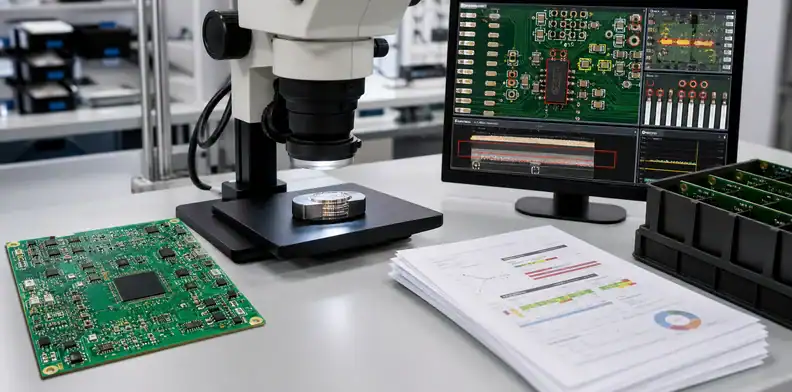
Quick Answer: AI PCB manufacturing evidence should be defined before the order because many records depend on the panel, coupon plan, inspection route, or assembly process. Electrical test, AOI, X-ray, microsection, TDR, first article inspection, and COC each prove different things. A quote without evidence assumptions cannot be compared with a quote that includes them.
A board that works on the bench is not the same as a board with documented production acceptance. AI-generated designs need evidence discipline because the buyer may have less confidence in the original assumptions. This article explains which evidence belongs to fabrication, assembly, first-article release, and repeat production.
Table of Contents
- What evidence proves an AI-designed board was built right?
- Why must evidence be planned before production?
- What does microsection prove?
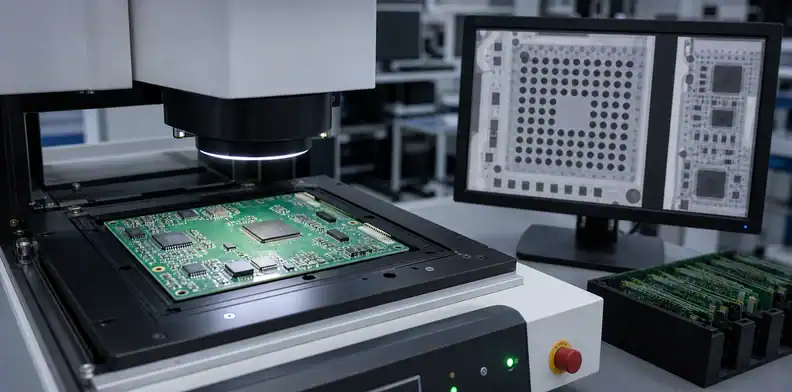
- When do AOI and X-ray help?
- Do you need test coupons for every build?
- Is a Certificate of Conformance enough?
- How should evidence affect quote comparison?
- What should be sent for QueenEMS review?
- How much evidence is enough for prototype versus production?
- How should records be tied to lot identity?
What evidence proves an AI-designed board was built right?
No single record proves everything, so choose evidence by risk.
Electrical test shows opens and shorts. AOI shows visible solder or assembly defects. X-ray helps hidden solder joints. Microsection documents plated-hole or via structure. TDR supports impedance. FAI compares the first build against released requirements.
For a high-risk AI design, choose evidence from the actual failure mode rather than asking for every possible report. The practical reason is that irrelevant evidence adds cost without improving acceptance.
For a high-risk AI design, connect each requested report to a controlled feature such as microvias, impedance coupons, plating thickness, or BGA inspection.
Evidence rule: Match each record to the failure mode it can actually detect.
Why must evidence be planned before production?
Some evidence requires coupons, panel planning, inspection routing, or operator records before the lot is built. The AI-generated PCB release checklist is useful when evidence planning exposes a missing release input.
A microsection coupon, impedance coupon, serial traceability label, or extra inspection step cannot always be added after shipment. Asking later often produces a declaration instead of the record you needed.
For a pre-production RFQ, state evidence requirements before the supplier plans the panel and inspection route. The practical reason is that records that require coupons or extra inspection cannot always be reconstructed.
For a pre-production RFQ, specify which evidence must be planned before panelization, including coupon location, sample size, and report format.
Evidence by risk:
| Risk | Useful record | Timing |
|---|---|---|
| Controlled impedance | TDR coupon | Panel planning |
| Hidden vias | Microsection | Before build |
| BGA/QFN | X-ray | Assembly inspection |
| Repeat build | FAI and COC | First lot |
Evidence that requires a coupon, panel feature, traveler step, or inspection route has to be requested before the lot is built. A buyer can ask for photos after delivery, but missing coupon design, unplanned cross-section location, or absent impedance sample cannot always be recovered later. Put those needs into the RFQ so the supplier can price and route the build correctly.
What does microsection prove?
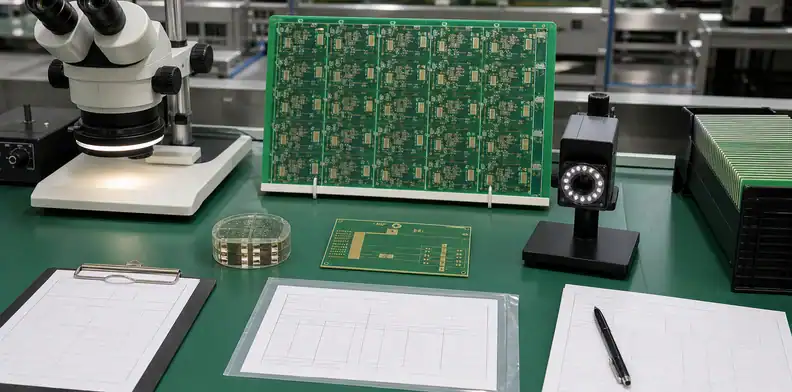
Microsection can show hidden structure that visual inspection cannot see. For plated through holes, buried vias, via-in-pad, heavy copper, or high-reliability boards, a cross-section can document plating, laminate condition, and internal feature quality. Use PCB microsection report requirements when the evidence question is about report fields, sections, and plating proof. It does not prove circuit function.
For a hidden-via or plated-hole concern, tie microsection request to the feature and acceptance question being checked. The practical reason is that a cross-section has value only when it answers a specific structure risk.
For hidden-via or plating concerns, add the sample location and cross-section expectation to the traveler request before fabrication starts.
Microsection call: Request it when hidden structure is part of acceptance, not as a generic comfort item.
A microsection is strongest when the report identifies the sampled feature, layer or hole type, measurement method, and acceptance basis. For AI-designed boards, it is useful on plating, microvia, heavy copper, buried via, or stackup risks that a visual image cannot prove. It should not be treated as a universal quality certificate for every electrical or assembly concern.
When do AOI and X-ray help?
AOI helps visible assembly defects; X-ray helps hidden joints and void-sensitive packages.
Use AOI for component presence, polarity, solder bridges, and visible solder shape. Use X-ray for BGA, QFN wetting clues, via fill under pads, or joints that cannot be inspected optically.
For a BGA or QFN assembly, use X-ray when the solder joint cannot be judged optically and AOI when visible defects are the concern. The practical reason is that choosing the wrong inspection method creates false confidence.
For BGA or QFN evidence, decide whether X-ray, AOI, paste inspection, or first-article photos are needed for the acceptance record.
AOI helps with visible copper, solder mask, silkscreen, and assembly placement conditions, while X-ray helps when solder joints or vias are hidden under packages. Neither method replaces design intent review. The RFQ should say which features need image evidence, because a routine AOI pass may not include the buried via, BGA, or filled-via concern that triggered the request.
Do you need test coupons for every build?
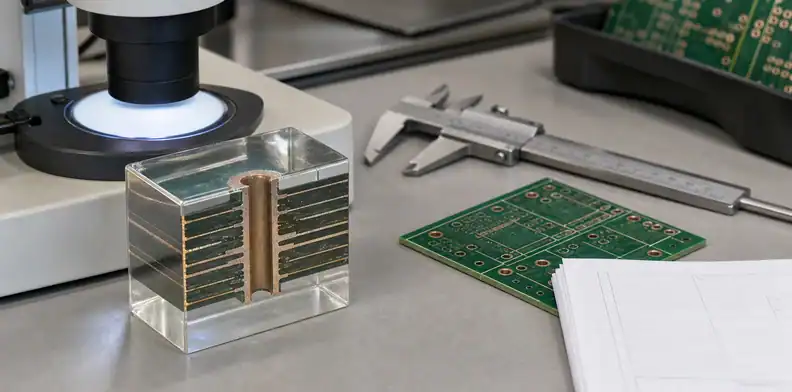
No. Coupons are most useful when the board has controlled impedance, HDI, buried vias, heavy copper, or reliability-sensitive structures.
A coupon adds evidence but also affects panel planning and cost. Low-risk prototypes may use standard electrical test only; production or high-speed boards often justify coupon planning.
For a controlled-impedance build, align coupon planning with the stackup and target nets before order release. The practical reason is that a finished board without a representative coupon may leave only calculation as proof.
If impedance evidence changes, update the coupon, TDR tolerance, and layer-pair references rather than altering only the quote comment.
What each record cannot prove:
| Evidence | Proves | Does not prove |
|---|---|---|
| Electrical test | Continuity | Functional performance |
| AOI | Visible assembly | Hidden joints |
| COC | Declared conformity | Measured detail |
| Microsection | Cross-section feature | Whole-board function |
Coupon check: Request coupons when acceptance depends on a feature that cannot be verified on the product board alone.
Is a Certificate of Conformance enough?
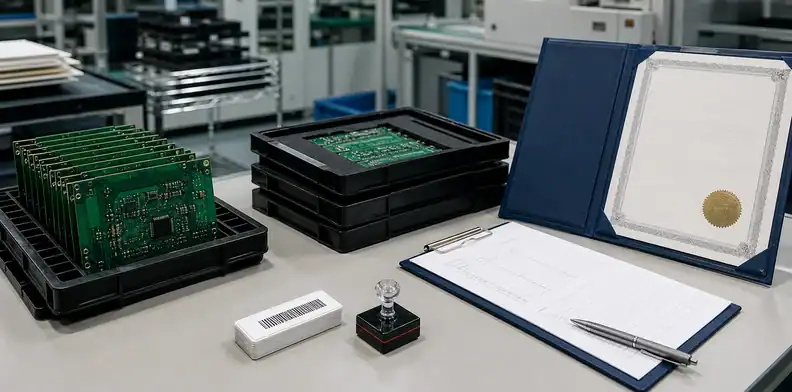
A COC is useful, but it is not a substitute for the records it references.
A strong COC names the order, revision, specification, inspection basis, and lot identity. It is weak when it only states that a board was manufactured without attaching or retaining measurable evidence.
For a COC request, ask what inspection records or process records support the declaration. The practical reason is that a certificate without traceable records is weak during receiving or dispute review.
For a COC request, state which lot, revision, controlled feature, and supporting report the certificate must reference.
A COC is useful as a shipment-level statement, but it is not the same as measured proof. When the design risk is impedance, plating, microvia reliability, laminate type, cleanliness, or controlled finish thickness, ask for the supporting report named in the purchase requirement. The COC can reference those records, but it should not be the only evidence for a controlled feature.
How should evidence affect quote comparison?
Compare quotes by evidence scope as well as unit price and lead time.
One supplier may include electrical test, FAI, COC, and microsection while another quotes only basic fabrication. Those are different scopes even when the board description is the same.
For a quote comparison, separate base fabrication price from test, inspection, coupon, and documentation price. The practical reason is that two quotes with different evidence scopes are not equivalent.
Close a quote comparison by separating fabrication price from report scope, coupon work, X-ray, microsection, and traceability costs.
Quote rule: A lower price is not comparable until evidence and inspection assumptions match.
Quotes should be compared with the evidence burden visible, not only with unit price and lead time. A supplier that includes TDR, microsection, AOI images, X-ray, or extra receiving documents may look more expensive until those deliverables are separated from fabrication cost. Ask each bidder to state which records are included, optional, or unavailable for the requested lot size.
What should be sent for QueenEMS review?
Send the board package, risk areas, required records, acceptance limits, and production intent.
For AI-assisted boards, highlight which assumptions came from the generated design and which were verified by engineering. QueenEMS can then focus on evidence that supports release, such as coupon planning, microsection need, AOI/X-ray scope, TDR requirement, or first-article checks.
For a QueenEMS evidence review, highlight which AI assumptions are verified and which remain open. The practical reason is that the review can then focus on records that close real risk instead of generic paperwork.
A QueenEMS evidence review is controlled when each requested record has a lot identity, acceptance basis, and owner for follow-up.
How much evidence is enough for prototype versus production?
Prototype evidence can be lighter, but it should still match the risk that would block the next decision. The AI PCB prototype to production checks article covers the scale-up decision after prototype evidence is reviewed.
A simple low-risk prototype may need electrical test and basic inspection only. A pilot build with controlled impedance, HDI, heavy copper, BGA assembly, or safety relevance may need FAI, coupon data, X-ray, microsection, or TDR evidence before the design can move forward. The evidence plan should grow with the consequence of failure.
Scope rule: Evidence should scale with design risk and order stage, not with a fixed paperwork habit.
How should records be tied to lot identity?
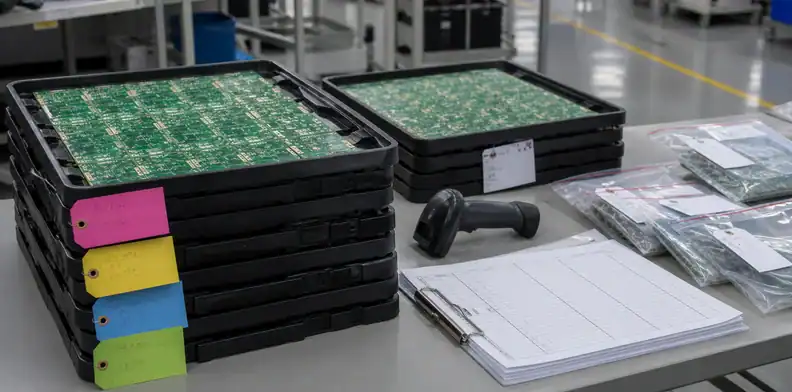
Tie records to PO, revision, lot, panel, serial range, or shipment so receiving can use them.
A useful report is connected to the exact boards being accepted. When evidence arrives without lot identity, it is hard to prove whether it belongs to the shipment under review. Ask for record naming that matches the order and keep the documents with the receiving package.
Traceability rule: Evidence without lot identity is weak acceptance support.
Evidence planning should also name the receiving decision. A microsection report is useful when receiving needs proof of plated-hole or via structure. TDR is useful when receiving needs proof of controlled impedance. X-ray is useful when hidden solder joints are a real assembly risk. When the decision is not named, evidence turns into paperwork that is hard to use during acceptance.
For AI-generated boards, add one more column to the evidence plan: assumption being closed. Examples include AI stackup assumption, via reliability assumption, BGA assembly assumption, or prototype-to-production repeatability. That wording keeps the review from asking for records by habit and helps the supplier understand why the report belongs in the quote.
For evidence planning, send QueenEMS the released board files, controlled features, coupon needs, inspection requests, lot traceability rules, and shipment records required through the QueenEMS contact page. Define the revision, build quantity, report format, and acceptance basis before production starts.
Lot identity should connect the purchase order, board revision, panel or date code, inspection report, and shipment paperwork. Without that connection, a report may prove that a supplier measured something, but not necessarily the boards in the buyer’s shipment. This matters most when a later field issue, incoming hold, or repeat build depends on the same evidence trail.
FAQ
Can I ask for microsection after delivery?
Sometimes, but it is weaker and may be impossible without the right coupon or retained panel evidence.
Does electrical test prove an AI PCB works?
No. It proves opens and shorts against the netlist, not firmware, RF behavior, power integrity, or product function.
What evidence should a first AI PCB prototype include?
Use at least electrical test and clear inspection feedback, then add microsection, TDR, AOI, X-ray, or FAI when the design risk calls for it.
How do I know which evidence belongs in the RFQ?
Use the RFQ to request evidence for the features that can fail silently: controlled impedance, plating thickness, microvias, fine lines, special materials, and lot traceability. Routine boards may need fewer records, but controlled features should be tied to a named report or coupon before production.
Sources
Written by the QueenEMS Engineering Team
Upload your files today · Free DFM check before production · Ship worldwide
Get your PCB prototypes in as fast as 24 hours. We handle FR4, Rogers, and hybrid boards up to 40 layers in volume production, with advanced builds subject to engineering review — free prototypes for 2–4 layer FR-4 boards, no minimum order.
Just upload your Gerber + BOM — we source every part, assemble, and inspect (AOI + X‑Ray) so you don't have to chase suppliers. Boards ship in as fast as 24 hours.