
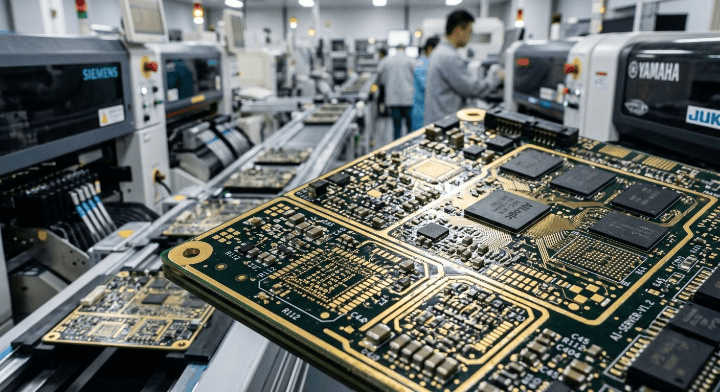
Many hardware teams design complex 16-layer server boards and immediately specify expensive laminates for every layer, resulting in inflated fabrication costs. When your stackup requires a highly reliable power or ground core, using premium high-speed materials for these specific layers wastes budget. The solution is the S1000-2M, Shengyi’s high-Tg filled epoxy laminate designed specifically for high-layer-count stability and hybrid stackup compatibility. Before you lock in your next BOM, reading our Shengyi PCB materials overview will show you how matching the right core material to the right layer saves thousands of dollars per production run.
Quick Answer: S1000-2M is a high-Tg (175–180°C) modified FR-4 laminate manufactured by Shengyi Technology, featuring an extremely low Z-axis expansion of 2.4% and an inorganic filled epoxy resin system. It is heavily used as the power and ground layer in 12+ layer hybrid stackups, reducing overall board costs by 25–40% compared to using homogeneous high-speed materials.
Key takeaways:
- Performance: Delivers a Tg of 175°C and Td of ~350°C, passing 5x lead-free reflows at 260°C.
- Cost-Efficiency: Costs 25% less than competitors like IT-180A or FR408HR with identical power-plane electrical performance.
- Processing Trap: Requires a 14-minute strengthened desmear cycle and ultrasonic washing due to tough inorganic fillers.
- Hybrid Champion: The default power/ground material paired with Synamic 6N or 8GN for AI server and 400G switch PCBs.
Table of Contents
- What Is S1000-2M and Why Is It Shengyi’s Highest-Volume PCB Material?
- What Does the “M” Mean and How Does S1000-2M Differ from S1000-2?
- What Electrical and Thermal Properties Define This Laminate?
- How Does S1000-2M Serve as the Power Layer in Shengyi Hybrid Stackups?
- How Does S1000-2M Compare to IT-180A, FR408HR, Megtron 4, and EM-370?
- When Should You Upgrade to Synamic 6 or S7439 for Signal Integrity?
- Which Automotive, Server, and HDI Applications Rely on This Material?
- Why Does It Need Strengthened Desmear and Ultrasonic Washing?
- What Makes Its 2.4% Z-Expansion Best in Class for Via Reliability?
- How Does the Supply Chain Work from Dongguan to Your Fab?
- FAQ
1. What Is S1000-2M and Why Is It Shengyi’s Highest-Volume PCB Material?
S1000-2M is a high-Tg, filled epoxy FR-4 laminate engineered by Shengyi Technology to meet IPC-4101/126 standards. It features a glass transition temperature (Tg) of 175–180°C and utilizes an inorganic filler system that strictly controls thermal expansion, making it the highest-volume core material used in Chinese PCB manufacturing for multi-layer industrial and telecom boards.
Core Material Classification
To understand this material, we must look at its resin chemistry. The base system uses a brominated epoxy resin (meaning it is not halogen-free) blended with proprietary inorganic fillers. This structural combination yields excellent CAF (Conductive Anodic Filament) resistance, typically passing strict 0.8–1.0 mm pitch testing requirements for high-density designs.
Why Factories Recommend It
From a fabrication standpoint, this material is highly predictable during the pressing cycle. When working on standard 8 to 12-layer boards, the rheology of the prepreg allows for excellent resin fill between heavy copper traces, preventing micro-voids.
| Specification | Value | Condition |
|---|---|---|
| Tg (DSC) | 175-180°C | Base specification ≥170°C |
| Z-axis expansion | 2.4% | 50-260°C |
| UL 94 | V-0 | Flammability rating |
| Halogen-free | No | Contains brominated flame retardants |
The data above illustrates why this laminate dominates the baseline high-Tg market.
Key Takeaway: S1000-2M provides the structural foundation for modern high-reliability electronics, balancing thermal stability with cost-effective manufacturing. Bottom line: Specify this material for any standard digital board over 8 layers that requires lead-free assembly and long-term thermal reliability.
2. What Does the “M” Mean and How Does S1000-2M Differ from S1000-2?
The “M” in S1000-2M stands for “Modified” or “Improved,” indicating a highly refined resin formulation compared to the legacy S1000-2. This modification increases the Tg by 5–10°C and reduces Z-axis expansion by a critical 14%, resulting in vastly superior plated through-hole (PTH) reliability during multiple thermal cycles.
The Engineering Upgrades
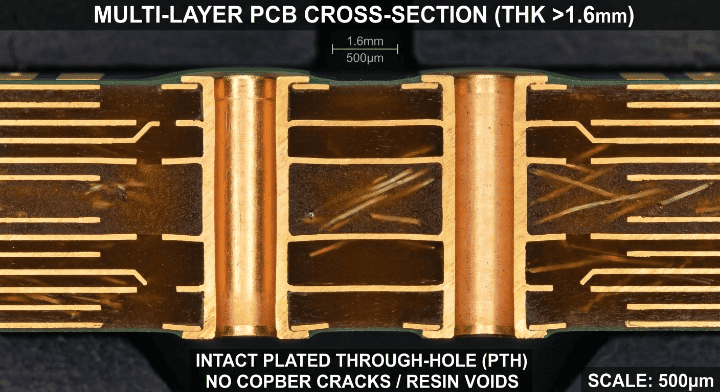
A frequent question on the Electronics Stack Exchange asks why manufacturers quote the “M” version instead of the standard version for thick boards. The answer lies in the CTE (Coefficient of Thermal Expansion). The standard version has a Z-expansion of 2.8%, which stresses via barrels on boards thicker than 1.6mm. The Modified version drops this to 2.4% and lowers the Z-CTE α1 to 41 ppm/°C.
Cost vs. Performance Trade-off
While the modified formulation costs approximately 5–10% more than the baseline laminate, the yield improvements on the factory floor easily offset the material premium. The modification allows the material to survive sequential lamination cycles required for HDI designs without delaminating.
| Dimension | S1000-2 | S1000-2M |
|---|---|---|
| Tg (DSC) | 170°C | 175-180°C |
| Z-expansion | 2.8% | 2.4% |
| Z-CTE α1 | ~45 ppm/°C | 41 ppm/°C |
| Target Application | Standard 8-10 layers | 12+ layers, automotive, heavy copper |
The mechanical differences prove the “M” version is strictly built for higher-stress environments.
Key Takeaway: The “M” designation guarantees a tighter molecular cross-linking that prevents copper barrel cracking on thick, complex boards. Bottom line: Never use standard S1000-2 for boards exceeding 12 layers or incorporating heavy copper; always verify the “M” version is listed on your stackup drawing.
3. What Electrical and Thermal Properties Define This Laminate?
S1000-2M is electrically defined by a Dielectric Constant (Dk) of 4.2–4.5 and a Dissipation Factor (Df) of 0.015–0.020 at 1–15 GHz. Thermally, it boasts a decomposition temperature (Td) of ~350°C and a T260 rating exceeding 60 minutes, which means it survives extreme soldering heat without degrading.
High-Frequency Limitations
Because the Df sits between 0.015 and 0.020, this is clearly not a high-speed signal material. High-frequency signals traveling through this dielectric will experience severe attenuation and dispersion. This is precisely why engineers isolate it to power, ground, and low-speed GPIO control routing.
Thermal Endurance
The T288 rating exceeds 20 minutes. In an assembly environment, this means the bare board can sit in a wave soldering machine or pass through a reflow oven five consecutive times at 260°C without blistering, measling, or suffering resin recession.
Key Takeaway: The electrical properties restrict this material to low-speed routing and power delivery, while the thermal properties make it nearly indestructible during assembly. Bottom line: Rely on its thermal endurance for complex assemblies, but route any signals faster than 3Gbps on a different dielectric material.
4. How Does S1000-2M Serve as the Power Layer in Shengyi Hybrid Stackups?
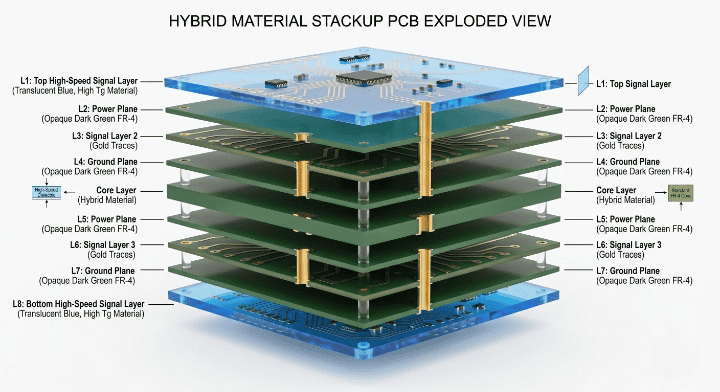
S1000-2M serves as the structural and thermal foundation in Shengyi hybrid stackups, acting as the dedicated power and ground cores while premium high-speed materials handle the signal layers. Mixing materials this way reduces total raw board cost by up to 40% because high-speed laminates cost three to five times more than standard high-Tg FR-4.
The Hybrid Strategy
S1000-2M is to Shengyi what FR408HR is to Isola and Megtron 4 is to Panasonic — the default power and ground layer material in every Shengyi-based hybrid stackup. A common pain point on the EEWeb forums asks: “Can I use S1000-2M as the power layer with Synamic 8GN signal layers?” The answer is yes, because their pressing temperatures and resin curing profiles are compatible.
Factory Cost Analysis
Our standard recommendation for Chinese AI server and switch boards follows a specific tier system: Synamic 8GN on high-speed signal layers, Synamic 6 or S7439 on secondary signal layers, and the subject material on all power, ground, and low-speed routing layers. This three-tier Shengyi hybrid saves approximately 35-40% versus an all-Synamic-8GN build. Its Z-axis expansion of 2.4% is actually the lowest among equivalent products, providing a measurable via reliability advantage during aggressive thermal qualification testing.
Key Takeaway: Using a homogeneous high-speed stackup for an 18-layer board is a massive waste of engineering budget when hybrid configurations perform identically. Bottom line: Always pair your high-speed Shengyi signal cores with this specific filled-epoxy core for your inner power and ground planes to maximize cost-efficiency without sacrificing structural integrity.
5. How Does S1000-2M Compare to IT-180A, FR408HR, Megtron 4, and EM-370?
When evaluated strictly as a power/ground core, S1000-2M matches the mechanical and thermal performance of IT-180A, FR408HR, Megtron 4, and EM-370(D), but costs 25% less and offers significantly faster lead times in Asia. The electrical differences between these five materials are completely irrelevant when transmitting DC power or serving as a ground reference plane.
The Five-Vendor Matchup
A recurring debate on Reddit’s /r/PrintedCircuitBoard is: “S1000-2M vs IT-180A vs FR408HR — which high-Tg should I use?” We stock all five high-Tg FR-4 equivalents and process them on the same production line. On a recent 20-layer server board, the customer asked us to quote three different materials for the 8 power/ground layers.
Real Production Metrics
Results: The Shengyi option came in at $0.85/layer-panel, IT-180A at $1.10, and Isola FR408HR specifications at $1.15. Processing was identical — same press recipe (190°C, 60 min), same drill parameters, same yield (96-97%). Electrical measurements on the power planes showed zero meaningful difference in PDN impedance. The customer chose Shengyi for two reasons: 25% lower material cost and a 1-day lead time from the Dongguan factory.
| Dimension | Shengyi S1000-2M | ITEQ IT-180A | Isola FR408HR | Panasonic Megtron 4 | EMC EM-370(D) |
|---|---|---|---|---|---|
| Tg (DSC) | 175-180°C | 175-180°C | 190°C | 176°C | 190°C |
| Z-expansion | 2.4% | 2.7% | 2.5% | ~2.8% | — |
| Resin | Filled epoxy | Phenolic | Epoxy variant | PPE | Epoxy |
| Price vs FR-4 | 1.2-1.5× | 1.5-2× | 1.5-2× | 2× | 1.5-2× |
Review our comprehensive PCB material selector tool to match your exact Df requirements.
Key Takeaway: For power and ground planes, these five materials are functionally identical, meaning your choice should be driven entirely by supply chain logistics and signal-layer compatibility. Bottom line: If your signal layers use Shengyi materials, use Shengyi for the power layers; only switch to Isola or Panasonic power cores if your signal layers belong to those respective ecosystems to ensure prepreg bonding compatibility.
6. When Should You Upgrade to Synamic 6 or S7439 for Signal Integrity?
You must upgrade from S1000-2M to Synamic 6, Synamic 6N, or S7439 when your digital signal speeds exceed 5–10 Gbps, or when your design requires a Dissipation Factor (Df) lower than 0.015. Using standard filled epoxy for high-speed differential pairs like PCIe Gen 4 or 112G PAM4 will result in fatal insertion loss and closed eye diagrams.
Identifying the Performance Ceiling
Engineers often push baseline FR-4 too far. While the mechanical properties are stellar, the signal attenuation at 10 GHz is severe. If your layout includes DDR4 memory routing, 10G Ethernet, or high-definition MIPI camera interfaces, the resin system will absorb too much of the signal energy, converting it to heat.
Stepping Up the Ladder
Upgrading to S7439 (Mid-Loss, Df ~0.009) or Synamic 6 (Low-Loss, Df ~0.006) resolves these signal integrity issues. These advanced materials use modified PPE/PPO resin systems that provide a much smoother transmission path. You keep the high-Tg base on the inner power planes, but wrap the outer signal layers in the Synamic series.
Key Takeaway: Standard high-Tg laminates cannot handle modern high-speed data protocols due to high dielectric losses. Bottom line: Calculate your maximum required frequency; if your insertion loss budget is tight at 5GHz, immediately swap your signal layers to S7439 or better.
7. Which Automotive, Server, and HDI Applications Rely on This Material?
S1000-2M is extensively utilized in automotive Engine Control Units (ECUs), 5G telecom base stations, and complex High-Density Interconnect (HDI) boards requiring 3 oz to 4 oz heavy copper. Its unique combination of high thermal decomposition and low Z-axis expansion makes it the ideal substrate for environments subjected to massive temperature fluctuations and high current loads.
Heavy Copper Power Delivery
In automotive applications, power distribution boards frequently utilize heavy copper to carry large currents. When pressing 3 oz copper, the resin must flow aggressively to fill the deep gaps between traces without leaving voids. The filled epoxy system accomplishes this perfectly, preventing CAF failures that would otherwise short out a vehicle’s power steering module.
Sequential Lamination Resilience
For HDI designs requiring blind and buried vias, the board goes through the lamination press multiple times. Standard FR-4 will degrade, become brittle, and eventually delaminate under repeated 190°C pressing cycles. The modified resin chemistry withstands up to four sequential lamination cycles, securing its place in advanced telecom routers.
Key Takeaway: The material’s true strength lies in its mechanical robustness under extreme manufacturing and operational stresses. Bottom line: Specify this laminate for any heavy copper design or HDI board requiring more than two lamination cycles to ensure zero delamination in the field.
8. Why Does It Need Strengthened Desmear and Ultrasonic Washing?
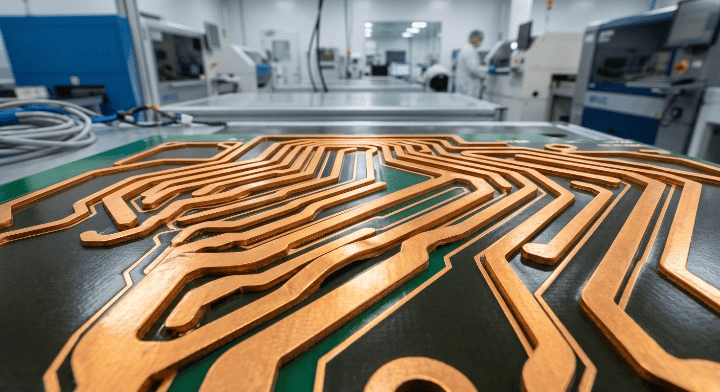
S1000-2M requires a strengthened desmear process and ultrasonic washing because its inorganic filler system is highly resistant to standard alkaline permanganate etching, causing resin smear to remain inside drilled holes. A standard 10-minute desmear cycle will leave epoxy residue on the copper inner layers, leading directly to open circuits or highly resistive vias.
The Manufacturing Trap
A frequent complaint on SierraConnect involves via failures on filled-epoxy boards. The inorganic filler system creates a desmear challenge that we learned the hard way. On our first production lot of a 16-layer automotive ECU board, we ran standard permanganate desmear at 75 g/L KMnO4, 80°C for 10 minutes. Cross-section inspection revealed residual smear on approximately 25% of holes, because the filled epoxy is simply harder to etch than unfilled systems.
Our Engineering Solution
Our solution was three-fold: we increased permanganate concentration to 90 g/L, extended cycle time from 10 to 14 minutes, and added an ultrasonic water wash step after desmear. After optimization, smear residue dropped below 2% of holes, and IST testing passed 1,200+ thermal cycles. The ultrasonic wash is the step most fab shops skip, assuming a standard spray rinse is sufficient. The inorganic filler particles trap permanganate solution in micro-cavities that spray rinse cannot reach, requiring ultrasonic agitation to dislodge them.
Key Takeaway: Standard FR-4 chemical processing parameters will cause catastrophic via failures when applied to inorganic-filled laminates. Bottom line: Audit your PCB manufacturer to ensure they run a dedicated, extended desmear cycle with post-desmear ultrasonic cleaning specifically for filled-epoxy materials.
9. What Makes Its 2.4% Z-Expansion Best in Class for Via Reliability?
S1000-2M achieves a 2.4% Z-axis expansion (from 50°C to 260°C) through dense inorganic filler packing, which minimizes the mechanical stress exerted on the copper plating of vias during reflow soldering. Because copper expands at roughly 17 ppm/°C and standard resins expand at over 60 ppm/°C, keeping the substrate’s expansion as close to copper as possible prevents the via barrels from tearing apart.
The Physics of Via Cracking
When a PCB goes through a wave soldering machine, the sudden shock of 260°C heat causes the resin to expand rapidly in the Z-axis (thickness). If a 2.0mm thick board expands by 3.5%, it violently pulls the thin copper plating inside the via. Micro-cracks form, which might pass electrical testing at room temperature but fail when the device heats up in the field.
Superior to Competitors
By dropping the Z-expansion to 2.4% and the pre-Tg CTE to 41 ppm/°C, this laminate actually outperforms many of its direct competitors. This tight dimensional stability ensures that even on a 24-layer board, the vias remain intact through multiple assembly heating cycles and years of operational thermal cycling.
Key Takeaway: The mathematical reduction in Z-axis thermal expansion directly translates to a massive decrease in latent via failures in the field. Bottom line: Never compromise on Z-axis CTE for boards thicker than 1.6mm; a maximum expansion of 2.5% should be your absolute hard limit in the fabrication notes.
10. How Does the Supply Chain Work from Dongguan to Your Fab?
Because Shengyi Technology is headquartered in Dongguan, China, fabrication facilities in Shenzhen can procure S1000-2M materials in 1 to 3 days, compared to the 3 to 6 weeks required to import specialized laminates from the US or Japan. This hyper-local supply chain drastically reduces overall board manufacturing lead times and eliminates international shipping tariffs on raw materials.
Eliminating Material Bottlenecks
When a client needs an urgent NPI (New Product Introduction) run of 16-layer server boards, waiting a month for raw materials is unacceptable. Because the base laminate and prepregs are manufactured locally in massive volumes, local fabs maintain deep inventory levels of every standard core thickness and glass style (1080, 2116, 7628).
Consistency and Lot Tracking
This localized ecosystem also ensures better lot-to-lot consistency. If a quality issue arises, factory engineers can have Shengyi technical support on-site within hours. This synergy allows us to push the boundaries of multilayer PCB manufacturing capabilities without the risks associated with importing boutique materials.
Key Takeaway: Selecting a globally recognized material manufactured near your assembly partner cuts weeks out of your production schedule. Bottom line: Leverage the geographical advantage of the Shenzhen-Dongguan tech corridor to accelerate your high-layer-count PCB prototyping from months to mere days.
FAQ
Is S1000-2M a halogen-free material? No, it is not halogen-free. It utilizes brominated flame retardants to achieve its UL 94 V-0 rating, meaning if your project strictly requires halogen-free compliance for environmental regulations, you must specify an alternative like Shengyi S1150G or S1000H.
Can I mix S1000-2M with Isola or Panasonic signal layers? No, mixing resin systems across different manufacturers is highly risky. You must pair it with Shengyi prepregs and cores (like the Synamic series) because different vendor resins have varying curing temperatures and shrinkage rates, which will cause severe delamination and board warpage during the lamination press.
Why do I see white residue in my drilled vias on these boards? The white residue is un-etched inorganic filler left behind due to inadequate desmear processing. Because the filled epoxy resists standard chemicals, your fabrication partner must increase the permanganate concentration, extend the desmear time by 40%, and use ultrasonic washing to clear the debris.
Does the “M” version cost significantly more than standard FR-4? Yes, it generally commands a 20% to 30% price premium over standard 140°C Tg FR-4. However, for boards requiring high reliability, the elimination of thermal failures and improved manufacturing yields completely justify the upfront material cost.
How do I know if I need this material instead of standard FR-4? If your design has more than 8 layers, utilizes copper weights over 2 oz, or operates in environments exceeding 130°C, you need this upgrade. Check your Z-axis expansion requirements; if you need to survive multiple lead-free assembly cycles without via cracking, standard FR-4 will fail where this material succeeds.
If you are designing complex high-layer-count boards and need expert guidance on optimizing your hybrid stackup for cost and reliability, contact our PCB engineering team today to request a quote from our manufacturing facility.
Written by the QueenEMS Engineering Team
Upload your files today · Free DFM check before production · Ship worldwide
Get your PCB prototypes in as fast as 24 hours. We handle FR4, Rogers, and Flex up to 60 layers — free prototypes for 2–4 layer boards, no minimum order.
Just upload your Gerber + BOM — we source every part, assemble, and inspect (AOI + X‑Ray) so you don't have to chase suppliers. Boards ship in as fast as 24 hours.