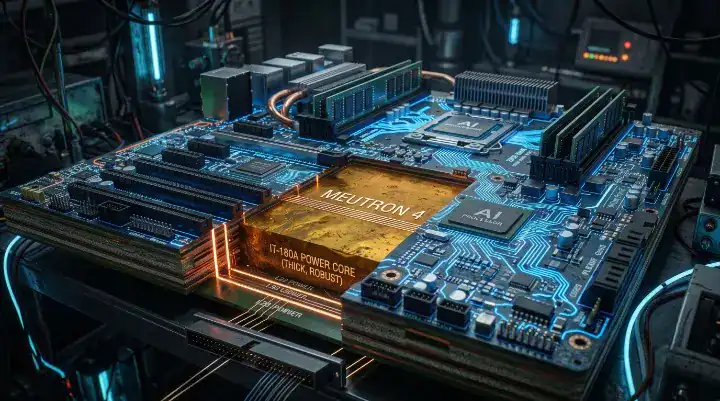
Quick Answer: IT-180A is ITEQ’s high-reliability High-Tg (180°C) FR-4 laminate featuring an exceptionally low Z-axis expansion of 2.7%. It serves as the primary power and ground core material in ITEQ-based AI server hybrid stackups, requiring optimized desmear parameters (10-15% higher permanganate concentration) compared to standard DICY-cured FR-4. Key takeaways:
- Delivers Tg 180°C with an ultra-low 2.7% Z-axis expansion
- Acts as the exact equivalent to FR408HR and Megtron 4 for power planes
- Mandates optimized desmear parameters to prevent via failure
- Reduces raw material costs by 28% in IT-988GSE hybrid builds
Table of Contents
- 1. What Is IT-180A and Why Do Engineers Call It “The Workhorse”?
- 2. What Makes IT-180A Different from Standard DICY-Cured FR-4?
- 3. What Electrical and Thermal Properties Define IT-180A?
- 4. How Does IT-180A Serve as the Power Layer in AI Server Hybrid Stackups?
- 5. How Does IT-180A Compare to FR408HR, Megtron 4, and S1000-2M?
- 6. When Should You Upgrade from IT-180A to IT-968 or IT-988GSE?
- 7. Which Heavy Copper and HDI Applications Use IT-180A?
- 8. Why Does IT-180A Need Optimized Desmear — Not Standard FR-4 Parameters?
- 9. When Is IT-180A Not Halogen-Free a Deal-Breaker?
- 10. How Will IT-180A Evolve as AI Servers Push Toward Higher Layer Counts?
Hardware engineers specifying PCB materials for automotive ECUs and high-layer-count AI servers frequently encounter severe via reliability issues during lead-free assembly. Relying on standard FR-4 for 20-layer boards often leads to barrel cracking under the immense thermal stress of multiple reflow cycles. The solution requires transitioning to IT-180A, an advanced phenolic-cured laminate that strictly limits physical expansion. By strategically pairing this material with high-speed layers like how to process IT-988GSE for 800G switches, you can protect both your thermal reliability margins and your fabrication budget.
1. What Is IT-180A and Why Do Engineers Call It “The Workhorse”?
IT-180A is ITEQ’s flagship high-reliability, high-Tg (180°C) FR-4 laminate, delivering a dielectric constant of ~4.1 and a dissipation factor of ~0.016 at 1 GHz. Engineers label it the “workhorse” because it consistently survives six lead-free reflow cycles at 260°C across 20-plus layer designs without manifesting delamination or via fracturing.
The Foundation of High-Reliability Designs
Most standard FR-4 materials begin to physically degrade when exposed to the sustained heat of modern surface mount technology (SMT) processes. IT-180A was specifically formulated to combat this thermal degradation, earning qualification under IPC-4101 slash sheets /99, /101, and /126.
Here is why it dominates the server backplane market:
- It resists Conductive Anodic Filament (CAF) growth exceptionally well.
- It maintains structural integrity through multiple sequential lamination cycles.
- It supports heavy copper weights up to 3 oz effortlessly.
Key Takeaway: You specify IT-180A when thermal-mechanical reliability is your absolute highest priority, significantly outweighing the need for ultra-low signal attenuation. Bottom line: Default to IT-180A for any through-hole board exceeding 14 layers where extreme thermal excursions during component assembly are guaranteed.
| Metric | Specification | Engineering Impact |
|---|---|---|
| Tg (DSC) | 180°C | Withstands severe SMT reflow |
| Lead-Free Rating | 6× reflow @ 260°C | Eliminates delamination risks |
| IPC Classification | 4101 /99, /101, /126 | Guarantees high-reliability standards |
Highlights the baseline durability that defines this specific material.
2. What Makes IT-180A Different from Standard DICY-Cured FR-4?
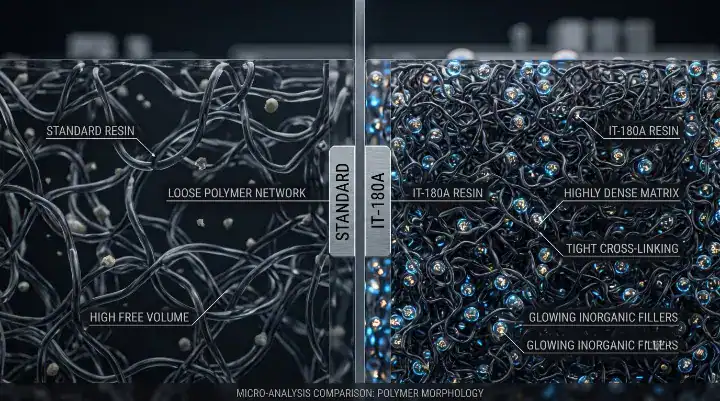
IT-180A utilizes a phenolic-cured filled epoxy resin system, whereas standard FR-4 uses a DICY (dicyandiamide) curing agent. This chemical shift drastically improves thermal stability, raising the decomposition temperature (Td) to 350°C compared to standard FR-4’s typical 300°C limit.
The Phenolic Curing Advantage
Phenolic curing creates a much denser, more highly cross-linked polymer network within the fiberglass matrix than DICY curing. This density is the exact mechanism that prevents moisture absorption and blocks the microscopic pathways where copper ions migrate to form electrical shorts (CAF).
Consider these structural differences:
- Phenolic resin resists the aggressive chemical attacks of plating baths.
- The addition of inorganic fillers strictly limits resin flow during pressing.
- The denser matrix requires modified chemical processing on the factory floor.
Key Takeaway: You are not just buying a higher temperature threshold; you are buying a fundamentally different molecular structure that physically stops moisture and copper migration. Bottom line: Never substitute a standard DICY-cured high-Tg material when a client specifically mandates the phenolic-cured IT-180A for harsh environment deployments.
| Property | Standard FR-4 (DICY) | IT-180A (Phenolic-Cured) | Difference |
|---|---|---|---|
| Td (Decomposition) | ~300-320°C | 350°C | Massive thermal upgrade |
| CAF Resistance | Moderate | Excellent | Blocks ion migration |
| Moisture Absorption | Higher | Lower | Prevents internal blistering |
Directly contrasts the chemical foundation against standard commodity laminates.
3. What Electrical and Thermal Properties Define IT-180A?
IT-180A limits Z-axis expansion to an incredibly low 2.7% between 50°C and 260°C, while maintaining a time-to-delamination at 288°C (T288) exceeding 20 minutes. Electrically, it operates exactly as expected for a filled epoxy, yielding a Dk of ~4.1 and Df of ~0.016 at 10 GHz.
The Critical Role of Z-Axis Expansion
Z-axis expansion measures how much the PCB swells vertically when heated. Because copper plating inside a via hole expands at a much lower rate (~17 ppm/°C) than standard epoxy resin (~60 ppm/°C), excessive resin expansion literally tears the copper barrel apart during soldering. IT-180A uses specialized inorganic fillers to force the resin’s expansion coefficient closer to the copper’s coefficient.
Look at the thermal boundaries:
- α1 (CTE below Tg) stays tightly controlled at ~50 ppm/°C.
- Time at 260°C (T260) exceeds 60 minutes without failure.
- The 2.7% total Z-expansion protects high-aspect-ratio vias.
Key Takeaway: The electrical properties are entirely average, but the mechanical stability is world-class, preventing catastrophic open circuits on dense, thick backplanes. Bottom line: Specify IT-180A strictly for its 2.7% Z-expansion when designing boards thicker than 2.4 mm (0.093 inches) to guarantee via integrity during assembly.
| Metric | IT-180A Value | Why It Matters for Yield |
|---|---|---|
| Z-Axis Expansion | 2.7% (50-260°C) | Prevents via barrel cracking |
| T288 | > 20 minutes | Survives multiple rework cycles |
| Dk / Df @ 10 GHz | ~4.1 / 0.016 | Standard performance, not for RF |
Summarizes the mechanical constraints that make this material a reliability staple.
4. How Does IT-180A Serve as the Power Layer in AI Server Hybrid Stackups?
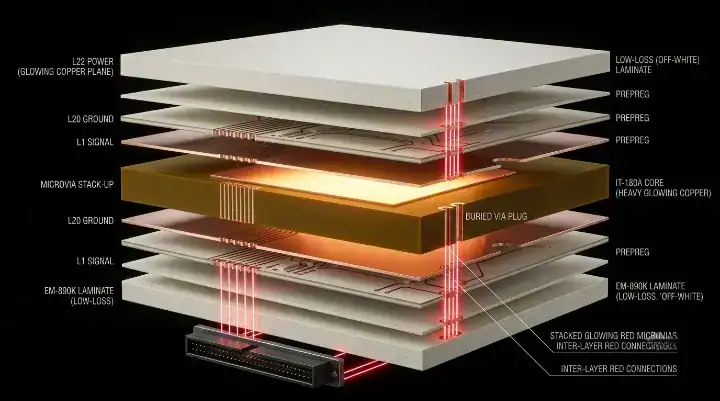
IT-180A plays the exact same role in ITEQ-based AI server hybrid stackups that FR408HR plays in Isola builds—it acts as the highly reliable, cost-effective base layer for thick DC power and ground planes.
Slashing the BOM Cost
A recent 20-layer board used IT-988GSE on 12 high-speed signal layers and IT-180A on 8 power/ground/low-speed layers. Material cost came in approximately 28% below an equivalent all-IT-988GSE build. IT-180A’s Z-axis expansion of 2.7% is one of the lowest in any high-Tg FR-4—it matches or beats FR408HR (2.5%) and Megtron 4 (2.8%).
This low Z-expansion directly translates to fewer barrel cracks during lead-free reflow, which is why IT-180A became the default high-Tg substrate for heavy copper (3 oz+) automotive ECUs and telecom backplanes.
Key Takeaway: For customers already using IT-988GSE on high-speed signal layers, keeping IT-180A on the inner power layers maintains single-vendor ITEQ prepreg compatibility. Bottom line: Always pair IT-180A specifically with higher-tier ITEQ signal materials to heavily reduce your raw fabrication cost without risking resin flow mismatches during the lamination cycle.
| Hybrid Layer Function | Material Assignment | Resulting Benefit |
|---|---|---|
| High-Speed Signal Layers | IT-988GSE (M8) | Maximum SI performance |
| DC Power / Ground Layers | IT-180A | 28% material cost reduction |
| Lamination Bonding | Matched ITEQ Prepreg | Uniform resin flow |
Illustrates the precise material assignment within a modern high-tier server stackup.
5. How Does IT-180A Compare to FR408HR, Megtron 4, and S1000-2M?
IT-180A forms part of the “Big Five” high-Tg phenolic equivalents, directly competing against Isola FR408HR, Panasonic Megtron 4, EMC EM-370(D), and Shengyi S1000-2M. In terms of electrical performance on power planes, the difference between them is mathematically zero.
The Fabrication Reality Across Vendors
We currently stock and process all five high-Tg FR-4 equivalents. On the fabrication line, they are nearly identical—same press recipe (190-200°C, 60 minutes), same drill parameters, similar first-pass yield (96-97%). The only processing variation is desmear: IT-180A and Megtron 4 core materials need optimized desmear parameters, while FR408HR works fine with standard chemistry.
In terms of electrical performance on power/ground layers, we have never measured a meaningful difference between any of them—because Df doesn’t matter on DC power planes.
The real selection criterion is supply chain compatibility:
- If signal layers use Tachyon 100G, use FR408HR as the Isola base layer in hybrid stackups.
- If signal layers use Megtron 7, use Megtron 4.
- If signal layers use Synamic 6N material from Shengyi, use S1000-2M.
- If signal layers use IT-988GSE, use IT-180A.
Key Takeaway: Mixing vendors on core plus prepreg in the exact same sublamination is the most common cause of severe impedance drift in hybrid stackups. You can quickly cross-reference these resin match requirements using an interactive PCB material selector tool. Bottom line: Never choose between IT-180A and FR408HR based on datasheets; choose based entirely on which vendor supplies the ultra-low-loss signal layers on your specific board.
| Feature | ITEQ IT-180A | Isola FR408HR | Panasonic Megtron 4 | Shengyi S1000-2M |
|---|---|---|---|---|
| Df (Loss Tangent) | ~0.016 | 0.0092 | 0.005 | 0.018 |
| Tg (Glass Transition) | 180°C | 190°C | 176°C | 170-180°C |
| Signal Layer Match | IT-988GSE | Tachyon 100G | Megtron 7/8 | Synamic 6N |
Maps the exact cross-vendor equivalents for high-reliability core materials.
6. When Should You Upgrade from IT-180A to IT-968 or IT-988GSE?
You must upgrade signal layers from IT-180A to IT-968 (M6) when routing 25G NRZ or PCIe Gen5, and to IT-988GSE (M8) when routing 56G PAM4 signals. IT-180A’s Df of 0.016 simply causes too much insertion loss at Nyquist frequencies above 8 GHz for any trace longer than 10 inches.
Navigating the ITEQ Upgrade Path
Hardware engineers building server motherboards frequently push high-Tg FR-4 to its absolute limits before upgrading, purely to save budget. IT-180A handles PCIe Gen3 flawlessly. It handles PCIe Gen4 (16 Gbps) marginally, provided the traces remain very short (under 10 inches).
However, physics dictates a hard stop at Gen5:
- PCIe Gen5 operates at 32 Gbps, requiring 16 GHz bandwidth.
- IT-180A signal eyes close completely at this attenuation level.
- You must switch to IT-968 (Df 0.004) for those specific differential pairs.
Key Takeaway: You do not need to upgrade the entire board; leave all DC power planes, ground planes, and low-speed legacy interfaces on IT-180A while selectively upgrading the high-speed lanes to a lower-loss ITEQ material. Bottom line: Specify IT-180A confidently for 10G Ethernet and PCIe Gen4, but strictly transition your signal layers to IT-968 or IT-988GSE for PCIe Gen5 and 56G PAM4 signaling.
| Signal Protocol | Max Speed | Is IT-180A Sufficient? | Upgrade Path |
|---|---|---|---|
| 10G Ethernet | 10 Gbps | ✅ Yes (< 15 inches) | None |
| PCIe Gen4 | 16 Gbps | ⚠️ Marginal (< 10 inches) | IT-968 (M6) |
| PCIe Gen5 | 32 Gbps | ❌ No | IT-968SE (M6+) |
| 56G PAM4 | 56 Gbps | ❌ No | IT-988GSE (M8) |
Provides the rigid engineering boundaries for upgrading signal traces off standard FR-4.
7. Which Heavy Copper and HDI Applications Use IT-180A?
IT-180A is the dominant substrate choice for 3 oz to 4 oz heavy copper automotive engine control units (ECUs) and dense 20-layer High-Density Interconnect (HDI) telecom backplanes. Its robust phenolic resin matrix resists the severe mechanical stress generated by thick copper expansion.
Managing Thick Copper Stresses
During multilayer PCB fabrication for high-layer-count AI server designs, pressing 4 oz copper generates immense pressure gradients across the panel. A standard epoxy flows too fast, leaving glass bundles exposed (measling) or failing to fill the deep copper canyons. IT-180A’s heavily filled phenolic system controls this flow rate perfectly.
In HDI applications, it provides stability:
- It survives multiple sequential lamination press cycles without excessive Z-axis drift.
- It provides an extremely stable platform for laser-drilled microvias.
- It resists plating chemicals during the via-in-pad copper plating processes.
Key Takeaway: The material’s ability to lock its physical dimensions in place during repeated 200°C press cycles is exactly why it dominates the complex sequential lamination market. Bottom line: Specify IT-180A for any HDI design requiring more than three sequential press cycles or utilizing internal copper weights exceeding 2 ounces.
| Application Type | Specific Challenge | How IT-180A Solves It |
|---|---|---|
| Heavy Copper (3 oz+) | Resin starvation between traces | Controlled, filled resin flow |
| Sequential HDI | Registration drift over 4 press cycles | Extremely low Z-axis expansion |
| Automotive ECUs | Sustained engine bay heat (125°C+) | High Tg and CAF resistance |
Highlights the specific mechanical scenarios where this material excels.
8. Why Does IT-180A Need Optimized Desmear — Not Standard FR-4 Parameters?
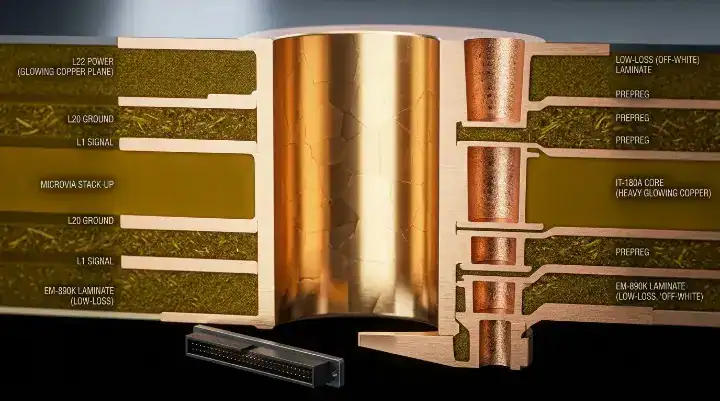
The single biggest fabrication gotcha with IT-180A is desmear. Because the phenolic-cured filled epoxy is significantly harder to dissolve than standard DICY-cured FR-4, running standard permanganate parameters will leave resin smear on the via walls, causing catastrophic open circuits after reflow.
The Fabrication Optimization Reality
When we first ran IT-180A on our line using standard FR-4 permanganate desmear parameters—75 g/L KMnO4, 80°C, 10 minutes—the PTH cross-sections showed resin smear residue on approximately 30% of the holes. Our via reliability testing failed at 800 thermal cycles—well below the 1,000+ cycles we consistently achieve on standard FR-4.
The fix was straightforward but non-obvious:
- We increased permanganate concentration to 85 g/L.
- We raised the bath temperature to 85°C.
- We extended the cycle time from 10 to 13 minutes.
Key Takeaway: After optimization, resin smear dropped to less than 2% of holes, and via reliability passed 1,500+ thermal cycles. ITEQ’s own datasheet warns about this, but many fab shops miss it. Bottom line: Explicitly ask your PCB fabricator for their optimized IT-180A desmear data during the DFM review; if they claim they just use standard FR-4 parameters, you are at severe risk of via failure.
| Desmear Parameter | Standard FR-4 Baseline | Optimized IT-180A Settings |
|---|---|---|
| KMnO4 Concentration | ~75 g/L | 85 g/L (Increased) |
| Bath Temperature | 80°C | 85°C (Increased) |
| Dwell Time | 10 minutes | 13 minutes (Extended) |
Details the exact chemical adjustments required to guarantee via plating reliability.
9. When Is IT-180A Not Halogen-Free a Deal-Breaker?
IT-180A contains brominated flame retardants to achieve its UL 94 V-0 rating, meaning it is explicitly not halogen-free. This becomes a hard deal-breaker only if your end product is destined for European telecommunications infrastructure or eco-conscious consumer electronics requiring strict IEC 61249-2-21 compliance.
The Halogen-Free Alternative Path
Most industrial, automotive, and military/aerospace applications do not strictly prohibit halogens, allowing IT-180A to be used freely based on its mechanical merits. However, if your compliance team flags the bromine content, you cannot use this material.
You must pivot to a halogen-free equivalent:
- ITEQ Ecosystem: Switch to IT-170GRA1 (Tg 175°C, HF).
- EMC Ecosystem: Switch to EM-370(D) (Tg 190°C, HF).
- Isola Ecosystem: Switch to TerraGreen (Tg 200°C, HF).
Key Takeaway: Do not wait until the final BOM review to check the halogen status; stripping IT-180A out of an approved hybrid stackup requires completely re-simulating the prepreg press cycles. Bottom line: If your project mandates a 100% halogen-free certification, immediately remove IT-180A from the CAD drawing and specify EMC EM-370(D) or ITEQ IT-170GRA1 for the power layers instead.
| Application Sector | Halogen-Free Mandate | Can You Use IT-180A? |
|---|---|---|
| European Telecom (5G) | Strict (IEC 61249-2-21) | ❌ No (Requires IT-170GRA1) |
| Enterprise AI Servers | Typically Exempt | ✅ Yes |
| Automotive ECUs | Variable by OEM | ✅ Yes (Usually allowed) |
Outlines the regulatory boundaries governing the deployment of brominated laminates.
10. How Will IT-180A Evolve as AI Servers Push Toward Higher Layer Counts?
As AI servers scale toward 30-layer architectures to support 224G PAM4 routing on the signal layers, IT-180A will completely solidify its position as the de facto structural core material, handling all DC power delivery while the ultra-low-loss materials handle the RF signaling.
The Expanding Core Strategy
The physics of DC power delivery (PDN) do not change just because the adjacent data bus speeds up. While Nvidia and AMD force hardware designers to adopt M9 and M10 grade laminates for the top and bottom signal layers, those same designers rely heavily on IT-180A to keep the internal 4 oz copper power planes cheap, stable, and rigid.
Consider the future of hybrid pressing:
- 2026: 22-layer boards (16 layers M8 + 6 layers IT-180A)
- 2028: 28-layer boards (20 layers M10 + 8 layers IT-180A)
- The cost saving percentage grows as M10 materials get more expensive.
Key Takeaway: The gap between signal layer pricing and power layer pricing is expanding exponentially, making the reliance on IT-180A base cores more critical for project financial survival than ever before. Bottom line: Treat IT-180A not as an aging technology, but as the permanent, highly reliable structural foundation that makes next-generation AI server manufacturing economically viable.
| Server Era | Signal Layer Choice | Core Layer Choice | IT-180A Role |
|---|---|---|---|
| Current (800G) | IT-988GSE (M8) | IT-180A | Primary Power Matrix |
| Future (1.6T) | M9/M10 (TBD) | IT-180A | Primary Power Matrix |
| Edge AI | IT-968 (M6) | IT-180A | Structural Core |
Projects the permanent integration of phenolic cores into future AI hardware architectures.
Conclusion
Mastering high-reliability PCB design requires moving past the basic “high-Tg FR-4” label to understand the underlying resin chemistry. IT-180A’s phenolic-cured matrix and ultra-low 2.7% Z-axis expansion make it the undisputed workhorse for AI server hybrid stackups, HDI backplanes, and heavy copper automotive designs. By explicitly matching it with ITEQ signal layers and ensuring your fabricator optimizes their desmear baths, you can lock in massive cost savings without compromising a single thermal cycle. If you need a partner to review your hybrid stackup or validate your high-layer-count desmear parameters, contact us today for PCB manufacturing and request a free DFM engineering review.
At QueenEMS, we believe that true engineering excellence means deploying the exact right material for the trace—not overpaying for signal integrity on a DC power plane.
FAQ
How does IT-180A compare to FR408HR? The performance difference on power and ground planes is mathematically zero. Both are high-reliability, high-Tg materials with excellent Z-axis stability. Your selection should depend entirely on matching your signal layer vendor: use IT-180A if your signal layers use ITEQ IT-988GSE, and use FR408HR if your signal layers use Isola Tachyon 100G, to ensure perfectly matched resin flow during lamination.
Is IT-180A just standard FR-4 with a higher Tg? No, it is fundamentally different. Standard FR-4 uses a DICY curing agent, while IT-180A uses a phenolic-cured filled epoxy. This phenolic chemistry drastically improves CAF resistance, lowers moisture absorption, and pushes the decomposition temperature (Td) up to 350°C, making it vastly superior to standard high-Tg FR-4 for surviving severe lead-free reflow profiles.
Why are my IT-180A boards failing via reliability tests? It is highly likely that your fabricator did not optimize their desmear parameters. IT-180A’s phenolic-cured resin is harder to dissolve than standard DICY FR-4. If a factory uses standard FR-4 permanganate baths, resin smear remains on the via walls, leading to poor copper adhesion and barrel cracking during thermal cycling. They must increase permanganate concentration or extend the dwell time.
Can I run PCIe Gen5 signals on IT-180A? No, you cannot route PCIe Gen5 signals on it. PCIe Gen5 operates at 32 Gbps, requiring 16 GHz bandwidth, which exceeds IT-180A’s loss performance threshold. You must upgrade your signal layers to IT-968SE or IT-988GSE. However, you can absolutely keep IT-180A as the power and ground layers on that exact same board.
Is IT-180A halogen-free? No, it is not. IT-180A relies on brominated flame retardants to achieve its UL 94 V-0 flammability rating. If your project mandates strict halogen-free compliance for European markets, you must pivot to a halogen-free equivalent like ITEQ IT-170GRA1 or EMC EM-370(D).
Written by the QueenEMS Engineering Team
Upload your files today · Free DFM check before production · Ship worldwide
Get your PCB prototypes in as fast as 24 hours. We handle FR4, Rogers, and Flex up to 60 layers — free prototypes for 2–4 layer boards, no minimum order.
Just upload your Gerber + BOM — we source every part, assemble, and inspect (AOI + X‑Ray) so you don't have to chase suppliers. Boards ship in as fast as 24 hours.