
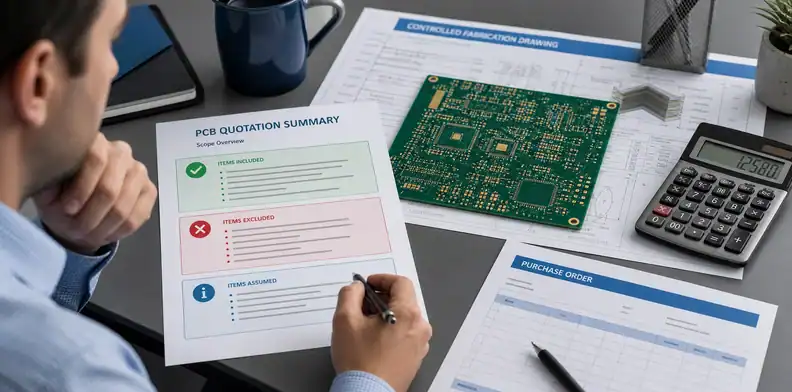
Quick Answer: Review PCB quote exclusions by separating the quotation into three records: what is included, what is excluded, and which assumptions keep the price valid. Do not issue the purchase order until the board revision, manufacturing scope, inspection evidence, delivery terms, and approval path for any later change are explicit.
Key takeaways – An exclusion is manageable when it is visible; an unstated assumption is usually the larger risk. – Compare the total first-order commitment, not only the unit price. – A low quote should be corrected before the PO when it omits required work. – The accepted quotation should remain linked to the same released files and revision as the purchase order.
PCB quote exclusions matter most in the hours before a buyer commits money and schedule. At that point, a quotation that appears complete may still leave tooling, testing, documentation, packaging, freight, or a difficult manufacturing feature outside the price.
The problem is rarely that every exclusion is unacceptable. Some work genuinely belongs to another supplier, some evidence is optional, and some charges cannot be known until engineering review is finished. The commercial risk begins when the buyer and fabricator attach different meanings to the same total.
A useful review therefore asks a more precise question than “Is everything included?” It asks what board is being priced, what work the supplier has promised, what remains conditional, and what event would change price or lead time after the order is placed.
Table of Contents
- Separate inclusions, exclusions, and assumptions
- Lock the board identity behind the price
- Find omitted tooling, test, and document costs
- Check delivery and commercial boundaries
- Judge whether an exclusion changes order risk
- Decide whether to reprice or document the gap
- Compare suppliers on the same scope
- Turn the accepted quote into a PO baseline
Separate inclusions, exclusions, and assumptions
A usable quotation distinguishes three different kinds of statement. An inclusion says the supplier will perform or deliver something for the quoted total. An exclusion says the item is outside scope. An assumption says the price works only while a stated condition remains true.
Those categories lead to different buyer actions. Included electrical testing should identify the coverage or method expected for the order. Excluded functional testing may be acceptable for a bare-board purchase. An assumption that the files contain no controlled impedance is different: if the design does require impedance control, the price and production route may no longer apply.
Build a short reconciliation table beside the quotation rather than relying on memory. Typical headings are fabrication, material, special processes, inspection, reports, tooling, packaging, freight, tax or duty treatment, and lead-time start. Copy the supplier’s wording into the table and mark unclear entries as open; do not rewrite an ambiguous sentence into the answer you hoped it meant.
This exercise also exposes silence. A quotation can omit a subject without calling it an exclusion. For example, “electrical test included” does not prove that impedance coupons, microsection reports, or a certificate of conformance are included. Silence should become a question before the PO, not a presumed promise after shipment.
The result should be a one-page scope record that a purchasing manager and an engineer can read the same way. That record becomes the foundation for a fair technical comparison and a clean order.
Lock the board identity behind the price
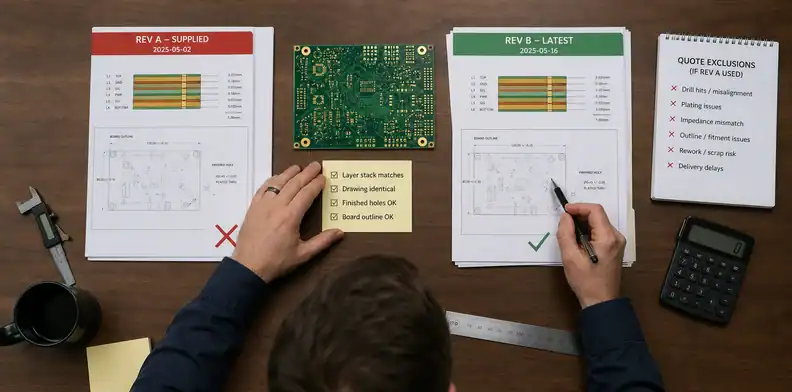
Every price must point to one controlled PCB definition. At minimum, confirm the part number, revision, quantity, dimensions, layer count, material requirement, finished thickness, copper construction, surface finish, solder mask, delivery format, and the exact file package used for quotation.
This is more than a file-completeness check. Two suppliers may both quote “six-layer FR-4” while using different material assumptions, stackups, copper distribution, impedance responsibility, or panel delivery. The quotations are not comparable if the physical board behind each price is different.
Use the released drawing and the PCB fabrication quote file requirements to identify information that the Gerbers do not state safely. Finished hole size, plated versus non-plated features, controlled-depth operations, board-edge details, dimensional tolerances, and special acceptance notes often need drawing-level control. When a quote substitutes a generic capability for a drawing requirement, ask the supplier to confirm the actual requirement it priced.
Revision identity deserves its own line. Record file names, revision letters or numbers, issue date, and any engineering-question response incorporated after the first submission. A later email attachment with the same filename can silently change the job while leaving the quotation number untouched.
Quantity also defines the quoted board. Price breaks may assume one lot, one shipment, or one panel strategy. A buyer requesting several delivery releases should confirm whether the total quantity is manufactured together, held as finished inventory, or built in separate lots. That decision affects traceability, storage, freight, and sometimes the price itself.
Find omitted tooling, test, and document costs
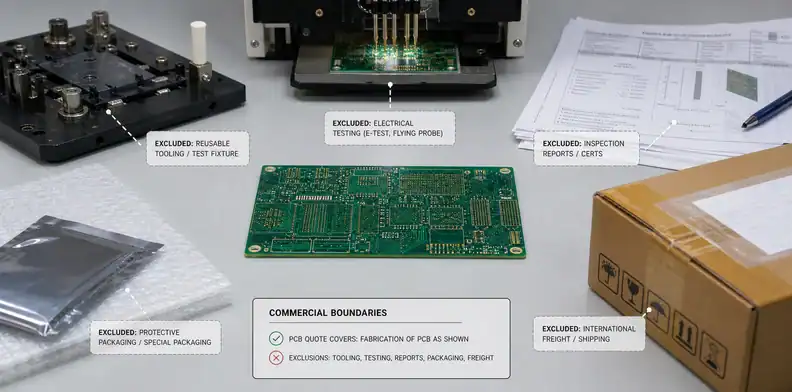
Fixed charges and evidence requirements are frequent sources of first-order surprises. Review NRE, phototools or CAM setup, electrical-test programming, impedance coupons, special fixtures, rout or scoring programs, panel tooling, stencil cost for assembly, and any customer-specific inspection setup.
The term “tooling included” is not enough when future orders matter. Ask whether the tooling charge applies once, whether it can be reused after a revision, how long the supplier retains the data, and whether a repeat order at another quantity will create a new setup charge. The existing QueenEMS explanation of PCB NRE and tooling cost can help purchasing separate first-order cost from recurring unit price.
Testing requires equally specific wording. For a normal bare PCB, electrical continuity and isolation testing may be part of the standard route, but the buyer should still confirm the quoted coverage and whether a report is supplied. Controlled impedance, microsection, ionic cleanliness, solderability, dimensional reporting, first article inspection, or customer-defined testing can create separate scope.
Documents should be treated as deliverables, not assumed by-products. A certificate of conformance, material declaration, test report, lot traceability record, impedance data, microsection evidence, inspection report, or packing record may require different collection and retention work. If the PO requires a document that the quote did not price or acknowledge, the supplier may have to revise either the scope or the commercial terms.
Classify each item as required for acceptance, useful for risk reduction, or unnecessary for this order. That keeps the review proportional. A simple prototype should not inherit an expensive evidence package without a reason, while a production board should not lose necessary proof merely to preserve a low headline price.
Check delivery and commercial boundaries
The factory subtotal is not the delivered commitment. Confirm the quoted Incoterm, shipping method, destination, estimated or fixed freight treatment, insurance responsibility, packaging basis, currency, payment fees, duties and taxes, and whether the lead time describes ship date or arrival date.
Shipping terms change which party arranges transport and where risk or cost transfers. The QueenEMS comparison of DDP and DAP for PCB shipments provides a useful starting point, but the quotation still needs the exact named destination and current commercial wording. Do not infer a landed price from a freight line that excludes import charges.
Lead time should have a defined starting event. It may begin after payment, after files are accepted, after engineering questions close, after the stackup is approved, or after materials are available. “Ten working days” is incomplete when the quotation leaves that trigger open. Record both the start condition and the promised ship or delivery basis.
Packaging is another quiet boundary. Standard vacuum or moisture-protective packaging may be suitable for many bare boards, yet a buyer may also need maximum pieces per pack, separators, corner protection, desiccant, humidity indication, part and revision labels, lot identification, or customer-specific cartons. If receiving depends on those details, they belong in the quoted scope.
Finally, confirm quote validity. Material availability, capacity, exchange rates, and expedited freight can change. A quotation past its validity date should be reconfirmed rather than copied into a new PO. The PCB quote validity review explains why an old price and an old lead-time promise may expire at different speeds.
Judge whether an exclusion changes order risk
Not every exclusion needs to be added. The right decision depends on whether the missing item changes board function, acceptance, schedule, total cost, or responsibility between suppliers.
Start with function. Excluding a special test is serious when that test is the buyer’s only evidence for a controlled requirement. Excluding a decorative report may be harmless when the standard process already provides adequate acceptance. The engineering owner should explain the consequence, while purchasing records how the choice affects price and delivery.
Next, test the handoff. Bare PCB fabrication can reasonably exclude assembly, components, programming, and system test. That boundary is safe only when another party clearly owns those activities and receives compatible data. A gap between two suppliers is more dangerous than a clearly priced item at either supplier.
Schedule impact comes from dependencies. An excluded panel drawing approval, customer-supplied material, special laminate authorization, or test method can keep the order on hold even when the fabrication lead time looks attractive. Ask whether the supplier can begin any work safely and which open item controls the committed ship date.
Commercial impact should be evaluated at the first-order total and the expected repeat-order total. One supplier may exclude tooling but offer a lower recurring price; another may include tooling but charge more per board. Neither model is automatically better. The correct comparison uses the expected order pattern and makes the ownership of reusable work explicit.
Assign each exclusion one of four dispositions: accept outside scope, add to the quote, transfer to a named party, or hold the order pending clarification. This turns a vague concern into a controlled purchasing decision.
Decide whether to reprice or document the gap
Request a corrected quotation when the missing item changes the product, required evidence, total commercial commitment, or promised schedule. A verbal assurance should not carry a requirement that materially affects fabrication or acceptance.
Repricing is normally appropriate for changed material, copper, stackup, finish, tolerance, special drilling, impedance scope, test coverage, documentation, delivery format, quantity, or expedited schedule. It is also appropriate when the supplier’s first quote was based on incomplete files and the completed package reveals a different manufacturing route.
A written clarification may be enough when the supplier confirms that an item is already included and the total does not change. The clarification should reference the quotation number, part and revision, exact question, agreed answer, approver, and date. Attach it to the final quote package or ask the supplier to issue a clean revision when the email chain has become difficult to follow.
Some items should remain deliberately excluded. A bare-board supplier should not be made responsible for an undefined system-level test. A prototype order may omit production documentation that provides no current decision value. State the exclusion and its owner so nobody interprets the lower scope as an oversight.
For complex boards, QueenEMS can review the Gerber or ODB++ data, fabrication drawing, stackup, quantity, and requested evidence to identify which open items affect the manufacturing quotation. The purpose of that review is to close scope before the order, not to turn every optional item into a charge.
Use a quote revision log when several rounds occur. Record what changed, why it changed, and the cost or schedule effect. This separates a justified reprice from unexplained quote drift and supports a cleaner approval decision.

Compare suppliers on the same scope
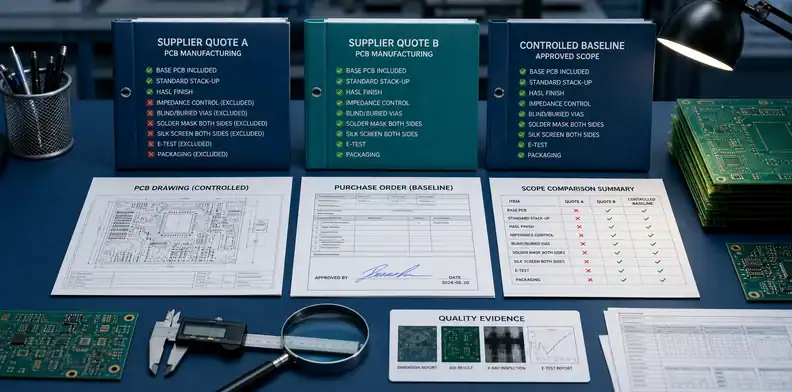
Normalize the scope before ranking suppliers. Put each supplier’s answer beside the same requirement, then compare technical compliance, evidence, lead-time basis, first-order total, recurring cost, and open risk.
Avoid turning the table into a simple yes-or-no scorecard. A “yes” to controlled impedance is weak when the quote does not state tolerance, coupon treatment, or report availability. A “no” to a customer-specific report may be acceptable when the order does not need that report. Add a notes column that captures the actual boundary.
Separate price certainty from price level. A slightly higher quotation with controlled files, explicit test scope, and a documented approval path may carry less financial variance than a low quote that depends on several open engineering assumptions. Conversely, a supplier should not receive a premium merely for writing a longer document; the content must reduce real uncertainty.
Look for response quality during clarification. Useful replies connect the question to a file, drawing note, capability, process choice, or commercial consequence. Vague promises such as “no problem” leave the buyer to guess what will happen in CAM. The clarification cycle is an early demonstration of how the supplier will manage production questions.
The comparison should end with a decision record, not only a supplier name. List the accepted scope, remaining exclusions, approvals required before production, and conditions that would trigger a revised quote. That record lets engineering, purchasing, and management approve the same deal.
Turn the accepted quote into a PO baseline
The final purchase order should reference the accepted quotation and the same controlled product definition. Include the supplier quote number and revision, buyer part number and revision, quantity, price, released file package, requested delivery, shipping term, packaging notes, required evidence, and the named approval route for deviations.
Do not copy every engineering specification into the PO if that creates a second uncontrolled source. Reference the released drawing or specification and make the precedence of documents clear. Where the PO adds commercial or quality clauses, confirm that they do not conflict with the quote or technical files.
The PCB purchase-order review process should catch mismatches before the supplier starts work. Compare line items, totals, revision identifiers, promised dates, and exception wording. Ask the supplier to acknowledge any deviation rather than silently accepting an order it cannot meet as written.
Preserve the quote reconciliation table with the order record. It helps accounts payable understand later invoices, helps receiving know what evidence should arrive, and gives engineering a baseline when the supplier raises a production question. For repeat orders, it also reveals which assumptions must be revalidated instead of copied forward.
Send QueenEMS the Gerber or ODB++ package, drill data, fabrication drawing, stackup or impedance requirements, quantity, target date, test and document needs, and delivery destination for a project-specific quotation. A clean submission allows the resulting price to show what is included, what remains open, and what must be approved before fabrication.
FAQ
Are PCB quote exclusions always a warning sign?
No. Clear exclusions are often evidence of disciplined scope control. The warning sign is an exclusion that removes a required function or acceptance item without assigning another owner, or an important subject that remains silent until after the PO.
Should electrical testing be included in every PCB quote?
The quotation should state the electrical-test scope that applies to the order. Standard continuity and isolation testing may be part of the normal fabrication route, while impedance data, microsection, solderability, or customer-specific reports may require separate confirmation.
Can I place the order while an exclusion is still open?
Yes, only when the open item cannot change the board, price, acceptance, or committed schedule and both parties record who will close it. Otherwise keep the affected work on hold until the quotation or written clarification is complete.
What is the difference between an exclusion and an assumption?
An exclusion states that an item is outside the supplier’s scope. An assumption states the condition under which the quoted scope and price remain valid; changing that condition may require a different process, price, or lead time.
What should I send for a quote-exclusion review?
Send the supplier quotation, Gerber or ODB++ data, drill files, fabrication drawing, stackup and impedance notes, quantity, delivery location, required inspection or reports, and any clarification emails already exchanged.
Sources
Written by the QueenEMS Engineering Team
Upload your files today · Free DFM check before production · Ship worldwide
Get your PCB prototypes in as fast as 24 hours. We handle FR4, Rogers, and Flex up to 60 layers — free prototypes for 2–4 layer boards, no minimum order.
Just upload your Gerber + BOM — we source every part, assemble, and inspect (AOI + X‑Ray) so you don't have to chase suppliers. Boards ship in as fast as 24 hours.