
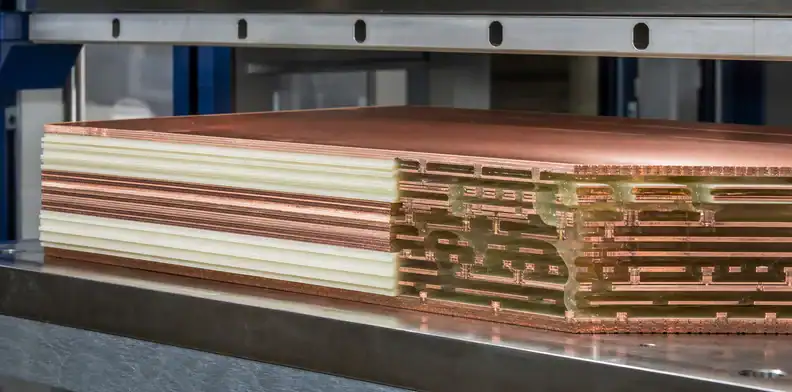
Quick Answer: Multilayer PCB resin flow must fill copper topography and bond the stack-up without starving local areas or creating uncontrolled squeeze-out. The drawing and RFQ should identify copper-heavy regions, cavities, impedance dielectrics, material restrictions, and the evidence needed when a supplier proposes a different prepreg construction.
A multilayer board can pass an early stack-up review and still become difficult to laminate once copper distribution, step features, cavities, and dielectric thickness are considered together. Resin flow is where the material selection becomes a physical press cycle, so the buyer needs a visible boundary between routine supplier process control and a construction change that affects the product.
Table of Contents
- Resin flow is a stack-up behavior, not a material label
- Dense copper and open areas compete for the same resin
- Starvation, voids, and squeeze-out are different findings
- Press-cycle adjustments need an approval boundary
- Impedance routes need a resin-flow view
- Cavities and step features narrow the process window
- Choose evidence that reflects the construction risk
- Build the RFQ around the pressable construction
- Turn the stack-up into a press-review worksheet
- Use first-article data to close the right question
Resin flow is a stack-up behavior, not a material label
Prepreg data sheets describe resin content and cure behavior, but they do not by themselves say how a specific panel will fill its etched copper pattern. Flow depends on the laminate system, copper thickness, local density, panel design, press cycle, and the spaces that must be filled. A material name in a stack-up is the starting point, not the completed lamination instruction.
Treat the stack-up as a construction drawing. It should show the core and prepreg positions, copper weights, finished thickness targets, impedance-controlled dielectrics, buried features, and any locations where the board is intentionally stepped or locally reinforced. A supplier can then identify whether the requested press route is ordinary, needs a change in prepreg style, or calls for a first-article check.
Construction boundary: approve a stack-up based on the intended finished geometry, not on resin percentage copied from a generic material table.
Boards with stepped-thickness stack-up requirements need that construction view early because a local step changes the volume that resin must fill. The no-flow prepreg lamination control article is also useful when a design intentionally limits flow near selected features.
Flow rule: quotation is ready only after the resin-demanding features are visible to the fabricator.
Dense copper and open areas compete for the same resin
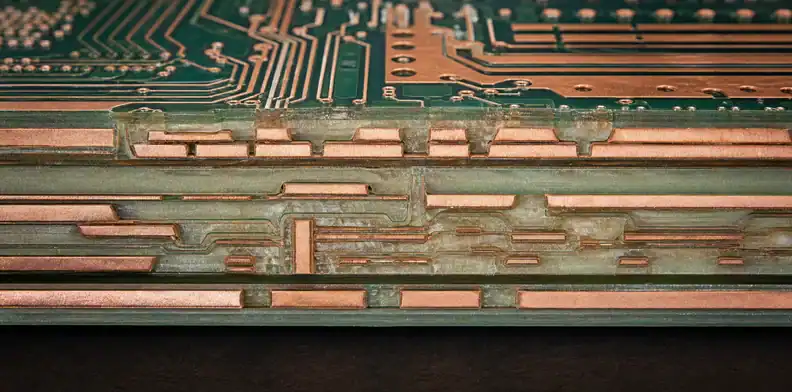
Dense copper fields create narrow channels and height changes that resin must wet and fill. Open areas can allow greater movement, so the same press cycle may leave different resin conditions across one panel. A large ground plane beside fine traces or an abrupt copper-density change deserves attention before the stack reaches the press.
The practical input is a layer view that makes dense and open regions visible. It is more useful than a broad instruction to “control copper balance” because it lets the fabricator locate zones where dielectric thickness, fill, or squeeze-out could differ. The PCB copper balance drawing review page addresses the CAM discussion; this article follows the effect into lamination.
Copper thieving may be a valid manufacturing proposal, but it must not silently enter a controlled RF or impedance area. Ask the supplier to mark its location and state whether it affects copper distribution, panel breakoff, or the available resin path.
Panel call: local copper geometry belongs in the lamination review whenever dielectric thickness or bond quality is controlled.
Starvation, voids, and squeeze-out are different findings
Resin starvation means there is insufficient resin where the construction needs bonding or dielectric fill. A void is an unbonded or unfilled area. Squeeze-out is resin that has moved beyond the intended panel boundary or local interface. These may occur together, but they are not interchangeable descriptions and they do not always have the same cause.
A supplier should report the observed condition and its location before proposing a correction. Adding a higher-flow prepreg may improve fill in one area while changing dielectric thickness or resin distribution in another. Increasing pressure may change the apparent symptom without resolving a material or panel-design mismatch.
The buyer’s acceptance note should state which regions are functionally sensitive: impedance routes, plane separations, controlled cavities, rigid-flex transitions, thermal interfaces, or regions near a connector. That turns a broad lamination question into a design-specific disposition.
Defect language: require the supplier to distinguish missing resin, trapped voids, and excess resin before engineering chooses a fix.
Press-cycle adjustments need an approval boundary
Press temperature, pressure, vacuum sequence, and dwell are normally factory-controlled details. The buyer should not ask to own those parameters unless a documented qualification program requires it. The buyer does own changes that alter the agreed material system, prepreg construction, dielectric target, layer relationship, or final board geometry.
A good supplier response says what remains inside its qualified route and what would move the product construction. For example, changing from one prepreg style to another within the approved laminate family may still alter resin flow and dielectric build. The response should state whether the finished thickness, impedance geometry, and evidence plan remain valid.
A first-article cross-section or thickness map can close a disputed point more effectively than a long description of press settings. The record should identify the panel revision and the area selected for review.
Approval line: the supplier controls the press recipe; engineering approves any change that moves the specified construction or performance margin.
Impedance routes need a resin-flow view
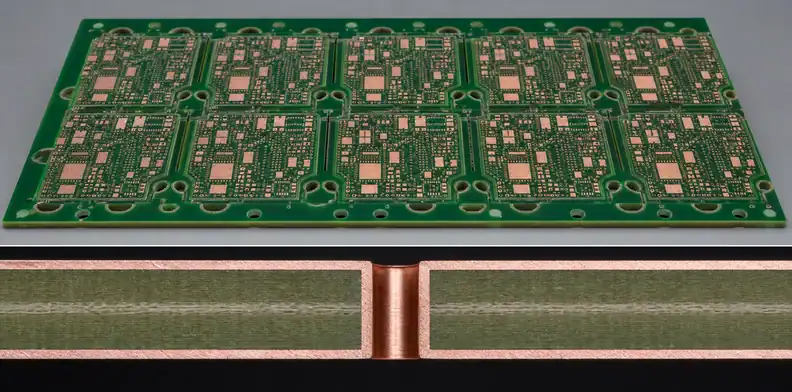
Controlled impedance depends on conductor geometry and the dielectric surrounding it after lamination, not only on a nominal pre-laminate thickness. Resin movement near dense copper, cavities, or mixed copper weights can change the finished dielectric condition that the coupon or field calculation assumes.
Include the controlled layer pair, target impedance, permitted adjustment path, and location of the critical routes in the quote package. The core versus prepreg impedance shift page explains why those two dielectric forms do not behave as interchangeable finished dimensions. Lamination review adds the question of whether the proposed construction can preserve that intent over the panel.
Do not request a universal thickness value without naming the location. A measurement at an open coupon zone may not represent a tightly patterned transmission line. The evidence plan should identify what the coupon represents and what it does not.
Signal check: impedance acceptance needs the finished dielectric location, not a generic statement about prepreg thickness.
Cavities and step features narrow the process window
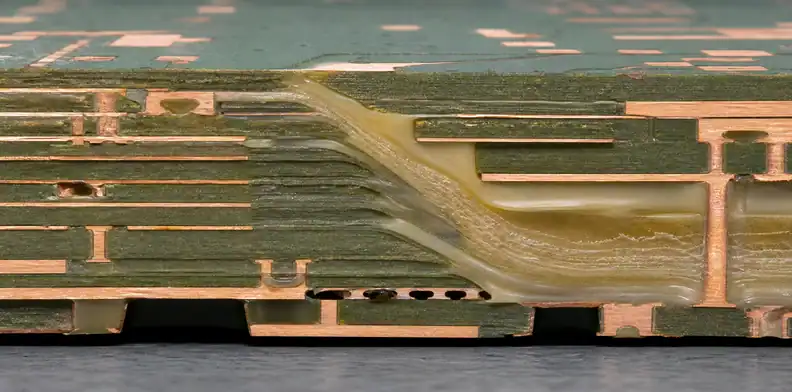
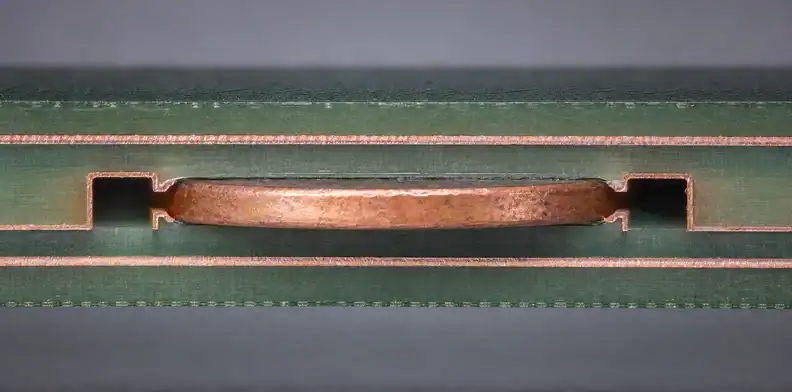
Cavities, embedded components, copper coins, stepped thickness regions, and deep local relief features create extra volume changes during lamination. They can alter resin paths, pressure distribution, and the amount of material available to nearby layers. Treating these elements as ordinary cutouts can lead to a quote that is mechanically incomplete.
Mark the feature depth, layer relationship, edge geometry, and any dielectric or copper keepout on the fabrication drawing. The embedded copper coin acceptance article is relevant when the step is a coin interface; a generic laminate process may not represent that local condition.
Where a feature lies near a controlled route, require a supplier mark-up showing whether the press sequence or material construction must change. This creates an engineering choice before tooling begins instead of a late production concession.
Feature check: a local cavity is part of the lamination design, even when its outline appears only on one layer drawing.
Choose evidence that reflects the construction risk
Not every multilayer board needs the same documentation. A routine build may only need the approved stack-up and final thickness. A high-layer, mixed-material, heavy-copper, or impedance-controlled build may need a first-article section, dielectric measurement, warp assessment, or a coupon result tied to the proposed construction.
The evidence request should name what decision it supports. A cross-section may show fill around a copper feature; an impedance coupon may show an electrical result; a flatness record may show handling risk. Asking for every report available can delay the lot while still leaving the actual lamination question unaddressed.
Keep the accepted stack-up, supplier disposition, and first-lot evidence with the product revision. On a reorder, a changed laminate availability or panel arrangement can reopen a flow question even when the Gerber files are unchanged.
Proof selection: choose records that answer the local resin-flow risk, not a generic document set.
Build the RFQ around the pressable construction
QueenEMS can review multilayer PCB resin flow when the RFQ includes fabrication data, controlled stack-up, copper weights, finished thickness, impedance notes, any local cavities or step features, material restrictions, and the regions where resin movement could change fit or electrical behavior. A marked layer view is particularly helpful for dense copper transitions and embedded structures.
Ask the supplier to return its proposed prepreg construction, any deviation from the released material system, anticipated evidence, and a clear list of questions that need design approval. This makes cost comparisons more honest because a low quote cannot hide a different lamination assumption.
Use the stack-up and critical-area drawings for a pressability review. The result should identify whether an open item is a normal process choice, a material substitution, or a construction change before the board is committed to production.
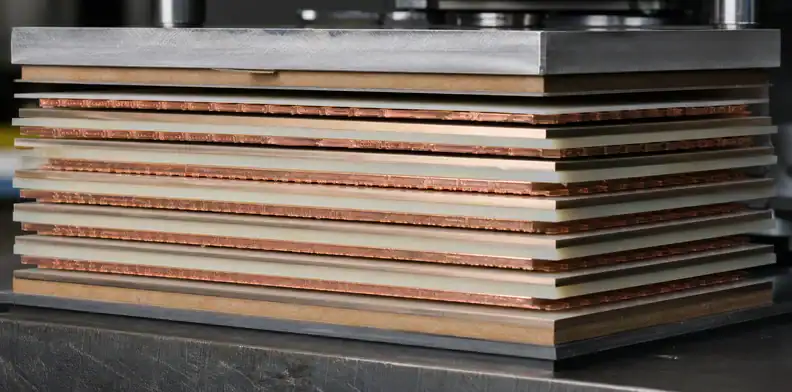
Turn the stack-up into a press-review worksheet
A press-review worksheet does not replace the supplier’s process documentation. It gives engineering, purchasing, and CAM one place to see the construction details that affect resin movement. The goal is to avoid a stack-up that is electrically described but mechanically ambiguous.
| Stack-up field | Why it changes resin flow | Buyer action before RFQ |
|---|---|---|
| Copper weight and density | Sets local topography and fill demand | Mark unusually dense-to-open transitions |
| Prepreg position and style | Changes available resin and dielectric build | Freeze approved alternatives or require review |
| Cavity, coin, or step feature | Creates a local pressure and volume change | Show depth, location, and nearby controlled routes |
| Impedance dielectric | May change after fill and cure | Identify the measured or modeled location |
| Panel edge and tooling zone | Can affect squeeze-out and representativeness | State whether the area is functional or sacrificial |
The worksheet also makes supplier quotations comparable. A price based on a different prepreg construction is not automatically wrong, but it should not be treated as equivalent until the finished construction is reviewed.
It is also worth separating values that are fixed design inputs from values that are manufacturing observations. Core thickness, target copper weight, controlled dielectric location, and cavity depth belong in the released construction. Press pressure, dwell time, and release film choice are part of the fabricator’s qualified route. Finished thickness, local fill quality, and coupon results are observations that can confirm whether the route produced the agreed construction. Mixing these three categories makes a CAM reply sound more alarming than it is, or hides a real stack-up change behind normal press terminology.
Use first-article data to close the right question
First-article evidence should answer the uncertainty that remained after stack-up review. A thickness measurement cannot prove copper-to-resin fill in a stepped area; an impedance result does not describe an unbonded local interface. Select the record according to the reason the build was considered nonroutine.
Name the measurement location before panels are built. A global finished-thickness value can be acceptable for a simple board, while a high-density zone next to a cavity or controlled line may need a location callout, section plane, or coupon relationship. The useful first-article report connects each reported value to a physical place on the approved panel or drawing. It then becomes clear whether a result closes the question that caused the press review, rather than merely adding a favorable number to the lot file.
Keep the report with the approved construction revision. On a later build, it can show which uncertainty was closed and which change would require the press-review question to be reopened.
That history is especially useful when the same electrical stack-up is proposed with a different prepreg availability or panel strategy.
| Open issue | Useful first-article evidence | Decision owner |
|---|---|---|
| Resin fill around a dense feature | Targeted cross-section at the agreed location | Engineering and quality |
| Finished dielectric near a controlled route | Coupon or defined dimensional measurement | Signal-integrity owner |
| Local cavity or embedded structure | Feature-specific section or first-piece photo set | Mechanical and electrical owners |
| Revised prepreg construction | Approved stack-up comparison and material traceability | Design release owner |
First-article check: record the condition that was uncertain in the quotation, rather than collecting a generic report bundle after the board is built.
Before release, compare the approved stack-up to the supplier’s final construction line by line. Check dielectric locations, prepreg style, copper weights, cavity treatment, and the first-lot evidence promised. This direct comparison is more reliable than assuming that equal layer counts have equal pressure and flow behavior.
Release check: stop the order when the quoted construction no longer matches the stack-up used for fit or electrical decisions.
For a multilayer quote with dense copper, cavities, or controlled impedance, send the stack-up, copper-weight table, and marked risk areas to QueenEMS for construction review. The response can separate a routine press choice from a material or construction change that needs engineering approval.
FAQ
Does higher resin content always prevent lamination voids?
No. More flow can solve one fill problem while changing dielectric build, squeeze-out, or dimensional behavior elsewhere on the panel.
Can a fabricator change prepreg style without approval?
Only when the approved stack-up and change-control agreement allow it. A change that moves dielectric geometry or material construction needs engineering review.
What evidence is useful for a dense copper area?
A targeted cross-section or agreed thickness record is useful when it identifies the actual dense region or a coupon proven to represent it.
Are cavities a separate lamination concern?
Yes. A cavity changes local volume and pressure paths, so its depth, layer relationship, and nearby controlled features belong in the press review.
Sources
- IPC-6012, Qualification and Performance Specification for Rigid Printed Boards
- Isola, prepreg and laminate technical data
Written by the QueenEMS Engineering Team
Upload your files today · Free DFM check before production · Ship worldwide
Get your PCB prototypes in as fast as 24 hours. We handle FR4, Rogers, and hybrid boards up to 40 layers in volume production, with advanced builds subject to engineering review — free prototypes for 2–4 layer FR-4 boards, no minimum order.
Just upload your Gerber + BOM — we source every part, assemble, and inspect (AOI + X‑Ray) so you don't have to chase suppliers. Boards ship in as fast as 24 hours.