

Quick Answer: Decision: blanket-PO release control. Controlled object: commercial schedule separating the blanket commitment from each authorized quantity, revision, delivery date, price basis, and ship-to instruction. Design-owned boundary: validity period, ceiling quantity or value, released revision, release authority, pricing reset rule, packaging, and liability boundaries. Supplier discretion: planning and material actions explicitly permitted before a firm release without converting forecast into finished inventory. Stop rule: a release without a current revision, demand exceeding the ceiling, unapproved build-ahead, or pricing outside the agreed validity.
A blanket PO can make repeat PCB buying easier: one agreement covers a period, and individual releases draw down quantities when the buyer needs them. For stable products, that can reduce quoting friction and protect supply planning.
The risk is treating a blanket PO like a magic repeat-order button. PCB builds depend on revision, stackup, material, finish, process availability, packaging, evidence and shipment details. Any of those can change between releases.
A good blanket PO turns repeat demand into a controlled release system rather than a pile of old assumptions.
Table of Contents
- Use blanket POs for stable repeat demand
- Lock price basis and validity
- Control each release quantity and date
- Protect revision control between releases
- Define inventory and cancellation exposure
- Keep evidence and packaging consistent
- Define the release trigger before the blanket PO is used
Use blanket POs for stable repeat demand
A blanket PO works best when the design, supplier, evidence and release cadence are predictable.
Stable monthly or quarterly releases, approved revision, known packaging, consistent evidence requirements and reasonable forecast accuracy make blanket orders easier to manage.
Connect the first release to PCB order confirmation so the supplier acknowledges price, quantity, revision, lead time and release mechanics.
A blanket PO is less useful when each release needs redesign, material substitution, first-article approval, or new shipment evidence.
Lock price basis and validity
The agreement should say when price holds and what triggers a new quote.
PCB pricing can change with material cost, copper weight, finish, panel utilization, quantity breaks, rush timing, evidence requirements and freight.
Use PCB quote validity to define the date, quantity band, revision, and assumptions behind the blanket price.
The blanket terms should say whether price changes after material market shifts, engineering revision, release delay, minimum order changes, or supplier capacity constraints.

Control each release quantity and date
Every release should act like a mini order with its own acknowledgement.
The blanket PO may set the total commitment, but each release still needs quantity, requested ship date, delivery destination, packing requirement and release proof.
Use PCB purchase order review for release checks, especially when a buyer pulls ahead, delays, or splits quantities.
A supplier should confirm whether inventory, work-in-process, material and shipment plan still support the requested release.
Protect revision control between releases
A repeat release is only repeat when the same approved revision and build assumptions still apply.
Engineering changes can invalidate price, tooling, panel data, test evidence, packaging labels and qualification records. The release should reference the active revision every time.
The repeat PCB order revision control article is the natural companion for blanket PO release discipline.
If a revision changes during the blanket period, decide whether remaining quantities shift to the new revision, stay on the old revision, or require separate quote and approval.

Define inventory and cancellation exposure
The buyer should know who owns material, finished boards and work-in-process under the blanket agreement.
A supplier may buy material or build ahead to support releases. That can improve lead time, but it creates liability when the forecast moves or the product changes.
The agreement should state inventory cap, cancellation charge, obsolescence rule, storage time, quality hold, and whether unused stock can be consumed on future releases.
Management needs this line because the apparent convenience of a blanket PO can hide real balance-sheet exposure.
Keep evidence and packaging consistent
Repeat releases still need the right documents, labels and receiving information.
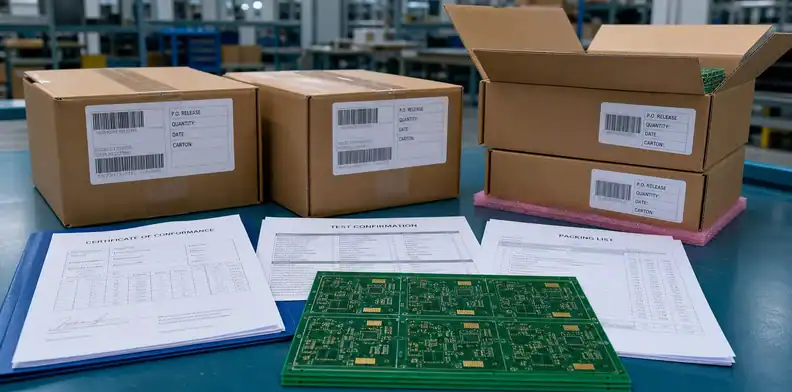
Ask for the quality documents, COC, test confirmation, inspection record, packing list, labels and carton information that receiving needs for every release.
Use PCB packaging and labeling requirements and PCB quality documents before shipment to keep release evidence from drifting.
QueenEMS can review PCB or PCBA blanket-order packages where repeat releases, revision control, supplier inventory or evidence requirements affect quotation. Send the blanket terms, active revision, release forecast, price basis, inventory rule and required documents; we can help return a controlled release framework.
Practical order-stage examples
A purchasing team may use a blanket PO to reduce repeated quote cycles, while engineering still requires every release to show the active revision and accepted build assumptions.
A supplier may build ahead to support fast releases. That helps only if the buyer understands cancellation and inventory liability when demand or revision changes.
A receiving team may reject a release that lacks labels or evidence even though the blanket order exists. Repeat buying still needs shipment documentation.
For accounting and operations, the blanket agreement should also define what counts as a release against the total commitment. Finished boards, reserved material, work in process, and unissued forecast quantities should not be treated as the same exposure when demand changes.
How to judge the supplier reply
Define the release trigger before the blanket PO is used
A blanket PO should not release every PCB build automatically. It should name the event that turns an agreement into a real build: a release order, active drawing revision, approved quantity, ship date, and any material or price condition that still needs confirmation.
In practical supplier review, this is the line that prevents a buyer from paying for boards that were technically covered by a blanket agreement but were not ready for the current product version. The supplier should be able to point to the release record before CAM, material allocation, or panel planning starts.
- Active drawing and Gerber or ODB++ revision
- Release quantity, requested date, and ship-to location
- Price validity, finish, material, and open DFM questions
- Buyer contact who can approve a hold, split shipment, or changed release
Production record for the blanket-PO release control
Controlled object
Controlled object: commercial schedule separating the blanket commitment from each authorized quantity, revision, delivery date, price basis, and ship-to instruction.
Failure boundary
Failure boundary: premature builds, obsolete inventory, disputed cancellation liability, wrong revisions, or a price agreement mistaken for production authority.
Design-owned conditions
Design-owned conditions: validity period, ceiling quantity or value, released revision, release authority, pricing reset rule, packaging, and liability boundaries.
Supplier discretion
Supplier discretion: planning and material actions explicitly permitted before a firm release without converting forecast into finished inventory.
Required proof
Required proof: numbered releases, supplier acknowledgments, remaining balance, revision confirmation, inventory status, and exception approvals.
Production stop
Production stop: a release without a current revision, demand exceeding the ceiling, unapproved build-ahead, or pricing outside the agreed validity.
Repeat-order baseline
Repeat-order baseline: blanket order number, release history, open commitment, inventory ownership, expiry, repricing events, and final closeout.
RFQ inputs
RFQ inputs: forecast, part and revision list, price breaks, lead times, release cadence, cancellation terms, packaging, quantities, and approval roles.
FAQ
Can the supplier decide the blanket-PO release control?
Discretion for blanket-PO release control: planning and material actions explicitly permitted before a firm release without converting forecast into finished inventory. Engineering control for blanket-PO release control: validity period, ceiling quantity or value, released revision, release authority, pricing reset rule, packaging, and liability boundaries.
What stops this blanket-PO release control?
Stop rule for blanket-PO release control: a release without a current revision, demand exceeding the ceiling, unapproved build-ahead, or pricing outside the agreed validity. Disposition owner for blanket-PO release control: the named engineering approver.
Which proof closes the blanket-PO release control?
Evidence for blanket-PO release control: numbered releases, supplier acknowledgments, remaining balance, revision confirmation, inventory status, and exception approvals. Revision link for blanket-PO release control: the quoted dataset.
What survives into the next order?
Reorder baseline for blanket-PO release control: blanket order number, release history, open commitment, inventory ownership, expiry, repricing events, and final closeout.
For a focused blanket-PO release control, send QueenEMS forecast, part and revision list, price breaks, lead times, release cadence, cancellation terms, packaging, quantities, and approval roles. Redline request: blanket-PO release control. Open assumptions: blanket-PO release control. Approver: blanket-PO release control owner.
Written by the QueenEMS Engineering Team
Sources
Upload your files today · Free DFM check before production · Ship worldwide
Get your PCB prototypes in as fast as 24 hours. We handle FR4, Rogers, and Flex up to 60 layers — free prototypes for 2–4 layer boards, no minimum order.
Just upload your Gerber + BOM — we source every part, assemble, and inspect (AOI + X‑Ray) so you don't have to chase suppliers. Boards ship in as fast as 24 hours.