
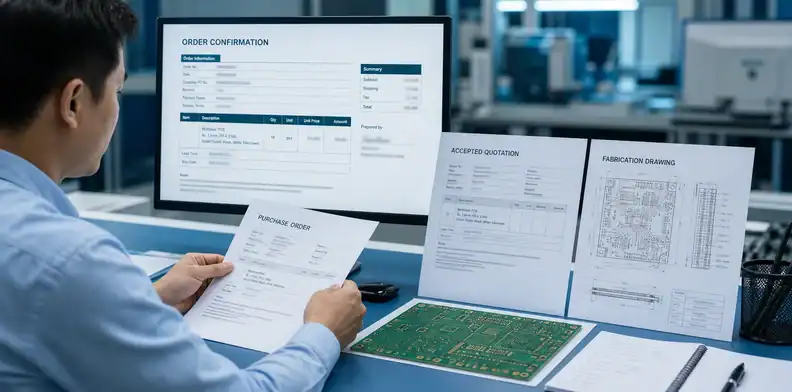
Quick Answer: Review a PCB order confirmation as the supplier’s controlled acceptance of your purchase order. Match the part number, revision, files, quantity, price, payment terms, delivery milestone, shipping term, test and documentation scope, approved deviations, and production-release status. Resolve every mismatch before the supplier starts irreversible work.
Key takeaways – A purchase order states what the buyer requests; an order confirmation states what the supplier has accepted. – Silence is not a safe method for resolving different prices, dates, or revisions. – The confirmation should point to the same technical baseline used for fabrication. – Any later change needs a new acknowledgment or controlled amendment.
A PCB order confirmation is easy to dismiss as an administrative receipt. For a custom board, it is one of the last opportunities to catch a commercial or technical mismatch before material, tooling, and capacity are committed. Buyers often discover too late that the supplier accepted a different ship date, assumed an older revision, excluded a report, or treated an unapproved DFM proposal as part of the job.
The review does not need to become a legal project. It needs a repeatable comparison between the purchase order, accepted quotation, released manufacturing package, and supplier acknowledgment. Purchasing, engineering, and quality each own different fields. Together they can turn the confirmation into a clean production baseline.
Table of Contents
- Understand what the supplier is acknowledging
- Match the commercial identity of the order
- Verify the technical production baseline
- Confirm quantity, price, and first-order charges
- Translate the promised date into milestones
- Check evidence, packaging, and delivery scope
- Resolve exceptions and control later changes
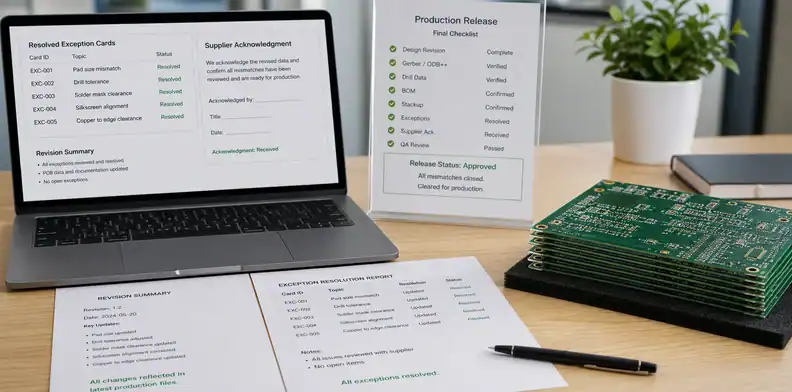
- Use a final release checklist
- FAQ
Understand what the supplier is acknowledging
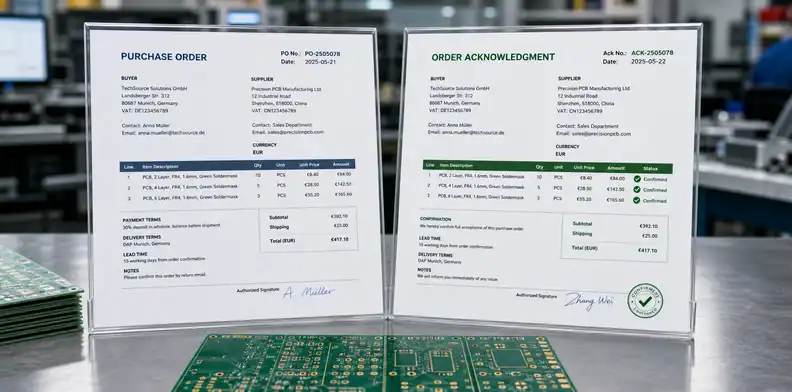
The buyer’s PO is an offer or instruction based on the buyer’s requirements. The supplier’s acknowledgment shows whether it accepts those requirements as written, rejects them, or accepts them with exceptions. An automated message saying “order received” may confirm transmission only. It may not confirm price, delivery, data revision, or production authorization.
Ask which document is the supplier’s binding order confirmation. It may be called a sales order acknowledgment, pro forma invoice, order acceptance, or confirmation sheet. Whatever the label, the record should carry a unique number, issue date, buyer PO number, supplier entity, and responsible contact.
Check the status language. “Pending engineering review,” “subject to material availability,” or “estimated delivery” is not the same as an unconditional acceptance. Conditional wording is manageable when its trigger, owner, and deadline are clear. It becomes risky when the buyer assumes the order is committed while the supplier still considers essential terms open.
For first orders, request a human review rather than relying only on the supplier portal. For repeat orders, automation can help, but the system should still flag changes in revision, quantity, price, date, and scope.
Define when acceptance becomes effective. Some suppliers acknowledge receipt first and issue a firm confirmation only after engineering and credit review. Others consider the order accepted unless they raise an exception within a stated period. The buyer should know which event creates the commitment and whether a deposit, credit approval, or signed drawing remains outstanding. Put these prerequisites beside the status rather than hiding them in general terms.
Keep evidence of transmission and receipt, but do not confuse it with content review. A portal timestamp proves that a file was uploaded; it does not prove that CAM used that file or that the supplier accepted the requested date. The useful record connects the message, attachments, version, and named approver.
Match the commercial identity of the order
Start with the identifiers that connect all records. Confirm the buyer’s legal entity and bill-to address, supplier legal entity, PO number, supplier order number, currency, incoterm, payment terms, and tax treatment. A correct board shipped under the wrong commercial entity can still create customs, payment, or accounting delays.
Then match every line item. Custom PCB orders may include bare boards, assembly, components, tooling, test, engineering, fixtures, reports, packaging, and freight as separate lines. The supplier confirmation should not merge items in a way that hides exclusions or makes later reconciliation impossible.
Use the accepted quotation number and revision. A quotation revised after DFM may change price or lead time even when the PCB part number stays the same. The order confirmation should identify which quote became the commercial basis. Review PCB quote exclusions before accepting an acknowledgment that references a different scope.
Record the contact who can approve commercial corrections. Engineering should not accidentally approve a price change while answering a technical question, and purchasing should not approve a product deviation merely because it removes a surcharge.
Verify the technical production baseline
A purchase order line that says “PCB per attached files” is incomplete when several file packages exist. The confirmation should identify the buyer part number, revision, supplier part number when used, released package name or date, layer count, board type, and any controlled drawing or stackup reference.
For PCBA, include the PCB revision, assembly revision, BOM revision, placement data revision, approved alternates, firmware or programming reference, and test specification. The supplier may use internal job numbers, but those numbers must map back to customer-controlled identifiers.
Compare the confirmed baseline with the final DFM record. An approved stackup, material alternative, enlarged feature, or panel decision should be incorporated or referenced explicitly. An open DFM proposal should not appear as an accepted requirement. The PCB DFM review before PO explains how to separate technical release from commercial authorization.
Ask the supplier to list exceptions rather than using a blanket phrase such as “per factory capability.” The purpose of the confirmation is to expose differences. It should not replace precise requirements with a general capability statement.
When the product is regulated or customer-controlled, add the required traceability: lot code format, date code limits, country-of-origin evidence, certificates, serialization, or change-notification requirements. These items affect the delivered record and belong in the accepted scope.
Confirm quantity, price, and first-order charges
Match ordered quantity and acceptable shipment quantity. PCB panel utilization or component packaging may tempt a supplier to propose overrun or underrun. Do not assume the buyer will accept extra boards, partial shipment, or a billing quantity different from the PO. Write the allowed range or require prior approval.
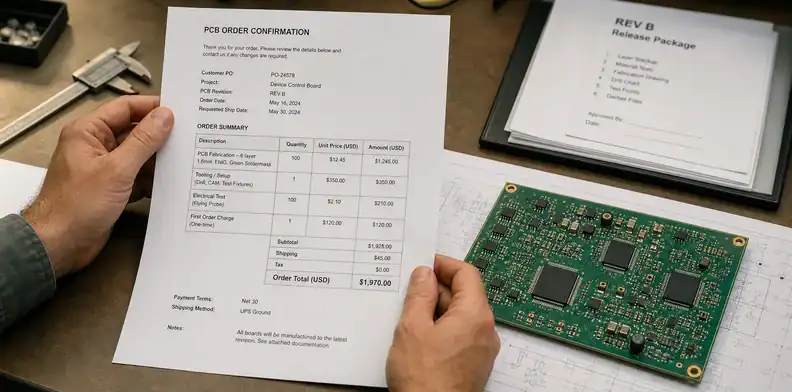
Check unit price, extended price, setup charges, tooling, electrical test, coupons, impedance reports, solder paste stencil, programming fixtures, NRE, component procurement, and any expedite fee. A correct total is not enough if recurring and nonrecurring charges are mixed. Future reorder decisions depend on that distinction.
For turnkey PCBA, compare the component commitment with the BOM sourcing record. MOQ, package quantity, non-cancellable/non-returnable material, and excess inventory can make the supplier’s first-order exposure higher than the assembled quantity suggests. Those items require their own approval rather than disappearing into a lump-sum line.
Confirm the currency and tax basis. A dollar sign does not distinguish USD from CAD, and a landed price is not the same as an ex-works price. Check whether bank charges, freight, duties, and import taxes are included or assigned to the buyer.
Finally, verify arithmetic and rounding. Small line differences can signal that the supplier used another quotation revision or quantity break. Fix the underlying reference rather than changing the PO total alone.
Translate the promised date into milestones
“Lead time: three weeks” leaves unanswered questions. Determine what starts the clock: PO receipt, deposit, file acceptance, DFM closure, material availability, or technical release. Then determine what stops it: factory completion, supplier ship date, carrier pickup, customs clearance, or delivery at the named destination.
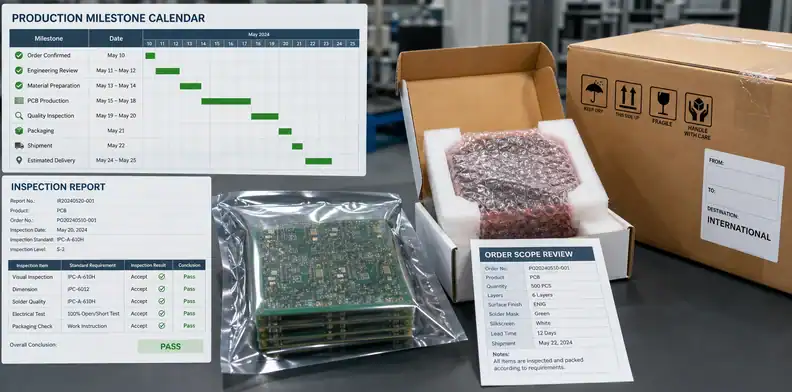
The order confirmation should state a calendar date for the committed milestone. For urgent projects, request intermediate dates for engineering closure, material allocation, tooling, first article, assembly, test, and shipment. Milestones give both sides a chance to recover before the final date is missed.
Separate production lead time from transit. International PCB shipments to the United States, Canada, or Mexico can face carrier and customs variation. The supplier can commit its ship date more directly than a final delivery date unless it controls the agreed delivery service. The named incoterm and destination clarify responsibility.
Partial shipment needs prior agreement. It may protect a launch, but it may also create duplicate freight, separate customs entries, incomplete kits, or receiving confusion. The acknowledgment should state the quantity and date for each release.
Where an approval deadline controls the schedule, put it in the confirmation. For example: “Ship date assumes customer closes DFM-03 by August 4.” That is more actionable than a later claim that engineering response caused an undefined delay.
Check evidence, packaging, and delivery scope
Quality evidence is part of the purchased deliverable when the buyer needs it for receiving, customer submission, or compliance. Confirm electrical-test status, impedance or coupon data, microsection requirements, dimensional report, first-article report, certificates, component traceability, AOI or X-ray evidence, functional-test results, and any sample retention.
Do not ask for every possible report by habit. Match evidence to the product risk and acceptance plan. A prototype may need targeted measurements and photos; a controlled production order may require lot-level reports. The QueenEMS PCB quality-control report sample helps buyers define evidence before shipment rather than request it after a problem.
Packaging can change usability and damage risk. State moisture-barrier, desiccant and humidity-card needs, vacuum packaging, interleaving, board separation, panel orientation, reel or tray requirements, labels, quantity per package, and carton markings. For PCBA, confirm ESD protection and whether batteries or programmed devices create shipping restrictions.
Delivery scope includes the named address, contact, carrier account when applicable, shipping service, incoterm with place, and document requirements. Mexico-bound orders may require importer and customs coordination different from a domestic US shipment. Canadian buyers should likewise confirm the agreed party for brokerage and taxes. Avoid country-name template articles; put the real destination facts in the order record.
Resolve exceptions and control later changes
Create an exception list from every mismatch between the PO and confirmation. Give each item an owner and one of four dispositions: supplier corrects the acknowledgment, buyer amends the PO, engineering approves a controlled deviation, or the order remains on hold.
Do not resolve conflicting terms by leaving both documents unchanged. A price amended only in email may fail accounts-payable matching. A date changed only in a portal may not reach the project team. A design change approved in chat may not reach CAM. Update the record that controls the affected requirement and obtain acknowledgment.
After acceptance, require change control. A new material lot issue, component shortage, yield concern, or schedule conflict can produce a supplier change request. The request should state the affected order, current baseline, proposed change, reason, cost, date effect, evidence, and approval needed.
Buyer changes need the same treatment. A revised quantity, address, board file, or delivery date can invalidate price and schedule. Ask the supplier for a revised confirmation and identify obsolete versions. The current document should be easy for production, receiving, and finance to recognize.
For cancellation or hold requests, distinguish recoverable work from irreversible commitment. The supplier should report completed operations, committed material, restocking possibilities, and remaining exposure. That information is especially important for custom laminates, special finishes, and NCNR components.
Use a final release checklist
Before allowing production to start, the buyer can complete a one-page review:
- PO and supplier confirmation numbers match.
- Buyer and supplier legal entities, currency, and payment terms are correct.
- Part number, revision, file package, and accepted DFM record are identified.
- Quantity, unit price, total, NRE, test, freight, and other charges reconcile.
- Production and shipping milestones are calendar dates with a defined start point.
- Incoterm includes the named place and the ship-to record is complete.
- Quality evidence, packaging, labels, and traceability are accepted.
- Exceptions have an owner and written disposition.
- Production release authority is named.
- Both sides retain the same final version.
Have engineering sign the technical baseline, purchasing accept commercial terms, and quality confirm evidence. A small company may have one person fill several roles, but the decisions should still be visible.
Receiving and finance also need usable outputs. Receiving should know the expected quantity, package labels, part revision, and documents that must arrive with the shipment. Finance should know the accepted prices, deposit, balance event, currency, freight basis, and invoice reference. Sharing the final confirmation prevents a technically correct order from being held because the warehouse or accounts-payable team sees different information.
For a high-risk first build, schedule a short supplier kickoff after acknowledgment. Review the controlled package, blockers, milestones, change contacts, and evidence plan. The kickoff does not replace written acceptance; it tests whether purchasing, engineering, quality, and the supplier are reading the record the same way. Capture any correction in a revised confirmation rather than relying on meeting notes alone.
The final release message should be concise: identify the controlled confirmation and state that production is authorized for the specified revision and quantity. Avoid adding new requirements inside the release email. New information should update the underlying PO, file package, or accepted deviation.
QueenEMS can return a clear acknowledgment after reviewing your controlled package. Send the RFQ or order documents through the QueenEMS contact page and state which evidence and delivery milestones your team needs confirmed.
FAQ
Is an invoice the same as a PCB order confirmation?
Not necessarily. A pro forma invoice may confirm price and payment but omit technical revision, evidence, or production status. Use it as the acknowledgment only when it identifies the complete accepted order or references the controlling documents.
Should production start before the order confirmation is signed?
Only under a written limited authorization that defines permitted work and financial exposure. For a normal custom order, resolve material mismatches and obtain a clear acknowledgment before irreversible production begins.
What should happen when the confirmed ship date differs from the PO?
The buyer should accept the new date through a PO amendment or require the supplier to correct the confirmation. Leaving both dates active creates a dispute rather than a commitment.
Does a repeat PCB order need a new confirmation?
Yes. Quantity, price, material availability, lead time, shipping terms, and revisions may change. A new acknowledgment confirms the actual reorder baseline even when the design is unchanged.
Who should approve the confirmation?
Purchasing normally coordinates it, engineering verifies the technical baseline, and quality verifies acceptance evidence. The person with delegated authority should issue the final commercial or production release.
Sources
- Oracle Purchasing documentation: supplier acknowledgments and change handling
- QueenEMS PCB quality-control report sample
Upload your files today · Free DFM check before production · Ship worldwide
Get your PCB prototypes in as fast as 24 hours. We handle FR4, Rogers, and Flex up to 60 layers — free prototypes for 2–4 layer boards, no minimum order.
Just upload your Gerber + BOM — we source every part, assemble, and inspect (AOI + X‑Ray) so you don't have to chase suppliers. Boards ship in as fast as 24 hours.