

Quick Answer: Decision: dual-source qualification. Controlled object: delta matrix comparing the approved primary build with the second supplier’s material, stackup, process, evidence, and logistics. Design-owned boundary: electrical and mechanical requirements, controlled stackup, approved materials, acceptance criteria, revision, and customer flowdowns. Supplier discretion: documented factory-specific process choices that meet the same released product and evidence requirements. Stop rule: volume allocation before the delta lot passes, an unexplained stackup change, or a second-source quote built from another revision.
A second PCB supplier can protect supply, price pressure and regional risk. It can also create hidden variation if the second source uses different material, stackup interpretation, panel method, finish process, inspection evidence or tolerance assumptions.
Dual sourcing is therefore not only a purchasing tactic. It is an engineering-controlled qualification decision that must keep the purchased product stable while giving the buyer supply flexibility.
The safest time to plan it is before a large commitment, not after the only supplier is late or the product owner is already asking for emergency volume.
Table of Contents
- Decide why the second source is needed
- Use one controlled technical baseline
- Run a qualification lot before volume split
- Compare evidence, not only price
- Control stackup and material variation
- Release the split with a change-control rule
- Keep the second source qualified after the first order
Decide why the second source is needed
Dual sourcing should solve a specific risk rather than create duplicate supplier work.
The reason may be capacity, geography, price pressure, material access, customer requirement, disaster recovery or volume ramp. Naming the reason tells the buyer what must be proven.
Start with how to choose a PCB manufacturer for the broad supplier screen, then narrow the second-source decision to the actual risk.
A second source for emergency backup may need different evidence than a second source intended to receive half of normal production.
Use one controlled technical baseline
A dual-source plan fails when each supplier interprets a different package.
Send the same Gerber or ODB++ data, fabrication drawing, stackup, material notes, finish requirement, impedance data, inspection requirements and packing expectations.
The PCB production release package should be the baseline for both suppliers so differences reflect supplier execution, not buyer file confusion.
Any supplier-specific concession should be recorded separately. A concession that is safe for one factory should not silently become the new product requirement for both.

Run a qualification lot before volume split
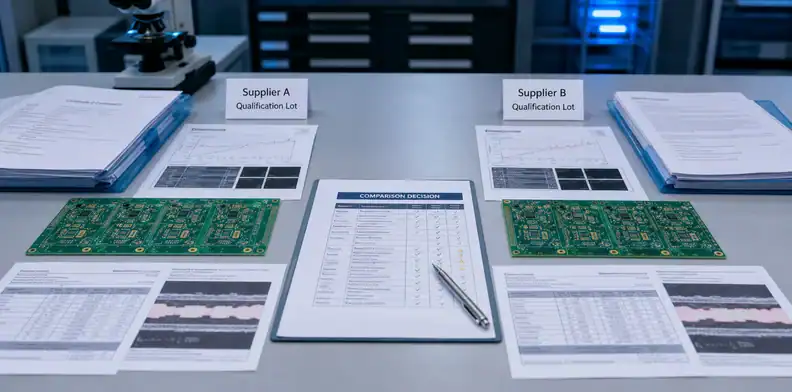
The second source should build a controlled lot before receiving real production volume.
A qualification order lets engineering and quality compare board dimensions, stackup, impedance, surface finish, plating, solderability, packing and documentation under production-like conditions.
Use PCB supplier qualification order to define what the lot must prove and what would block approval.
Purchasing should not split volume only from a quote comparison. The quote shows commercial readiness; the qualification lot shows whether the product and evidence match the baseline.
Compare evidence, not only price
The second source may be cheaper because it excludes evidence, uses a different assumption, or quotes a less demanding process.
Ask both suppliers for the same quality document set where it matters: COC, test report, impedance report, microsection, material declaration, photos, packing list or inspection summary.
The PCB quality documents before shipment page helps align shipment evidence before the buyer compares lot acceptance.
A price gap is useful only after the buyer knows whether both suppliers are quoting the same stackup, finish, tolerance, report and release responsibility.
Control stackup and material variation
Supplier independence should not become uncontrolled product variation.
Different factories may propose different laminate brands, prepreg combinations, copper treatment, impedance compensation or panel layouts. Some differences are harmless; others affect reliability, RF behavior, assembly or customer approval.
Use supplier stackup signoff before accepting a second-source stackup as equivalent.
Engineering should define where equivalents are allowed and where buyer approval is required. Purchasing should record any cost or lead-time effect.
Release the split with a change-control rule
A dual-source production split needs one owner for future changes.
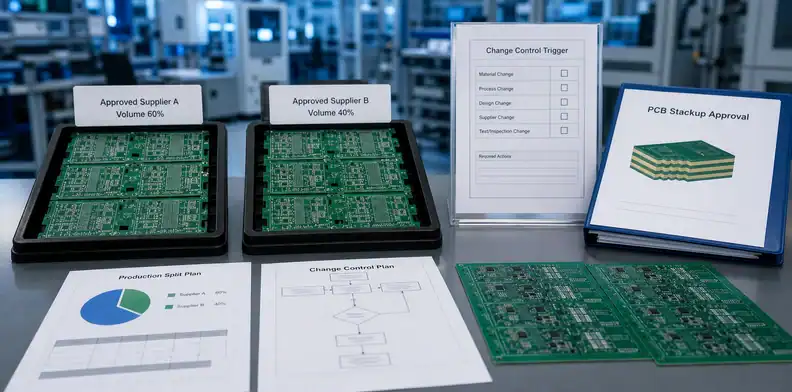
After qualification, record approved suppliers, approved stackups, material boundaries, evidence package, concession history, volume split, and trigger for requalification.
Use PCB manufacturer capability check when process limits, special features or volume scaling can change supplier suitability.
Practical order-stage examples
A buyer may qualify a second supplier for geopolitical or capacity reasons while keeping the first supplier as the main production source.
An engineer may reject a cheaper second-source quote if the stackup, material, impedance evidence or finish assumption does not match the approved production product.
A manager may want supply resilience, but quality still needs a rule for requalification after process, material, site or revision changes.
For higher-volume work, the buyer should decide whether the second source is approved for emergency backup only, controlled pilot releases, or normal allocation. Those three states need different evidence levels, because an emergency source may protect continuity while a routine source must also prove stable repeat quality.
How to judge the supplier reply
Keep the second source qualified after the first order
A second PCB supplier is not truly qualified just because one trial lot passed. The buyer should decide how the backup source stays current after the first order: repeated audit evidence, annual sample build, controlled stackup comparison, or a trigger that reopens qualification after a design or material change.
This is the practical part that many dual-source plans miss. If the second source is not used for a year, the buyer may still have a name on a supplier list but no reliable production path when the primary supplier becomes constrained.
- How often the second source must refresh evidence
- Which design or material changes reopen qualification
- Whether the backup source receives forecast or sample demand
- Who approves switching production volume
Production record for the dual-source qualification
Controlled object
Controlled object: delta matrix comparing the approved primary build with the second supplier’s material, stackup, process, evidence, and logistics.
Failure boundary
Failure boundary: two nominally equivalent boards behaving differently, uncontrolled material substitution, false price comparisons, or an unqualified production split.
Design-owned conditions
Design-owned conditions: electrical and mechanical requirements, controlled stackup, approved materials, acceptance criteria, revision, and customer flowdowns.
Supplier discretion
Supplier discretion: documented factory-specific process choices that meet the same released product and evidence requirements.
Required proof
Required proof: qualification-lot inspection, relevant coupon or test results, processed stackup, assembly outcome, and closed deviation record.
Production stop
Production stop: volume allocation before the delta lot passes, an unexplained stackup change, or a second-source quote built from another revision.
Repeat-order baseline
Repeat-order baseline: qualified supplier and site, baseline revision, accepted deltas, validation evidence, allocation ceiling, and requalification triggers.
RFQ inputs
RFQ inputs: approved fabrication package, stackup, material list, quality clauses, primary-supplier evidence, qualification quantity, assembly feedback, and ramp plan.
FAQ
Can the supplier decide the dual-source qualification?
Discretion for dual-source qualification: documented factory-specific process choices that meet the same released product and evidence requirements. Engineering control for dual-source qualification: electrical and mechanical requirements, controlled stackup, approved materials, acceptance criteria, revision, and customer flowdowns.
What stops this dual-source qualification?
Stop rule for dual-source qualification: volume allocation before the delta lot passes, an unexplained stackup change, or a second-source quote built from another revision. Disposition owner for dual-source qualification: the named engineering approver.
Which proof closes the dual-source qualification?
Evidence for dual-source qualification: qualification-lot inspection, relevant coupon or test results, processed stackup, assembly outcome, and closed deviation record. Revision link for dual-source qualification: the quoted dataset.
What survives into the next order?
Reorder baseline for dual-source qualification: qualified supplier and site, baseline revision, accepted deltas, validation evidence, allocation ceiling, and requalification triggers.
For a focused dual-source qualification, send QueenEMS approved fabrication package, stackup, material list, quality clauses, primary-supplier evidence, qualification quantity, assembly feedback, and ramp plan. Redline request: dual-source qualification. Open assumptions: dual-source qualification. Approver: dual-source qualification owner.
Written by the QueenEMS Engineering Team
Sources
Upload your files today · Free DFM check before production · Ship worldwide
Get your PCB prototypes in as fast as 24 hours. We handle FR4, Rogers, and Flex up to 60 layers — free prototypes for 2–4 layer boards, no minimum order.
Just upload your Gerber + BOM — we source every part, assemble, and inspect (AOI + X‑Ray) so you don't have to chase suppliers. Boards ship in as fast as 24 hours.