

Quick Answer: Decision: capacity-reservation agreement. Controlled object: dated reservation schedule defining the constrained resource, product family, factory or line, quantity window, deposit, and expiry. Design-owned boundary: reserved build window, site and process, capacity amount, deposit treatment, file-freeze date, material authority, and expiry. Supplier discretion: forecast updates inside the agreed window when they do not displace another reserved job or authorize irreversible work. Stop rule: files missing at the cutoff, scope moving outside the reserved process, deposit terms unclear, or capacity being shifted without approval.
A forecast does not build boards, but a late forecast can still lose a production slot. Capacity reservation sits between a casual forecast and a firm purchase order: the buyer asks the supplier to protect time, material, or planning effort before the final release is ready.
That can be useful for launches, seasonal builds, investor-driven delivery dates, or products waiting for final approval. It can also waste money when the reservation is vague, the files are not stable, or the supplier is only promising to try.
The commercial question is not whether a supplier is busy. It is what the reservation actually locks, what it costs, and what decision is still missing before manufacturing starts.
Table of Contents
- Define what capacity is being reserved
- Separate forecast, reservation and firm PO
- Control material and component authority
- Set the release cutoff and change rule
- Compare reservation cost with launch risk
- Turn the reservation into an RFQ record
- Decide who owns unused reserved capacity
Define what capacity is being reserved
Capacity reservation should name the resource: line time, panel volume, material, engineering review, assembly labor, or shipment window.
A supplier can reserve different things. Bare PCB work may need CAM time, laminate availability, drilling or plating capacity, or finish capacity. PCBA may need SMT line planning, feeder setup, inspection/test time, and component readiness.
Ask for a reservation statement that identifies the protected window and the assumptions behind it. A phrase like “we will support your forecast” is weaker than a named week, quantity band, and release cutoff.
Tie the later order acknowledgement to PCB order confirmation so the reserved window turns into a controlled supplier commitment.
Separate forecast, reservation and firm PO
The buyer should not let a forecast behave like a PO unless commercial liability is understood.
A forecast tells the supplier expected demand. A reservation asks the supplier to hold capacity or prepare work. A firm PO authorizes defined quantity, price, delivery and scope.
Use PCB quote validity to confirm whether the quoted price still applies when a reservation changes the timing, volume, material source, or evidence burden.
The reservation document should say what happens if the buyer reduces quantity, delays release, changes revision, or cancels before material or production starts.

Control material and component authority
Capacity is not useful if the supplier cannot buy or allocate the constrained material or parts that control the schedule.
For PCBA projects, the longest path may be components rather than board fabrication. A capacity reservation should identify whether the supplier may prebuy long-lead parts, reserve reels, or only plan assembly time.
Link component exposure to long-lead PCBA parts before design freeze when BOM maturity is the real bottleneck.
Purchasing should record whether prebuy, deposit, NCNR exposure, or alternate approval is allowed before the final PO. Engineering should approve any substitution that changes product risk.
Set the release cutoff and change rule
A reservation needs a last safe date for file freeze, PO release, material authority and shipment method.
A supplier may hold capacity for a certain week only if the buyer releases files by a defined date. Missing that cutoff can move the order even if a deposit was paid.
A file change after reservation should trigger a clear review: no impact, capacity still valid; partial impact, engineering review; major impact, reservation repriced or rescheduled.
The PCB production release package should contain the frozen file set, reservation reference, approved materials, evidence requirements and release owner.

Compare reservation cost with launch risk
A reservation cost is justified only when the protected delivery window matters more than the unused-capacity risk.
A founder may reserve capacity to protect a demo build; a procurement manager may reserve it to avoid a line-down risk; an engineering team may reject it if the design is not stable enough.
The comparison should include deposit, cancellation exposure, forecast confidence, file maturity, material risk, supplier reliability and the cost of missing the target date.
A lower reservation price can be misleading if it excludes material allocation, test time, documentation or shipment evidence that the launch actually needs.
Turn the reservation into an RFQ record
The final reservation record should be short enough for purchasing and specific enough for production.
Ask the supplier to confirm reserved window, quantity band, covered process, release cutoff, deposit, cancellation rule, material-buy authority, accepted revision and evidence package.
Use PCB purchase order review before converting the reservation into a PO. The PO should reference what was reserved and what remains conditional.
Practical order-stage examples
A hardware startup may have a launch date before the enclosure, firmware or customer approval is fully closed. Reservation can protect a build window, but the supplier still needs a file-freeze rule.
A purchasing team may want supplier support for a ramp forecast without exposing the company to a full PO. The reservation should state whether the deposit is refundable and whether unused capacity can move to a later build.
An engineer may block capacity release if a material substitution, impedance stackup or assembly alternate is still open. That boundary protects the buyer from paying for speed on the wrong configuration.
How to judge the supplier reply
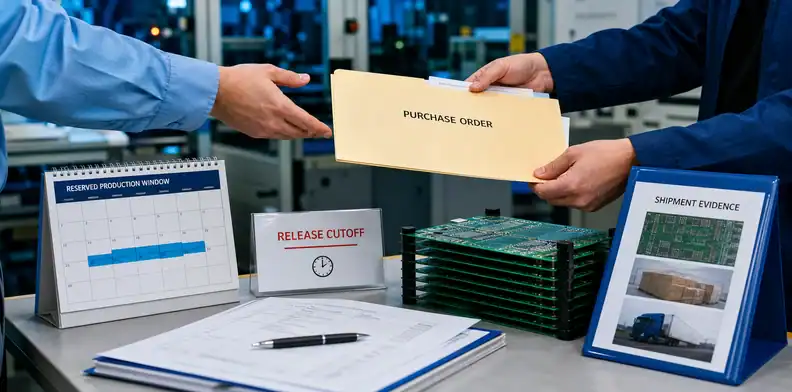
Decide who owns unused reserved capacity
Capacity reservation protects a build window, but it can also create exposure if the forecast changes. Before reserving PCB capacity, the buyer should know whether unused time can roll forward, convert to another part number, or expire as a commercial cost.
This point is especially important when engineering, purchasing, and sales are working from different launch assumptions. A clean reservation note keeps the factory from holding capacity forever and keeps the buyer from discovering cancellation terms after the production window has passed.
- Unused-capacity deadline
- Rollover or substitution permission
- Deposit, cancellation, or premium exposure
- Buyer contact who can release, move, or cancel the slot
Production record for the capacity-reservation agreement
Controlled object
Controlled object: dated reservation schedule defining the constrained resource, product family, factory or line, quantity window, deposit, and expiry.
Failure boundary
Failure boundary: paying for vague priority, losing the protected slot, authorizing materials too early, or disputing unused capacity.
Design-owned conditions
Design-owned conditions: reserved build window, site and process, capacity amount, deposit treatment, file-freeze date, material authority, and expiry.
Supplier discretion
Supplier discretion: forecast updates inside the agreed window when they do not displace another reserved job or authorize irreversible work.
Required proof
Required proof: supplier confirmation of the slot, readiness milestones, material status, deposit ledger, and written release or expiry notices.
Production stop
Production stop: files missing at the cutoff, scope moving outside the reserved process, deposit terms unclear, or capacity being shifted without approval.
Repeat-order baseline
Repeat-order baseline: reservation ID, protected dates, site, amount, milestones, deposit application, unused-capacity decision, and renewal trigger.
RFQ inputs
RFQ inputs: demand window, product families, technology and line needs, forecast confidence, file-freeze plan, material risks, deposit proposal, and fallback route.
FAQ
Can the supplier decide the capacity-reservation agreement?
Discretion for capacity-reservation agreement: forecast updates inside the agreed window when they do not displace another reserved job or authorize irreversible work. Engineering control for capacity-reservation agreement: reserved build window, site and process, capacity amount, deposit treatment, file-freeze date, material authority, and expiry.
What stops this capacity-reservation agreement?
Stop rule for capacity-reservation agreement: files missing at the cutoff, scope moving outside the reserved process, deposit terms unclear, or capacity being shifted without approval. Disposition owner for capacity-reservation agreement: the named engineering approver.
Which proof closes the capacity-reservation agreement?
Evidence for capacity-reservation agreement: supplier confirmation of the slot, readiness milestones, material status, deposit ledger, and written release or expiry notices. Revision link for capacity-reservation agreement: the quoted dataset.
What survives into the next order?
Reorder baseline for capacity-reservation agreement: reservation ID, protected dates, site, amount, milestones, deposit application, unused-capacity decision, and renewal trigger.
For a focused capacity-reservation agreement, send QueenEMS demand window, product families, technology and line needs, forecast confidence, file-freeze plan, material risks, deposit proposal, and fallback route. Redline request: capacity-reservation agreement. Open assumptions: capacity-reservation agreement. Approver: capacity-reservation agreement owner.
Written by the QueenEMS Engineering Team
Sources
Upload your files today · Free DFM check before production · Ship worldwide
Get your PCB prototypes in as fast as 24 hours. We handle FR4, Rogers, and Flex up to 60 layers — free prototypes for 2–4 layer boards, no minimum order.
Just upload your Gerber + BOM — we source every part, assemble, and inspect (AOI + X‑Ray) so you don't have to chase suppliers. Boards ship in as fast as 24 hours.