

Quick Answer: PCB overage underage terms should say whether the buyer will accept, reject, pay for, credit, return, or hold boards when the delivered quantity does not match the purchase order. For a 100-board PO, the policy should say whether 96 accepted boards close the order, whether 106 boards can be billed, and who approves either exception. The safest rule is to define the allowed quantity range before release, then require written approval when the supplier ships below or above that range.
Key takeaways
- Treat PCB overage underage as a receiving and payment rule, not only a supplier courtesy.
- Put the allowed variance, invoice rule, and approval owner on the PO before fabrication starts.
- Separate free extra prototype boards from billable over-delivery and from a short shipment that blocks production.
- Keep a receiving record that connects delivered quantity, accepted quantity, rejected quantity, and any credit or follow-up build.
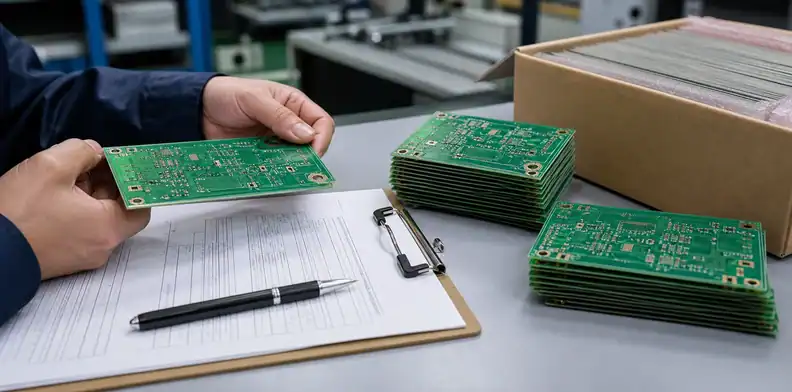
PCB overage underage questions usually appear after the box arrives: the buyer ordered 100 bare boards, receiving counts 96 or 106, and purchasing is not sure whether to accept, pay, reject, or ask for a credit. For prototype orders, a few extra boards may feel harmless. For production orders, the same gap can affect assembly kitting, customer allocation, inventory valuation, and invoice matching.
The useful answer is not a universal percentage. It is a written quantity rule tied to the purchase order, quote assumptions, and receiving inspection. This article explains how a buyer can define that rule before placing a custom PCB order, then use it when the delivered count is different from the ordered count.
Table of Contents
- What quantity rule should be set before release?
- When are extra PCB boards free or billable?
- How much underage should block the order?
- Use accepted quantity as the receiving control point
- Who decides invoice, credit, or replacement?
- What PO wording keeps the rule clear?
- Send QueenEMS a quote-ready quantity record
What quantity rule should be set before release?
The buyer should define the allowed delivery quantity before the supplier starts fabrication. A PCB overage underage rule is strongest when it names the ordered quantity, allowed variance, whether extras are free or billable, and who can approve a shipment outside the range.
Without that rule, the supplier and buyer may both think they are being reasonable while using different assumptions. A fabricator may build extra boards to protect yield, especially on small prototype quantities or panelized jobs. A buyer may treat the PO quantity as exact because the ERP, assembly plan, and customer promise are built around that number.
The first decision is whether the PO needs exact quantity or a controlled tolerance. A prototype order may accept a few free extras because they help debug and do not create a billing issue. A production order that feeds assembly, certification samples, or customer allocation often needs tighter control.
Use the same discipline as a PCB purchase order review before release. The quantity rule should sit beside revision, price, delivery term, quality evidence, and change-approval language. If a supplier acknowledgement repeats the rule correctly, receiving has a clear basis for action later.
| PO field | Quantity question it should answer |
|---|---|
| Ordered quantity | What count is the supplier expected to ship? |
| Allowed variance | Is any overage or underage acceptable without approval? |
| Billing rule | Are extra boards free, billable, or not accepted? |
| Shortage rule | Does a short shipment close the PO, create a credit, or require replacement? |
| Approval owner | Who can accept a quantity outside the agreed range? |
This does not need to become legal-heavy wording. A short commercial note is often enough: “Ship 100 accepted boards. No billable overage without buyer approval. Notify buyer before shipment if accepted quantity will be below 100.” The point is to create one shared receiving rule before the boards exist.
When are extra PCB boards free or billable?
Extra PCB boards should be classified before the invoice is approved. Free extras can be useful, but billable overage changes the purchase decision and should not be accepted silently unless the PO already allows it.
Small PCB prototype suppliers sometimes ship one or two extra boards because the panel yielded more good boards than the order required. That can be helpful when engineering needs spare samples for bring-up, destructive testing, or assembly setup. The buyer still needs to know whether those extra boards are accepted inventory, engineering samples, or simply unbilled surplus.
Billable overage is different. If the supplier ships 106 boards against a 100-board PO and invoices for 106, purchasing should check whether the quote or PO allowed that. A buyer may accept extra boards when demand is real, the revision is frozen, and inventory carrying cost is low. The same buyer may reject overage when the design is likely to change or when finance needs invoice-to-PO matching.
Common overage outcomes should be written as business choices:
- accept free extra boards for engineering or production reserve;
- accept and pay for approved extra boards;
- hold the extra quantity for buyer review before inventory receipt;
- reject or return unapproved extras if return cost and handling make sense;
- ask the supplier to correct the invoice to the accepted quantity.
For a production lot, overage also touches traceability. Extra boards should still match the same revision, finish, lot, date code, test status, and packaging evidence as the accepted shipment. A free board that is not traceable should not quietly enter production stock.
How much underage should block the order?
Underage matters when the accepted board count is lower than the PO quantity. The buyer should decide whether the shortage is acceptable, whether it triggers replacement boards, or whether the PO remains open until the missing quantity is resolved.
A shortage is not always the same problem. If a 100-piece prototype order arrives with 98 accepted boards and engineering only needs 20 for validation, receiving may accept the shipment and record the difference. If a 100-piece production order supports a 100-unit customer shipment, 98 boards may stop assembly or force a split shipment.
The practical test is downstream impact. Ask whether the missing boards affect assembly kitting, customer delivery, first article approval, spare samples, certification builds, or future reorder planning. The answer tells purchasing whether to close the PO, request a credit, ask for replacement, or hold the invoice.
| Underage situation | Buyer action |
|---|---|
| Shortage has no schedule impact | Accept received quantity and record the variance |
| Shortage affects customer shipment | Hold closure and request supplier recovery plan |
| Shortage caused by rejected boards | Link the gap to incoming inspection evidence |
| Shortage is outside PO tolerance | Require buyer approval before closing the PO |
| Shortage will be replaced later | Keep original PO open or create a controlled follow-up line |
This is where a buyer can avoid a common receiving mistake. Do not let a warehouse count alone decide the commercial answer. Quantity must be read with accepted quality, revision match, and the build plan.
If the supplier announces the shortage before shipping, ask for the reason and the proposed disposition. A shortage from panel fallout, failed electrical test, damaged packaging, or held boards may require different action. The supplier response should say how many boards were built, how many passed, how many failed or were scrapped, and whether replacement boards will follow.
Use accepted quantity as the receiving control point
Receiving should count only boards that match the ordered revision and pass the agreed incoming checks. A shipment can be numerically complete but still short on accepted boards if some boards have the wrong revision, wrong finish, damaged edges, missing test evidence, or visible nonconformance.
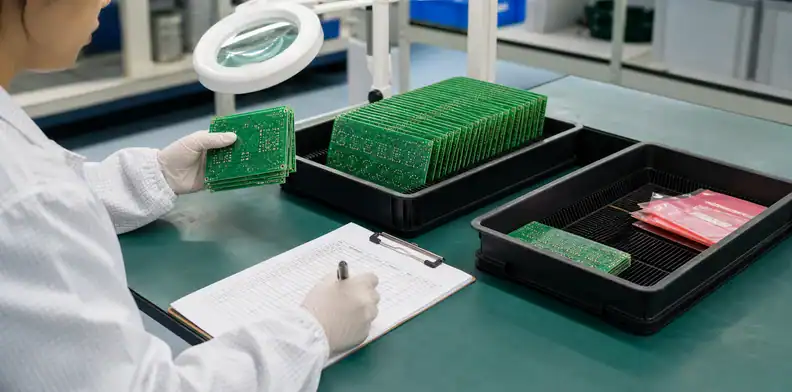
This is why PCB overage underage terms should connect to PCB incoming inspection, not only to the packing list. The packing list may say 100 pieces. Receiving may count 100 pieces. Quality may accept only 96 after revision, finish, solder mask, dimension, packaging, and electrical test evidence are checked.
For buyer control, record three quantities separately:
- shipped quantity: what the supplier physically sent;
- received quantity: what the warehouse physically counted;
- accepted quantity: what the buyer released to stock, assembly, or engineering use.
The accepted quantity is the number that matters for payment and production planning. The difference between shipped and accepted quantity should point to a reason, not disappear into a manual count correction.
For example, a box may contain 102 boards against a 100-board PO. Two boards are free extras, but three boards show handling damage. The buyer may accept 99 usable boards, hold three damaged boards for disposition, and reject any billable quantity above 100. That answer is clearer than saying “shipment over by two” or “short by one” without quality context.
The receiving record should include part number, revision, PO number, supplier lot, packing list quantity, physical count, accepted quantity, rejected quantity, and the person who approved any exception. This record also helps the next reorder because the buyer can see whether the quantity variance was a one-time yield issue or a supplier pattern.
Who decides invoice, credit, or replacement?
Invoice handling should follow the accepted quantity and the written PO rule. When the delivered quantity is different from the ordered quantity, purchasing should decide whether to pay the original PO, adjust the invoice, request credit, create a replacement line, or approve an overage charge.
ERP systems often treat over-delivery and under-delivery as receiving exceptions because the purchase order, receipt, and invoice no longer match. That administrative issue becomes a production issue when the team closes the PO too early or pays for a quantity that quality did not accept.
The safest workflow keeps four decisions separate:
| Decision | Owner | Record to keep |
|---|---|---|
| Physical receipt | Warehouse or receiving | Count against packing list |
| Acceptance | Quality or engineering | Inspection and release record |
| Commercial disposition | Purchasing | Credit, replacement, invoice adjustment, or accepted overage |
| Production impact | Planner or owner | Whether shortage affects assembly or shipment |
For overage, the buyer may approve payment only when the extra boards are wanted, traceable, and within an agreed tolerance. For underage, the buyer may accept the shortage with credit, request replacement boards, or keep the order open until the missing accepted quantity arrives.
The PCB quote exclusions page is useful before this point because quantity variance can hide inside quote assumptions. A quote may price “100 pcs” but say nothing about overage, replacement after yield loss, or what happens when accepted boards are fewer than ordered. Those exclusions are easier to fix before the PO than after receiving.
Avoid a vague email such as “OK, ship what you have.” That phrase may solve today’s schedule issue while creating tomorrow’s invoice dispute. A better response says: “Ship 96 accepted boards now; invoice 96 only; keep PO open for four replacement boards unless buyer cancels the balance.” The sentence is short, but it gives receiving, accounting, and production the same instruction.
What PO wording keeps the rule clear?
The PO clause should be short enough for purchasing to reuse and clear enough for the supplier to follow. It should define overage, underage, notification, invoice handling, and replacement responsibility without turning the order into a legal memo.
A useful PCB overage underage clause may look like this:
Ship the ordered quantity of accepted boards shown on this PO. No billable overage is allowed without written buyer approval. If accepted quantity will be below the ordered quantity, supplier must notify buyer before shipment with passed quantity, rejected quantity, reason, and proposed recovery. Buyer may accept partial quantity with credit, keep the balance open for replacement, or reject unapproved quantity variance.
That wording is not legal advice. It is a practical manufacturing instruction that can be adapted by the buyer’s purchasing team. The key is that it tells the supplier when to ask before shipping and tells receiving what record to check when the count is different.
The clause can be lighter for prototypes:
| Order type | Practical quantity wording |
|---|---|
| Prototype | Free extra boards may be accepted if they match revision and test status; no billable overage without approval. |
| Pilot build | Notify buyer before shipping below ordered accepted quantity; extras must be traceable. |
| Production | Exact accepted quantity required unless PO states an allowed variance and invoice rule. |
| Customer allocation build | No overage or underage accepted without owner approval because each board is allocated. |
Make the supplier acknowledgement repeat the rule. The PCB order confirmation step is where this should be checked. If the supplier confirms only price and date, but not quantity disposition, the buyer still has an open commercial assumption.
The rule should also avoid confusing PCB boards with PCBA component attrition. Bare-board quantity variance is about delivered boards versus PO quantity. Assembly overage is often about spare components, reel quantities, setup loss, and leftover parts. Those are related procurement ideas, but they belong in separate RFQ language.

Send QueenEMS a quote-ready quantity record
Before release, send a quantity record that lets the PCB supplier quote and acknowledge the same delivery rule the buyer expects to enforce. The record should include ordered quantity, allowed variance, billing rule for extras, short-shipment recovery rule, inspection evidence, and the approval owner for exceptions.
QueenEMS can help review whether the order package is quote-ready or whether the buyer needs one more quantity clause before production starts. For PCB and PCBA projects with quantity-sensitive releases, the review should include the PO draft, supplier quote, part number, revision, target build quantity, required accepted quantity, assembly or customer allocation plan, and any approved partial-ship or replacement rule.
This is especially useful when the project is moving from prototype to repeat order. A prototype buyer may accept free extras casually. A production buyer needs the supplier, receiving, planner, and accounting team to understand the same accepted quantity. A controlled rule prevents the order from becoming a small argument at the loading dock.
If your PCB or PCBA project has a quantity variance risk, send QueenEMS the quote, PO draft, packing or receiving expectation, and any assembly allocation requirement through the QueenEMS contact page. We can help return a quote-ready quantity interpretation, supplier question list, and release note so overage, underage, invoice, and replacement decisions are not left to after-shipment emails.
FAQ
Do I have to pay for extra PCB boards the supplier shipped?
No, not automatically. Payment should follow the PO, quote, and any written overage approval. Free extras may be accepted when they match revision and test status, but billable overage should require buyer approval.
Can I reject a PCB shipment that is short of the ordered quantity?
Yes, if the shortage violates the PO or blocks the buyer’s accepted release requirement. The more useful action is to record the accepted quantity, ask for the shortage reason, and decide whether to accept credit, request replacement boards, or keep the PO open.
Is a small PCB overage normal on prototype orders?
Yes, small free extras can happen on prototype orders because panel yield may produce more usable boards than the ordered count. The buyer should still label them correctly so they do not become unapproved billable inventory.
What quantity should receiving use for payment?
Use the accepted quantity, not only the packing list quantity. Boards that are damaged, wrong revision, missing required evidence, or rejected during incoming inspection should be separated from accepted stock before invoice approval.
Should PCB overage underage terms be on the quote or the PO?
Put the rule on both when possible. The quote should expose the supplier’s assumption, and the PO should become the controlled buyer instruction used by receiving, quality, and accounting.
Sources
Written by the QueenEMS Engineering Team
Upload your files today · Free DFM check before production · Ship worldwide
Get your PCB prototypes in as fast as 24 hours. We handle FR4, Rogers, and Flex up to 60 layers — free prototypes for 2–4 layer boards, no minimum order.
Just upload your Gerber + BOM — we source every part, assemble, and inspect (AOI + X‑Ray) so you don't have to chase suppliers. Boards ship in as fast as 24 hours.