Quick Answer: Large PCB cleaning is qualified only when the complete assembly and rack fit, the chemistry is compatible with every exposed material, dissolved residue is removed rather than redistributed, and hidden volumes are rinsed and dried. Define product-relevant cleanliness evidence before choosing the wash method, especially when coating or high-voltage performance follows.
Large PCB cleaning is not a scaled-up wipe-down. Long assemblies create spray shadows, flexible spans and many places for liquid to remain: connectors, relay bodies, low-standoff components, card guides and cavities. A board may look clean at the center while flux film has moved toward an edge or rinse water remains beneath the largest parts.
Start with the acceptance evidence and product risks described in PCB cleanliness testing requirements. For an oversized populated board, the next task is to establish a cleaning route that can meet those requirements: equipment fit, compatible chemistry, washing, rinsing, drying, inspection and traceability.
Table of Contents
- Decide what cleaning must remove and prove
- Qualify the complete machine and rack envelope
- Match chemistry to every exposed material
- Move dissolved residue off the whole assembly
- Rinse and dry hidden volumes
- Validate large PCB cleaning with product-relevant evidence
- Control timing, handling and change
- Quote a complete large-board cleaning route
Decide what cleaning must remove and prove
Start with the residue source and downstream requirement. Identify solder paste/flux, wave or selective flux, hand-solder flux, adhesives, fingerprints, machining debris, marker, mask residue and process chemicals. Record the exact material names and supplier process instructions. “No-clean” is a flux classification, not automatic approval to ignore product, coating or reliability needs.
Name the residue and reliability risk
Ask where the residue can collect and what it can affect: leakage under bias and humidity, corrosion, conformal-coating adhesion, optical surfaces, connector contacts, test probes, appearance or high-impedance sensing. The same visible film can have different consequences in a low-voltage consumer product and a high-voltage or high-reliability assembly.
Review how long residue remains before cleaning and what thermal history it has experienced. A process qualified for fresh flux may not remove material that has baked during repeated soldering or rework. Keep reworked units visible in the route.
Define acceptance before choosing chemistry
Set visual, ionic, surface-insulation-resistance, local analytical, coating-adhesion or other evidence according to product risk and governing requirements. The IPC page on test methods for flux/process residues emphasizes validation of acceptable contamination on production assemblies. It does not provide one universal numeric limit for every product.
Define sample location and frequency. A bulk extraction result can average clean and dirty regions; a local method may be needed for a difficult connector or high-impedance area. State whether evidence is for process qualification, lot release or periodic monitoring.
Purpose rule: Cleaning is complete when the specified product condition is demonstrated, not when solvent has been applied or the center of the board looks shiny.
Qualify the complete machine and rack envelope
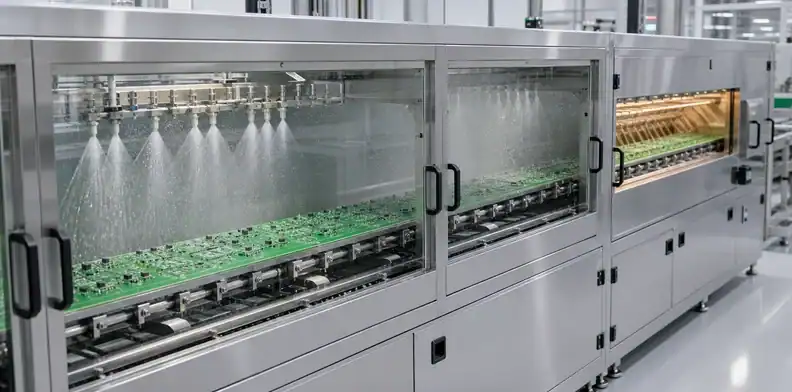
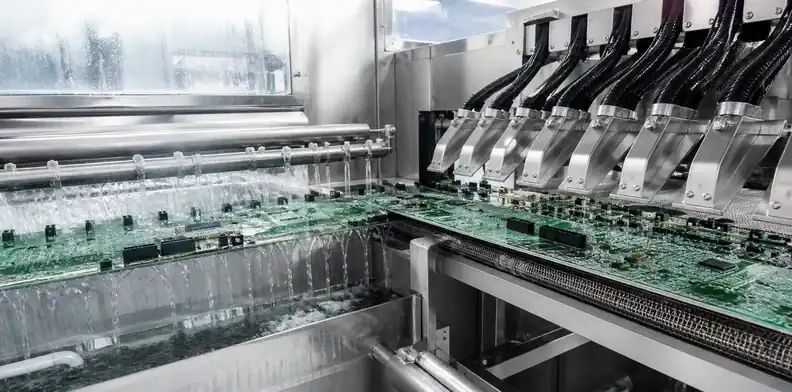
Compare the populated assembly and its rack against loading door, chamber, spray clearance, basket, rotation/oscillation travel, rinse and drying stages. Include length, width, thickness, mass, maximum heights on both sides, fragile protrusions and required orientation. The board may fit a chamber but not the rack pitch or spray-motion envelope.
The University of Sherbrooke lists an AAT Aqua ROSE 4.0 CL with racks supporting very large boards up to 18 x 20 inches. Seika describes a large-PCB cleaning system with an anti-warp concept. These examples demonstrate available approaches; they are not universal factory limits or guarantees of QueenEMS capacity.
| Envelope input | Review question | Failure mode |
|---|---|---|
| Populated size and mass | Can the rack load and move safely? | Drop, collision or unstable cycle |
| Top/bottom height map | Do spray and supports clear all parts? | Broken part or blocked jet |
| Support/retention zones | Is the hot wet board controlled? | Bowing, vibration or abrasion |
| Orientation and drainage | Can liquid leave cavities and edges? | Retained wash/rinse chemistry |
| Connector and opening direction | Are jets entering or trapping liquid? | Contamination driven deeper |
| Loading/unloading method | Can operators handle a wet large board? | Flexing and recontamination |
Define support contacts on structurally safe areas without trapping residues against the board. If the rack oscillates or rotates, verify component retention and clearance through the full motion. Avoid squeezing a warped board flat unless the product drawing allows that condition.
Perform a dry loading trial and, when useful, a water-only or witnessed qualification cycle before committing product. Record rack revision and orientation so repeat lots use the same geometry.
Match chemistry to every exposed material
Cleaning compatibility includes more than FR-4 and solder. Review components, labels, inks, adhesives, gaskets, seals, connectors, switches, displays, batteries, coatings already present, metal finishes and plastics. Confirm whether immersion, pressure spray, ultrasonic energy, temperature and vacuum or hot-air dry are allowed.
Start with the flux supplier’s process window
Use the exact flux/paste manufacturer’s recommended cleaner, concentration, temperature, wash window and rinse requirements as the starting point. Verify compatibility with the actual soldering history. Mixing residue families from SMT, selective soldering and manual repair can require a combined process review.
Water-soluble residue generally needs an effective aqueous wash and rinse route, while other flux systems may require a matched saponifier or solvent process. Do not substitute IPA because it is convenient without demonstrating removal; a solvent can dissolve residue and spread it over a larger area.
Review components, labels and downstream coating
Obtain component cleaning restrictions from authoritative documentation. Open-frame relays, microphones, sensors, trimmers, unsealed connectors or label systems may restrict immersion or pressure. If one part cannot tolerate the proposed route, consider local protection, a different cleaning method, a process-order change or a component change—each with validation.
Downstream conformal coating creates an interface requirement. Residual cleaner, surfactant or moisture can cause dewetting or adhesion problems. The conformal coating types guide helps identify material families, but the coating and cleaning suppliers must confirm the selected combination.
Record cleaner material/lot, concentration control, bath life, temperature and change criteria. Chemistry outside its qualified state is a different process even if the recipe name is unchanged.
Move dissolved residue off the whole assembly
Solubilizing flux is only the first step. Flow must carry dissolved contamination away, and subsequent rinse stages must prevent redeposition. A recent Reddit discussion about residue remaining after IPA captured a common symptom: the solvent can spread a thin film rather than remove it. Treat forum experience as a problem signal, then qualify the production method with controlled evidence.
Challenge spray shadows and low standoffs
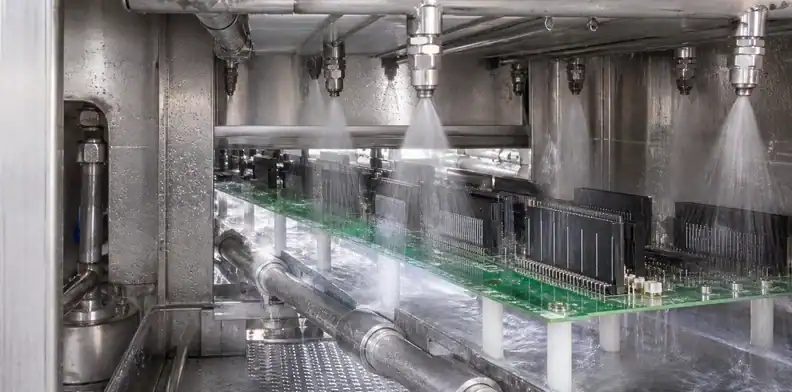
Map dense components, bottom-terminated packages, connectors, heatsinks, board edges and fixture contacts. Choose orientation and spray/oscillation so fresh chemistry reaches and exits difficult spaces. One fixed jet direction may leave the downstream side of tall components untouched.
Use a representative challenge vehicle or product locations for qualification. Fluorescent tracer, process indicators, local extraction or other approved methods can help show whether the route reaches a shadow region. A flat coupon cannot represent a low-standoff package on a populated large board.
Prevent redistribution during manual cleaning
If manual cleaning is approved, use enough fresh cleaner and absorbent material to lift residue off the board. Reusing a saturated swab or brushing until solvent evaporates can move contamination to an edge. Define brush/swab type, ESD compatibility, sequence, fresh-material frequency and final rinse/wipe.
Manual work on a long board needs support and zoning. Divide the board into controlled regions with overlap, track which regions are complete, and inspect the boundary. Avoid leaning on the assembly or flexing it while scrubbing.
DigiKey’s discussion of white residues notes that flux, cleaner, soldering conditions and board materials can interact. When an unexpected film appears, stop and identify it instead of escalating brush force or solvent strength without compatibility data.
Removal rule: Every wash step needs a mechanism that transports dissolved residue away and prevents the same contaminated liquid from drying elsewhere.
Rinse and dry hidden volumes
Rinse quality, flow and staging determine what remains after the active cleaner has done its work. Define fresh-rinse quality, number or flow, temperature and monitoring according to the qualified process. Recirculated stages may remove bulk chemistry; a final controlled rinse helps prevent carryover, subject to the route design.
Arrange the board so rinse reaches the same low-clearance and shadowed regions as the wash. If the assembly changes orientation between stages, document it. Avoid driving contaminated liquid into unsealed connectors or cavities that cannot drain.
Drying should remove surface films and retained liquid. Use air knives, controlled compressed gas, hot air, vacuum or other compatible methods based on geometry and component limits. Blow-off direction matters: it should move water out of openings, not deeper into them. Control air cleanliness and pressure.
Challenge relays, connectors, sockets, shields, cable housings, through-holes and bottom-side pockets. Inspect immediately and after a defined dwell; hidden water may migrate later. Weight change, humidity exposure, insulation measurements, local inspection or other methods can support qualification where appropriate.
Do not infer dryness from a warm board or a dry central surface. MicroCare describes moisture trapped beneath low-standoff components, where surface observations can be misleading. For qualification, identify the actual retention sites by reference designator and cavity geometry, challenge the worst permitted rack loading and orientation, and record the method used to detect residual liquid at those sites. Whole-board mass change or an insulation reading can provide complementary evidence but cannot, alone, prove every hidden volume is dry. Define the approved condition before electrical power, high-voltage test, coating or sealed packaging, including clean storage if the board waits.
Drying heat also affects a large assembly mechanically. Support it through the hot stage and cool it before free-state shape assessment. Record temperature limits for labels, plastics and components.
Drying check: Do not energize, coat or seal the assembly until the approved method has challenged its connectors, cavities and low-clearance volumes for retained liquid.
Validate large PCB cleaning with product-relevant evidence
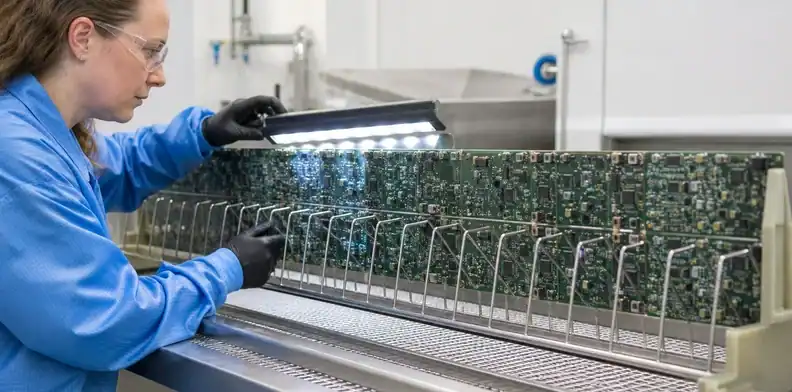
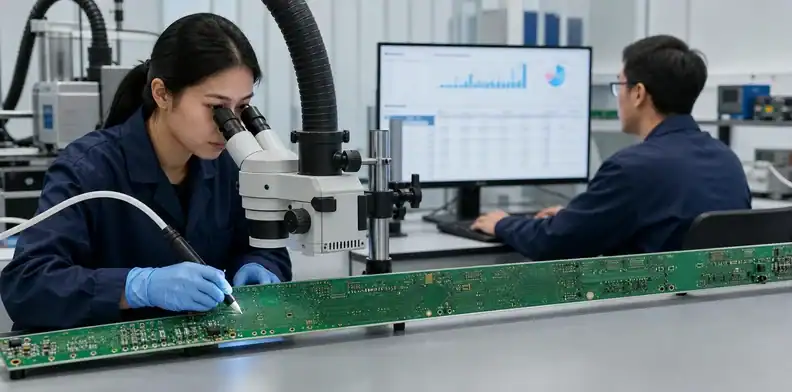
Validation should combine process controls with product results. Inspect difficult locations under adequate lighting/magnification, verify no cleaner or residue remains around connectors and low standoffs, and apply the selected cleanliness test to representative boards or zones.
Separate visual appearance from ionic risk
A visually clean surface can retain ionic contamination, while a harmless cosmetic stain can appear suspicious. State which visual defects matter and which electrical/reliability evidence controls release. Avoid using UV response, surface gloss or solder-mask color as a substitute for the approved test.
Bulk ionic testing can monitor a process but may dilute a small highly contaminated zone on a large board. Match extraction area and method to the acceptance plan. Where the product has high-impedance, high-voltage or coating-critical regions, consider targeted validation and environmental testing appropriate to the risk.
Test the process at difficult locations
During qualification, select locations based on geometry and residue load: beneath the lowest package, behind the tallest connector, near the last manual-solder operation, inside the rack contact zone and at drainage edges. Document why each is challenging and how it was evaluated.
Correlate results with chemistry concentration, wash/rinse/dry conditions and time from soldering. Run enough cycles to expose bath aging or rack-loading effects. A single clean board in fresh chemistry does not define a production window.
When coating follows, include a representative adhesion/coverage check under the selected material process. The new large-board coating route should treat clean/dry status as an input, but cleanliness validation remains its own controlled record.
Use the broader large PCB inspection plan to integrate cleanliness with dimensional, workmanship and shipment evidence rather than issuing unrelated reports.
Control timing, handling and change
The traveler should link soldering completion, allowable wait before cleaning, rework events, cleaning recipe, rack/orientation, chemistry status, wash/rinse/dry records, inspection/test, clean storage and downstream coating or packing. Long delays can make residue harder to remove or allow uncontrolled contamination.
Handle clean assemblies with gloves and approved supports. Keep dirty and clean zones physically separated, including racks and brushes. A cleaned board placed on a contaminated mat or returned to an unclean carrier has not completed the route.
For high-reliability or coating-bound product, define maximum clean-to-coat exposure and storage humidity/packaging. If the interval is exceeded, specify reinspection or re-cleaning authority. Avoid repeated cleaning without an assessment of component and material exposure.
Change control should cover flux/paste, soldering profile, hand-solder material, cleaner, concentration, water quality, equipment, nozzle/spray, rack, load pattern, wash timing, rinse, dry, component/label or coating. Determine whether changes need document update, targeted trial or full requalification.
Trend results by rack position and board region. A failure concentrated at the upper rack or far end may indicate flow or drainage. Track rework boards separately; extra flux and thermal history can create a different cleaning challenge.
The large PCB handling guide provides support and transfer principles. Apply them to wet and hot states, when the assembly is more vulnerable and grip options are limited.
| Process record | Condition to capture | Reason to reopen qualification |
|---|---|---|
| Wash and rinse | Chemistry state, recipe and rack load | Flux, cleaner or spray change |
| Dry and storage | Temperature, time and protected interval | New cavity, component or delay |
| Cleanliness evidence | Method, location and result | Limit, coating or product-risk change |
Record rule: A repeat lot must not inherit the cleaning release after its residue source, rack geometry, chemistry, rinse or drying condition changes without review.
Quote a complete large-board cleaning route
Provide finished assembly dimensions, mass, both-side height map, BOM/material restrictions, flux/paste and hand-solder materials, soldering-to-cleaning timing, sensitive components, existing coatings/labels, required cleanliness evidence, downstream conformal coating, quantity and record expectations. Identify high-voltage or high-impedance zones and hidden volumes.
Ask the supplier to return:
- machine, chamber and rack usable envelope with loaded orientation;
- support/retention and component-clearance plan;
- cleaner chemistry, concentration/temperature and compatibility review;
- wash coverage for shadows and low-standoff parts;
- rinse quality/monitoring and carryover control;
- drying method and proof for connectors/cavities;
- product-relevant test locations, frequency and limits;
- change triggers, re-clean authority and shipment records.
Request exceptions before the PO. If one component prohibits the main route, the alternative local process and its evidence should appear in the quotation. If no-clean processing is proposed instead, product/coating acceptance must approve that strategy.
Assemble controlled drawings, BOM data and evidence requirements with the large PCB RFQ file checklist. Separate qualification tests, recurring process and special reports commercially.
| Quotation line | Scope to expose | Buyer comparison point |
|---|---|---|
| Route qualification | Compatibility, rack and challenge testing | One-time evidence and samples |
| Recurring cleaning | Wash, rinse, dry and handling cycle | Per-board process and controls |
| Release records | Test frequency, report and retention | Lot-level deliverable |
Quotation request: Open a cleaning-route enquiry at the QueenEMS Large Format PCB page and include the populated envelope, exact fluxes, sensitive-part list, downstream coating and cleanliness acceptance plan. The response must define difficult-location wash, rinse and dry evidence instead of a generic board-washing line item.
FAQ
Can a very large PCBA be washed in an automated cleaner?
Yes when the populated assembly, rack, mass, component heights and full wash/rinse/dry motion fit the configured equipment. Confirm actual factory capacity and orientation.
Why does flux residue return after IPA dries?
The solvent may dissolve and redistribute residue without carrying it off the board, or it may be chemically mismatched. Use a qualified cleaner, fresh removal media and an effective rinse/removal step.
Are no-clean flux residues always safe to leave?
No universal answer applies. Consider actual flux processing, product voltage/environment, coating compatibility, customer requirements and validated cleanliness evidence.
How can trapped water be found after cleaning?
Target known cavities and low-clearance locations using a product-qualified method that can reveal liquid at those sites. Humidity, mass or electrical measurements may complement the inspection, but their sensitivity and coverage must be established; no single outer-surface or whole-board check proves all cavities dry.
Should cleaning occur before conformal coating?
Follow the approved flux/coating process. Where cleaning is required, verify both cleanliness and complete drying before coating, and control the interval and handling between stages.
Sources
- IPC: Test Methods to Validate Flux and Process Residues
- University of Sherbrooke AAT Aqua ROSE 4.0 CL
Written by the QueenEMS Engineering Team
Upload your files today · Free DFM check before production · Ship worldwide
Get your PCB prototypes in as fast as 24 hours. We handle FR4, Rogers, and hybrid boards up to 40 layers in volume production, with advanced builds subject to engineering review — free prototypes for 2–4 layer FR-4 boards, no minimum order.
Just upload your Gerber + BOM — we source every part, assemble, and inspect (AOI + X‑Ray) so you don't have to chase suppliers. Boards ship in as fast as 24 hours.